Monetary Policy
Contents: 7 sections
Cambridge International AS & A Level Economics 9708 (AS Level) Current syllabus: 2026–2028, Version 2 Official syllabus points: 5.3.1–5.3.4
Exam Essentials
1. Definition of monetary policy
Monetary policy is action by a central bank or monetary authority to influence the cost and availability of money and credit in order to affect aggregate demand and pursue macroeconomic objectives.
The current syllabus identifies three tool categories:
- interest rates;
- money supply;
- credit regulations.
A strong definition must not reduce monetary policy to “changing interest rates” only. Equally, it should not define monetary policy only as changing the money supply, because Cambridge separately identifies all three tools.
2. The main transmission idea
Monetary policy affects the macroeconomy through a chain:
- **policy tool changes
- borrowing, saving and credit conditions change
- consumption and investment change
- aggregate demand changes
- equilibrium real output, national income, the price level and employment change**
The chain is not instantaneous or guaranteed. Its strength depends on confidence, debt, commercial-bank behaviour, the availability of credit and the economy’s spare capacity.
The Tools of Monetary Policy
3. Interest rates
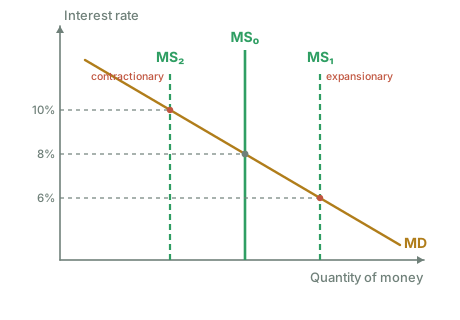
A central bank can change its policy interest rate. This influences, but does not mechanically determine, the interest rates charged and paid by commercial banks and other lenders.
A reduction in the policy interest rate
A lower policy rate may:
- reduce the cost of variable-rate and new borrowing;
- reduce the reward from saving;
- increase household consumption;
- make more investment projects profitable;
- improve cash flow for indebted households and firms;
- raise asset prices and confidence in some circumstances;
- place downward pressure on the exchange rate, which may raise net exports, although exchange-rate analysis is studied more fully in Unit 6.
The likely result is higher C, higher I, and possibly higher X − M, so aggregate demand rises.
An increase in the policy interest rate
A higher policy rate may:
- increase borrowing costs;
- increase debt repayments for borrowers on variable rates;
- increase the reward from saving;
- reduce consumption financed from credit;
- make fewer investment projects profitable;
- reduce asset prices or confidence;
- place upward pressure on the exchange rate, potentially reducing net exports.
The likely result is lower consumption and investment, so aggregate demand falls.
Interest-rate exam cautions
- The central bank usually changes a policy rate, not every market rate directly.
- Commercial banks may not pass on the full change.
- Fixed-rate borrowers may be unaffected until refinancing.
- A lower rate does not force households or firms to borrow.
- A higher rate can increase income for savers, so the consumption effect is not identical for every household.
4. Money supply
The money supply is the quantity of money available in the economy. At AS level, the focus is not on detailed definitions of monetary aggregates or on the commercial-bank money multiplier. The focus is how a monetary authority may seek to increase or decrease liquidity and monetary conditions.
Increasing the money supply
An increase in money supply or liquidity can:
- make funds more available to financial institutions;
- put downward pressure on interest rates;
- make credit easier to obtain;
- support consumption and investment;
- increase aggregate demand.
Possible methods can include central-bank purchases of financial assets or operations that add liquidity to the banking system. Detailed quantitative-easing mechanics are not required as core AS content.
Decreasing the money supply
A reduction in money supply or liquidity can:
- make funds less available;
- put upward pressure on interest rates;
- tighten credit conditions;
- reduce consumption and investment;
- lower aggregate demand.
Money-supply exam cautions
- An increase in monetary liquidity does not guarantee an equal increase in bank lending.
- Banks may hold additional reserves or restrict lending if borrowers appear risky.
- Households and firms may be unwilling to borrow during a recession.
- Do not import the A Level quantity theory of money or bank-credit multiplier into the compulsory AS answer unless the question specifically provides or requests it.
5. Credit regulations
Credit regulations are rules or controls that influence the amount, availability, eligibility or terms of borrowing.
They can be broad or selective. Examples include:
- ceilings on the amount banks may lend;
- maximum loan-to-value or loan-to-income ratios;
- minimum deposits for hire purchase or mortgages;
- maximum repayment periods;
- rules affecting reserve or liquidity positions;
- restrictions on lending to particular sectors or types of borrower;
- relaxation of existing restrictions to make credit more available.
Looser credit regulations
Looser rules may allow more households and firms to obtain loans. This can raise consumption and investment, shifting AD to the right.
Tighter credit regulations
Tighter rules may reduce the amount of borrowing or require larger deposits. This can lower consumption and investment, shifting AD to the left.
Why credit regulation is distinct from interest rates
The interest rate is the price of borrowing. Credit regulations affect whether borrowing is available and on what terms. Credit can remain difficult to obtain even when the policy rate is low.
Expansionary and Contractionary Monetary Policy
6. Expansionary monetary policy
Expansionary monetary policy is designed to increase aggregate demand.
It may involve:
- lowering the policy interest rate;
- increasing the money supply or liquidity;
- relaxing credit regulations.
The intended chain is:
- lower interest rates / more money / easier credit
- borrowing and spending rise
- consumption and investment rise
- AD shifts right
- real output and national income rise
- employment rises
- the price level is likely to rise
Expansionary policy is most likely to be used when:
- real output is below potential;
- cyclical unemployment is high;
- aggregate demand is weak;
- inflation is below the desired rate or deflation is a risk.
7. Contractionary monetary policy
Contractionary monetary policy is designed to reduce aggregate demand.
It may involve:
- raising the policy interest rate;
- reducing money supply growth or liquidity;
- tightening credit regulations.
The intended chain is:
- higher interest rates / less money / tighter credit
- borrowing and spending fall
- consumption and investment fall
- AD shifts left
- growth in real output and national income weakens
- employment may fall
- pressure on the price level is reduced
Contractionary policy is most likely to be used when excessive aggregate demand is generating inflationary pressure.
8. A comparison table
| Feature | Expansionary monetary policy | Contractionary monetary policy |
|---|---|---|
| Policy rate | Lower | Higher |
| Money supply/liquidity | Increase | Reduce or grow more slowly |
| Credit regulations | Loosen | Tighten |
| Consumption | Likely to rise | Likely to fall |
| Investment | Likely to rise | Likely to fall |
| Aggregate demand | Shifts right | Shifts left |
| Real output and income | Likely to rise | Likely to fall or grow more slowly |
| Employment | Likely to rise | May fall |
| Price level | Likely to rise | Downward pressure |
AD/AS Analysis
9. Expansionary policy in AD/AS
Start from an equilibrium where AD intersects SRAS.
Expansionary monetary policy increases one or more components of aggregate demand, usually consumption and investment. Therefore:
- AD shifts from AD1 to AD2;
- equilibrium real output rises from Y1 to Y2;
- equilibrium national income rises;
- the price level rises from P1 to P2;
- firms require more labour, so employment rises and cyclical unemployment falls.
The role of spare capacity
The size of each effect depends on the shape of aggregate supply.
- With substantial spare capacity, real output and employment may rise considerably, with a relatively small increase in the price level.
- Near full capacity, the same AD increase may cause a larger rise in the price level and a smaller rise in real output.
10. Contractionary policy in AD/AS
Contractionary monetary policy lowers consumption and investment. Therefore:
- AD shifts from AD1 to AD2 to the left;
- equilibrium real output and national income fall or grow more slowly;
- the price level is lower than it otherwise would have been;
- firms require less labour, so employment may fall.
This can reduce demand-pull inflationary pressure, but it cannot directly remove a negative supply shock. If inflation is caused by higher energy or input costs, contractionary monetary policy may reduce secondary demand pressure while also lowering output.
11. Price level versus inflation rate
A static AD/AS diagram directly shows a change in the price level, not the annual inflation rate. In written analysis:
- a rightward AD shift tends to create upward pressure on the price level and may raise inflation;
- a leftward AD shift tends to reduce upward pressure on the price level and may reduce inflation.
Avoid saying that a single diagram “shows inflation of 4%” unless time-period data are provided.
Exam Mastery
12. Building a complete causal chain
A high-quality answer should not jump from the tool directly to “the economy improves”. Use the full chain.
Example: lower interest rates
- The central bank lowers the policy interest rate.
- Commercial borrowing rates are likely to fall.
- Saving becomes less attractive and borrowing becomes cheaper.
- Household consumption and firm investment are likely to rise.
- Aggregate demand shifts right.
- Equilibrium national income and real output rise.
- Employment rises as firms expand production.
- The price level is likely to rise, especially near full capacity.
Example: tighter credit regulations
- The monetary authority raises minimum deposits and lowers permissible loan-to-value ratios.
- Fewer households qualify for loans.
- Credit-financed consumption falls.
- Aggregate demand shifts left.
- Inflationary pressure falls, but real output and employment may also fall.
13. Conditional analysis without drifting into A Level
Although full evaluation of policy effectiveness is mainly developed later, AS answers should still avoid certainty. Useful conditions include:
- confidence: low rates may not raise borrowing when expectations are pessimistic;
- commercial-bank pass-through: lenders may not reduce rates fully;
- existing debt: highly indebted borrowers may repay debt rather than spend;
- creditworthiness: banks may ration loans even when liquidity rises;
- time lags: contracts and decisions adjust gradually;
- spare capacity: determines the split between output and price effects;
- cause of inflation: monetary contraction is better suited to demand-pull than supply-side inflation;
- fixed versus variable rates: some borrowers respond only when contracts reset.
These are conditions on the transmission chain, not a requirement to reproduce the full A Level policy-effectiveness syllabus.
14. Common misconceptions
- “Monetary policy means only changing interest rates.” Incorrect. Cambridge also specifies money supply and credit regulations.
- “A lower interest rate always increases borrowing.” Incorrect. Confidence, debt and lending standards matter.
- “The central bank sets every interest rate in the economy.” Incorrect. It influences market rates through the policy rate and financial conditions.
- “More money automatically creates the same percentage increase in real output.” Incorrect. The response depends on lending, spending and spare capacity.
- “Expansionary monetary policy shifts LRAS right.” Its primary AS-level effect is through AD. Investment may have longer-run supply effects, but these are not the core 5.3 mechanism.
- “Contractionary policy lowers all prices.” It reduces demand pressure and the equilibrium price level relative to what it would otherwise be; it does not guarantee every individual price falls.
- “Devaluation is always a monetary-policy tool.” Exchange-rate policy is treated separately in Unit 6 and should not be inserted automatically into a 5.3 answer.
Exam Technique
15. Multiple-choice method
When comparing policy stances:
- identify the tool;
- decide whether it makes money or credit cheaper/easier or more expensive/harder;
- trace the effect on consumption and investment;
- identify the AD direction;
- infer output, price-level and employment effects.
16. Data-response and essay method
A concise analytical paragraph can follow:
- **tool
- borrowing/saving or credit availability
- C/I
- AD
- output/income
- employment
- price level
- condition**
Example:
A reduction in the policy interest rate is expansionary because it is likely to reduce commercial borrowing costs. This can increase household consumption and business investment, shifting AD to the right. Equilibrium real output and national income rise, so firms employ more labour. The price level also rises, with a larger inflationary effect if the economy is already close to full capacity.
Check you have it
Question 1
Which policy will not cause a reduction in the rate of inflation?
Answer: C.
Reducing interest rates is a monetary policy tool used by central banks to stimulate the economy by encouraging borrowing and spending. When interest rates are lowered, individuals and businesses are more likely to borrow money to spend on goods and services, which can lead to an increase in aggregate demand and potentially an increase in inflation, as more money is circulating in the economy. Therefore, reducing interest rates may not cause a reduction in the rate of inflation, as it may actually lead to an increase in inflation.
The correct answer is C - reducing interest rates.
Question 2
What is not an example of monetary policy?
Answer: A.
Monetary policy works through the money supply, interest rates and credit conditions, and is normally operated by the central bank. A tariff is a tax on imported goods, which makes it a fiscal and trade policy instrument: it raises government revenue and alters relative prices between domestic and foreign goods. It has nothing to do with the quantity of money or the cost of borrowing.
Why the other options are monetary policy:
- B, a rise in interest rates by the central bank, is the principal monetary policy instrument, raising the cost of borrowing and the reward for saving.
- C, tighter credit regulations, restricts the volume of lending banks may undertake, controlling credit creation and therefore the growth of the money supply.
- D, a rise in the money supply, is monetary policy by definition, expansionary in this case.
Question 3
What would make a policy of raising interest rates less likely to be effective in reducing inflation?
Answer: B.
17. Summary checklist
You should be able to:
- define monetary policy;
- identify interest rates, money supply and credit regulations as tools;
- explain how each tool affects borrowing and spending;
- distinguish expansionary from contractionary policy;
- trace both policy stances through AD/AS;
- analyse effects on national income, real output, price level and employment;
- explain why the outcome depends on pass-through, confidence and spare capacity;
- avoid importing A Level money-market and banking theory into the compulsory AS core.
What the syllabus asks for on this topicCurrent Cambridge requirements
Current Cambridge requirements
This topic must cover:
- the definition of monetary policy;
- the tools of monetary policy: interest rates, money supply and credit regulations;
- the distinction between expansionary and contractionary monetary policy;
- AD/AS analysis of the effects of expansionary and contractionary monetary policy on equilibrium national income, real output, the price level and employment.

Related CIE 9708 topics
Not the topic you were looking for? Describe what you are stuck on in your own words and we will take you to the notes that answer it.