Efficiency and Market Failure
Contents: 11 sections
Cambridge International AS & A Level Economics 9708 (A Level) Current syllabus: 2026–2028, Version 2 Official syllabus points: 7.3.1–7.3.6
Exam Essentials
1. Economic efficiency
Economic efficiency concerns whether scarce resources are being used and allocated in ways that avoid unnecessary waste and generate the greatest attainable benefit.
Two distinct questions must be separated:
- Are goods and services being produced at the lowest attainable resource cost? This is productive efficiency.
- Is the economy producing the combination and quantity of goods and services that best reflects social benefits and social costs? This is allocative efficiency.
A firm or economy can satisfy one condition without satisfying the other. Producing the wrong product mix very cheaply is productively efficient but allocatively inefficient. Producing a socially desirable quantity with avoidably high costs is allocatively targeted but productively inefficient.
Productive efficiency
2. Definition
Productive efficiency occurs when output is produced using the least-cost combination of resources, so that no more output can be obtained from the available inputs without using additional resources or sacrificing some other output.
There are two closely related ways to express the idea:
- technical perspective: maximum output from a given quantity of inputs;
- cost perspective: a given output produced at the minimum attainable average cost.
The second formulation requires input prices as well as technology. A production method may use fewer physical inputs but not be the cheapest if those inputs are unusually expensive.
3. Productive efficiency for an economy: the PPC
On a production possibility curve:
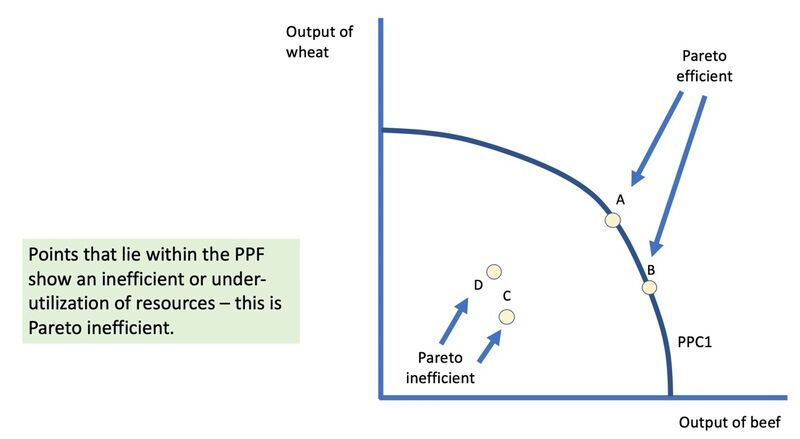
- a point inside the curve indicates unemployed, underused or inefficiently used resources;
- a point on the curve is productively efficient for the stated resources, technology and time period;
- a point outside the curve is currently unattainable.
Moving from inside the PPC to the boundary raises productive efficiency because the economy produces more without requiring additional resources. Moving from one point on the PPC to another changes the product mix but does not, by itself, increase productive efficiency: both points already use resources fully and efficiently.
Critical distinction
Every point on the PPC is productively efficient, but not every point is allocatively efficient. Society may prefer one product mix to another.
4. Productive efficiency for a firm
For a firm, productive efficiency is normally associated with production at the minimum point of the relevant average cost curve.
At the minimum point of an average cost curve:
MC = AC
The equality is a mathematical relationship: when marginal cost is below average cost, it pulls the average down; when marginal cost is above average cost, it pushes the average up. Therefore MC crosses AC at AC's minimum.
For long-run productive efficiency, the firm should operate at the minimum point of the long-run average cost curve. A firm can be at the minimum of a particular short-run average cost curve while still using a plant size that is not least-cost in the long run.
Conditions supporting productive efficiency
Productive efficiency is more likely when:
- managers and workers have appropriate incentives;
- firms face pressure to control costs;
- technology and production methods are used effectively;
- resources can move towards more productive uses;
- information about processes and input prices is available;
- avoidable organisational slack or X-inefficiency is limited.
Competition can encourage cost control, but productive efficiency is not guaranteed merely because many firms exist. Equally, a large firm may exploit economies of scale and achieve lower average costs than several smaller firms.
Allocative efficiency
5. Definition
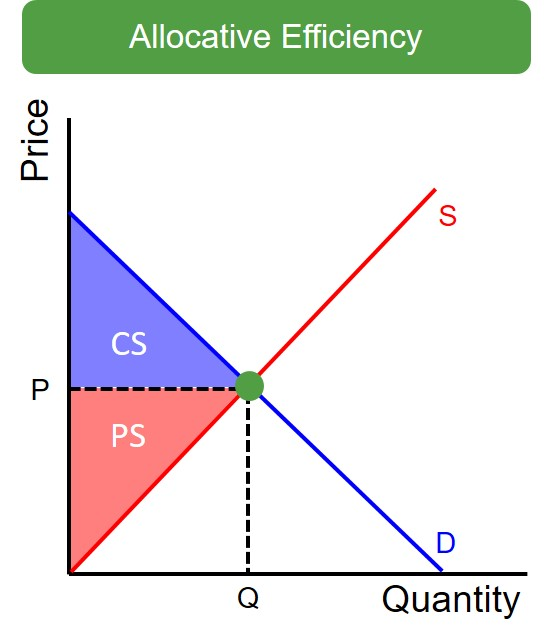
Allocative efficiency occurs when resources are allocated to the combination and quantity of goods and services that maximises net social benefit.
The social optimum occurs where:
MSB = MSC
where:
- MSB is marginal social benefit: the extra benefit to society from one more unit;
- MSC is marginal social cost: the extra cost to society from one more unit.
At quantities below the social optimum, MSB exceeds MSC. Society gains more from an additional unit than it costs to produce, so output should rise.
At quantities above the social optimum, MSC exceeds MSB. The extra unit costs society more than it benefits society, so output should fall.
6. When is P = MC a valid condition?
In a competitive market without external costs or benefits:
- demand can represent marginal private benefit and marginal social benefit;
- supply can represent marginal private cost and marginal social cost;
- a price-taking firm's price equals marginal revenue;
- profit maximisation occurs where MR = MC.
Under these restrictive conditions:
P = MC = MSB = MSC
This is why P = MC is commonly used as a shorthand condition for allocative efficiency.
However, P = MC is not universally sufficient. If pollution creates an external cost, the firm's MC may represent only marginal private cost, while MSC is higher. If consumption creates external benefits, market demand may understate MSB. The safest social condition is therefore MSB = MSC.
7. Total surplus and the marginal condition
In a simple competitive market with no externalities, allocative efficiency maximises the sum of consumer surplus and producer surplus.
This does not mean:
- consumer surplus alone is maximised;
- every consumer receives the good;
- the outcome is equal or fair;
- the market equilibrium is always efficient.
The conclusion depends on the demand and supply curves accurately representing all relevant social benefits and costs.
Conditions supporting allocative efficiency
Allocative efficiency requires, at minimum:
- decisions based on the full social costs and benefits;
- no unpriced external effects;
- sufficiently accurate information;
- prices that guide resources towards valued uses;
- limited market power that restricts output below the social optimum;
- provision of goods for which private markets would otherwise be missing;
- resources able to respond to changing relative benefits and costs.
Comparing productive and allocative efficiency
8. The two efficiencies are not the same
| Question | Productive efficiency | Allocative efficiency |
|---|---|---|
| Main concern | How output is produced | What and how much is produced |
| Economy condition | On the PPC | Preferred point/product mix; MSB = MSC |
| Firm condition | Minimum relevant AC | P = MC only under no-externality competitive conditions |
| Main failure | Waste or excessive cost | Overproduction, underproduction or missing output |
| Typical remedy | Better methods, incentives, competition, scale | Correct prices/information, address externalities, market power or missing markets |
Example
A country uses all resources efficiently to produce a very large quantity of luxury housing and too little basic sanitation. It may be on its PPC, so it is productively efficient. If the marginal social benefit of sanitation exceeds its marginal social cost while the opposite is true for the final units of luxury housing, the product mix is allocatively inefficient.
Efficiency and equity
Efficiency and equity are different criteria. An allocation may be efficient but highly unequal. A more equal allocation may or may not be more efficient.
Do not label every unequal outcome a market failure. Market failure is primarily about inefficient resource allocation. Governments may intervene for equity reasons even when the allocation satisfies a narrow efficiency condition.
Pareto optimality
9. Pareto improvements
A Pareto improvement is a change that makes at least one person better off without making anyone else worse off.
If an economy has idle resources, using them to produce a good valued by someone can potentially create a Pareto improvement, provided no other person's welfare is reduced.
10. Pareto optimality
An allocation is Pareto optimal or Pareto efficient when no further Pareto improvement is possible:
no person can be made better off without making at least one other person worse off.
Pareto optimality is a test of efficiency, not a test of fairness.
Important implications
- There can be many Pareto-optimal allocations.
- One person owning nearly everything could be Pareto optimal if transferring resources would make that person worse off.
- A move from one Pareto optimum to another creates winners and losers and cannot be judged using the Pareto criterion alone.
- Value judgements or a social welfare function are needed to choose between efficient distributions.
Pareto optimality and the PPC
A point inside the PPC is normally productively inefficient and may allow a Pareto improvement. A point on the PPC is productively efficient, but it is not automatically a complete Pareto optimum. Full Pareto efficiency also depends on:
- whether the product mix matches consumers' marginal valuations;
- whether goods are distributed efficiently between consumers;
- whether external costs and benefits are included.
Therefore, “on the PPC” is evidence of production efficiency, not sufficient proof of overall Pareto optimality.
Dynamic efficiency
11. Definition
Dynamic efficiency occurs when resources are allocated efficiently over time through innovation, investment and the development of improved products and production methods.
It can involve:
- process innovation, reducing costs or resource use;
- product innovation, improving quality or creating new goods and services;
- investment in research and development;
- learning by doing and workforce development;
- adoption and diffusion of technology;
- replacement of obsolete capital.
Dynamic efficiency is broader than a downward shift of LRAC. A new medicine may improve welfare even if it is initially expensive. A cleaner production process may raise private cost but reduce social cost.
12. Static versus dynamic efficiency
- Static efficiency asks whether resources are used efficiently at a point in time.
- Dynamic efficiency asks whether decisions today improve productive possibilities and welfare in the future.
There may be a trade-off. R&D spending raises current cost and may reduce short-run profit, but successful innovation can lower future cost or increase future benefit.
Conditions supporting dynamic efficiency
Dynamic efficiency may be encouraged by:
- expected rewards from innovation;
- access to finance;
- skilled labour and research capacity;
- competitive pressure to improve;
- sufficient profit to fund risky investment;
- intellectual-property protection of appropriate length;
- openness to new firms and technologies;
- institutions that allow unsuccessful methods to be replaced.
Neither monopoly nor competition guarantees the result. Market power may finance R&D but weaken the pressure to innovate. Fierce competition may strengthen the pressure but reduce retained profit and make long-horizon investment harder.
Market failure
13. Definition
Market failure occurs when the free-market mechanism does not allocate resources efficiently, so the market quantity or product mix differs from the socially efficient outcome.
It can take the form of:
- over-allocation: too many resources go to an activity relative to the social optimum;
- under-allocation: too few resources go to an activity;
- non-provision or a missing market.
Market power may also permit productive or X-inefficiency, but this is a related performance problem rather than the central definition of market failure in this topic.
Market failure can be partial, a market exists but produces the wrong quantity, or complete, where the private market does not provide the good at all.
A market outcome can be undesirable without being a market failure in the strict efficiency sense. For example, society may dislike an unequal distribution of income even if voluntary exchanges are Pareto efficient.
14. Welfare loss
When output differs from the quantity where MSB = MSC, mutually beneficial units may be missing or socially harmful units may be produced. The lost net social benefit is commonly described as a deadweight welfare loss.
Detailed externality diagrams and welfare-loss calculations are developed in Topic 7.4. Topic 7.3 focuses on recognising the broad reasons markets can fail.
Reasons for market failure
15. Externalities
An externality exists when production or consumption affects a third party and that effect is not fully reflected in the market price.
- Negative externalities can cause overproduction or overconsumption.
- Positive externalities can cause underproduction or underconsumption.
The market decision is based on private costs and benefits, while efficiency depends on social costs and benefits. Topic 7.4 develops production and consumption externalities in full.
16. Public goods and missing markets
A pure public good is:
- non-rival: one person's consumption does not significantly reduce availability to others;
- non-excludable: it is difficult or impossible to prevent non-payers from benefiting.
Non-excludability creates the free-rider problem. People can benefit without revealing willingness to pay, so private firms may be unable to collect enough revenue. The good may be underprovided or not provided.
Not every government-provided service is a pure public good. Education and healthcare are generally rival to some degree and users can be excluded; they may instead be merit goods with external benefits and information problems.
17. Common-access resources
A common-access or common-pool resource is difficult to exclude users from but rival in consumption. Fish stocks, groundwater and the atmosphere's capacity to absorb pollution are examples.
Each user gains the private benefit of extraction or use but shares the depletion cost with others. Without effective rights, rules or cooperation, the resource may be overused. This is sometimes called the tragedy of the commons.
Public goods and common resources must not be confused:
| Excludable? | Rival? | Typical failure | |
|---|---|---|---|
| Pure public good | No | No | Underprovision/free riding |
| Common resource | Difficult | Yes | Overuse/depletion |
18. Information failure
Markets work poorly when buyers or sellers lack information about quality, risk, long-term effects or alternatives.
Forms include:
- imperfect information affecting both sides;
- asymmetric information, where one side knows more than the other;
- consumers underestimating benefits of merit goods;
- consumers underestimating costs of demerit goods;
- adverse selection and moral hazard, developed further in Topic 7.4.
Information failure can distort demand, supply, quality and market participation. It does not follow that consumers are unintelligent; acquiring and processing information can itself be costly.
19. Market power and imperfect competition
A firm with market power may restrict output and raise price above marginal cost. Relative to the competitive benchmark; this can create:
- underproduction;
- loss of consumer surplus;
- deadweight welfare loss;
- possible X-inefficiency if weak competitive pressure allows avoidable cost;
- barriers preventing more efficient entrants.
However, market power may also support economies of scale or innovation. The existence of a large firm is not, by itself, proof of market failure. Detailed market-structure analysis belongs in Topic 7.6.
20. Factor immobility and slow adjustment
Resources may not move rapidly towards uses with higher social benefit because of:
- occupational immobility: workers lack relevant skills;
- geographical immobility: housing, family or migration constraints;
- specialised capital that cannot be redeployed;
- time lags and uncertainty;
- barriers to entry or exit.
Persistent immobility can leave labour and capital underused or trapped in lower-productivity activities. Prices may signal a better allocation, but the physical adjustment may be slow or costly.
21. Behavioural biases and bounded rationality
Consumers and firms may use heuristics, display present bias, respond to framing or fail to process complex information. Choices can then differ from the fully informed, internally consistent decisions assumed in simple models.
Behavioural bias is not a licence to label every unpopular choice a market failure. The analysis should identify:
- the specific bias or information problem;
- how it changes decisions;
- why the resulting quantity differs from the social optimum.
Integrated analysis
22. A reliable market-failure chain
For an examination answer, use this sequence:
- Identify the market condition: for example an external cost, free riding, asymmetric information or market power.
- Explain the private decision made by consumers or firms.
- Compare private and social incentives.
- State the allocation error: overproduction, underproduction, non-provision or excessive cost.
- Link to the efficiency condition: MSB is not equal to MSC, or production is not at minimum attainable cost.
- Identify the consequence: lost net social benefit, depleted resources, poor quality, restricted output or wasted resources.
23. Worked examples
Example A: a factory with unpriced pollution
The firm considers wages, energy and materials but not the respiratory harm imposed on nearby residents. Marginal private cost understates marginal social cost. The market price is too low and output too high relative to the social optimum. Resources are over-allocated and allocative efficiency is not achieved.
Example B: national defence
It is difficult to exclude non-payers from national defence and one resident's protection does not normally reduce protection available to another. People have an incentive to free ride, so willingness to pay is not fully revealed. A profit-seeking supplier may not provide the socially desired quantity.
Example C: a dominant digital platform
Strong network effects and entry barriers give the platform market power. It may charge above marginal cost or reduce quality. This can restrict output below the efficient level. Yet scale may lower average cost and support innovation, so the judgement requires evidence rather than assuming every dominant firm produces a net welfare loss.
Example D: vocational mismatch
Vacancies grow in renewable-energy engineering while unemployed workers possess unrelated skills. Wage signals alone do not create qualifications immediately. Occupational immobility causes labour underutilisation and delays the movement of resources towards higher-value production.
Evaluation and exam mastery
24. Common traps
Trap 1: “All market equilibria are allocatively efficient”
Only if market demand and supply reflect all social benefits and costs and market power/information problems are absent.
Trap 2: “P = MC always proves allocative efficiency”
The MC may be private rather than social, and price may not equal marginal social benefit.
Trap 3: “On the PPC means allocatively efficient”
It proves productive efficiency for the stated constraints, not that society prefers that product mix.
Trap 4: “Pareto optimal means fair”
The criterion is silent on equality and distribution.
Trap 5: “Dynamic efficiency means only lower LRAC”
It also includes better quality, new products, cleaner processes and future capabilities.
Trap 6: “Merit goods are public goods”
Merit goods are underconsumed because benefits are underestimated or information is imperfect. Pure public goods are non-rival and non-excludable.
Trap 7: “Government provision proves market failure has been solved”
Intervention can itself be poorly designed. Government failure is examined in Topic 8.1.
25. Evaluation framework
When judging whether a market is efficient, ask:
- Which efficiency is relevant: productive, allocative, dynamic or Pareto?
- Are costs and benefits private or social?
- Is the problem temporary adjustment or persistent failure?
- How large is the divergence from the social optimum?
- Are there countervailing benefits such as scale or innovation?
- Is the evidence strong enough to identify the efficient quantity?
- Would intervention improve the outcome after administrative cost and unintended effects?
Check you have it
Question 1
The government wants to regulate the consumption of a demerit good in order to increase society’s net welfare.
In which situation will society’s net welfare increase?
Answer: D.
Question 2
What is the specific advantage of pollution permits, when compared with an alternative policy of taxes levied on the quantity of pollutants emitted by firms?
Answer: D.
Question 3
A government wants to introduce a policy that will reduce the pollution caused by the production of a good.
Which policy would not make use of market forces?
Answer: B.
A ban replaces the market with an administrative prohibition. No trading occurs, no price is set, and no producer weighs costs against benefits, the quantity is simply zero by decree. Nothing about the outcome is determined by market forces.
Why the other options use market forces:
- A, a quota, caps the quantity produced but leaves the market to allocate that quantity. Price still adjusts to clear the restricted supply, and producers still decide who supplies within the limit. It is a constraint on the market rather than a replacement of it.
- C, a tax on production, works entirely through prices. It raises private cost towards social cost so that producers, acting in their own interest, choose a lower output. The market decides how much of the reduction each firm bears.
- D, tradable pollution permits, is the purest market-based instrument of the four. The government fixes the total quantity of pollution but lets firms buy and sell permits, so a price for pollution emerges and abatement is concentrated where it is cheapest.
26. Final synthesis
Productive efficiency concerns producing at minimum attainable cost. Allocative efficiency concerns producing the quantity and mix where marginal social benefit equals marginal social cost. Pareto optimality asks whether anyone can be made better off without harming someone else. Dynamic efficiency brings time, innovation and investment into the analysis.
Market failure occurs when decentralised market incentives do not produce an efficient allocation. The key reasons include externalities, public goods, common resources, information failures, market power, resource immobility and behavioural limitations. The strongest answers do not merely list these reasons: they show the private incentive, the resulting allocation error and the exact efficiency condition that fails.
What the syllabus asks for on this topicCurrent Cambridge requirements
Current Cambridge requirements
This topic must cover:
- definitions of productive efficiency and allocative efficiency;
- the conditions required for productive and allocative efficiency;
- Pareto optimality;
- the definition of dynamic efficiency;
- the definition of market failure;
- reasons why market failure occurs.
Related CIE 9708 topics
Not the topic you were looking for? Describe what you are stuck on in your own words and we will take you to the notes that answer it.