Protectionism
Contents: 11 sections
Cambridge International AS & A Level Economics 9708 (AS Level) Current syllabus: 2026–2028, Version 2 Official syllabus points: 6.2.1–6.2.3
Exam Essentials
1. Meaning of protectionism
Protectionism is the use of government measures to restrict international trade or give domestic producers an advantage over foreign competitors.
Protection can work by:
- raising the domestic price of imports;
- limiting the permitted quantity of imports;
- lowering the cost or increasing the return received by exporters;
- banning specified trade completely;
- increasing the time, uncertainty or administrative cost of importing.
Protectionism is the opposite direction to trade liberalisation, which reduces or removes artificial trade barriers.
A policy is not protectionist merely because it affects trade. A genuine safety, health or environmental rule may be legitimate. It becomes a protectionist concern when it discriminates against foreign products or is more restrictive than necessary to achieve the stated objective.
2. The free-trade benchmark
To analyse a barrier, begin with the free-trade position.
For a small importing country that cannot affect the world price:
- the world price is below the domestic no-trade equilibrium price;
- domestic consumers buy at the world price;
- domestic firms supply part of domestic demand;
- imports fill the gap between quantity demanded and domestic quantity supplied.
A protectionist measure changes this outcome. Most tools benefit at least one domestic group, but also impose costs on others. The central exam task is therefore to identify:
- policy tool
- price/cost/quantity change
- imports or exports
- stakeholder effects
- efficiency and macroeconomic effects
- evaluation
Tariffs
3. Definition
A tariff is a tax placed on an imported good or service.
Two common forms are:
- specific tariff: a fixed amount per unit, such as $20 per imported bicycle;
- ad valorem tariff: a percentage of the import value, such as 12% of the price.
For a small country with complete pass-through, a specific tariff raises the domestic price from the world price by the amount of the tariff.
4. Tariff mechanism
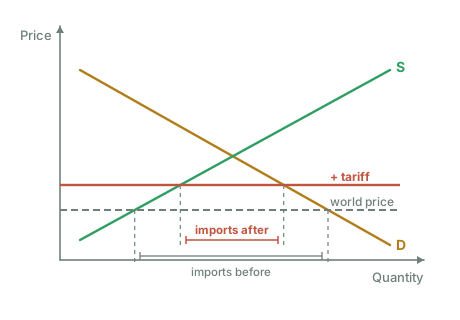
- tariff imposed
- landed cost of imports rises
- domestic price rises
- domestic quantity demanded falls
- domestic quantity supplied rises
- imports fall
Suppose at the world price of $40:
- domestic demand is 1,000 units;
- domestic supply is 300 units;
- imports are 700 units.
A $10 tariff raises the domestic price to $50. At that price:
- demand falls to 850;
- domestic supply rises to 450;
- imports fall to 400.
Government tariff revenue is:
tariff per unit × quantity imported after the tariff
In the example:
$10 × 400 = $4,000
5. Tariff stakeholder effects
Domestic consumers
Consumers generally lose because:
- the domestic price rises;
- consumption falls;
- choice may fall;
- the tariff may be regressive if the protected good takes a larger share of low-income household budgets.
Domestic producers
Import-competing firms generally gain because:
- they receive a higher price;
- they sell more output;
- revenue and employment may rise in the protected industry.
These gains can be temporary if firms do not use protection to become more efficient.
Government
The government receives tariff revenue, provided imports continue. Revenue may be used for public spending or adjustment assistance, but it is a transfer from buyers rather than a free gain to society.
Foreign producers
Foreign firms usually sell fewer units into the protected market. Their revenue may fall, particularly if they cannot reduce prices or redirect exports elsewhere.
The wider economy
Under the standard small-country model, the tariff creates two efficiency losses:
- production inefficiency: higher-cost domestic output replaces lower-cost imports;
- consumption inefficiency: some consumers stop buying even though the world resource cost is below their willingness to pay.
The loss of consumer surplus exceeds the combined producer gain and government revenue. The difference is deadweight welfare loss.
6. Important tariff qualifications
Do not write that the domestic price must always rise by the full tariff. The result depends on:
- whether the country is large enough to affect the world price;
- the elasticities of foreign supply and domestic demand/supply;
- exchange-rate movements;
- whether foreign exporters absorb part of the tariff in lower margins;
- evasion, exemptions and product substitution.
Import quotas
7. Definition
An import quota is a legal limit on the quantity or value of a product that may be imported during a period.
A quota directly fixes the maximum permitted import quantity. It does not itself specify the domestic price. The price rises until the gap between domestic demand and domestic supply equals the permitted imports.
8. Quota mechanism
- import quota below free-trade imports
- restricted import supply
- domestic shortage at the old price
- domestic price rises
- demand falls and domestic supply rises
- import gap equals quota
Suppose free-trade imports are 700 units. A quota permits only 400 imports. The domestic price must rise until:
domestic demand − domestic supply = 400
The resulting price and quantity effects can resemble those of a tariff that reduces imports to the same level.
9. Quota rents
The higher domestic price creates a quota rent:
(domestic price − world price) × permitted import quantity
Who receives the rent depends on how import rights are allocated:
- government, if licences are auctioned;
- domestic importing firms, if licences are granted free;
- foreign exporters, if they control scarce export licences;
- politically connected firms, if allocation is corrupt or discretionary.
This is a major difference from a tariff, where the government normally receives the tax revenue.
10. Quota stakeholder effects
- Consumers pay more and buy less.
- Domestic producers receive a higher price and supply more.
- Foreign exporters sell fewer units, although some may capture quota rents.
- Government revenue is not automatic.
- The economy experiences production and consumption inefficiency under the standard model.
11. Tariff versus quota
| Feature | Tariff | Import quota |
|---|---|---|
| Directly controls | Price wedge/tax rate | Maximum import quantity |
| Government income | Tariff revenue | Only if licences are auctioned |
| Response to rising domestic demand | Imports can rise, with tariff still paid | Import quantity remains capped, so price may rise further |
| Risk of lobbying/corruption | Present | Often greater because licences are scarce assets |
| Transparency | Tax rate usually visible | Allocation rules may be less transparent |
A quota can therefore become more restrictive than an equivalent tariff when domestic demand increases.
Export subsidies
12. Definition
An export subsidy is a government benefit that is conditional on a firm exporting. It may take the form of a payment per unit exported, tax relief, subsidised finance, transport support or another export-contingent benefit.
Do not confuse an export subsidy with a general production subsidy. A production subsidy is paid for producing, whether the output is sold domestically or abroad. An export subsidy is linked specifically to export performance.
13. Export-subsidy mechanism
For a small exporting country:
- export subsidy
- return from selling abroad rises
- domestic producers expand output and divert more supply to exports
- domestic supply available to consumers falls
- domestic price may rise
- domestic consumption falls
- exports rise
If the world price is $80 and the government pays a $12 subsidy per exported unit, producers can receive an effective $92 on exports. With free movement between domestic and export markets, the domestic price tends towards $92 because firms will not willingly sell at home for less than they can receive abroad.
14. Export-subsidy stakeholder effects
Producers
Exporting firms gain from a higher effective return, larger output and increased exports.
Domestic consumers
Consumers in the subsidising country may lose because the domestic price rises and domestic consumption falls.
Government and taxpayers
The fiscal cost is:
subsidy per exported unit × quantity exported after the subsidy
The spending has an opportunity cost because the same public funds could finance other priorities or reduce taxation.
Foreign producers and global markets
Subsidised exports can lower world prices and displace foreign producers. Trading partners may retaliate or impose countervailing measures. The policy distorts production towards the subsidised industry and may create global overproduction.
15. Export-subsidy qualifications
The precise impact depends on:
- whether the country can influence the world price;
- domestic and foreign elasticities;
- the size and design of the subsidy;
- production capacity;
- whether the measure is temporary;
- responses by trading partners.
Embargoes
16. Definition and impact
An embargo is a complete or near-complete official ban on importing or exporting a specified product, or on trade with a specified country.
An embargo is more restrictive than a quota because the permitted quantity may be zero.
Possible effects include:
- covered imports or exports collapse;
- domestic prices rise if alternative supplies are limited;
- shortages or rationing emerge;
- domestic substitute producers expand;
- consumers face reduced choice and quality;
- firms using the banned product as an input face higher costs;
- smuggling, evasion and black markets may develop;
- the target country may retaliate;
- political or security objectives may be pursued even at an economic cost.
An embargo may be imposed for national security, foreign-policy, health or ethical reasons. The economic cost does not prove the policy fails if the primary objective is non-economic.
Excessive administrative burdens (“red tape”)
17. Meaning
Excessive administrative burdens are rules or procedures that make importing unusually slow, costly, uncertain or difficult.
Examples include:
- complicated import licensing;
- repeated customs inspections;
- unnecessary documentation;
- discriminatory testing or certification;
- product standards designed around domestic producers;
- long and unpredictable border delays;
- local-language labelling rules with no proportionate justification;
- arbitrary origin or registration requirements.
18. Mechanism and impact
- more paperwork/delay/testing
- fixed and variable trade costs rise
- effective import supply falls
- imports become less competitive
- domestic price may rise
- import quantity falls
Red tape can be especially damaging to small exporters because a fixed compliance cost is spread over fewer units.
However, not every standard is disguised protection. Safety, health, consumer-information and environmental rules can be legitimate. A strong answer distinguishes:
- legitimate regulation: evidence-based, transparent, non-discriminatory and no more restrictive than necessary;
- protectionist red tape: excessive, discriminatory, opaque or unrelated to the stated objective.
Arguments for protectionism
19. Protecting infant industries
A new domestic industry may initially have high average costs because it has not yet achieved:
- economies of scale;
- learning by doing;
- a skilled workforce;
- supplier networks;
- finance and brand recognition.
Temporary protection may allow the industry to reduce costs and become internationally competitive.
Evaluation
The argument is strongest when:
- the industry has a realistic path to lower costs;
- spillover benefits exist;
- protection has a clear time limit and performance conditions;
- government can identify the industry without political capture.
It is weak when firms become permanently dependent, lobby for extensions or never achieve comparative advantage.
20. Protecting employment and easing adjustment
Protection may preserve jobs and incomes in an import-competing sector, preventing sudden regional unemployment and allowing workers time to retrain.
Evaluation
- Jobs saved are visible, but jobs lost elsewhere are less visible.
- Costlier imported inputs may reduce employment in downstream industries.
- Retaliation may reduce export employment.
- Supporting worker retraining and mobility may be cheaper than permanently protecting an inefficient industry.
21. Strategic industries and national security
Governments may protect food, energy, defence, medicines, semiconductors or critical infrastructure to reduce dependence on foreign suppliers during war, disaster or geopolitical disruption.
Evaluation
Resilience has value, but full self-sufficiency can be extremely costly. Diversified suppliers, strategic reserves and targeted capacity support may achieve security with less distortion than broad tariffs or embargoes.
22. Preventing dumping and unfair competition
Dumping broadly involves exporting a product at an unfairly low price relative to its normal value. It is not correct to assume every cheap import is dumped or that dumping always means a price below physical production cost.
Protection may be argued for when foreign firms use subsidies or temporarily low prices to eliminate domestic competitors and later exploit market power.
Evaluation
- Evidence is difficult to establish.
- Low prices may reflect genuine comparative advantage or higher productivity.
- Anti-dumping action can be captured by domestic firms seeking protection from fair competition.
23. Health, safety and environmental protection
Restrictions may block unsafe food, hazardous products, invasive species or goods produced in ways that create serious environmental harm.
Evaluation
The measure should be proportionate, evidence-based and applied consistently to domestic and foreign products. Otherwise, the stated objective may disguise protectionism.
24. Improving the current account
Tariffs, quotas or red tape may reduce import expenditure by encouraging consumers to switch to domestic products.
Evaluation
The result depends on:
- demand elasticity;
- domestic capacity and quality;
- the imported-input content of domestic production;
- retaliation against exports;
- exchange-rate and income effects;
- whether the underlying competitiveness problem is solved.
Protection may provide short-run relief without correcting weak productivity.
25. Raising government revenue
Tariffs can raise revenue, especially where other taxes are difficult to collect.
Evaluation
Revenue is highest only if imports continue. Very high tariffs may shrink the tax base, encourage evasion and impose a regressive burden on consumers.
26. Diversification and reduced dependence
A country dependent on one export or imported essentials may protect alternative industries to diversify production and reduce vulnerability.
Evaluation
Protection can create new capability, but it can also direct resources away from industries with stronger long-run potential.
Arguments against protectionism
27. Higher prices and reduced consumer choice
Tariffs, quotas, embargoes and red tape restrict lower-cost foreign supply. Consumers generally face higher prices, lower consumption and less variety.
28. Misallocation of resources
Protection encourages resources to remain in higher-opportunity-cost domestic production. The economy moves away from specialisation according to comparative advantage, reducing total output and welfare under standard assumptions.
29. Weaker competition, productivity and innovation
Protected firms face less pressure to:
- cut costs;
- improve quality;
- innovate;
- adopt new technology;
- respond to consumers.
Temporary protection can therefore become a cause of permanent inefficiency.
30. Retaliation and trade wars
Trading partners may impose their own tariffs, quotas or administrative barriers. Exports fall, supply chains become less efficient and the original current-account or employment objective may be undermined.
31. Higher costs for domestic firms
Many imports are intermediate goods and capital equipment. Protection can raise input costs, shift SRAS left, reduce competitiveness and harm firms that export finished products.
32. Government failure and rent-seeking
Protection creates concentrated gains for firms, workers or licence holders. These groups may spend resources lobbying for barriers rather than improving productivity.
Quota licences and exemptions can create corruption, favouritism and administrative cost.
33. Fiscal and opportunity costs
Export subsidies use public funds. Protecting one industry may mean less spending on education, infrastructure, healthcare or broad productivity improvements.
34. Evasion and unintended consequences
High barriers may encourage:
- smuggling;
- false customs declarations;
- rerouting through third countries;
- product reclassification;
- black markets;
- substitution towards lower-quality goods.
Exam Mastery
35. Comparing the tools
| Tool | Main mechanism | Likely direct beneficiary | Main direct cost |
|---|---|---|---|
| Tariff | Raises import price through tax | Domestic producers and government | Consumers; import users |
| Import quota | Caps import quantity | Domestic producers and quota-rent holders | Consumers; efficiency |
| Export subsidy | Raises return from exporting | Exporting producers | Taxpayers and domestic consumers |
| Embargo | Bans specified trade | Some domestic substitutes; political objective | Consumers, input users and target exporters |
| Red tape | Raises compliance time/cost | Domestic producers protected from imports | Importers, consumers and small exporters |
36. A high-quality analysis chain
Example: tariff to protect employment
- tariff raises landed import cost
- domestic price rises
- domestic demand contracts but domestic firms expand output
- imports fall
- protected-sector employment may rise
- consumer real income falls and input costs may increase
- retaliation may reduce export employment
- overall employment effect is ambiguous
37. Evaluation framework
A judgement should depend on:
- Objective: security, adjustment, revenue or political pressure?
- Evidence of market failure or unfair trade: is intervention correcting a real problem?
- Tool design: targeted, transparent and temporary, or broad and permanent?
- Elasticities: how strongly do demand, supply and trade volumes respond?
- Domestic spare capacity: can local firms replace imports without extreme price rises?
- Time period: short-run adjustment versus long-run dependency and innovation.
- Retaliation risk: how exposed are exporters?
- Imported inputs: will domestic production costs rise?
- Distribution: who gains and who pays?
- Government capability: can licences, standards and sunset clauses be administered fairly?
- Alternatives: retraining, competition policy, strategic reserves or direct adjustment support may be less distortionary.
38. Common exam mistakes
- Saying all protection benefits the whole domestic economy.
- Treating government tariff revenue as a net welfare gain.
- Assuming quota rents always go to the government.
- Confusing an import quota with an export quota.
- Treating export subsidies as ordinary production subsidies.
- Saying export subsidies necessarily lower the domestic price.
- Calling every safety regulation protectionist.
- Defining dumping simply as any import sold cheaply.
- Ignoring imported inputs and downstream firms.
- Claiming protection must improve the current account.
- Evaluating only the protected industry and not the wider economy.
Check you have it
Question 1
What would reduce an economy’s protection against the import of cars?
Answer: A.
Question 2
Which statement about trade protection is correct?
Answer: D.
Question 3
What is a disadvantage when a quota replaces a tariff to reduce imports?
Answer: B.
39. Answer structure for a discuss question
Question: Discuss whether a government should protect a new domestic battery industry from imports.
A strong response should:
- define protectionism and identify a suitable tool;
- explain how the tool changes price, output, imports and employment;
- develop the infant-industry or strategic-security case;
- analyse consumer, taxpayer, downstream-firm and foreign effects;
- consider retaliation and long-run efficiency;
- judge whether protection is temporary, targeted and performance-conditioned;
- compare protection with alternatives such as training, infrastructure, research support or diversified sourcing.
Mastery Summary
You have mastered Topic 6.2 when you can:
- define protectionism precisely;
- trace the full impact of tariffs and quotas;
- calculate tariff revenue, quota rents and subsidy cost;
- distinguish import restrictions from export support;
- explain embargoes and protectionist red tape;
- build arguments for and against protection;
- identify winners, losers and efficiency effects;
- evaluate protection using evidence, design, duration, retaliation, distribution and alternatives.
What the syllabus asks for on this topicCurrent Cambridge requirements
Current Cambridge requirements
This topic must cover:
- the meaning of protectionism in international trade;
- the impact of five named tools: tariffs, import quotas, export subsidies, embargoes and excessive administrative burdens (red tape);
- arguments for and against protectionism.

Related CIE 9708 topics
Not the topic you were looking for? Describe what you are stuck on in your own words and we will take you to the notes that answer it.