Introduction to the Circular Flow of Income
Contents: 30 sections
Syllabus boundary
This introductory AS topic does not require:
- the multiplier process;
- calculation of marginal or average propensities to consume, save, import or tax;
- detailed Aggregate Demand analysis, which follows in Topic 4.3.
The topic in one idea
Production creates income; income finances expenditure; expenditure provides revenue that encourages further production.
The circular flow shows how four things move repeatedly between the sectors of an economy:
- resources;
- goods and services;
- income;
- expenditure.
The model connects Topic 4.1 to the rest of macroeconomics:
value of national output = value of national income = value of national expenditure.
These totals are measured from different sides of the same production process.
1. What is the circular flow of income?
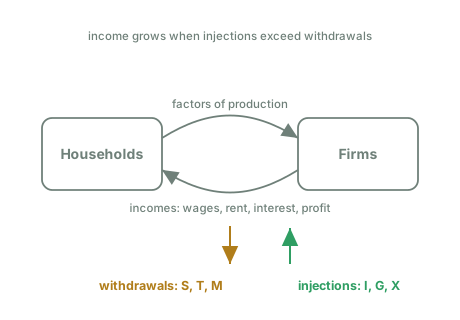
The circular flow of income is a simplified model showing how income and spending move between decision-makers in an economy.
The main sectors are:
- households;
- firms;
- government;
- the international economy.
A financial sector may also be shown as the channel through which savings can finance investment. At AS Level, the key assessed flows remain savings and investment rather than the institutional detail of financial markets.
Why the flow is circular
Firms pay income to households for supplying factors of production. Households then spend some of that income on firms' goods and services. That expenditure becomes firms' revenue, which allows firms to pay factor incomes and continue production.
The money repeatedly moves around the economy rather than reaching a final endpoint.
2. The simple two-sector closed economy
The simplest model contains only:
- households;
- firms.
It excludes:
- government;
- foreign trade.
Households
Households:
- own or supply factors of production;
- receive factor incomes;
- purchase goods and services.
Factor incomes include:
- wages for labour;
- rent for land;
- interest for capital;
- profit for entrepreneurship.
Firms
Firms:
- hire factors of production;
- organise production;
- pay factor incomes;
- sell goods and services;
- receive consumer expenditure.
Basic monetary chain
- Firms pay factor incomes to households
- households use income to buy output from firms
- firms receive sales revenue
- firms continue paying incomes and producing output.
3. Real flows and money flows
A circular-flow model contains two types of flow moving in opposite directions.
Real flows
Real flows are flows of actual resources, goods or services.
Examples:
- labour services supplied by households to firms;
- land and capital services supplied to firms;
- consumer goods supplied by firms to households.
Money flows
Money flows are payments made in return for real flows.
Examples:
- wages, rent, interest and profit paid to households;
- consumer expenditure paid to firms.
Opposite-direction principle
If labour services move from households to firms, wages move from firms to households.
If consumer goods move from firms to households, consumer spending moves from households to firms.
Examination trap
Do not draw or describe wages flowing from households to firms. Households supply labour; firms pay wages.
4. Income, output and expenditure are equal in value
Suppose a firm produces goods worth $1 million and sells all of them.
- The value of output is $1 million.
- The expenditure on that output is $1 million.
- The revenue is distributed as income or retained profit, so the income generated is also $1 million.
Therefore:
This is an accounting identity.
It does not mean every household receives equal income or every firm earns the same profit.
It means the economy-wide totals describe the same economic activity from three perspectives.
5. Consumption and saving
Households do not necessarily spend all their income on current consumption.
Household income can be used for:
- consumption;
- saving;
- taxes once government is introduced.
In a simple two-sector model:
where:
- Y = national income;
- C = consumption;
- S = saving.
Saving is a leakage because that part of current income is not being spent on current domestically produced consumer goods and services.
Important qualification
Saving is not automatically harmful.
Financial institutions can channel saving to firms that undertake investment. Saving is called a leakage only because it leaves the current circular flow of consumption spending.
6. Investment
Investment is spending on capital goods and additions to inventories that help produce future output.
Examples:
- machinery;
- factories;
- business software;
- commercial vehicles;
- unplanned or planned inventory accumulation in national accounts.
Investment is an injection because it adds spending to the circular flow without arising directly from current household consumption.
Examination trap
Buying existing company shares is a financial transaction, not investment in the national-income sense.
The relevant concept is spending on newly produced capital goods or inventory.
7. The government sector
Adding government creates a three-sector closed economy.
The economy is still closed because it has no international trade.
The government affects the flow mainly through:
- taxation;
- government spending.
Taxation
Taxes are a leakage from the circular flow because they reduce the income available for private consumption.
The symbol normally used is:
Government spending
Government expenditure on currently produced goods and services is an injection.
Examples:
- paying teachers to provide education;
- purchasing medical equipment;
- building infrastructure;
- purchasing administrative services.
The symbol normally used is:
Transfer payments
Transfer payments include benefits and pensions paid without receiving current production in return.
They are not themselves counted as government purchases of current output. They can affect disposable income and therefore influence consumption.
This distinction prevents double counting and becomes important in fiscal policy.
8. The international economy
An open economy trades with other economies.
The international sector adds:
- exports;
- imports.
Exports
Exports are domestically produced goods and services purchased by foreign buyers.
Export expenditure is an injection because it creates revenue and income for domestic producers.
Imports
Imports are goods and services produced abroad and purchased by domestic residents.
Import spending is a leakage because the expenditure creates income for foreign producers rather than domestic producers.
Common direction error
- Exports bring spending into the domestic circular flow.
- Imports send spending out of the domestic circular flow.
The physical goods move in the opposite direction from the money payment.
9. Closed and open economies
Closed economy
A closed economy has no international trade.
It may be shown as:
Two-sector closed economy
- households;
- firms.
Three-sector closed economy
- households;
- firms;
- government.
Neither contains exports or imports.
Open economy
An open economy includes the international sector and therefore:
- exports;
- imports.
Most real economies are open economies, although the degree of openness varies.
Examination trap
A closed economy does not necessarily mean an economy without government. It means an economy without foreign trade.
10. Leakages from the circular flow
A leakage, also called a withdrawal, removes spending from the current domestic circular flow.
The three main leakages are:
Saving (S)
Income not used for current consumption.
Taxation (T)
Income transferred to government rather than used directly for private consumption.
Imports (M)
Domestic expenditure on output produced abroad.
Why each is a leakage
The question to ask is:
Does this use of income immediately create demand for current domestic output?
If not; it is a leakage from the current domestic flow.
11. Injections into the circular flow
An injection adds expenditure to the current domestic circular flow from a source other than household consumption.
The three main injections are:
Investment (I)
Business spending on capital goods and inventories.
Government spending (G)
Government purchases of current goods and services.
Exports (X)
Foreign spending on domestically produced goods and services.
Why each is an injection
Each adds demand for domestic production and therefore adds revenue and income to the domestic economy.
12. Deriving the equilibrium condition
In an open economy with government, national income can be shown by its uses:
National expenditure on domestic output can be shown as:
Equating the two expressions and cancelling consumption gives:
Therefore:
Circular-flow equilibrium occurs when total leakages equal total injections.
13. Equilibrium in different models
Two-sector closed economy
Closed economy with government
Open economy with government
Meaning of equilibrium
At equilibrium there is no internal tendency for national income to change because injections equal leakages.
The flow can continue at its current level.
Critical qualification
Equilibrium does not necessarily mean:
- full employment;
- low inflation;
- equality;
- maximum living standards;
- environmental sustainability.
An economy can settle at a low level of income and employment.
14. Disequilibrium: injections exceed leakages
Suppose:
More spending is entering the circular flow than leaving it.
Adjustment chain
- Injections exceed leakages
- planned expenditure exceeds current output
- firms experience unexpectedly falling inventories or stronger orders
- firms raise production
- firms hire more resources and pay more income
- national income rises.
As income rises, leakages will normally rise until they equal injections.
The detailed multiplier process is not required in Topic 4.2.
Likely effects during adjustment
- rising real output;
- rising employment;
- rising household income;
- possible pressure on prices if capacity is limited.
The precise outcome depends on spare capacity and Aggregate Supply, developed in Topic 4.3.
15. Disequilibrium: leakages exceed injections
Suppose:
More spending is leaving the circular flow than entering it.
Adjustment chain
- Leakages exceed injections
- planned expenditure is below current output
- firms experience unexpected inventory accumulation or weak orders
- firms cut production
- employment and factor incomes fall
- national income falls.
As income falls, leakages will normally fall until they equal injections.
Likely effects during adjustment
- falling real output;
- falling employment;
- falling household income;
- reduced pressure on prices.
16. Numerical equilibrium examples
Example 1: open-economy equilibrium
- Saving = 80
- Taxation = 120
- Imports = 100
- Investment = 90
- Government spending = 110
- Exports = 100
Leakages:
Injections:
The circular flow is in equilibrium.
Example 2: expansionary disequilibrium
- Leakages = 420
- Injections = 470
Injections exceed leakages by 50, so national income tends to rise.
Example 3: contractionary disequilibrium
- Leakages = 600
- Injections = 540
Leakages exceed injections by 60, so national income tends to fall.
17. Changes that increase injections
Other things equal, the following can increase the flow of spending:
- firms increase investment;
- government increases purchases of goods and services;
- foreign demand for exports rises.
If injections rise above leakages, national income tends to increase.
Important language
Do not say that an injection automatically increases equilibrium national income by exactly the value of the injection. That would involve the multiplier, which is outside this AS subtopic.
State only the direction of pressure unless more information is provided.
18. Changes that increase leakages
Other things equal, the following can reduce spending on domestic output:
- households save more;
- government collects more tax;
- residents spend more on imports.
If leakages rise above injections, national income tends to decrease.
Qualification
An increase in saving may provide finance for increased investment. The final effect depends on whether investment also changes.
The circular-flow categories identify where spending leaves and enters; they do not imply that every leakage is socially undesirable.
19. Links between sector balances
The equilibrium condition can be rearranged:
This shows that the financial positions of the private, government and external sectors are connected.
At AS Level, students do not need advanced sectoral-balance analysis, but they should recognise that:
- one sector's spending can be another sector's income;
- a government deficit can provide a net injection if G > T;
- a trade surplus provides a net injection if X > M;
- high private saving relative to investment is a net leakage.
Examination caution
Do not conclude that any single deficit or surplus is automatically good or bad. Its impact depends on the economy's wider conditions.
20. Inventories and the adjustment process
Inventories help explain how disequilibrium is detected.
Injections greater than leakages
Demand is stronger than firms expected. Inventories fall unexpectedly. Firms respond by increasing production.
Leakages greater than injections
Demand is weaker than firms expected. Inventories accumulate unexpectedly. Firms respond by reducing production.
This is a useful analytical bridge between the circular-flow model and macroeconomic equilibrium.
21. Common misconceptions and exam traps
Trap 1: Exports are a leakage
Wrong. Exports are foreign spending on domestic output, so they are an injection.
Trap 2: Imports are an injection
Wrong. Spending on imports creates income abroad, so it is a leakage.
Trap 3: Taxes are an injection because government receives money
Wrong. Taxes withdraw income from private spending. Government purchases are a separate injection.
Trap 4: Transfer payments are automatically government spending in GDP
Wrong. Transfers are not payment for current output, although they may influence consumption.
Trap 5: Saving means money disappears permanently
Wrong. Saving is a leakage from current consumption but may finance investment.
Trap 6: Investment means purchasing shares
Wrong in national-income accounting. Investment means spending on newly produced capital goods and inventories.
Trap 7: A closed economy has no government
Wrong. Closed means no foreign trade.
Trap 8: Equilibrium requires exports to equal imports
Wrong. Total injections must equal total leakages. Individual components need not be equal.
Trap 9: Equilibrium means the economy is performing well
Wrong. Equilibrium can occur at low income and high unemployment.
Trap 10: Injections exceeding leakages causes income to fall
Wrong. It creates upward pressure on output and income.
Trap 11: Leakages exceeding injections causes inventories to fall
Wrong. Weak spending causes unintended inventory accumulation.
Trap 12: The multiplier must be calculated
Wrong for Topic 4.2. The direction of adjustment is required, not multiplier calculation.
Trap 13: Marginal propensities are required
Wrong for Topic 4.2. They are explicitly excluded.
Trap 14: Goods and money flow in the same direction
Wrong. The real flow and corresponding money payment move in opposite directions.
22. Paper 1 technique
Common Paper 1 tasks include:
- identifying a real or money flow;
- identifying an injection or leakage;
- distinguishing closed and open economies;
- selecting the correct equilibrium condition;
- calculating total injections and leakages;
- predicting the direction of national-income adjustment;
- recognising an inventory signal.
Fast method
- Classify every item as consumption, saving, tax, investment, government spending, export or import.
- Add S + T + M for leakages.
- Add I + G + X for injections.
- Compare the totals.
- State:
- injections greater
- income tends to rise
- leakages greater
- income tends to fall
- equal
- circular-flow equilibrium.
23. Paper 2 technique
Four-mark explanation: households and firms
Households supply factors of production to firms and receive wages, rent, interest and profit. Firms supply goods and services to households and receive consumer expenditure. The real and money flows move in opposite directions, creating a circular flow of production, income and expenditure.
Six-mark explanation: open-economy equilibrium
In an open economy with government, saving, taxation and imports are leakages, while investment, government spending and exports are injections. The circular flow is in equilibrium when total leakages equal total injections, so S + T + M = I + G + X. There is then no internal tendency for national income to change.
Eight-mark analysis: injections rise
If injections rise above leakages, planned expenditure exceeds current output. Firms experience stronger orders or unintended reductions in inventories. They increase output and employment, which raises factor incomes and national income. Income continues to adjust until injections and leakages are again equal. The size of the final change is not required because the multiplier is outside the AS topic.
Evaluation point
The effect on real output depends on spare capacity. If the economy is near capacity, stronger spending may place more pressure on prices rather than substantially increasing output.
24. Worked integrated case
An economy records:
- consumption: 900;
- saving: 120;
- taxation: 180;
- investment: 160;
- government spending: 190;
- exports: 140;
- imports: 130.
Step 1: Calculate leakages
Step 2: Calculate injections
Step 3: Compare
Injections exceed leakages by 60.
Step 4: Analyse
Planned spending is greater than current income withdrawn from the flow. Firms are likely to experience stronger demand or falling inventories. They raise output and employment, causing national income to rise.
Step 5: Respect the syllabus boundary
Do not multiply 60 by a multiplier. Topic 4.2 requires only the direction and mechanism of adjustment.
25. Active recall
- Define the circular flow of income.
- Why is the flow described as circular?
- State the roles of households.
- State the roles of firms.
- Distinguish a real flow from a money flow.
- Explain why national output, income and expenditure are equal in value.
- Define a closed economy.
- Define an open economy.
- List the three leakages.
- Explain why saving is a leakage.
- Explain why taxation is a leakage.
- Explain why imports are a leakage.
- List the three injections.
- Explain why investment is an injection.
- Explain why government spending is an injection.
- Explain why exports are an injection.
- State the equilibrium condition for a two-sector economy.
- State the equilibrium condition for an open economy with government.
- What happens when injections exceed leakages?
- What happens when leakages exceed injections?
- How do inventories signal disequilibrium?
- Why does equilibrium not necessarily mean full employment?
- Why are transfer payments not direct purchases of current output?
- Why is buying shares not national-income investment?
- Which calculations are explicitly not required in Topic 4.2?
26. One-minute revision summary
Core identity
National output = national income = national expenditure.
Main sectors
- households;
- firms;
- government;
- international economy.
Leakages
- saving;
- taxation;
- imports.
Injections
- investment;
- government spending;
- exports.
Equilibrium
Disequilibrium
- injections > leakages
- national income tends to rise
- leakages > injections
- national income tends to fall.
Check you have it
Question 1
Aggregate demand in an economy may decrease as a result of an increase in
Answer: C.
Aggregate demand is C + I + G + (X – M). Imports enter with a negative sign, because spending on foreign goods generates income for foreign producers, not domestic ones. An increase in import expenditure therefore reduces aggregate demand for domestic output; it is a withdrawal from the circular flow.
Why the other options are wrong:
- A, consumption expenditure, is the largest positive component of AD. More consumption raises AD.
- B, government expenditure, is an injection. More government spending raises AD directly.
- D, investment expenditure, is also a positive component and an injection, and it raises future productive capacity as well.
Question 2
What is most likely to increase a country’s circular flow of income?
Answer: A.
A larger budget deficit means the government is spending more than it takes in taxation. Government spending is an injection into the circular flow and taxation is a withdrawal, so a wider deficit means injections rise relative to withdrawals. National income increases, and the multiplier carries the effect through further rounds of spending.
Why the other options are wrong:
- B, higher imports, is a withdrawal. Money spent on foreign goods becomes income for foreign producers, so the domestic circular flow shrinks.
- C, higher interest rates, reduces consumption and investment. Saving, another withdrawal, becomes more attractive, so the flow contracts.
- D, a higher exchange rate, makes exports dearer and imports cheaper. Exports (an injection) fall and imports (a withdrawal) rise, so the flow contracts on both counts.
Question 3
Which action might be part of an expansionary economic policy?
Answer: D.
Syllabus exclusions
- no multiplier calculation;
- no marginal or average propensity calculations.
What the syllabus asks for on this topicOfficial syllabus coverage · Product mastery map
Official syllabus coverage
Students must understand:
- 4.2.1 the circular flow of income in a closed economy and an open economy, including flows between households, firms, government and the international economy;
- 4.2.2 injections and leakages, with the multiplier not required;
- 4.2.3 equilibrium and disequilibrium, with marginal and average propensities not required.
Product mastery map
The official requirements are divided into ten measurable skills:
- explain the circular-flow model and the income–output–expenditure identity;
- explain the role of households and firms;
- distinguish real flows from money flows;
- explain the government's role in the circular flow;
- explain the international sector's role;
- distinguish closed and open economies;
- identify and explain leakages;
- identify and explain injections;
- derive and apply circular-flow equilibrium conditions;
- analyse disequilibrium and the direction of adjustment in national income.
Related CIE 9708 topics
Not the topic you were looking for? Describe what you are stuck on in your own words and we will take you to the notes that answer it.