Growth and Survival of Firms
Why Firms Differ in Size, How They Grow and Why Cartels Break
Contents: 8 sections
1. Why this topic matters
Topic 7.6 asked what a market looks like. This topic asks how the firms inside it got to their present size and what happens when they try to change it.
Cambridge sets three things here: the reasons firms differ in size, the routes by which they grow, and cartels. The last of those sits in this topic rather than with oligopoly, which surprises candidates who have only met collusion as part of market structure.
The recurring evaluation is that growth is not automatically good. It is good when it lowers long-run average cost or secures something the firm needs, and bad when it buys diseconomies, integration costs and regulatory attention instead.
2. Why firms differ in size
The question "why do small firms survive in an industry with large ones?" is examined far more often than candidates expect, and "they cannot afford to grow" is rarely the answer.
- The market is small or highly specialised, so there is no demand to serve at a larger scale. A firm making bespoke instruments has no mass market to expand into.
- Personal service and local knowledge are what customers are buying, and both dilute with size.
- Diseconomies of scale set in, so growth would raise average cost rather than lower it.
- The owner prefers control, valuing independence over a larger but shared enterprise. This is an objective other than profit, which links to 7.8.
- Flexibility, since a small firm can respond to changing demand faster than a large one with committed capacity.
- Small firms supply large ones as specialist subcontractors, a role that depends on staying focused.
- Low barriers to entry mean new small firms keep appearing, so the size distribution stays small even as individual firms come and go.
The general point is that firm size is determined by the interaction of the minimum efficient scale from 7.5 with the size of the market. Where minimum efficient scale is large relative to demand, few firms survive. Where it is small, many do.
3. Internal growth
Internal growth, also called organic growth, means expanding the firm's own capacity: more plant, more outlets, more staff, financed from retained profit or borrowing.
- It is slower but easier to control.
- It avoids the cultural and organisational problems of combining two firms.
- It is limited by the rate at which the firm can generate or raise finance.
Diversification can be pursued organically as well, by developing new products for new markets rather than buying a firm that already serves them.
4. External growth: integration
External growth means combining with another firm, through a merger, where two firms agree to join, or a takeover, where one acquires control of another, sometimes against the wishes of the target's board.
4.1 The three methods
- Horizontal integration: firms at the same stage of the same industry combine, such as one supermarket chain buying another.
- Vertical integration: firms at different stages of the same supply chain combine. Backward vertical integration is towards the supplier, such as a coffee chain buying plantations. Forward vertical integration is towards the customer, such as a manufacturer buying its distributors.
- Conglomerate integration: firms in unrelated markets combine.
To identify the type in a multiple-choice question, ask where the two firms sit relative to each other. Side by side is horizontal, one above the other in the same chain is vertical, and neither is conglomerate. A bank buying a travel agent is conglomerate, not horizontal, because the two sell unrelated services to the same people.
4.2 Reasons for integration
- Economies of scale, lowering long-run average cost.
- Market power, giving greater influence over price and weaker competitive pressure. This is the main motive for horizontal integration.
- Security of supply through backward integration, and of outlets through forward integration.
- Capturing the margin at another stage of the chain.
- Risk spreading through conglomerate diversification, so a downturn in one market does not sink the business.
- Speed, since buying capacity is faster than building it.
- Managerial motives, since larger firms pay and confer more status, which is the principal-agent problem of 7.8.
4.3 Consequences of integration
For the firm:
- lower average cost if the expected economies of scale materialise;
- higher market share and greater pricing power;
- but integration costs, since combining two organisations, systems and cultures is expensive and frequently fails to deliver the savings promised at the time of the deal; and
- possible diseconomies of scale from the larger organisation.
For consumers and the wider economy:
- horizontal integration reduces the number of competitors, so it attracts the closest attention from competition authorities and carries the clearest risk of higher prices;
- vertical integration may lower costs and therefore prices, but can foreclose rivals from supplies or outlets, which harms competition indirectly;
- conglomerate integration has the least direct effect on competition in any one market; and
- employment often falls where the two firms had duplicated functions.
The balanced judgement is that the effect depends on the type of integration and on whether the market remains contestable afterwards, not on the size of the combined firm alone.
5. Cartels
A cartel is a formal agreement between producers to act together, setting output quotas or prices so that the group as a whole behaves like a single monopolist. OPEC, which sets oil production quotas among member states, is the standard example.
5.1 Conditions for an effective cartel
A cartel needs all of the following, and the absence of any one of them tends to break it:
- a small number of firms, so agreement can be reached and monitored;
- a large combined market share, so restricting the group's output actually raises price;
- inelastic demand for the product, so the price rise is not undone by consumers switching away;
- similar costs among members, since firms with very different costs want very different prices;
- a homogeneous product, so there is a single price to agree on;
- barriers to entry, or the high price simply attracts new suppliers;
- the ability to detect and punish cheating; and
- no effective legal prohibition, since cartels are illegal in most jurisdictions.
5.2 Why cartels are unstable
Each member gains individually by quietly producing above its quota, because it sells the extra output at the high price the others are maintaining. Every member reasons the same way, so output creeps up and the price falls back. This is the Prisoner's Dilemma of 7.6 applied to a real agreement: the collectively best outcome is not individually stable.
A cartel therefore tends to survive only while cheating can be detected and punished, and the incentive to cheat is strongest exactly when the cartel is most successful and the price gap is widest.
5.3 Consequences of a cartel
- Higher prices and lower output than under competition, so consumer surplus falls and there is a deadweight welfare loss, as in monopoly.
- Supernormal profit sustained for the members while the agreement holds.
- Reduced incentive to innovate, since the competitive pressure that drives dynamic efficiency has been removed.
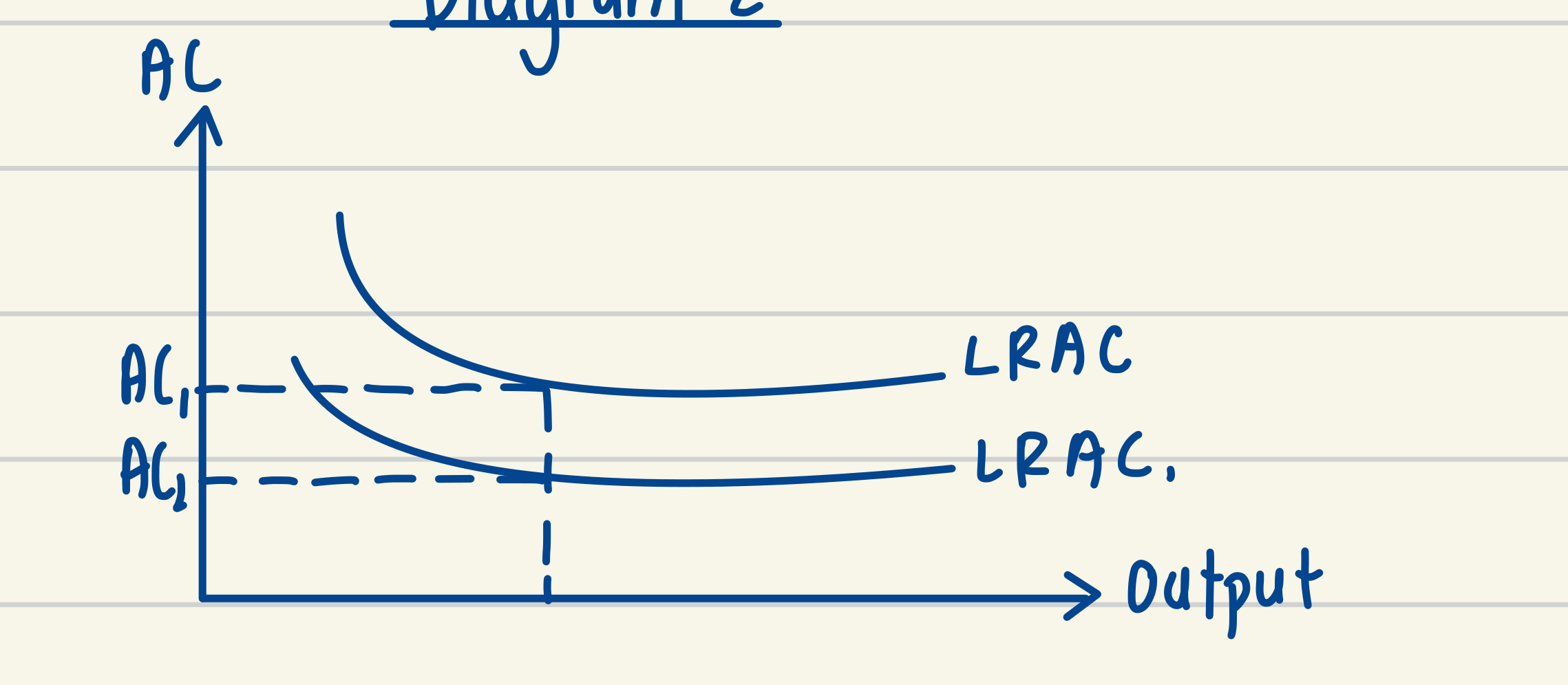
This is what a cartel puts at risk, and it is worth being precise about which movement it is. Economies of scale are a movement ALONG a single long-run average cost curve: the firm gets bigger and slides down the curve it already has. Dynamic efficiency is the whole curve shifting DOWN, from LRAC to LRAC1, so that average cost is lower at every output including the one the firm already produces.
The diagram shows the second. Innovation, better technology and better production methods move the curve itself, and the gap between AC1 and AC2 at an unchanged output is the gain. A cartel does not remove economies of scale, but it removes the competitive pressure that funds and forces the shift, so the lower curve never arrives. Writing "the firm moves down its LRAC" when you mean the curve has shifted is one of the commonest ways to lose the analysis mark here.
- Stability of price and income for producers, which is the argument members make in their own defence, and which has some force where the alternative is violently fluctuating commodity prices.
6. Integrated analysis and common traps
6.1 A complete chain
Two of the four supermarket chains in a country propose to merge, giving the combined firm a 45 per cent market share.
Analysis: this is horizontal integration. The combined firm gains buying power over suppliers and can spread fixed costs of distribution and IT over more stores, lowering long-run average cost. With four firms reduced to three and a 45 per cent share, the five-firm concentration ratio rises and tacit coordination becomes easier.
Evaluation: whether consumers lose depends on contestability. If entry by discounters is credible and switching costs are low, the merged firm cannot raise price far. The cost savings may be passed on in lower prices if competition remains, and retained as profit if it does not. The competition authority's decision therefore turns on entry conditions rather than on the share alone.
6.2 Common examination errors
- Calling every takeover horizontal integration without checking the stage of production.
- Confusing backward with forward vertical integration. Backward goes towards the supplier.
- Treating a merger and a takeover as identical. A merger is agreed, a takeover need not be.
- Assuming growth always lowers average cost, forgetting diseconomies and integration costs.
- Explaining why small firms survive purely in terms of finance.
- Placing cartels under market structures. Cambridge examines them here, in 7.7.
- Stating that cartels are unstable without explaining the individual incentive to exceed quota.
- Assuming a cartel must include every producer, when it needs only enough combined share to move the price.
7. Paper 3 and Paper 4 mastery
Paper 3 tests: identifying the type of integration from a described deal, selecting the condition a cartel most requires, and identifying why a small firm survives in a concentrated industry.
Paper 4 asks whether growth by merger benefits consumers, or whether a cartel can ever be justified. The reliable structure is to identify the type of integration first, then work through cost effects and competition effects separately, then conclude on entry conditions. For cartels, set the producer-stability argument against the consumer welfare loss and note that the agreement's own instability limits how long either lasts.
Check you have it
Question 1
A government is successful in raising the rate of economic growth.
As a result, which other macro-economic aim would it most likely have achieved in the short run?
Answer: B.
Economic growth means real output is rising, and producing more output requires more labour. Firms take on additional workers, so employment rises and cyclical unemployment falls. This is the most direct and reliable short-run companion to growth, which is why the two objectives are usually treated as complementary.
Why the other options are wrong:
- A, a balance of payments surplus, is unlikely. Growth raises incomes, and part of the increase is spent on imports, so the current account typically worsens as an economy expands.
- C, lower inflation, generally works the other way in the short run. Growth driven by rising aggregate demand pushes the price level up, especially as the economy approaches capacity. Only growth driven by an outward shift of aggregate supply would lower inflation, and that takes longer to arrive.
- D, a stronger exchange rate, is uncertain. Faster growth pulls in imports, which increases the supply of domestic currency on foreign exchange markets and tends to weaken it. Higher interest rates might follow and support the currency, but that is indirect and not assured.
Question 2
In a developing economy, which policy is most likely to increase the rate of economic growth but restrict economic development?
Answer: C.
Question 3
Firms often remain small even when growth could result in technical economies of scale. What is not a likely reason for this?
Answer: C.
8. Final checklist
A fully prepared learner can:
- give at least six reasons why small firms survive alongside large ones, and relate size to minimum efficient scale against market size;
- distinguish internal from external growth and state the advantages of each;
- define horizontal, vertical (forward and backward) and conglomerate integration and classify an example correctly;
- state at least five reasons for integration and the consequences for the firm and for consumers;
- explain why horizontal integration attracts the most regulatory attention;
- define a cartel and list at least six conditions for it to be effective;
- explain why cartels are unstable using the individual incentive to exceed quota; and
- evaluate the consequences of a cartel for producers and consumers.

Related CIE 9708 topics
Not the topic you were looking for? Describe what you are stuck on in your own words and we will take you to the notes that answer it.