Reasons for Government Intervention in Markets
Contents: 25 sections
Cambridge International AS & A Level Economics 9708
The topic asks why governments may intervene. Topic 3.2 examines the methods used and their effects.
1. The central economic issue
Governments may intervene when unrestricted market outcomes fail to provide certain goods, create consumption levels judged socially undesirable, or produce prices that conflict with objectives such as affordability, producer security or stability.
A complete analysis chain is:
- market outcome
- economic problem
- affected group
- government objective
- possible intervention.
A valid reason for intervention does not guarantee that a policy will work.
2. Government intervention: meaning and scope
Government intervention occurs when the state deliberately influences:
- production;
- consumption;
- prices;
- market access;
- resource allocation.
Possible methods include taxation, subsidies, direct provision, price controls and information. Those methods belong mainly to Topic 3.2.
Reason versus method
- Reason: why government is considering intervention.
- Method: the instrument government uses.
Example:
- affordability is a reason;
- a maximum price is a possible method.
3. Public goods
Definition
A public good is:
- non-rival; and
- non-excludable.
Non-rivalry
One person's consumption does not significantly reduce the benefit available to another person.
Non-excludability
It is difficult or impossible to prevent non-payers from benefiting.
Standard examples
- national defence;
- street lighting;
- flood defences;
- some lighthouse services.
Real-world goods may be mixed cases. Classify them from their characteristics, not from who provides them.
4. The free-rider problem and non-provision
A free rider receives the benefit of a good without paying for it.
Core chain
- non-excludability
- non-payers can benefit
- consumers have an incentive to hide willingness to pay
- private firms cannot reliably collect revenue
- profit incentive is weak or absent
- market non-provision.
Consumers may value flood protection but still wait for others to pay. If many people behave this way, the market does not reveal the true collective benefit.
Why government may intervene
Compulsory taxation can finance collective provision without relying on voluntary payment. The detailed method of direct provision is studied in Topic 3.2.
5. Public goods are not free goods
A free good is abundant relative to demand and has no opportunity cost.
A public good is defined by non-rivalry and non-excludability, but it still uses scarce resources and has an opportunity cost.
National defence uses labour, equipment, land and finance. It is therefore an economic good, not a free good.
6. Government-provided goods are not automatically public goods
State education and healthcare are not normally pure public goods because:
- places and staff time are limited;
- access can be restricted;
- one person's use may reduce availability for others.
They are often analysed as merit goods or publicly provided private services.
7. Merit goods and under-consumption
Definition
A merit good is a good or service considered under-consumed in a free market relative to the quantity judged desirable for individuals or society.
Examples may include:
- education;
- healthcare;
- vaccinations;
- preventive screening;
- libraries.
Causes of under-consumption
Imperfect information
Consumers may underestimate long-term benefits.
Short-term decision-making
Immediate cost or inconvenience may outweigh future gain in the consumer's decision.
Low income
Consumers may understand the benefit but be unable to afford the market price.
Wider social benefits
Consumption may benefit people other than the direct consumer.
Core chain
- benefits underestimated or good unaffordable
- market demand too low
- consumption below the preferred level
- potential private and social benefits are lost
- government considers intervention.
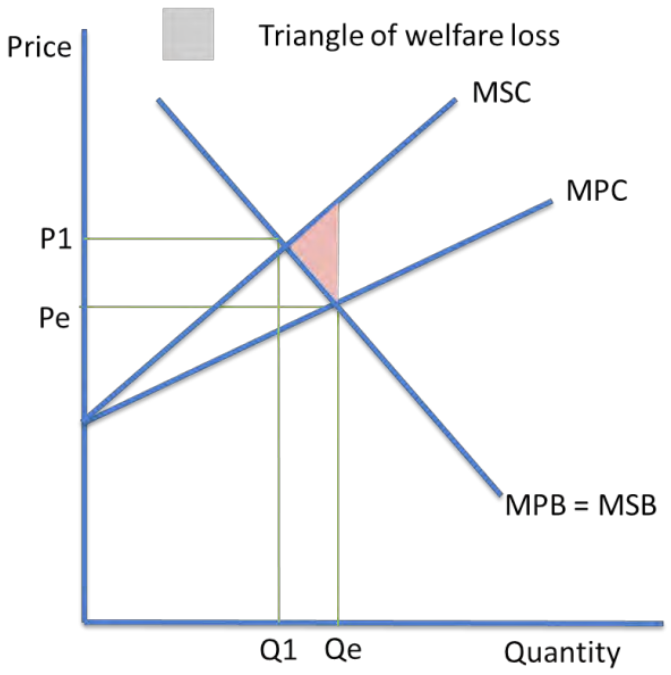
8. Demerit goods and over-consumption
Definition
A demerit good is a good or service considered over-consumed in a free market relative to the quantity judged desirable for individuals or society.
Examples may include:
- cigarettes;
- alcohol;
- gambling services;
- highly harmful or addictive products.
Causes of over-consumption
- consumers underestimate long-term cost;
- imperfect information;
- addiction and habit;
- short-term gratification;
- wider costs imposed on society.
Core chain
- costs underestimated or addiction affects decisions
- market demand too high
- consumption above the preferred level
- avoidable private and social costs
- government considers intervention.
9. Merit and demerit classifications involve value judgements
The classification is partly normative. Governments and societies may disagree about:
- which products qualify;
- the socially desirable quantity;
- the balance between freedom and protection;
- the appropriate strength of intervention.
Evidence can inform the judgement but cannot remove every value judgement.
The case for intervention is stronger when:
- information failure is severe;
- harm is large or irreversible;
- children or vulnerable consumers are affected;
- a targeted policy is available at reasonable cost.
It may be weaker when informed adults bear mainly private costs or policy is poorly targeted.
10. Why governments may control prices
The syllabus requires the reasons for controlling prices. Detailed maximum- price, minimum-price and buffer-stock effects are studied in Topic 3.2.
Main objectives include:
- improving affordability;
- protecting consumers;
- supporting producer income;
- maintaining employment and strategic capacity;
- reducing damaging price instability.
11. Reasons to limit high prices
A government may consider price restraint when a market price is judged too high.
Affordability of essentials
Examples may include housing, energy, medicines, basic food and transport.
- market price rises
- low-income consumers cannot afford sufficient quantity
- access falls and hardship rises
- government seeks to restrain price.
Consumer protection
Government may believe sellers possess strong market power or consumers have few alternatives.
Emergencies
During war, disaster or severe shortage, government may seek to prevent extreme prices for necessities.
Evaluation preview
A lower controlled price may create excess demand and shortages. This is an effect of the method, studied in Topic 3.2.
12. Reasons to support low prices
Government may seek to prevent a producer price falling below a chosen level.
Producer income
This may matter when prices are volatile and producers face high fixed costs or uncertain output.
- market price collapses
- producer revenue and income fall
- firms or farms may exit or reduce investment
- employment and future supply decline
- government considers price support.
Regional employment
A price collapse in a major regional industry may cause business failure and local unemployment.
Strategic capacity
Government may wish to maintain domestic production for food security, energy security or national resilience.
Evaluation preview
Supporting prices may generate surpluses and public cost.
13. Reasons to stabilise prices
Some markets, especially agricultural commodity markets, experience large price fluctuations due to:
- variable weather and harvests;
- changing global conditions;
- inelastic demand;
- inelastic short-run supply.
Volatility can make it difficult for:
- consumers to budget;
- producers to plan investment;
- workers to maintain stable income;
- governments to maintain food security.
The objective may be a more predictable price range rather than permanently high or low prices. Buffer-stock schemes are one method studied in Topic 3.2.
14. Equity and efficiency
Equity rationale
Government may wish to improve fairness and access, for example by making an essential good more affordable.
Efficiency rationale
Government may wish to avoid public-good non-provision or correct a quantity of merit or demerit consumption judged inefficient.
The objectives can conflict. A low controlled price may improve affordability for successful buyers but create shortages and weaken supply incentives.
15. Positive and normative reasoning
Positive questions
- Is the public good privately provided?
- How large is under- or over-consumption?
- Which consumers cannot afford the market price?
- How volatile has the producer price been?
Normative questions
- What quantity should society prefer?
- Which price is unfair?
- How much personal freedom should be restricted?
- Which producers should be protected?
Government intervention combines factual analysis with value judgements.
16. A reason does not prove effectiveness
Government should also consider:
- the size of the problem;
- whether the cause is understood;
- whether the policy targets the cause;
- administrative cost;
- opportunity cost of public funds;
- information available to government;
- unintended consequences.
Market failure can create a reason to consider intervention, but government action can still fail to improve the outcome.
17. Integrated examples
Street lighting
- non-rival and non-excludable;
- free-rider problem;
- inadequate private revenue;
- reason: address public-good non-provision.
Childhood vaccination
- benefits may be underestimated;
- low income may restrict access;
- wider society may benefit;
- reason: address merit-good under-consumption.
Cigarettes
- addiction and imperfect information;
- long-term health costs may be underestimated;
- reason: address demerit-good over-consumption.
Urban rents
- high market rents may exclude low-income households;
- reason: improve affordability and access.
Agricultural prices
- volatile or low prices may threaten producer income and future supply;
- reason: support or stabilise prices.
18. Comparison table
| Problem | Why it occurs | Government objective |
|---|---|---|
| Public-good non-provision | Non-excludability and free riding weaken revenue | Ensure collective provision |
| Merit-good under-consumption | Benefits underestimated or consumers cannot afford it | Raise consumption |
| Demerit-good over-consumption | Costs underestimated, addiction or short-term decisions | Reduce consumption |
| High essential price | Low-income consumers lose access | Improve affordability |
| Low producer price | Income, employment and future supply threatened | Support production |
| Price volatility | Demand and supply shocks create uncertainty | Stabilise prices |
19. Common exam traps
- Government-provided does not automatically mean public good.
- Public good does not mean free good.
- Merit good does not mean public good.
- Demerit goods are not necessarily illegal.
- A maximum price is a method, not a reason.
- A minimum price is a method, not a reason.
- Public-good non-provision is caused by the payment problem, not zero value.
- Merit-good under-consumption can arise from low income as well as information.
- Price control may create disequilibrium.
- Merit and demerit classifications contain value judgements.
- Intervention uses scarce resources and has opportunity cost.
- A valid reason does not guarantee a successful policy.
20. Paper 1 technique
Ask:
- Is the problem non-provision?
- Is non-excludability creating free riding?
- Is consumption judged too low or too high?
- Is the price concern affordability, producer income or stability?
- Is the answer option a reason or merely a policy instrument?
21. Paper 2 model responses
Explain public-good non-provision [6]
A public good is non-rival and non-excludable. Non-excludability means non-payers cannot easily be prevented from benefiting. Consumers may therefore free ride and conceal willingness to pay. A private firm cannot reliably collect sufficient revenue to cover costs, leading to non-provision and a reason for government intervention.
Explain merit-good under-consumption [4]
Consumers may underestimate long-term benefits because of imperfect information. Some consumers may understand the benefit but be unable to afford the market price. Demand and consumption are therefore below the level considered socially desirable.
Explain demerit-good over-consumption [4]
Consumers may underestimate long-term costs, lack information or be affected by addiction and short-term gratification. Demand and consumption are therefore above the level considered socially desirable.
Discuss whether government should always intervene in a demerit-good market
For intervention:
- imperfect information;
- addiction;
- large or irreversible harm;
- effects on vulnerable consumers;
- wider costs.
Evaluation:
- consumer freedom;
- normative classification;
- enforcement and administrative costs;
- poor targeting;
- substitution or illegal markets;
- informed adults may bear mainly private costs.
Judgement:
Intervention is strongest where evidence of serious information failure or harm is clear and a proportionate policy can improve decisions at reasonable cost.
22. Active recall
- State the three official reasons in Topic 3.1.
- Define non-rivalry.
- Define non-excludability.
- Explain the free-rider problem.
- Why may a public good face non-provision?
- Why is a public good not a free good?
- Define a merit good.
- Give three causes of merit-good under-consumption.
- Define a demerit good.
- Give three causes of demerit-good over-consumption.
- Why are merit and demerit labels partly normative?
- Why might government restrain a high price?
- Why might government support a low price?
- Why might government stabilise prices?
- Distinguish a reason from a method.
- Give one equity reason for intervention.
- Give one efficiency reason for intervention.
- Why does a valid reason not prove policy success?
23. One-minute revision
Public goods
- non-excludability
- free riding
- inadequate private revenue
- non-provision.
Merit goods
benefits underestimated or unaffordable → under-consumption.
Demerit goods
costs underestimated, addiction or short-term decisions → over-consumption.
Price control reasons
- affordability and consumer protection;
- producer-income and employment support;
- strategic supply;
- price stability.
Check you have it
Question 1
Why might governments provide free education for children aged 4 to 16 years old?
Answer: A.
Education is a merit good. Households underestimate the private benefit, higher lifetime earnings, better health, wider opportunity, partly because those benefits arrive years later and are hard to assess when the decision is made for a child. Expressed demand is therefore below informed demand, and a free market would leave consumption below the socially optimal level. Providing education free at the point of use removes the price barrier and raises consumption towards the optimum. There are positive externalities too: a better-educated workforce raises productivity for everyone, so social benefit exceeds private benefit.
Why the other options are wrong:
- B reverses the direction. Merit goods are under-consumed in a free market, which is the reason for intervening at all.
- C misclassifies education as a public good. It is rival (finite classroom places) and excludable (fees can be charged), so free-riding is not the problem.
- D would make education not worth buying for the individual at all, which is false, private returns to schooling are large and positive. The problem is that consumers undervalue those returns, not that they do not exist.
Question 2
Governments provide public goods.
What is an example of a public good?
Answer: A.
Question 3
What is not an example of a public good?
Answer: A.
A public good must be both non-rival and non-excludable, and education fails both tests. It is rival, because a place in a classroom taken by one child is not available to another and teacher attention is finite. It is excludable, because a school can charge fees and turn away non-payers, private schools do exactly that. Since a supplier can charge and does face rivalry in consumption, the market can supply education, which is why it is a merit good rather than a public good.
Why the other options are wrong:
- B, C and D all satisfy both conditions. Flood defences protect every property behind them regardless of who paid; national defence protects all citizens simultaneously; a street light illuminates the road for one more passer-by at no cost and cannot be switched off for non-payers. In each case free-riding makes private provision unprofitable.
The common error is to reason from who pays rather than from the two properties: education is often government-funded, and that tempts students to file it as a public good. Funding is a policy choice; non-rivalry and non-excludability are characteristics of the good.
Best evaluation point
A reason for intervention does not guarantee that intervention will improve the market outcome.
What the syllabus asks for on this topicOfficial syllabus coverage · Product mastery map
Official syllabus coverage
Students must understand intervention for the purpose of:
- 3.1.1 addressing the non-provision of public goods;
- 3.1.2 addressing the over-consumption of demerit goods and the under-consumption of merit goods;
- 3.1.3 controlling prices in markets.
Product mastery map
- identify public-good characteristics;
- explain free riding and non-provision;
- explain merit-good under-consumption;
- explain demerit-good over-consumption;
- explain affordability and consumer-price objectives;
- explain producer-price support and price stability;
- evaluate the rationale for intervention and distinguish reasons from methods.
Related CIE 9708 topics
Not the topic you were looking for? Describe what you are stuck on in your own words and we will take you to the notes that answer it.