Resource Allocation in Different Economic Systems
Contents: 31 sections
The topic in one question
Who decides what, how and for whom to produce, and what are the consequences of that method of decision-making?
Every economic system must allocate scarce resources. The systems differ in:
- who owns productive resources;
- who makes decisions;
- how information is communicated;
- which incentives guide behaviour;
- how income and output are distributed;
- how much freedom consumers and firms possess;
- the role of government.
The economic-systems spectrum
Economic systems are best viewed as a spectrum.
``text Greater market coordination Greater state coordination Private ownership Public ownership Decentralised decisions Central planning Price mechanism Administrative allocation Market economy -------------- Mixed economy -------------- Planned economy ``
Modern economies are normally mixed. The distinction concerns the degree and form of market and government involvement.
A country should not be labelled purely market or purely planned merely because:
- some firms are private;
- the government owns one industry;
- taxes are high;
- prices are regulated in one market.
Classification depends on the overall pattern of ownership, coordination and decision-making.
1. Essential definitions
| Term | Examination-ready definition |
|---|---|
| Economic system | The institutions and mechanisms through which an economy makes decisions and allocates scarce resources. |
| Market economy | An economy in which most resources are privately owned and decisions are largely coordinated through demand, supply and the price mechanism. |
| Planned economy | An economy in which the state owns or controls a large share of resources and a central authority makes major production and allocation decisions. |
| Mixed economy | An economy in which both market forces and government decisions influence resource allocation, with both private and public ownership. |
| Price mechanism | The process through which changes in demand and supply alter prices, creating signals and incentives that allocate resources. |
| Consumer sovereignty | The idea that consumers influence what is produced through their purchasing decisions. |
| Profit motive | The incentive for firms and entrepreneurs to make decisions that increase profit. |
| Central planning | The use of a government or planning authority to set production priorities, targets and resource allocations. |
| Private sector | Organisations owned by private individuals or shareholders. |
| Public sector | Organisations owned or controlled by government. |
| Nationalisation | Transfer of an enterprise or industry from private to public ownership. |
| Privatisation | Transfer of an enterprise or asset from public to private ownership. |
2. The three allocation questions revisited
Every system must decide:
What to produce?
- Which goods and services?
- Consumer or capital goods?
- Healthcare or luxury goods?
- Defence or education?
- Present consumption or future investment?
How to produce?
- Labour-intensive or capital-intensive methods?
- Private firms or public enterprises?
- Renewable or non-renewable energy?
- Domestic or imported inputs?
- High-cost sustainable methods or cheaper polluting methods?
For whom to produce?
- According to ability and willingness to pay?
- According to need?
- According to contribution to production?
- Through universal public provision?
- Through rationing or waiting lists?
The economic system determines how these answers are reached.
3. Market economy
Examination-ready definition
A market economy is an economy in which most productive resources are privately owned and decisions are coordinated mainly through demand, supply and the price mechanism.
Core characteristics
A market economy normally contains:
- private property;
- private enterprise;
- decentralised decision-making;
- consumer choice;
- competition;
- profit-seeking firms;
- flexible market prices;
- limited direct state production;
- factor incomes such as wages, rent, interest and profit.
"Limited government" does not mean no government. Even strongly market-oriented economies need legal institutions to support:
- property rights;
- contracts;
- competition;
- consumer protection;
- money;
- public order.
Who makes decisions?
Consumers
Consumers choose:
- what to purchase;
- how much to purchase;
- where to purchase;
- whether to save.
Their spending communicates information about demand.
Firms and entrepreneurs
Firms choose:
- what to produce;
- production methods;
- employment;
- investment;
- price;
- market entry and exit.
They respond to expected revenue, cost and profit.
Resource owners
Workers, landowners and capital owners decide how to supply their resources, subject to constraints.
Government
Government may provide a legal framework and limited services, but does not centrally direct most production in a theoretical market economy.
4. The price mechanism
Examination-ready definition
The price mechanism is the process through which demand and supply interact to determine prices, and those prices create signals and incentives that allocate resources.
The mechanism performs three closely related functions:
- signalling;
- incentive;
- rationing.
Some textbooks also identify a transmission function: price changes transmit information between buyers and sellers. This is captured within signalling.
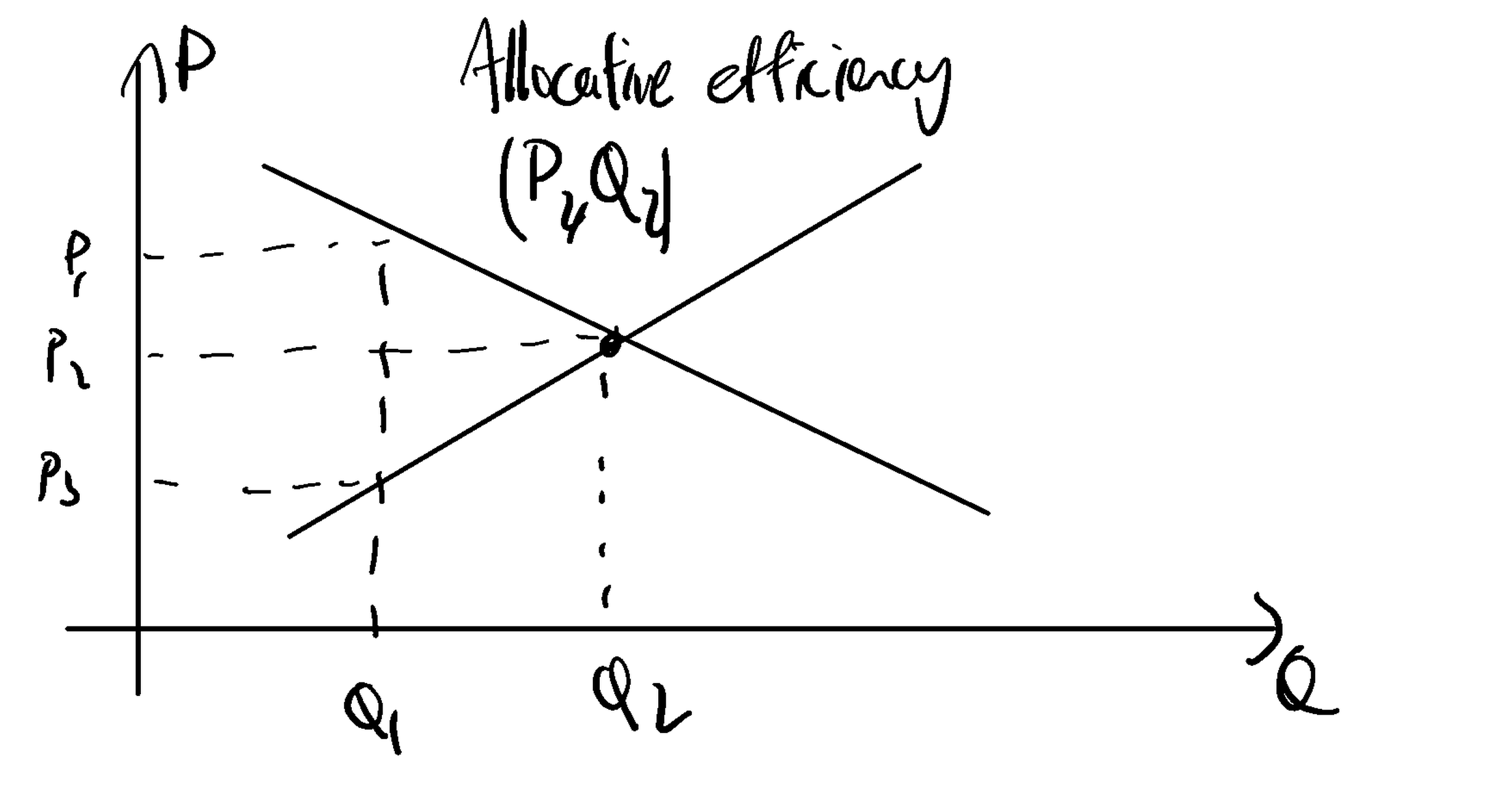
The diagram is the case for the mechanism in one picture, and the useful detail is that both wrong prices give the same answer. At the higher price P1 producers would supply plenty but consumers only want Q1; at the lower price P3 consumers want plenty but producers only offer Q1. Either way the quantity actually traded is Q1, short of Q2.
Only at P2 does the amount people are willing to pay for the last unit equal the cost of producing it, which is what allocative efficiency means. That is the standard against which the planned economy later in this topic is judged, so it is worth fixing here rather than treating it as a separate idea.
4.1 Signalling function
Prices communicate information about relative scarcity and demand.
Example:
- Demand for electric bicycles rises
- price tends to rise
- firms receive a signal that consumers value additional production.
A falling price may signal:
- weaker demand;
- excess supply;
- lower scarcity;
- reduced profitability.
4.2 Incentive function
Higher prices and expected profit can encourage firms to:
- increase output;
- enter the market;
- invest;
- move resources from other uses;
- innovate.
Analytical chain:
- Increased demand
- upward pressure on price
- potential profit rises
- firms expand supply
- labour and capital move into the market.
Consumers also receive incentives:
- Higher price
- greater opportunity cost of purchasing the product
- quantity demanded may fall or consumers seek substitutes.
4.3 Rationing function
Scarce goods are allocated to consumers who are willing and able to pay the market price.
When demand exceeds available supply, price tends to rise. Some consumers:
- reduce quantity demanded;
- leave the market;
- purchase substitutes.
The limited supply is rationed through price.
Critical evaluation
Price rationing reflects ability and willingness to pay, not necessarily:
- need;
- social value;
- fairness;
- urgency.
A wealthy consumer may purchase a luxury property while a low-income household cannot afford adequate housing. The price mechanism has allocated resources, but the outcome may be inequitable.
5. Resource allocation in a market economy
What to produce?
Consumer demand and expected profit strongly influence output.
- Greater demand and willingness to pay
- stronger revenue opportunity
- firms direct resources towards the product.
This is linked to consumer sovereignty.
Limit to consumer sovereignty
Consumers influence production only where they possess purchasing power.
Their choices may also be affected by:
- advertising;
- imperfect information;
- habit;
- monopoly power;
- limited alternatives.
Firms may influence demand rather than simply obey it.
How to produce?
Firms seek methods that help achieve their objectives, commonly profit.
They compare:
- wages;
- machinery costs;
- productivity;
- reliability;
- quality;
- regulation;
- energy prices.
Competition may encourage lower-cost methods.
However, private cost minimisation may ignore external costs such as pollution unless these are priced or regulated.
For whom to produce?
Output is largely distributed through market purchasing power.
Income is earned from ownership and supply of factors:
- wages from labour;
- rent from land;
- interest from capital;
- profit from enterprise.
Those with greater income and wealth can command more market output.
The outcome may reflect productivity and scarcity, but can also reproduce:
- inherited wealth;
- unequal opportunity;
- discrimination;
- market power.
6. Advantages of a market economy
6.1 Consumer choice
Consumers can often choose between:
- products;
- firms;
- qualities;
- prices.
Competition may expand variety.
6.2 Responsiveness
Changing prices provide rapid information.
- Demand rises
- price and profit signals change
- firms respond without waiting for a central instruction.
6.3 Incentives
Private gain can motivate:
- effort;
- investment;
- enterprise;
- innovation;
- risk-taking;
- cost reduction.
6.4 Competition and efficiency
Competitive pressure may encourage firms to:
- reduce waste;
- improve quality;
- lower costs;
- respond to consumers.
Firms that consistently fail to satisfy consumers may lose sales or exit.
6.5 Innovation
Potential profit can reward firms that develop:
- new products;
- improved production methods;
- new business models.
6.6 Decentralised information
Millions of decisions can be coordinated without one authority collecting every piece of information.
Prices combine dispersed information about:
- preferences;
- scarcity;
- costs;
- expectations.
6.7 Flexibility
Resources may move between uses as relative prices and profitability change.
7. Disadvantages of a market economy
7.1 Inequality
Market incomes and wealth may be distributed very unequally.
The market answers "for whom" according to purchasing power rather than need.
7.2 Under-provision of public goods
Some goods may not be profitably provided because non-payers cannot easily be excluded.
Public goods are studied fully in Topic 1.6.
7.3 External costs and benefits
Market prices may not include effects on third parties.
Examples:
- pollution;
- congestion;
- vaccination spillovers;
- education benefits.
This can cause resource misallocation.
7.4 Merit and demerit goods
Imperfect information may lead to:
- under-consumption of beneficial goods;
- over-consumption of harmful goods.
These are developed in Topic 1.6.
7.5 Monopoly power
Weak competition may allow firms to:
- raise prices;
- reduce output;
- limit choice;
- earn persistent excess profit;
- weaken innovation.
7.6 Instability
Market economies may experience:
- unemployment;
- inflation;
- financial crises;
- volatile investment;
- regional decline.
7.7 Short-termism
Firms and investors may favour short-term returns over:
- long-term infrastructure;
- resilience;
- environmental sustainability;
- basic research.
7.8 Imperfect information
Consumers and firms may make poor decisions because information is:
- incomplete;
- expensive;
- misleading;
- asymmetric.
7.9 Duplication and waste
Competing firms may duplicate:
- advertising;
- distribution;
- unused capacity;
- research.
Competition can improve performance but may also use resources in socially unproductive ways.
8. Planned economy
Examination-ready definition
A planned economy is an economy in which the state owns or controls a large share of productive resources and a central authority makes major decisions about production and allocation.
Other terms include:
- centrally planned economy;
- command economy.
"Command economy" can imply stronger administrative control. For examination purposes, Cambridge commonly contrasts a free market economy with a centrally planned economy.
Core characteristics
A planned economy commonly has:
- extensive public ownership;
- central production targets;
- administrative resource allocation;
- government-controlled prices and wages;
- limited private enterprise;
- prioritisation of state objectives;
- restricted consumer sovereignty;
- production according to a national plan.
The precise degree of planning varies.
Who makes decisions?
A planning authority may decide:
- quantities to produce;
- industrial priorities;
- investment;
- employment;
- input allocations;
- prices;
- wages;
- distribution rules;
- imports and exports.
Public enterprises implement the plan.
Consumers and workers may still make some choices, but these choices have less influence over overall resource allocation than in a market economy.
9. Resource allocation in a planned economy
What to produce?
Government planners determine priorities.
Possible priorities include:
- basic food;
- housing;
- healthcare;
- education;
- heavy industry;
- defence;
- infrastructure;
- capital goods.
The government may deliberately sacrifice present consumer goods to expand future productive capacity.
How to produce?
Planning authorities can determine:
- production methods;
- factory locations;
- resource inputs;
- employment levels;
- technology;
- scale;
- environmental standards.
Decisions may be based on:
- national strategy;
- full employment;
- regional development;
- security;
- output targets.
They may not reflect the least-cost method if incentives and information are weak.
For whom to produce?
Distribution may be based more heavily on:
- assessed need;
- state priorities;
- equal access;
- fixed prices;
- rationing;
- public provision;
- occupational status.
This can reduce the role of ability to pay, but political influence or bureaucratic privilege may still create inequality.
10. Administrative allocation
Without market prices playing the central coordinating role, planners may use:
- output quotas;
- material allocations;
- licences;
- waiting lists;
- ration coupons;
- fixed prices;
- investment budgets;
- employment assignments;
- import controls.
Example:
A steel ministry may allocate tonnes of steel to construction, transport and defence according to the plan.
The method can coordinate national priorities, but requires extensive information.
11. Advantages of a planned economy
11.1 Ability to prioritise basic needs
Government can direct resources towards:
- healthcare;
- education;
- housing;
- essential food;
- rural services.
Provision need not depend solely on profitability.
11.2 Greater equality
The state can:
- set wages;
- provide universal services;
- limit private accumulation;
- distribute necessities.
This may reduce market-income inequality.
11.3 Strategic coordination
Central planning can coordinate:
- infrastructure;
- energy systems;
- industrial development;
- defence;
- regional policy.
Large interdependent projects may be easier to align.
11.4 Long-term planning
The government can prioritise projects with:
- long payback periods;
- large external benefits;
- strategic importance.
11.5 Full-employment objective
State enterprises may maintain employment even where it is not immediately profitable.
This may protect income and communities, though it can reduce productivity.
11.6 Control of harmful production
The state can restrict products or methods considered socially harmful.
11.7 Reduced duplication
A single coordinated provider may avoid some competitive duplication.
Whether this is a gain depends on whether the provider remains efficient.
12. Disadvantages of a planned economy
12.1 Information problem
A central authority must estimate:
- millions of consumer preferences;
- input availability;
- local conditions;
- changing technology;
- opportunity costs.
Information may be:
- delayed;
- inaccurate;
- manipulated;
- too detailed to process.
A planner may know the target number of shoes but not the preferred sizes, styles, locations or quality.
12.2 Weak consumer signals
Fixed prices and production quotas may not accurately reveal changing demand.
This can create:
- shortages;
- surpluses;
- queues;
- unwanted varieties;
- poor quality.
12.3 Weak incentives
Managers and workers may have less incentive to:
- reduce costs;
- improve quality;
- innovate;
- take risks;
- respond to consumers.
This depends on the reward and accountability system.
12.4 Bureaucracy and delay
Decisions may require approval through several administrative levels.
This can reduce flexibility.
12.5 Limited choice and freedom
Consumers may face restricted:
- product variety;
- employment choice;
- business formation;
- location choice.
12.6 Political priorities
Resources may be allocated according to:
- political prestige;
- military objectives;
- regime stability;
- bureaucratic interests.
State decision-making is not automatically identical to social welfare.
12.7 Soft budget constraints
A public enterprise may expect government support if it makes losses.
This can reduce pressure to:
- control cost;
- close inefficient capacity;
- improve productivity.
12.8 Innovation problems
Innovation may be weaker when:
- rewards are limited;
- failure is punished;
- competition is absent;
- decision-makers avoid risk.
However, planned systems can mobilise major scientific projects when political priority and resources are strong.
12.9 Measurement and target distortion
Managers may focus on achieving the measured target rather than the true social objective.
Example:
If a factory is rewarded for producing tonnes of nails; it may make nails that are unnecessarily heavy.
13. Mixed economy
Examination-ready definition
A mixed economy is an economy in which both market forces and government decisions influence resource allocation, and both private and public ownership exist.
Most contemporary economies are mixed.
Why mixed economies exist
Neither markets nor governments allocate every resource perfectly.
Mixed economies attempt to use:
- market signals and private incentives;
- government correction, provision and redistribution.
The balance differs by:
- country;
- period;
- political priorities;
- sector;
- crisis conditions.
Mixed does not mean exactly 50:50
A mixed economy can be:
- predominantly market-oriented;
- relatively state-directed;
- different across sectors.
Example:
- smartphones may be allocated mainly through markets;
- emergency healthcare may be publicly provided;
- electricity may be privately produced but tightly regulated;
- education may contain public and private providers.
Forms of government involvement
Government can influence allocation through:
- taxation;
- subsidies;
- regulation;
- price controls;
- direct provision;
- public ownership;
- welfare payments;
- competition policy;
- environmental policy;
- information;
- public investment.
Detailed methods are examined later.
Forms of market involvement
Private firms may:
- produce goods and services;
- invest;
- innovate;
- employ labour;
- set prices;
- compete for consumers;
- respond to profit.
14. Resource allocation in a mixed economy
What to produce?
Some output responds to consumer demand and profit.
Other output reflects government priorities.
Example:
- restaurants respond mainly to market demand;
- vaccination programmes may be publicly organised;
- defence is determined mainly by government.
How to produce?
Private firms choose methods within:
- laws;
- taxes;
- subsidies;
- labour standards;
- environmental rules.
Public enterprises may follow commercial and social objectives.
For whom to produce?
Some products are allocated by price.
Others are allocated:
- free at the point of use;
- at subsidised prices;
- according to eligibility;
- according to need;
- through welfare transfers.
15. Advantages of a mixed economy
15.1 Combines market information with public objectives
Markets can coordinate everyday consumer choices while government addresses areas where markets perform poorly.
15.2 Retains incentives and enterprise
Private ownership and profit can encourage:
- innovation;
- investment;
- responsiveness;
- efficiency.
15.3 Provides essential services
Government can provide or finance:
- healthcare;
- education;
- infrastructure;
- security;
- social protection.
15.4 Redistribution
Taxes and transfers can reduce extreme inequality.
15.5 Regulation
Government may reduce:
- monopoly abuse;
- pollution;
- unsafe products;
- misleading information.
15.6 Stabilisation and resilience
Government can intervene during:
- recession;
- financial crisis;
- pandemic;
- natural disaster;
- energy emergency.
16. Disadvantages and tensions in a mixed economy
16.1 Government failure
Intervention may fail because of:
- poor information;
- political incentives;
- bureaucracy;
- regulatory capture;
- unintended consequences;
- administrative cost.
16.2 Reduced market incentives
High or badly designed taxes and regulations may weaken:
- investment;
- enterprise;
- work incentives;
- innovation.
The effect depends on design and context.
16.3 Conflicting objectives
A public enterprise may be expected to:
- keep prices low;
- employ workers;
- earn profit;
- invest;
- provide universal service.
These objectives may conflict.
16.4 Regulatory uncertainty
Frequent policy changes can make investment planning more difficult.
16.5 Boundary disputes
There is continuing debate over:
- what government should provide;
- what should be privately produced;
- how much redistribution is desirable;
- how much regulation is efficient.
16.6 Both failures can coexist
A mixed economy may experience:
- market failure;
- government failure;
- inequality;
- bureaucracy;
- monopoly;
- political distortion.
"Mixed" is not automatically optimal. Outcomes depend on institutional quality and policy design.
17. Comparing the three systems
| Feature | Market economy | Planned economy | Mixed economy |
|---|---|---|---|
| Main ownership | Private | State/public | Both |
| Main coordinator | Price mechanism | Planning authority | Markets plus government |
| What to produce | Consumer demand and profit | State priorities and plan | Demand, profit and public priorities |
| How to produce | Firms choose based on costs and objectives | Planners set methods and targets | Firms choose within regulation; state may produce |
| For whom | Purchasing power and factor income | State allocation, need or rationing | Price plus public provision and redistribution |
| Consumer choice | Usually high | Usually more restricted | Varies by sector |
| Private enterprise | Central | Limited | Important but regulated |
| Equality | May be low | May be higher in formal distribution | Redistribution can moderate inequality |
| Responsiveness | Often relatively fast | May be slower | Depends on market and public institutions |
| Information | Decentralised through prices | Collected administratively | Both systems of information |
| Incentives | Profit, wages, property rights | Targets, public duty, administrative rewards | Market and public incentives |
| Main risks | Market failure and inequality | Information, incentive and bureaucracy problems | Both market and government failure |
18. Evaluation criteria
Students should not evaluate systems using only "good" and "bad."
Use criteria.
Allocative efficiency
Are resources directed towards the combination of output that best satisfies preferences and social needs?
Productive efficiency
Is output produced at low opportunity cost with minimal waste?
Dynamic efficiency
Does the system encourage:
- innovation;
- investment;
- adaptation?
Equity
How fairly are income, wealth and access to essentials distributed?
Consumer sovereignty
How strongly do consumer choices influence output?
Freedom
How much freedom exists to:
- consume;
- work;
- invest;
- create firms;
- own property?
Stability
Can the system manage:
- unemployment;
- inflation;
- crises;
- strategic shortages?
Sustainability
Does it account for:
- pollution;
- resource depletion;
- future generations?
Information
How well does the system collect and communicate local, changing information?
Incentives
Do decision-makers have reasons to:
- work;
- save;
- invest;
- innovate;
- reduce waste?
Administrative cost
How expensive and complex is coordination?
Institutional quality
Does the economy have:
- rule of law;
- capable public administration;
- competition;
- transparency;
- accountable government?
A system's performance depends heavily on institutions.
19. No system is automatically best
A strong judgement is conditional.
Market allocation may work particularly well when:
- consumers are well informed;
- competition is strong;
- property rights are clear;
- external effects are small;
- goods are excludable;
- income distribution is acceptable.
State allocation may be particularly useful when:
- services are essential;
- public goods are involved;
- external benefits are large;
- strategic coordination is required;
- universal access is a priority;
- long-term investment is needed.
Mixed allocation may work well when:
- market incentives are preserved;
- intervention targets genuine failures;
- regulation is predictable;
- public administration is capable;
- policies are evaluated and corrected.
Sector-specific judgement
It may be misleading to ask which system is best for every activity.
A plausible conclusion may distinguish:
- competitive consumer goods;
- healthcare;
- defence;
- infrastructure;
- utilities;
- innovation;
- environmental protection.
20. Ownership is not the same as allocation method
This is an important nuance.
A privately owned firm may be:
- heavily regulated;
- paid by government;
- operating under a fixed-price contract.
A publicly owned firm may:
- charge market prices;
- compete with private firms;
- pursue profit.
Therefore, ownership and allocation are connected but not identical.
Students should identify:
- who owns;
- who decides;
- which incentives operate;
- how output is distributed.
21. Nationalisation and privatisation
These terms indicate movement along the mixed-economy spectrum.
Nationalisation
Transfer from private to public ownership.
Possible reasons:
- universal access;
- strategic control;
- natural monopoly;
- coordination;
- national security.
Possible concerns:
- weak incentives;
- political interference;
- budget pressure.
Privatisation
Transfer from public to private ownership.
Possible reasons:
- stronger efficiency incentives;
- competition;
- private investment;
- reduced fiscal burden.
Possible concerns:
- monopoly power;
- inequality of access;
- profit placed above service;
- underinvestment without regulation.
These policies are explored more fully later. Here they illustrate that the mix can change over time.
22. Integrated examples
Example 1: Smartphones
In a market-oriented allocation:
- consumers choose brands;
- firms compete;
- prices signal demand;
- profit encourages innovation;
- output goes to those willing and able to pay.
Potential strength:
- rapid innovation and variety.
Potential weakness:
- unequal access;
- environmental waste;
- market power;
- persuasive advertising.
Example 2: Emergency healthcare
Pure price allocation may exclude low-income patients.
State provision can allocate treatment according to medical need.
Potential strength:
- universal access and external benefits.
Potential weakness:
- waiting lists;
- budget constraints;
- bureaucratic allocation;
- weak consumer choice.
A mixed system may combine:
- public funding;
- private providers;
- regulated prices;
- universal eligibility.
Example 3: Housing
Market allocation:
- prices signal scarcity;
- high prices encourage construction;
- housing goes to those able to pay.
Problems:
- low-income exclusion;
- planning constraints;
- speculative demand;
- homelessness.
Government may use:
- social housing;
- subsidies;
- regulation;
- infrastructure;
- planning policy.
Each method changes incentives and may produce unintended effects.
Example 4: Energy transition
Markets can encourage renewable investment when prices and profit support it.
Government may be needed because of:
- pollution externalities;
- network infrastructure;
- long-term uncertainty;
- strategic coordination.
A mixed approach may combine:
- private investment;
- carbon pricing;
- subsidies;
- public grids;
- regulation.
23. Common misconceptions and Cambridge-style traps
Trap 1: A market economy has no government
Even market systems require legal and institutional support.
Trap 2: Government ownership automatically means a fully planned economy
A mixed economy can contain public enterprises.
Trap 3: Mixed means exactly half market and half state
The balance varies by country, sector and time.
Trap 4: Market allocation means resources go to those who need them most
Price rationing reflects ability and willingness to pay.
Trap 5: Planned economies make no use of prices
Prices may exist, but may be administratively fixed and play a weaker coordinating role.
Trap 6: Central planning guarantees equality
Formal distribution may be more equal, but political privilege and shortages may remain.
Trap 7: Profit always means social benefit
Profit reflects private revenue and cost, which may exclude external effects.
Trap 8: Planning always prevents waste
Planning may reduce duplication but create surpluses, shortages or target distortion.
Trap 9: Markets always maximise consumer welfare
Outcomes depend on competition, information, externalities and income distribution.
Trap 10: Government intervention always corrects market failure
Intervention can create government failure.
Trap 11: Consumer sovereignty is absolute
Purchasing power, advertising and market power limit it.
Trap 12: Public provision must be publicly produced
Government can finance a service delivered by private providers.
Trap 13: Ownership alone identifies the economic system
Decision-making and coordination mechanisms also matter.
Trap 14: A system should be judged only by efficiency
Equity, freedom, stability, sustainability and resilience also matter.
24. Paper 1 technique
Questions commonly test:
- characteristics of each system;
- who makes decisions;
- functions of the price mechanism;
- consumer sovereignty;
- profit motive;
- ownership;
- advantages and disadvantages;
- system classification from a scenario;
- allocation of what/how/for whom.
Quick classification method
Market
Look for:
- private ownership;
- flexible prices;
- profit;
- competition;
- consumer demand.
Planned
Look for:
- state ownership;
- production targets;
- fixed prices;
- administrative allocation;
- planning authority.
Mixed
Look for:
- private markets plus taxes, regulation, public provision or public ownership.
Price mechanism method
- information communicated
- signalling
- firms encouraged to expand
- incentive
- some consumers excluded by higher price
- rationing.
25. Paper 2 technique
Explain questions
Define the system, then explain the allocation chain.
Weak:
The market uses prices.
Strong:
Higher consumer demand places upward pressure on price. The higher price signals stronger scarcity and may increase potential profit. Firms have an incentive to expand output, so labour and capital move into the market.
Compare questions
Use the same allocation question for both systems.
Example:
In a market economy, what to produce is influenced by consumer demand and expected profit. In a planned economy, a central authority decides output targets according to state priorities.
Discuss questions
Use explicit criteria.
Possible structure:
- market advantages;
- market limitations;
- planning advantages;
- planning limitations;
- context-specific judgement.
Model four-mark answer
Question:
Explain how the price mechanism allocates more resources to a product whose demand has increased. [4]
Model answer:
Increased demand creates upward pressure on the product's price. The higher price signals to firms that the product has become more scarce relative to demand. It may raise expected profit, giving firms an incentive to increase production. Firms therefore employ more labour and capital in that market, reallocating resources from less profitable uses.
Model comparison answer
Question:
Explain one difference between decision-making in market and planned economies. [4]
Model answer:
In a market economy, production decisions are decentralised and influenced by consumer demand, prices and expected profit. Firms respond to price signals by changing output. In a planned economy, a central authority sets production targets and allocates inputs according to government priorities, so consumer purchasing decisions have less direct influence.
Model evaluative question
Question:
Discuss whether a market economy is more likely than a planned economy to maximise benefits for consumers. [12/20 depending paper format]
Market case
- consumer sovereignty;
- competition;
- choice;
- responsiveness;
- innovation;
- efficiency.
Market limitations
- purchasing power differs;
- monopoly;
- imperfect information;
- externalities;
- public goods;
- inequality.
Planned case
- basic needs;
- universal provision;
- strategic coordination;
- equality.
Planned limitations
- weak signals;
- shortages;
- limited choice;
- weak incentives;
- bureaucracy.
Judgement
Markets may serve consumers effectively where competition is strong and consumers are informed and able to pay. Planning may serve consumers better where essential access, public goods or major external benefits matter. The most convincing conclusion is therefore sector-specific, and a well-designed mixed economy may achieve a better balance than either extreme.
26. Active recall
- Define an economic system.
- Define a market economy.
- Define a planned economy.
- Define a mixed economy.
- What are the three functions of the price mechanism?
- Explain the signalling function.
- Explain the incentive function.
- Explain the rationing function.
- Define consumer sovereignty.
- Why is consumer sovereignty limited?
- How does a market economy decide what to produce?
- How does a planned economy decide what to produce?
- How does a mixed economy decide what to produce?
- Give three advantages of market allocation.
- Give three limitations of market allocation.
- Give three advantages of planning.
- Explain the information problem.
- Explain a weak-incentive problem.
- Why can targets distort behaviour?
- Why is mixed not the same as 50:50?
- Define government failure.
- Why is ownership not identical to allocation?
- Define nationalisation.
- Define privatisation.
- Give a sector where state allocation may be stronger.
- Give a sector where market allocation may be stronger.
- State four criteria for evaluating systems.
- Why is purchasing power different from need?
- How can a shortage arise in a planned system?
- Why might a mixed economy outperform either extreme?
27. One-minute revision
Market economy
- private ownership;
- decentralised decisions;
- price mechanism;
- profit motive;
- consumer sovereignty.
Planned economy
- state ownership or control;
- central targets;
- administrative allocation;
- government priorities.
Mixed economy
- market forces plus intervention;
- private and public sectors;
- allocation varies by sector.
Price mechanism
- signalling;
- incentive;
- rationing.
Main market strength
Prices and profit can coordinate changing information and encourage responsiveness.
Main market weakness
Ability to pay, market failure and inequality can produce socially undesirable allocation.
Main planning strength
Government can coordinate strategic priorities and allocate essentials according to social objectives.
Main planning weakness
Information, incentives and bureaucracy can create shortages, surpluses and weak responsiveness.
Check you have it
Question 1
The transition of centrally planned economies to market economies was accompanied by a significant change in the composition of output. What was an immediate consequence of this transition?
Answer: C.
Question 2
The provision of rail services is switched from the private sector to the public sector. What is necessarily correct?
Answer: C.
Question 3
An economy is changing from a planned economy to a market economy. Which action would be expected during this change?
Answer: C.
Explanation:
When an economy transitions from a planned economy to a market economy, it typically involves the shift from government control over the means of production (nationalisation) to a more privatised system where industries and services are operated by private individuals and companies (privatisation).
Privatisation allows for competition, efficiency, innovation, and better resource allocation - key features of a market economy. It encourages private investment, increases productivity, and often leads to the improvement of services provided to consumers.
Therefore, the replacement of nationalisation by privatisation would be an expected action during this transition. This option reflects a move towards a market-based system that encourages private ownership and free market competition, which are essential components of a market economy.
The other options are not directly related to the transition from a planned economy to a market economy. For example, the replacement of fiscal policy by monetary policy or the replacement of private property rights by common ownership does not inherently define the shift from a planned economy to a market economy. Similarly, the replacement of multinational companies by national companies does not necessarily reflect a move towards a market economy, as market economies typically encourage a mix of domestic and foreign companies to compete in the marketplace.
Strong final judgement
The best allocation method depends on the market, institutional quality and the weight placed on efficiency, equity, freedom and long-term social goals.
What the syllabus asks for on this topicOfficial syllabus coverage · Product mastery map
Official syllabus coverage
Students must understand:
- 1.4.1 decision-making in market, planned and mixed economies;
- 1.4.2 resource allocation in these economic systems.
Product mastery map
The two official syllabus statements are divided into six measurable portal skills:
- decision-making in a market economy;
- decision-making in a planned economy;
- decision-making in a mixed economy;
- resource allocation through the price mechanism;
- resource allocation through state planning;
- comparison and evaluation of economic systems.
Related CIE 9708 topics
Not the topic you were looking for? Describe what you are stuck on in your own words and we will take you to the notes that answer it.