Factors of Production: four questions to try now
Real past-paper questions, the answer key from the mark scheme, and the explanation that goes with it. No account needed to answer them.
Question 1
The change from WX to YZ in a country’s production possibility curve is shown. Y W food O X Z clothes What could have caused this shift?

Answer: D.
Question 2
A country can produce manufactured goods and agricultural products as shown in the diagram. agricultural V products T S Q R O manufactured goods Given this information, which statement is definitely correct?
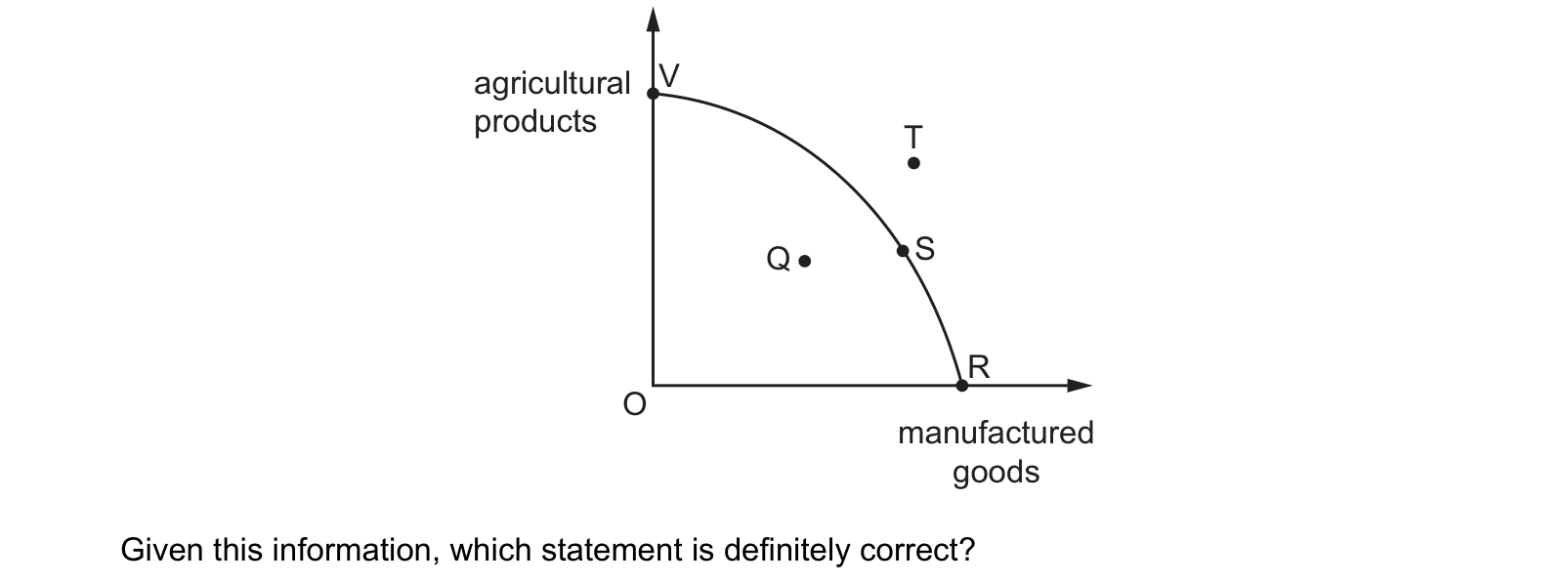
Answer: A.
Question 3
An economist knows the current point at which an economy is operating within its production possibility curve. What can the economist judge from this knowledge about the economy?
Answer: C.
Explanation:
When an economist knows the current point at which an economy is operating within its production possibility curve, they can judge its level of output of two goods. The production possibility curve represents the maximum quantity of two goods that can be produced given the resources and technology available in the economy. The point at which the economy is operating on the curve shows how efficiently resources are being utilised to produce those two goods. If the economy is operating below the curve, it indicates inefficiency or underutilisation of resources, while operating beyond the curve is unattainable with the current resources.
Knowing the current point on the production possibility curve does not provide direct information on the degree of self-sufficiency, international competitiveness, or the rate of economic growth of the economy. These factors depend on various other economic indicators and policies in place apart from the production possibilities of two goods in the economy.
Question 4
Countries X and Y both produce goods M and N. They decide to specialise and trade freely in the goods.
Under which conditions are the gains from specialisation and free trade likely to be smallest?
Answer: C.
Two separate mechanisms shrink the gains here. First, specialisation requires each country to move factors out of one good and into the other. If factors are immobile between goods: workers with the wrong skills, capital that cannot be repurposed, the reallocation is slow and costly, so the theoretical gains from specialising are not realised in practice. Second, if factors are highly mobile between countries, they can simply relocate to wherever they are most productive. Production moves to the factors' new location rather than goods moving between countries, so trade substitutes are available and the specific gains from trade are smaller.
Why the other options are wrong:
- A and B both have high mobility between goods, so each country can reallocate resources easily and capture the gains from specialising.
- D is the most tempting alternative, since low mobility between goods is indeed a limit. But low mobility between countries actually raises the value of trade: when factors cannot move, exchanging goods is the only way to benefit from differences in comparative advantage. C combines the obstacle to specialising with the availability of an alternative to trade, which is the worst of both.
What this practice covers
These questions are drawn from past CIE 9708 papers. You answer, you find out immediately whether you were right, and you get the reasoning for the correct option and for each distractor. Wrong answers go to a mistakes locker so you can come back to exactly those.
Practice is free. You need an account only so your progress and your mistakes are still there next time.
What examiners see students get wrong here
These are the errors that cost marks on factors of production, taken from our own topic notes. Read them before you practise and you will recognise the traps in the questions.
- Money is capital. Incorrect. Money is finance. Capital is the productive asset purchased with finance.
- Capital means every valuable asset. A valuable painting held for enjoyment is not necessarily productive capital.
- Land means only farmland. Land includes all natural resources.
- Labour means only physical work. Labour includes mental and physical effort.
- A worker's skill is physical capital. Skill embodied in the worker is human capital.
- The entrepreneur is simply the manager. Management and enterprise can overlap, but entrepreneurship includes risk and uncertain strategic decision-making.
- Profit is guaranteed. Enterprise may receive profit or suffer loss.
- Division of labour always improves quality. It may improve consistency but may also create boredom, fragmented responsibility and quality problems.
Revise it first
If any of the above is unfamiliar, work through the notes before practising: Factors of Production revision notes.