Fiscal Policy: five questions to try now
Real past-paper questions, the answer key from the mark scheme, and the explanation that goes with it. No account needed to answer them.
Question 1
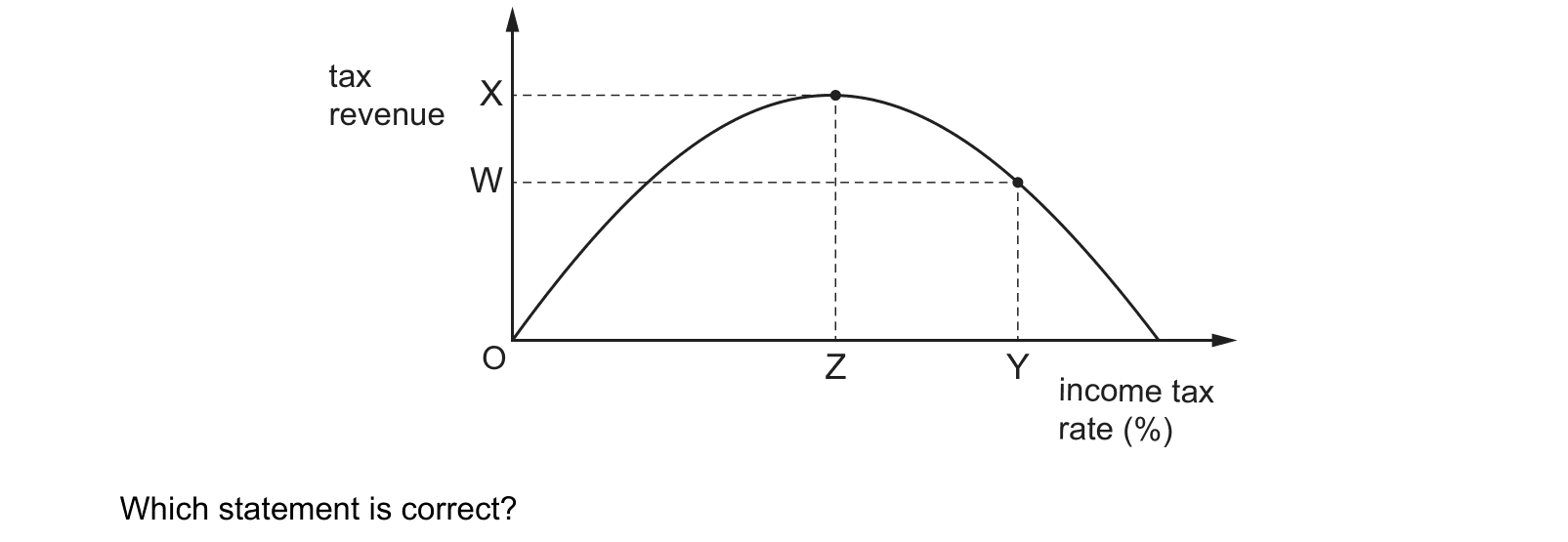
The diagram shows the relationship between the income tax rate and tax revenue. tax revenue income tax rate (%) O X W Z Y Which statement is correct? A
Answer: C.
The diagram is a Laffer curve, and the single rule that answers every option is its shape. Tax revenue is zero at a 0% rate, because nothing is taxed, and zero again at a 100% rate, because nobody works for an income they keep none of. So revenue rises, peaks, and falls. The peak here is at Z, the revenue-maximising rate.
That gives two sides, and they behave in opposite ways. Below Z the curve slopes upward, so raising the rate raises revenue and cutting it lowers revenue. Beyond Z the curve slopes downward, so raising the rate lowers revenue and cutting it raises revenue. C describes the downward-sloping side exactly.
Why the others are wrong.
A says a cut from Y to Z decreases revenue. Y sits beyond Z, on the falling side, so cutting the rate from Y back to Z moves toward the peak and revenue increases to its maximum. A is wrong in the opposite direction to the truth.
B says a cut below Z increases revenue. Below Z you are on the rising side, so a cut moves you down the curve and revenue falls. This is the most tempting distractor, because the phrase "tax cuts can raise revenue" is a real Laffer claim, but it only holds on the far side of the peak. At a rate near zero, cutting further drives revenue toward zero.
D says revenue always increases as the rate increases. That is only true below Z. Beyond Z the curve falls, which is the whole point of drawing it as a curve rather than a straight line.
The trap to remember. Which direction a tax change moves revenue depends entirely on which side of the peak you start from. An answer that says tax cuts raise revenue, without saying the rate must already be above the revenue-maximising rate, has not stated the theory correctly.
Question 2
Changes in fiscal policy can affect the distribution of income and wealth.
Which combination of fiscal policy would most likely be regressive?
Answer: A.
A regressive change takes a larger proportion of income from the poor than from the rich. Both halves of A do this. Lowering the income threshold at which tax becomes payable drags the lowest earners into the tax net for the first time, so people on small incomes now pay tax where before they paid none, a large proportional hit at the bottom. Cutting inheritance tax benefits those with assets to bequeath, who are concentrated at the top. The burden shifts downwards on both counts.
Why the other options are wrong:
- B is progressive. Cheaper doctor visits and higher unemployment benefits both raise the real incomes of the poorest most.
- C is progressive. Higher tax rates at higher income levels take proportionally more from top earners, and corporation tax falls largely on shareholders.
- D is mixed but broadly progressive. A higher standard income tax rate falls on earners in proportion to income, while cutting a goods and services tax helps the poorest most, indirect taxes are regressive because low-income households spend a larger share of income on taxed goods, so reducing one is a progressive move.
Question 3
What would be a positive effect on the growth of an economy in the short run, if the government reduced a direct tax on individual earnings?
Answer: D.
Question 4
Which combination of fiscal and monetary policies is most likely to be effective in the short run to prevent deflation in a closed economy?
Answer: C.
Deflation is a falling price level, caused by deficient aggregate demand. Preventing it requires expansionary policy on both fronts. Increasing the budget deficit, spending more or taxing less, raises aggregate demand directly through government spending and consumption. Cutting the interest rate lowers the cost of borrowing and the reward for saving, so consumption and investment rise. Both instruments push AD outward, which raises the price level and averts deflation. In a closed economy there are no exchange rate or trade effects to complicate the result.
Why the other options are wrong:
- A and B decrease the budget deficit, which is contractionary. Lower spending or higher taxes reduce AD and make deflation worse.
- B and D decrease the money supply, which is contractionary monetary policy. Less money in circulation puts downward pressure on prices, the opposite of what is needed.
- A pairs contractionary fiscal policy with expansionary monetary policy, so the two work against each other.
Question 5
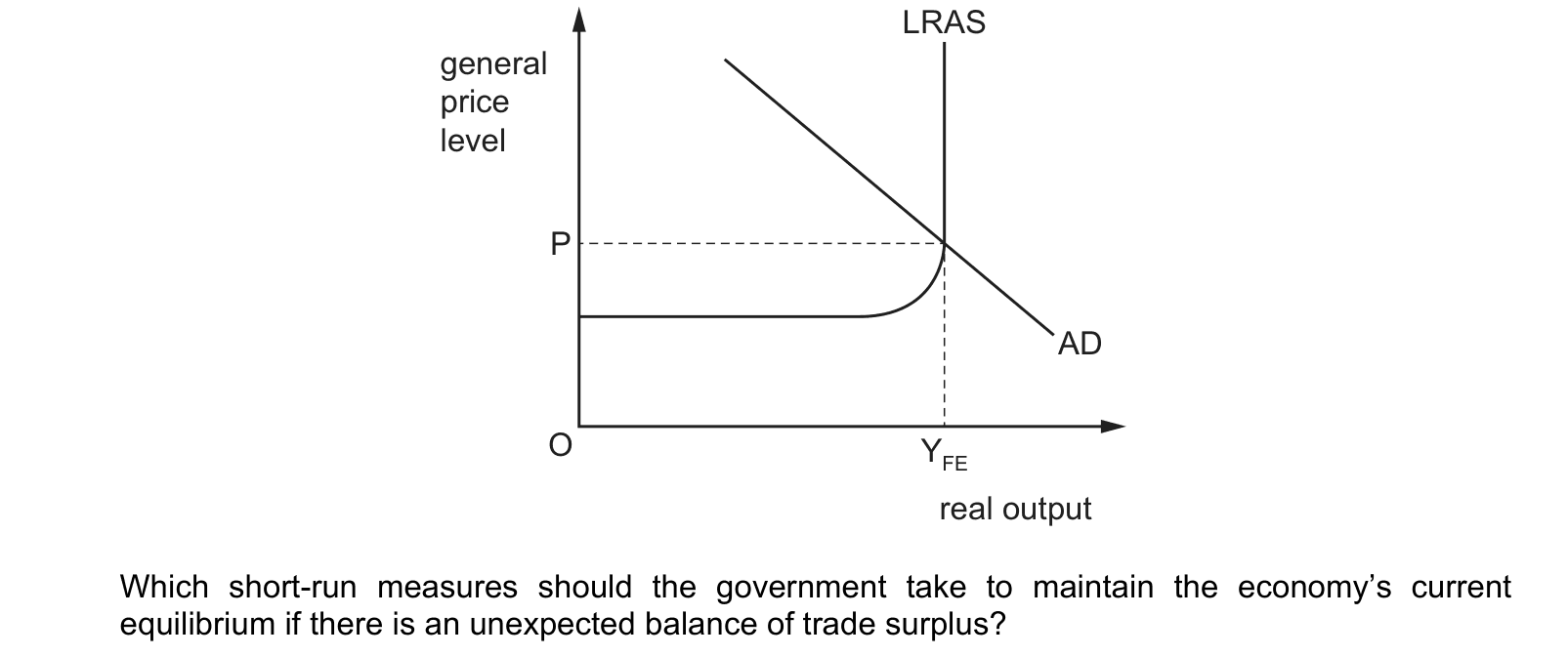
The diagram shows an economy at full employment equilibrium. general price level real output O LRAS AD P YFE Which short-run measures should the government take to maintain the economy’s current equilibrium if there is an unexpected balance of trade surplus?
Answer: B.
To hold the current equilibrium the government must offset that injection with an equal withdrawal, which means a CONTRACTIONARY fiscal stance: higher direct taxation with spending unchanged, running a budget surplus: B.
- A raises spending and taxation together. A balanced-budget change is mildly expansionary, not contractionary, because government spending injects the full amount while higher taxes cut consumption by less than the full amount, part comes out of saving.
- C and D are both expansionary, so each adds to the very pressure that needs offsetting.
What this practice covers
These questions are drawn from past CIE 9708 papers and filtered to fiscal policy. You answer, you find out immediately whether you were right, and you get the reasoning for the correct option and for each distractor. Wrong answers go to a mistakes locker so you can come back to exactly those.
Practice is free. You need an account only so your progress and your mistakes are still there next time.
What examiners see students get wrong here
These are the errors that cost marks on fiscal policy, taken from our own topic notes. Read them before you practise and you will recognise the traps in the questions.
- Deficit equals debt. Wrong: “The national debt is this year’s deficit.” Correct: the deficit is a flow; debt is an accumulated stock.
- A smaller deficit means debt is falling. A smaller positive deficit usually means debt is still rising, just more slowly.
- Progressive means richer people pay more money. Progressive means the average tax rate rises with income.
- Marginal tax rate equals average tax rate. The marginal rate applies to additional income. The average rate applies to total income.
- All government payments are direct G. Transfers affect AD indirectly when recipients spend them.
- Expansionary policy always creates large real growth. Near full capacity, much of the effect may appear as a higher price level.
- Capital spending is always beneficial. The effect depends on project quality, timing, capacity constraints and opportunity cost.
Revise it first
If any of the above is unfamiliar, work through the notes before practising: Fiscal Policy revision notes.