Supply-side Policy: five questions to try now
Real past-paper questions, the answer key from the mark scheme, and the explanation that goes with it. No account needed to answer them.
Question 1
A government decides to borrow from the general public in order to finance its extra spending on apprenticeship training schemes. Which types of macroeconomic policy are being used?
Answer: A.
Take the three in turn against what the government actually did.
Fiscal policy is any deliberate change in government spending or taxation. Here spending rises, so fiscal policy is being used. The fact that it is paid for by borrowing rather than by tax does not change that; borrowing is how the spending is financed, not a separate kind of policy.
Monetary policy means the central bank acting on the interest rate or the money supply. Borrowing from the general public sells bonds to people who already hold the money, so purchasing power is transferred rather than created. No new money enters circulation and the central bank has done nothing, so monetary policy is not being used. This is the step that decides the question, and it is why C and D are wrong: both claim fiscal policy is absent, which cannot be right when government spending has risen.
Supply side policy raises the productive capacity of the economy. Apprenticeship training improves the skills of the workforce, which shifts long run aggregate supply to the right, so supply side policy is being used. B is the trap for anyone who spots the fiscal element and stops there: it treats the training as ordinary spending and misses that what the money buys is productive capacity.
Question 2
A government decides to remove fees for higher education provided by the public sector and the private sector.
What is the consequence of this policy?
Answer: A.
Question 3
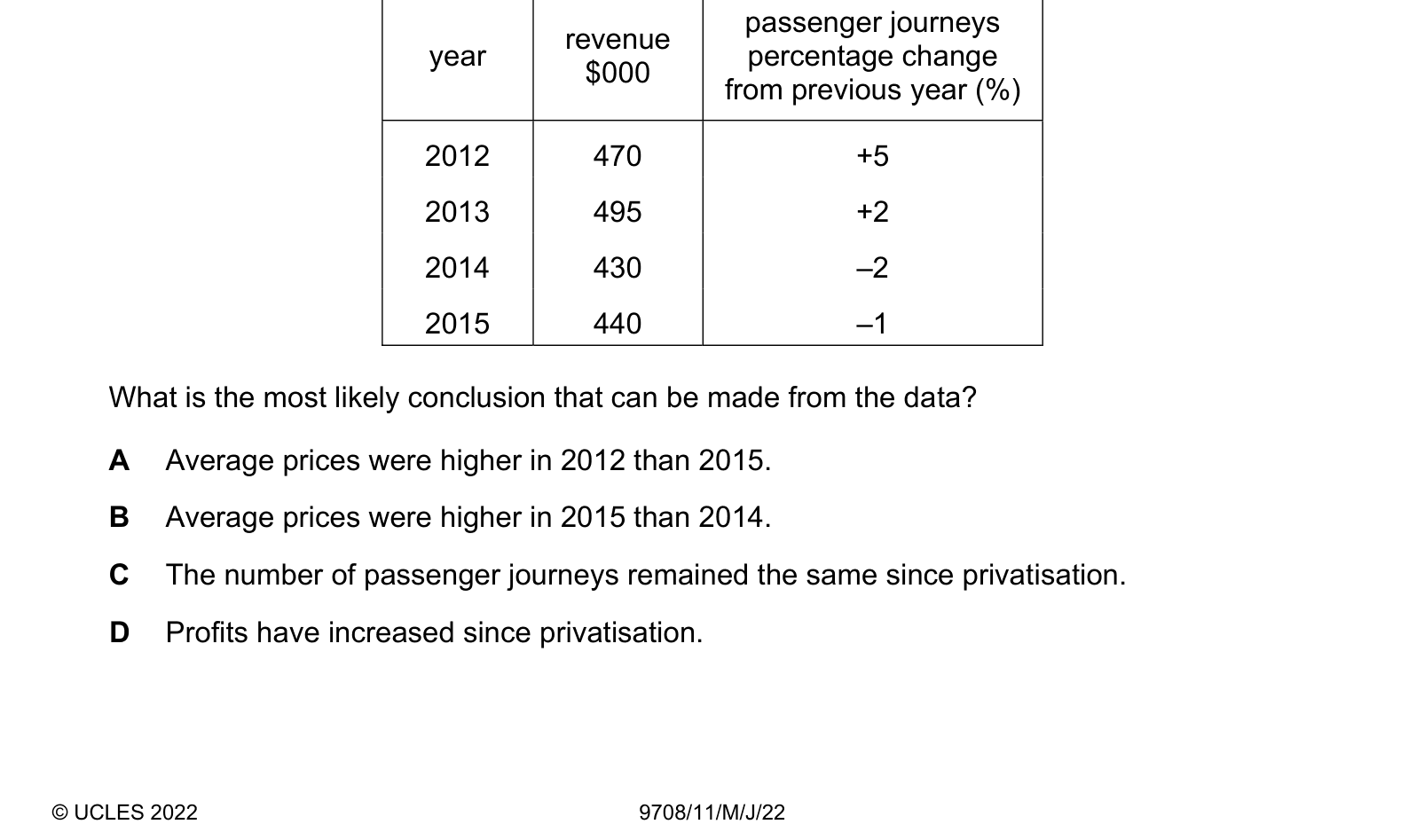
The table shows data from a bus company that was privatised in 2013. year revenue $000 passenger journeys percentage change from previous year (%) 2012 470 +5 2013 495 +2 2014 430 –2 2015 440 –1 What is the most likely conclusion that can be made from the data?
Answer: B.
Explanation:
To determine the average prices or revenue of the bus company, we need to look at the revenue figures provided for each year.
From the data:
- Revenue in 2012: $470,000
- Revenue in 2013: $495,000
- Revenue in 2014: $430,000
- Revenue in 2015: $440,000
Therefore, we can conclude that the average prices in 2015 were higher than in 2014 based on the revenue figures provided. This makes option B the most likely conclusion that can be made from the data.
Question 4
Supply-side policies can be used to correct cost-push inflation. Which policy would best achieve this aim in the long run?
Answer: D.
Explanation:
- Cost-push inflation occurs when the costs of production increase, leading to an increase in prices. Supply-side policies aim to increase the economy's ability to produce goods and services, which can help to reduce inflationary pressures in the long run.
- Increasing productivity through technological advancements and automation can help to reduce the costs of production. By supporting the replacement of labour-manned machines by the use of robots, a country can improve efficiency and reduce labour costs, ultimately lowering the pressure on prices to rise due to increased production costs.
- Allowing trade unions to maintain work practices irrespective of productivity (option A) would not be effective in reducing cost-push inflation as it could prevent necessary changes in the production process to increase efficiency and reduce costs.
- Encouraging workers to work extra hours for extra pay (option B) may not necessarily address the underlying causes of cost-push inflation. It may increase production in the short term but is unlikely to have a significant impact on long-term cost pressures.
- Increasing total labour supply by employing more unskilled workers (option C) may lead to an increase in production but may not address the specific issue of increasing costs contributing to cost-push inflation.
Question 5
Which supply-side measure is most likely to produce short-run growth in a country’s aggregate supply?
Answer: A.
What this practice covers
These questions are drawn from past CIE 9708 papers and filtered to supply-side policy. You answer, you find out immediately whether you were right, and you get the reasoning for the correct option and for each distractor. Wrong answers go to a mistakes locker so you can come back to exactly those.
Practice is free. You need an account only so your progress and your mistakes are still there next time.
What examiners see students get wrong here
These are the errors that cost marks on supply-side policy, taken from our own topic notes. Read them before you practise and you will recognise the traps in the questions.
- “Supply-side policy means increasing supply.” Too vague. Refer to productivity, productive capacity and LRAS.
- Confusing output with productivity. More output from more inputs is not necessarily higher productivity.
- Shifting AD instead of LRAS. Training and technology may affect spending too, but their defining effect is on productive capacity and LRAS.
- Claiming the price level must fall immediately. Many policies have time lags and can raise AD during implementation.
- Treating education as a pure public good. Education is normally a merit good with external benefits, not necessarily non-excludable and non-rival.
- Assuming technology always increases employment. Technology may create jobs, complement labour or replace tasks.
- Importing A Level evaluation as the core answer. At AS, analyse the specified mechanisms and macro outcomes first. Add a concise condition rather than replacing the answer with a broad ideological debate.
Revise it first
If any of the above is unfamiliar, work through the notes before practising: Supply-side Policy revision notes.