Fiscal Policy: five questions to try now
Real past-paper questions, the answer key from the mark scheme, and the explanation that goes with it. No account needed to answer them.
Question 1
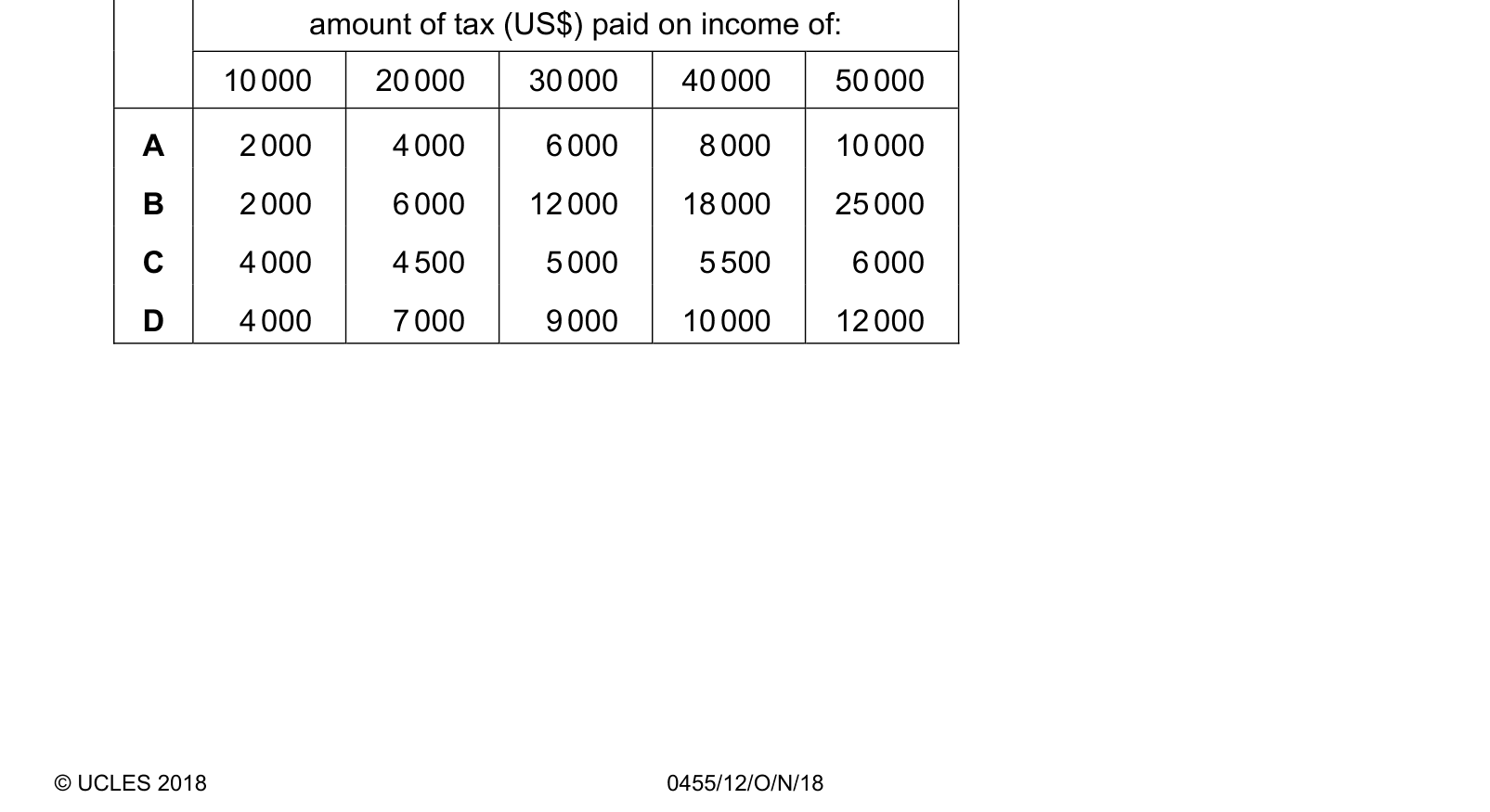
The table shows the amount of tax paid as income rises in four countries, A–D. Which country has a progressive tax? amount of tax (US$) paid on income of:
Answer: B.
A progressive tax takes a larger percentage of income as income rises, so convert every figure into a rate before comparing. In this country the rates run 20%, 30%, 40%, 45% and 50%. The share of income taken increases at every step, which is the definition of progressive taxation.
Why the other options are wrong:
- A pays $2000, $4000, $6000, $8000 and $10 000, which is 20% at every income level. That is a proportional tax.
- C pays $4000, $4500, $5000, $5500 and $6000. The rates fall from 40% down to 12%, so this is strongly regressive: the tax bill rises in money terms while taking an ever smaller share.
- D pays $4000, $7000, $9000, $10 000 and $12 000, giving 40%, 35%, 30%, 25% and 24%. Again the rate falls, so it is regressive.
Question 2
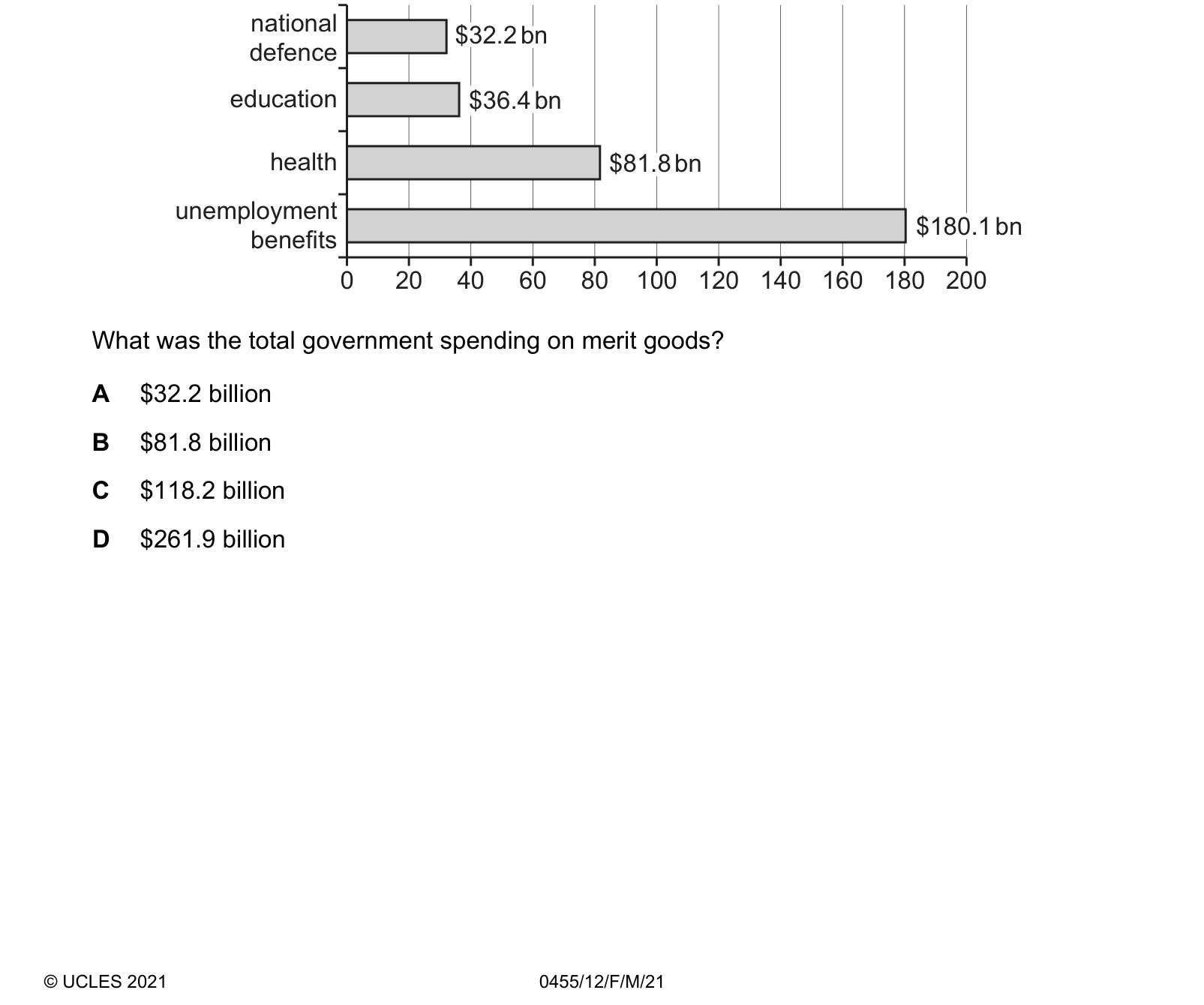
The diagram shows selected areas of government spending for a country. $32.2 $32.2 bn bn $36.4 $36.4 bn bn $81.8 $81.8 bn bn $180.1 $180.1 bn bn
Answer: C.
A merit good is one that benefits the individual who consumes it and also brings wider benefits to society, and which would be under-consumed if left to the market because people undervalue it. Education and health are the standard examples, so the total is $36.4 billion plus $81.8 billion, which is $118.2 billion.
Why the other options are wrong:
- A, $32.2 billion, is national defence. That is a public good, non-excludable and non-rival, which the market would not provide at all rather than merely under-provide.
- B, $81.8 billion, is health on its own and leaves out education.
- D, $261.9 billion, adds health to unemployment benefits. Benefits are a transfer payment: the government moves money from taxpayers to recipients without producing any good or service, so they are not spending on a merit good.
Question 3
One aim of government policy is to redistribute income through taxation in order to reduce
inequality.
Which policy will achieve this aim?
Answer: B.
Question 4
A government decides to boost the economy through the use of a budget deficit. Which target should it adopt to achieve this aim?
Answer: D.
Question 5
A government decides to spend more on defence and cannot spend money on a new airport. Which concepts can be applied to the above statement?
Answer: C.
What this practice covers
These questions are drawn from past Cambridge IGCSE papers and filtered to fiscal policy. You answer, you find out immediately whether you were right, and you get the reasoning for the correct option and for each distractor. Wrong answers go to a mistakes locker so you can come back to exactly those.
Practice is free. You need an account only so your progress and your mistakes are still there next time.
What examiners see students get wrong here
These are the errors that cost marks on fiscal policy, taken from our own topic notes. Read them before you practise and you will recognise the traps in the questions.
- Confusing fiscal policy (government) with monetary policy (central bank).
- Confusing a budget deficit with the national debt.
- Saying a progressive tax means "the rich pay more". They pay a higher percentage.
- Calling VAT progressive because richer people spend more in total. It is regressive as a share of income.
- Ignoring time lags and the opportunity cost of spending.
Revise it first
If any of the above is unfamiliar, work through the notes before practising: Fiscal Policy revision notes.