13 past-paper questions on this unit. Five of them are below. Answer on the page: each one is marked the moment you pick, the correct option is shown whether or not you found it, and the full explanation opens either way.
CIE 0620 ChemistryPaper 1 and Paper 2 MCQsFree account
Experimental design: five questions to try now
Real past-paper questions, the answer key from the mark scheme, and the explanation that goes with it. No account needed to answer them.
Question 1
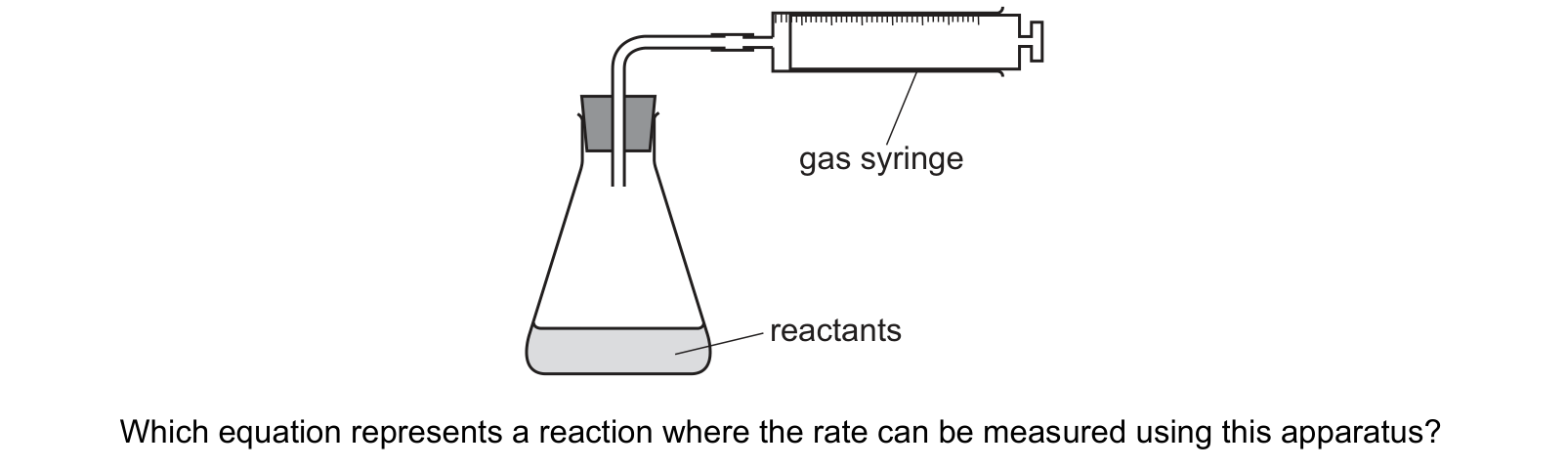
The apparatus shown is used to measure the rate of a reaction. Which equation represents a reaction where the rate can be measured using this apparatus?
Answer: A.
The apparatus is a flask connected to a gas syringe, so it can follow only a reaction that gives off a gas, and the volume collected in the syringe is what is measured against time. Magnesium with hydrochloric acid produces hydrogen, which the syringe collects, so that reaction can be followed. Neutralising hydrochloric acid with sodium hydroxide gives only a salt and water, with no gas at all. Iron displacing copper from copper(II) sulfate produces a solid deposit rather than a gas, and sodium reacting with bromine gives a solid salt, so in both cases the syringe would stay empty.
Question 2
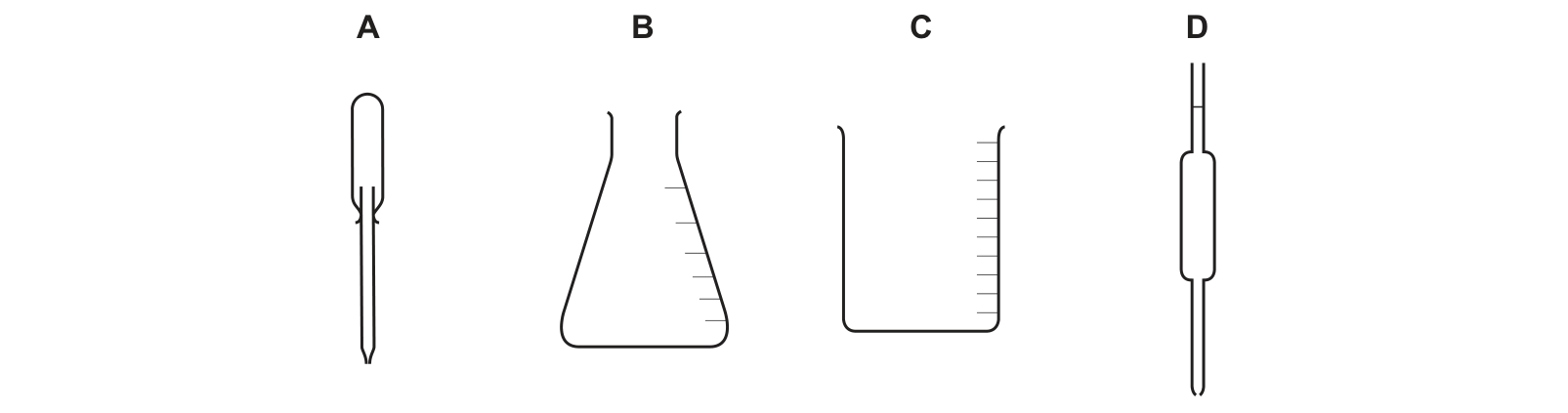
Which piece of apparatus is used to measure 25.0 cm³ of aqueous sodium hydroxide? Use the source image for S20 Paper 12, question 2.
Answer: D.
Measuring 25.0 cm cubed to that precision calls for apparatus calibrated for exactly that volume, and the pipette, drawn as a long tube with a bulb in the middle and a single graduation mark, delivers 25.0 cm cubed every time it is filled to the line. The teat pipette is for adding drops and carries no scale at all. The conical flask has approximate graduations and exists to hold and swirl a reaction mixture rather than to measure it. The beaker is graduated more coarsely still, its markings being only a rough guide, so neither container can give a reliable 25.0 cm cubed.
Question 3
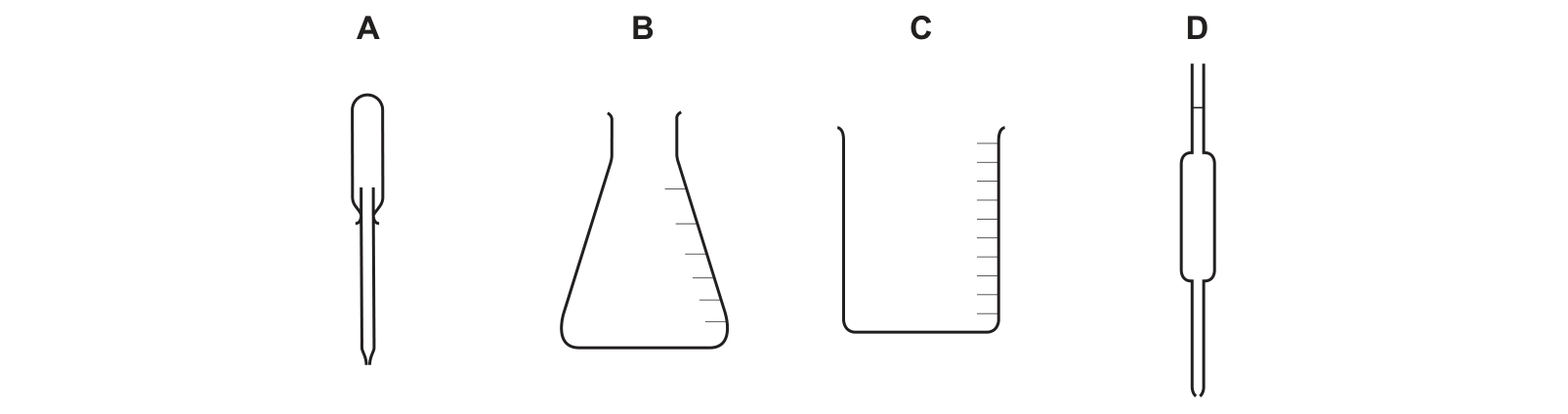
Which piece of apparatus is used to measure 25.0 cm³ of aqueous sodium hydroxide? Use the source image for S20 Paper 22, question 2.
Answer: D.
The volume 25.0 cm cubed is quoted to one decimal place, which rules out any container with rough markings and points to apparatus made for that single volume. The bulb pipette, drawn as a narrow tube widening into a reservoir with one etched line, delivers exactly 25.0 cm cubed when filled to that line. A dropping pipette has no graduations and serves only for adding small amounts drop by drop. The conical flask and the beaker both carry approximate scales meant for estimating volumes, and readings taken from them can easily be several cubic centimetres out.
Question 4
Which two pieces of apparatus are most useful to measure the rate of a reaction in which a gas is given off?
Answer: C.
Rate is a change divided by a time, so any pair of instruments for measuring rate has to supply the size of the change and the time it occupied. Where a gas is given off, a gas syringe measures the volume produced and a stop watch measures the time, so that pair covers both requirements. Pairing an accurate balance with a gas syringe looks plausible because each could measure the amount of change on its own, but neither of them measures time, so no rate can be calculated from them. A balance with a thermometer measures mass and temperature and again leaves time out of the reckoning. A stop watch with a thermometer does supply time, but a thermometer follows temperature rather than how much gas has been made, which is the wrong quantity for this reaction.
Question 5
Which piece of apparatus is used to measure 24.5 cm³ of gas produced during a reaction?
Answer: C.
Measuring gas as it is produced needs apparatus with a graduated scale that the gas can push into, and a measuring cylinder inverted over water does exactly that, letting 24.5 cm cubed be read straight off. A beaker carries only rough graduations intended as a guide, so it could not tell 24.5 apart from 24 or 25, and being open at the top it would let the gas escape anyway. A conical flask has no useful scale at all and serves as a reaction vessel rather than a measuring one. A volumetric pipette is precise but delivers one fixed volume of liquid, so it can neither collect a gas nor report an unknown volume. The half cubic centimetre in the figure is the clue that a graduated scale is wanted rather than a single fixed mark.
These questions are drawn from past CIE 0620 Chemistry papers and filtered to experimental design. You answer, you find out immediately whether you were right, and you get the reasoning for the correct option and for each distractor. Wrong answers go to a mistakes locker so you can come back to exactly those.
Practice is free. You need an account only so your progress and your mistakes are still there next time.
These are the errors that cost marks on experimental design, taken from our own topic notes. Read them before you practise and you will recognise the traps in the questions.
Naming a measuring cylinder where a burette or a pipette is required for an accurate volume.
Recording a burette reading to one decimal place.
Saying a gas syringe is more accurate because it is bigger; the real advantage is that no gas dissolves and none escapes.
Following a reaction by mass loss when the gas produced is hydrogen.
Saying an impurity raises the melting point. It lowers it.
Defining a saturated solution without saying "at that temperature".
Saying a substance is impure because it melts at 122 °C when the book says 122 °C. A sharp value at the book figure is evidence of purity.