8 past-paper questions on this unit. Five of them are below. Answer on the page: each one is marked the moment you pick, the correct option is shown whether or not you found it, and the full explanation opens either way.
CIE 0620 ChemistryPaper 1 and Paper 2 MCQsFree account
Acid-base titrations: five questions to try now
Real past-paper questions, the answer key from the mark scheme, and the explanation that goes with it. No account needed to answer them.
Question 1
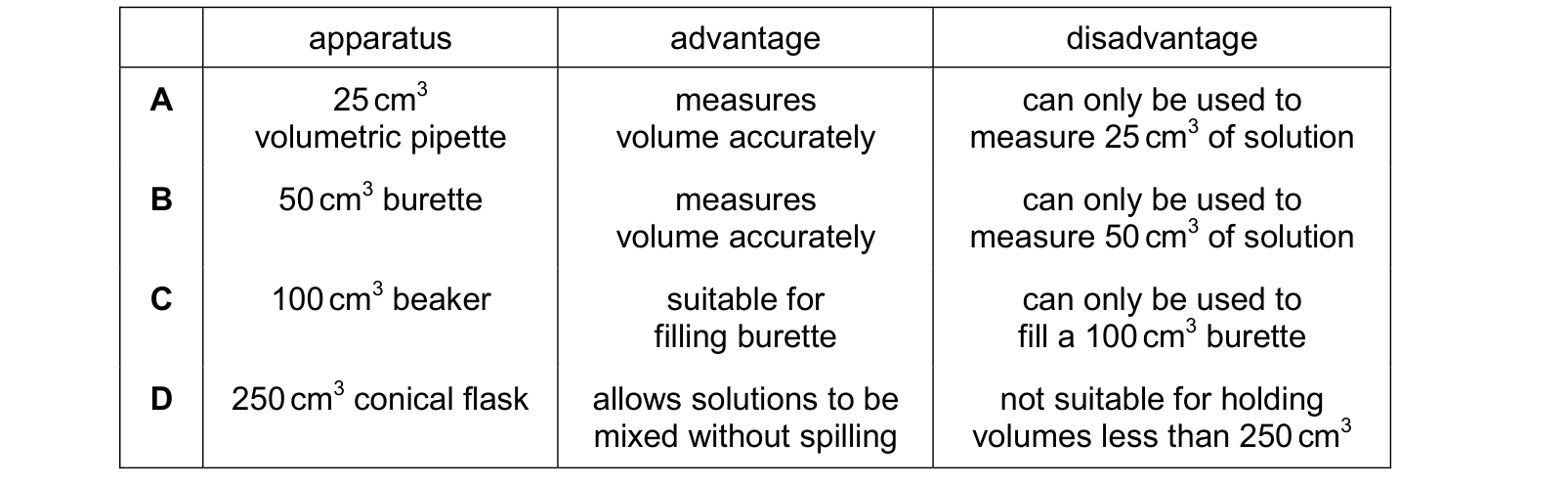
Which row shows an advantage and a disadvantage for the stated apparatus used in a titration? Each answer gives, in order: apparatus; advantage; disadvantage.
Answer: A.
All three columns in each row have to be right, so a true advantage attached to a false disadvantage still sinks the row. A volumetric pipette is accurate precisely because it is calibrated to deliver one particular volume, and being locked to that single volume is genuinely its drawback, so its advantage and its disadvantage are two sides of the same design. The burette row states a true advantage but a false disadvantage, since a 50 cm cubed burette delivers any volume up to 50 cm cubed rather than only 50. The beaker row fails twice over, because a beaker can fill a burette of any capacity and its real weakness is that its graduations are only rough. The conical flask row offers a genuine advantage, since the sloping sides allow swirling without loss, but the claim that it cannot hold less than 250 cm cubed is untrue; 250 is its capacity, not a minimum.
Question 2
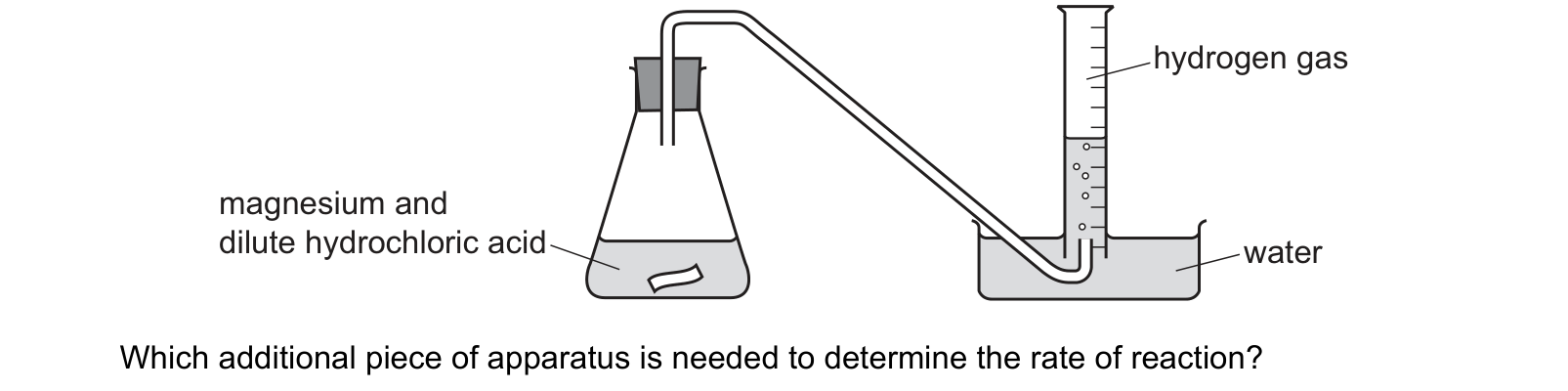
The apparatus used to investigate the rate at which hydrogen gas is given off when a piece of magnesium reacts with dilute hydrochloric acid is shown. Which additional piece of apparatus is needed to determine the rate of reaction?
Answer: C.
Rate is an amount of change divided by the time it takes, so measuring one always needs two quantities and one of them has to be time. The apparatus already collects hydrogen in an inverted measuring cylinder over water, so the volume of gas is being measured, and what is missing is an instrument for the time, which is a stop watch. A balance would allow a different method, following the mass lost as gas escapes, but that means abandoning the gas collection already set up and it still supplies no time. A burette measures volumes of liquid and adds nothing the collecting cylinder does not already give. A volumetric pipette delivers one fixed volume of liquid, which belongs to preparing the reaction rather than to following it.
Question 3
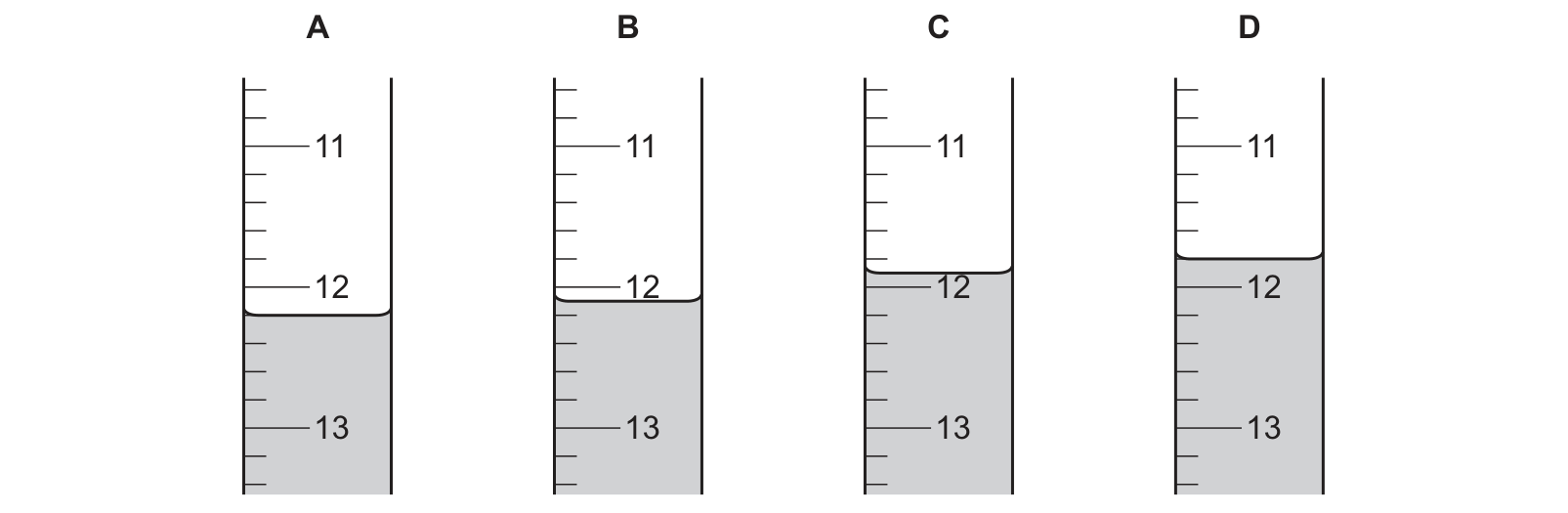
Which burette shows a reading of 12.1 cm3? Use the source image for W22 Paper 13, question 2.
Answer: B.
A burette scale runs downwards, with the numbers increasing towards the tap at the bottom, and the reading is always taken at the bottom of the meniscus. A reading of 12.1 therefore needs the liquid surface just past the 12 mark on the way down to 13, about a tenth of the gap between them. One burette shows the surface further down still, roughly two tenths past 12, which reads as 12.2. Two others show the surface above the 12 mark, which means readings below 12 such as 11.8, and calling either of those 12.1 means reading the scale upwards as though it were a measuring cylinder. Checking which way the numbers run before reading the level is what stops that reversal.
Question 4
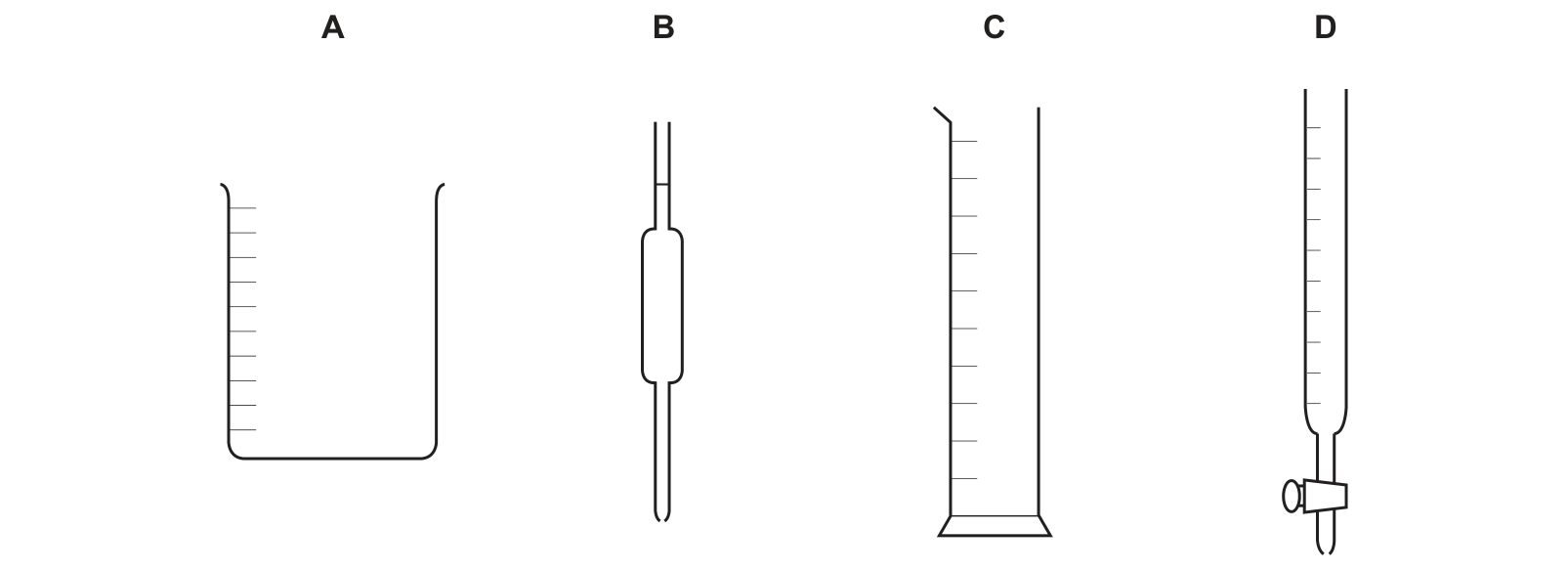
Which diagram shows a burette? Use the source image for W20 Paper 12, question 3.
Answer: D.
A burette is a tall graduated tube fitted at its lower end with the tap that lets liquid run out a little at a time, so the volume delivered can be read from the scale. The drawing with graduations down its length and the tap near the bottom is therefore the burette. The tall graduated tube standing on its own broad base has no tap, so it is a measuring cylinder, and liquid has to be poured from it rather than released in controlled amounts. The narrow tube with a bulb in the middle and a single mark is a pipette, made to deliver one fixed volume. The wide vessel with rough graduations up its side is a beaker, which holds liquid rather than measuring it accurately.
Question 5
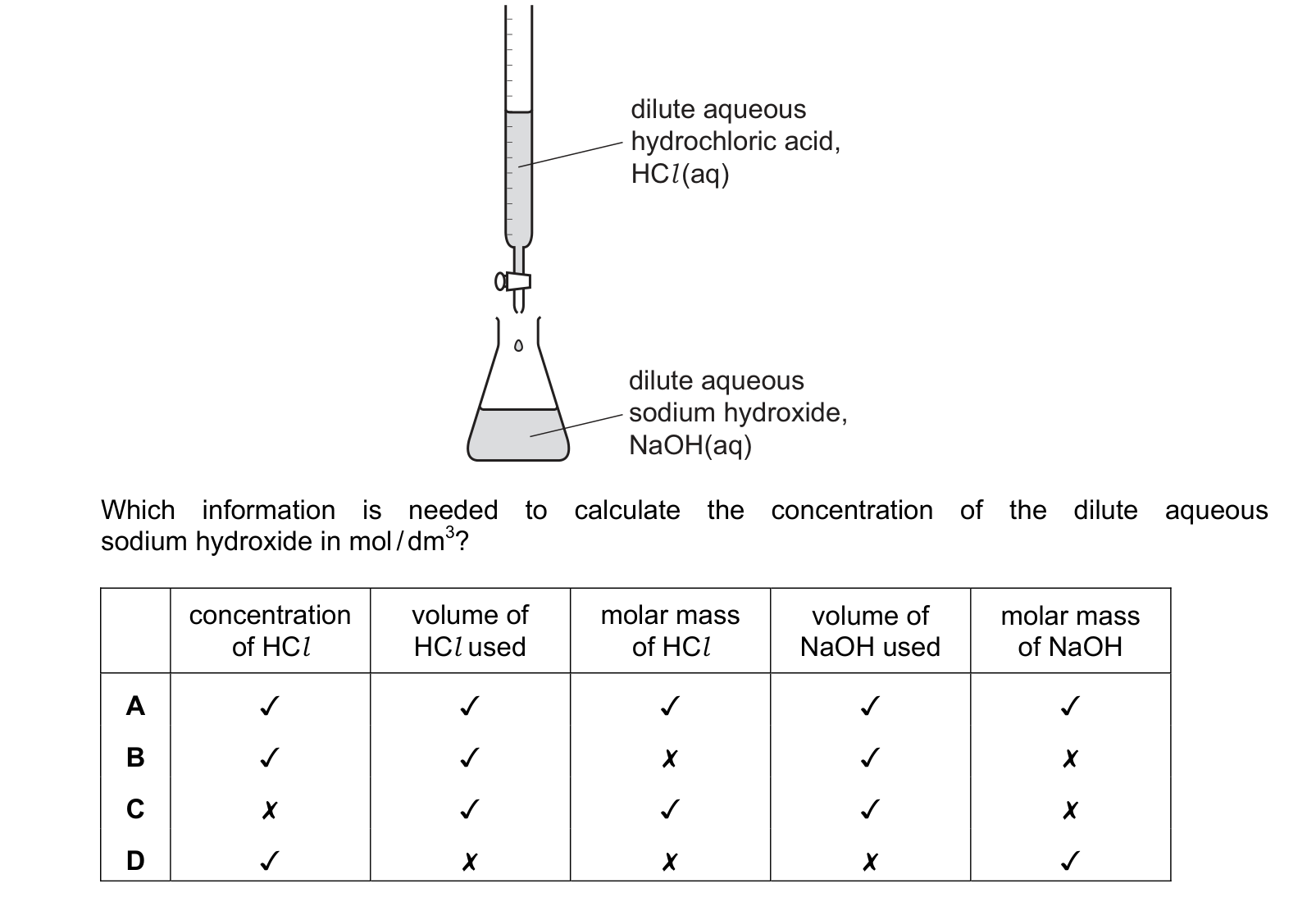
The concentration of a sample of dilute aqueous sodium hydroxide is found by titration. The apparatus used is shown. Which information is needed to calculate the concentration of the dilute aqueous sodium hydroxide in mol / dm3? Use the source image for S23 Paper 22, question 8.
Answer: B.
Concentration in mol per dm cubed comes from moles and volume, so molar masses are needed nowhere in the calculation. What is needed is the concentration of the acid and the volume of acid used, which together give the moles of acid, and then the volume of alkali, which turns those moles into a concentration; that is three ticks and two crosses. The row ticking everything includes the two molar masses, which would only matter if the answer had to be converted into grams per dm cubed. The row leaving out the concentration of the acid removes the one quantity that fixes the scale of the whole calculation.
These questions are drawn from past CIE 0620 Chemistry papers and filtered to acid-base titrations. You answer, you find out immediately whether you were right, and you get the reasoning for the correct option and for each distractor. Wrong answers go to a mistakes locker so you can come back to exactly those.
Practice is free. You need an account only so your progress and your mistakes are still there next time.
These are the errors that cost marks on acid-base titrations, taken from our own topic notes. Read them before you practise and you will recognise the traps in the questions.
Rinsing the burette with distilled water before filling it with acid.
Worrying about water in the conical flask, which does not affect the result.
Recording burette readings to one decimal place instead of two.
Reading the top of the meniscus, or reading it from above.
Adding a whole squirt of indicator instead of 2 or 3 drops.
Leaving an air bubble in the burette jet.
Including the rough titration in the average.
Choosing universal indicator, which gives no sharp end-point.