27 past-paper questions on this unit. Five of them are below. Answer on the page: each one is marked the moment you pick, the correct option is shown whether or not you found it, and the full explanation opens either way.
CIE 0620 ChemistryPaper 1 and Paper 2 MCQsFree account
Separation and purification: five questions to try now
Real past-paper questions, the answer key from the mark scheme, and the explanation that goes with it. No account needed to answer them.
Question 1
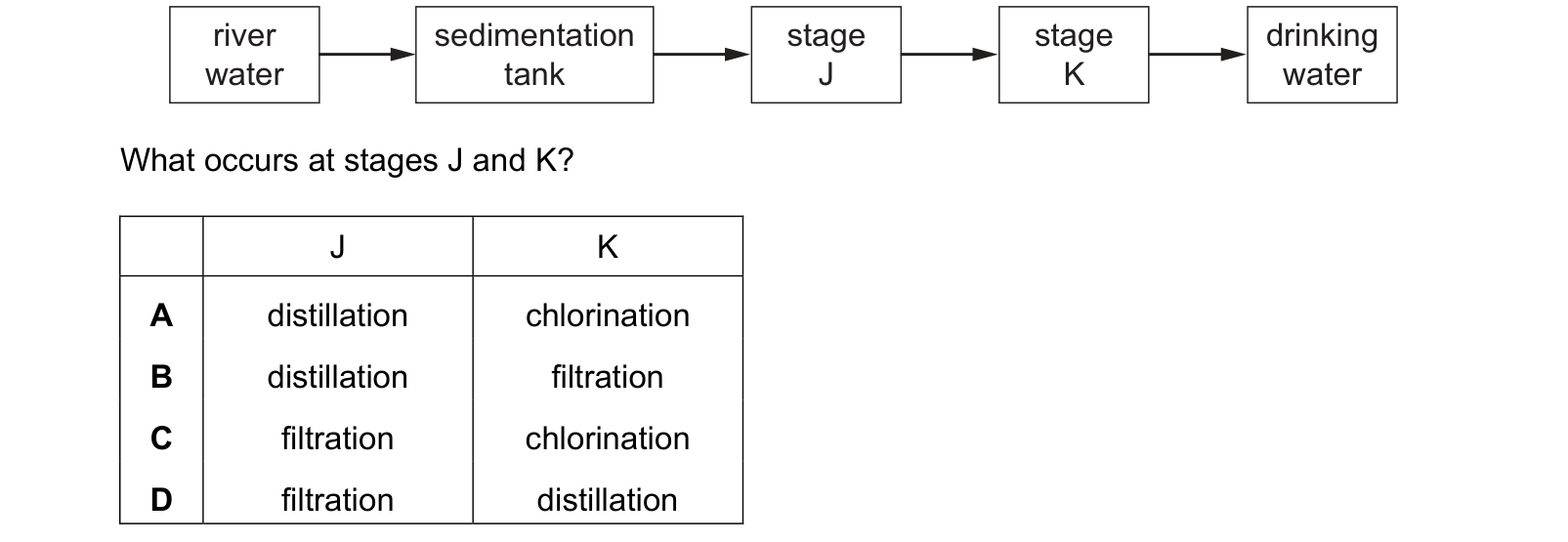
The flow chart shows stages in the treatment of river water to produce drinking water. water tank J K water What occurs at stages J and K? Each answer gives, in order: J; K.
Answer: C.
Water treatment removes impurities in order of size, largest first. The sedimentation tank has already allowed the heaviest particles to settle, so stage J deals with the finer suspended solids still floating in the water, and that is filtration through beds of sand and gravel. Filtration cannot remove bacteria, which are far too small to be caught reliably, so stage K adds chlorine to kill them, and chlorination is always the last step before the water is supplied. The rows placing distillation at stage J describe boiling the entire supply and condensing it again, which would work in a laboratory but costs far too much energy for a public supply and is not what treatment works do. Putting distillation at stage K instead would leave the bacteria untouched by anything, and killing them is the one job the treatment cannot skip.
Question 2
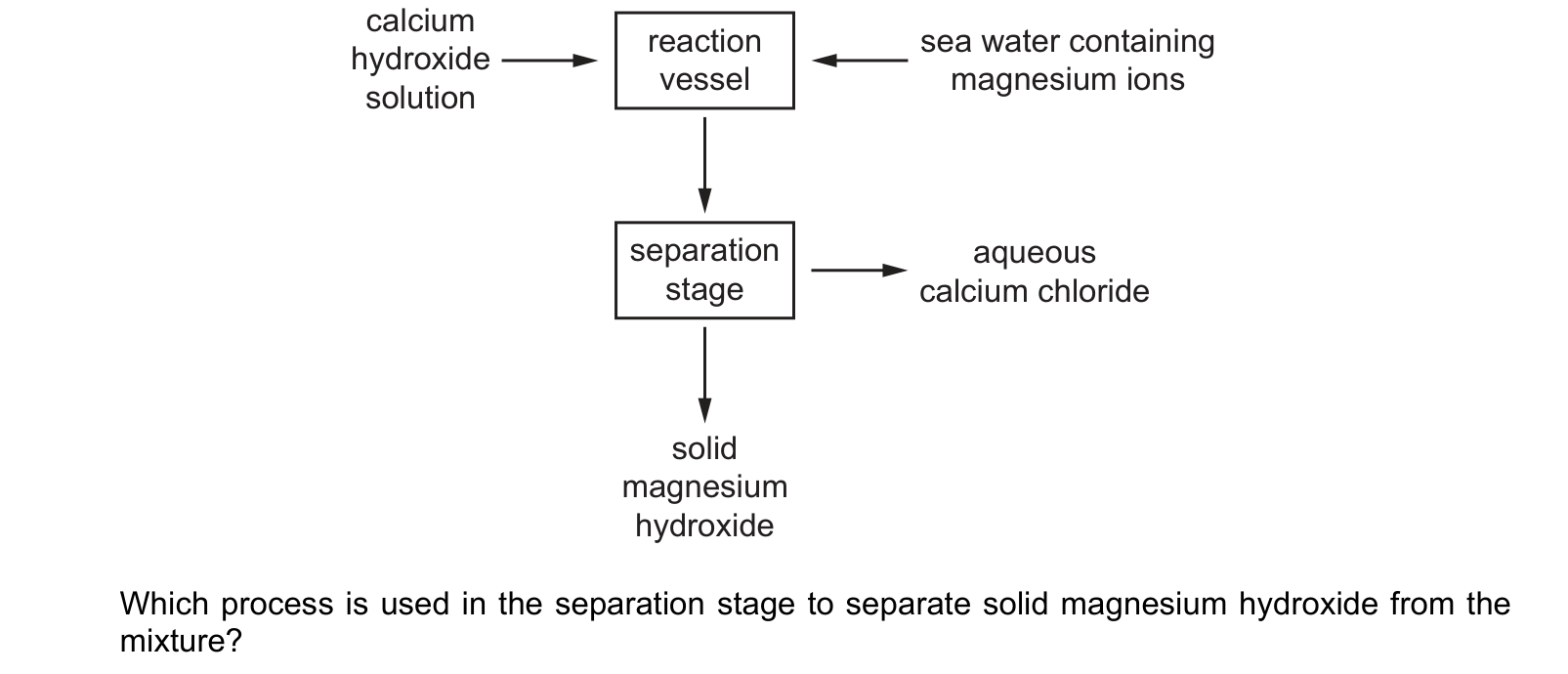
Magnesium hydroxide can be obtained from sea water as shown. magnesium hydroxide Which process is used in the separation stage to separate solid magnesium hydroxide from the mixture?
Answer: B.
In the reaction vessel the calcium hydroxide solution meets magnesium ions in sea water and magnesium hydroxide comes out as a solid, while the calcium chloride formed alongside it stays dissolved. Separating an insoluble solid from a solution is the job of filtration, so the magnesium hydroxide is caught on the filter and the aqueous calcium chloride passes through, which is what the flow diagram shows leaving by the side arm. Crystallisation would apply if the wanted product were dissolved, but magnesium hydroxide never enters solution at all. Distillation separates liquids by their boiling points and would leave the solid still mixed with the calcium chloride. Chromatography separates dissolved substances that move through a solvent at different speeds, which is a different problem entirely from removing a suspended solid.
Question 3
River water contains soluble impurities, insoluble impurities and bacteria. River water is made safe to drink by filtration and chlorination. Which statement is correct?
Answer: B.
Filtration separates by size, holding back particles too large to pass through the bed, so it deals with the insoluble impurities, while chlorination works chemically and kills the bacteria that filtration cannot catch. Soluble impurities are dissolved as individual ions or molecules, far smaller than any filter pore, so they pass straight through and remain in the water after both stages. That is why every statement claiming filtration removes soluble impurities fails, whatever else it is paired with. Chlorine does not remove dissolved solids either, so treating it as a remover of soluble matter swaps the roles of the two stages over. Filtration and chlorination make water safe to drink rather than pure, and that distinction is exactly what the question is probing.
Question 4
Several processes are used to treat domestic water. Which row identifies a reason for the given process? Each answer gives, in order: process; reason.
Answer: B.
Filtration passes water through beds of sand and gravel that trap suspended particles, so it removes insoluble solids, and that is the row where the process and the reason match. Chlorination adds chlorine to kill bacteria rather than to remove impurities. Sedimentation lets suspended solids settle out under gravity, so it also deals with insoluble matter rather than soluble solids. Carbon is used to absorb the substances causing tastes and odours, not to kill bacteria. Every wrong row pairs a real process with the job of a different one.
Question 5
Which row identifies methods of testing the purity of a compound? Each answer gives, in order: melting point; boiling point; chromatography.
Answer: A.
All three methods can be used to test purity. A pure substance melts at a sharp fixed temperature and boils at a sharp fixed temperature, whereas an impurity lowers and broadens the melting point and raises the boiling point, so both fixed points are useful tests. Chromatography adds a third check, since a pure substance gives a single spot while a mixture gives more than one. Because every method works, the row of three ticks is the only possible answer, and any row containing a cross rejects a technique schools use for exactly this purpose.
These questions are drawn from past CIE 0620 Chemistry papers and filtered to separation and purification. You answer, you find out immediately whether you were right, and you get the reasoning for the correct option and for each distractor. Wrong answers go to a mistakes locker so you can come back to exactly those.
Practice is free. You need an account only so your progress and your mistakes are still there next time.
These are the errors that cost marks on separation and purification, taken from our own topic notes. Read them before you practise and you will recognise the traps in the questions.
Swapping residue and filtrate.
Saying filtration separates a dissolved solid from its solution. Dissolved particles pass straight through the paper.
Evaporating a solution to dryness when crystals are wanted.
Cooling a saturated solution quickly, which gives small, impure crystals.
Washing crystals with warm water, which dissolves them.
Placing the thermometer bulb in the boiling liquid instead of level with the side-arm.
Sending the condenser water in at the top.
Using simple distillation for two miscible liquids, which does not separate them properly.