8 past-paper questions on this unit. Five of them are below. Answer on the page: each one is marked the moment you pick, the correct option is shown whether or not you found it, and the full explanation opens either way.
CIE 0620 ChemistryPaper 1 and Paper 2 MCQsFree account
Reactivity series: five questions to try now
Real past-paper questions, the answer key from the mark scheme, and the explanation that goes with it. No account needed to answer them.
Question 1
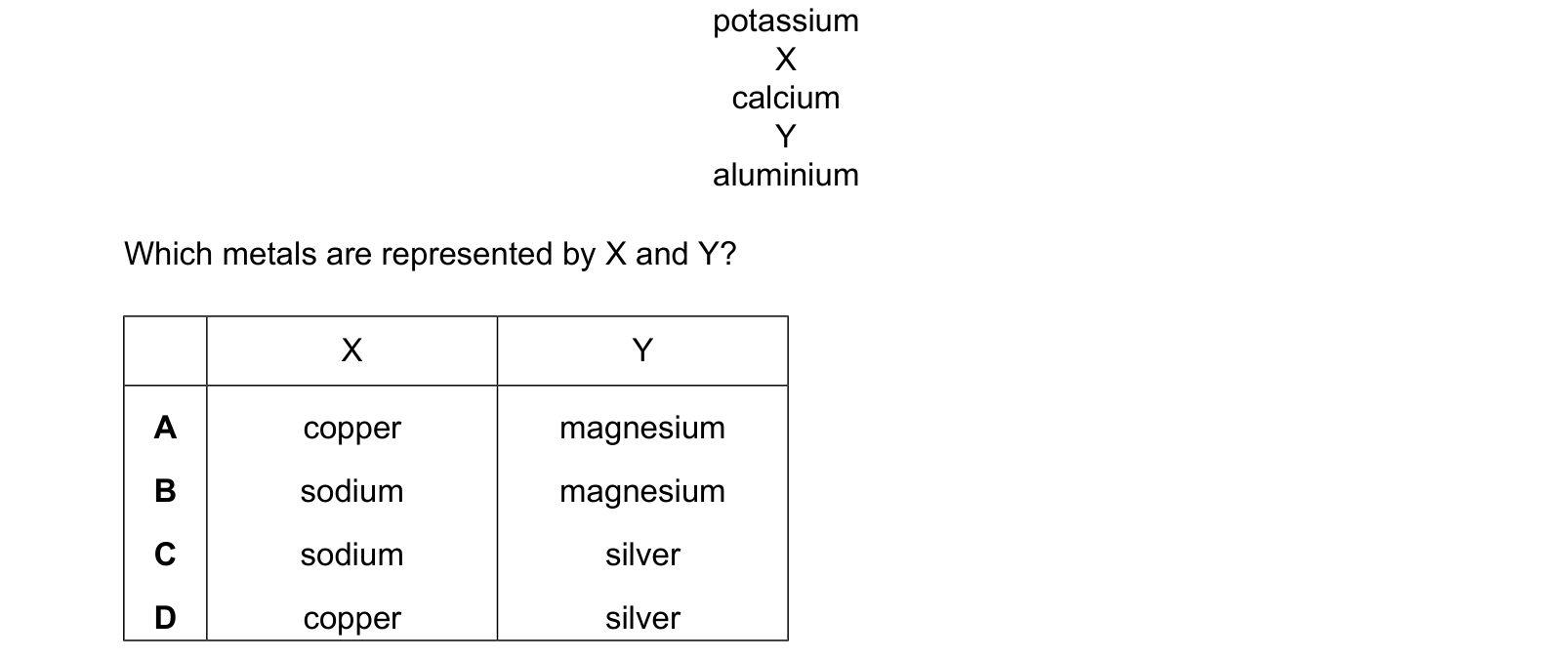
Part of the reactivity series is shown. potassium X calcium Y aluminium Which metals are represented by X and Y? Each answer gives, in order: X; Y.
Answer: B.
This part of the reactivity series runs potassium, sodium, calcium, magnesium, aluminium, so X is sodium and Y is magnesium. Both are placed by their reactions with water, since sodium attacks cold water vigorously like potassium, calcium reacts steadily with cold water, and magnesium reacts only very slowly with cold water but readily with steam, which puts magnesium between calcium and aluminium. Copper is far too unreactive for either gap, sitting below hydrogen and reacting with neither water nor dilute acid. Silver is less reactive still, so any row placing copper or silver among the top five has hauled a metal from the bottom of the series to the top.
Question 2
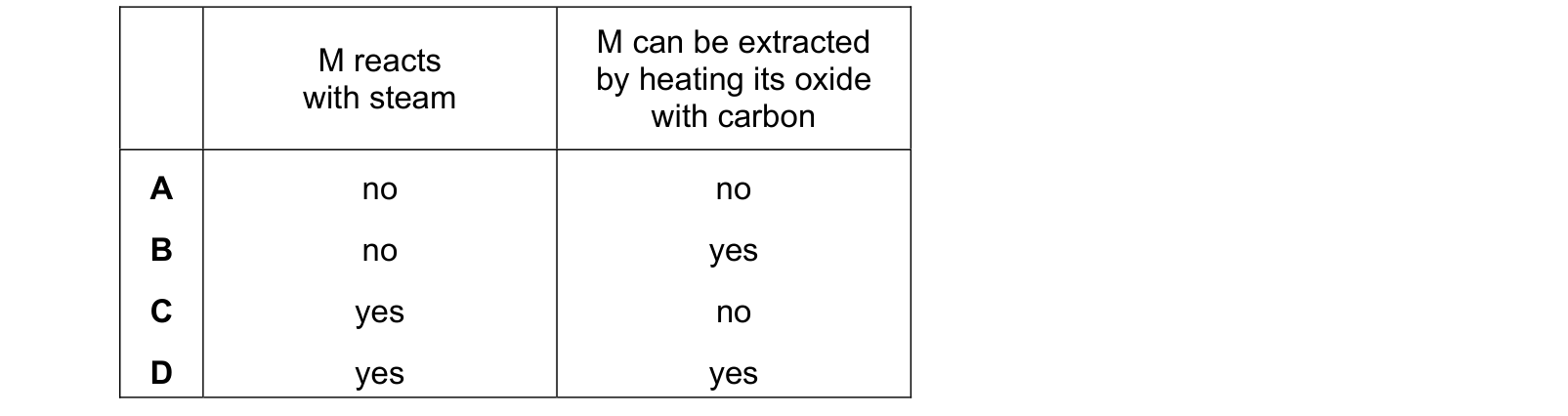
A metal M is between sodium and magnesium in the reactivity series. Which reactions occur with M and its oxide? Each answer gives, in order: M reacts with steam; M can be extracted by heating its oxide with carbon.
Answer: C.
Metal M sits between sodium and magnesium, so it is very near the top of the reactivity series and both columns follow from that position. A metal that reactive attacks water readily, so it certainly reacts with steam to give the oxide and hydrogen, and metals in that region react even with cold water. It also lies well above carbon, so carbon cannot take the oxygen from its oxide and the metal has to be obtained by electrolysis of a molten compound. Any row answering yes to carbon reduction has placed M below carbon, and any row answering no to steam has treated a metal above magnesium as though it were as unreactive as copper.
Question 3
The metal beryllium does not react with cold water. It reacts with hydrochloric acid but cannot be extracted from its ore by using carbon. Where is beryllium placed in the reactivity series?
Answer: A.
Three clues each set a boundary on where beryllium can sit. Reacting with hydrochloric acid puts it above hydrogen, so it cannot lie below copper, and failing to react with cold water keeps it below the very reactive metals such as calcium and sodium. Not being extractable with carbon is the decisive clue, since carbon reduces only the oxides of metals below it in the series, so beryllium must sit above carbon, and carbon lies between aluminium and zinc. The only position satisfying all three is between magnesium and zinc, because every lower placement would permit carbon reduction, which the question explicitly rules out.
Question 4
Four iron nails are added to four different metal sulfate solutions. In which solution does a displacement reaction occur?
Answer: A.
A displacement reaction occurs only when the added metal is more reactive than the metal already in solution, so iron can displace only metals below it in the series. Copper lies below iron, so a nail in copper(II) sulfate becomes coated with brown copper while the blue solution fades to the pale green of iron(II) sulfate. Zinc, magnesium and sodium all lie above iron, so none of them can be pushed out by it and those three nails stay unchanged. The colour change in the copper tube is the clearest evidence, since it is visible within minutes.
Question 5
Which statement explains why aluminium appears to be unreactive?
Answer: A.
Aluminium stands high in the reactivity series, above zinc and iron, so on paper it ought to corrode readily; what saves it is that the surface oxidises the instant it meets air, giving a thin, dense and firmly attached layer of aluminium oxide that seals the metal beneath. Because that layer is unbroken and does not flake away, nothing further reaches the metal and the object appears inert. Saying aluminium is low in the reactivity series contradicts its position and would also make extraction easy, when in fact it demands electrolysis. Low density and being solid at room temperature are true of the metal but have nothing to do with how it reacts.
These questions are drawn from past CIE 0620 Chemistry papers and filtered to reactivity series. You answer, you find out immediately whether you were right, and you get the reasoning for the correct option and for each distractor. Wrong answers go to a mistakes locker so you can come back to exactly those.
Practice is free. You need an account only so your progress and your mistakes are still there next time.
These are the errors that cost marks on reactivity series, taken from our own topic notes. Read them before you practise and you will recognise the traps in the questions.
Leaving carbon and hydrogen out of the order, and then being unable to answer the extraction question.
Saying copper reacts with dilute hydrochloric acid to give hydrogen.
Writing a hydroxide as the product of a metal with steam, or an oxide as the product with cold water.
Saying aluminium is less reactive than zinc, rather than that its oxide layer makes it appear so.
Predicting that copper displaces zinc from zinc sulfate solution.
Explaining reactivity by "it reacts more" rather than by the tendency to lose electrons and form positive ions.
Describing a displacement without the colour change, which is where the observation mark sits.