24 past-paper questions on this unit. Five of them are below. Answer on the page: each one is marked the moment you pick, the correct option is shown whether or not you found it, and the full explanation opens either way.
CIE 0620 ChemistryPaper 1 and Paper 2 MCQsFree account
Extraction of metals: five questions to try now
Real past-paper questions, the answer key from the mark scheme, and the explanation that goes with it. No account needed to answer them.
Question 1
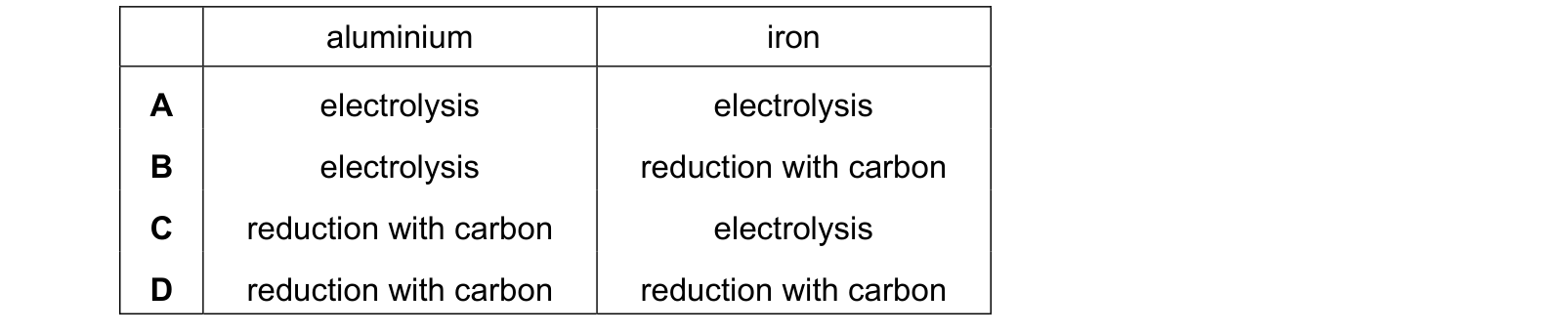
Which row describes the method of extraction of aluminium and iron from their ores? Each answer gives, in order: aluminium; iron.
Answer: B.
Whether carbon can extract a metal depends on where that metal sits relative to carbon in the reactivity series. Aluminium is above carbon, so carbon cannot pull the oxygen away from it, and the only route is electrolysis of molten aluminium oxide dissolved in cryolite. Iron is below carbon, so heating its ore with carbon and carbon monoxide in a blast furnace does reduce it, and that is far cheaper than electrolysis, which is why iron has been smelted for thousands of years and aluminium only since the nineteenth century. The row using carbon for both treats aluminium as though it were as easy to reduce as iron, ignoring how tightly aluminium holds its oxygen. The row using electrolysis for both would work but would waste an enormous amount of electricity on a metal that carbon reduces perfectly well.
Question 2
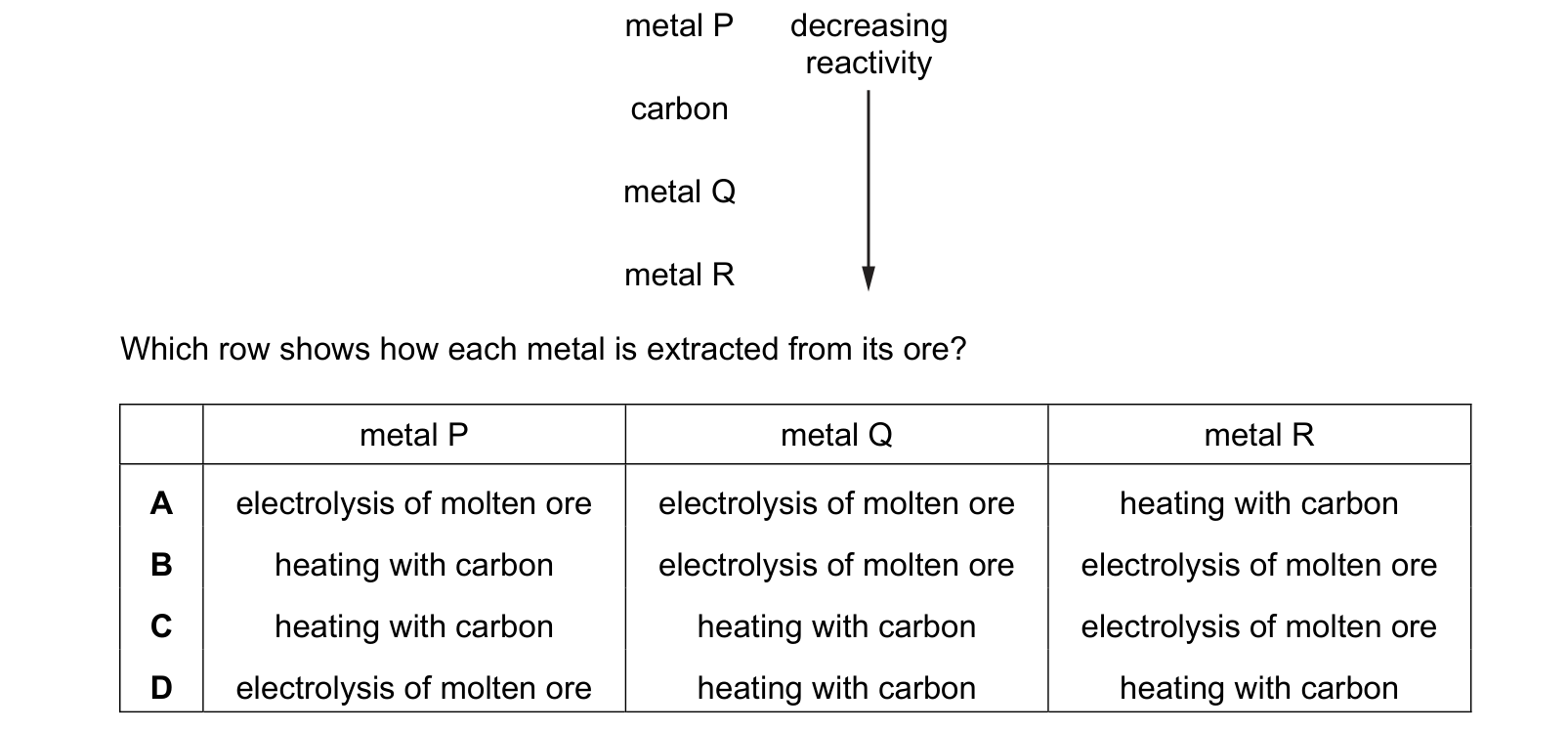
Part of the reactivity series of metals is shown. metal P decreasing reactivity carbon metal Q metal R Which row shows how each metal is extracted from its ore? Each answer gives, in order: metal P; metal Q; metal R.
Answer: D.
Carbon marks the dividing line, because it can only take oxygen from a metal less reactive than itself. Metal P sits above carbon, so its ore grips its oxygen too tightly for carbon to remove it and electrolysis of the molten compound is the only route. Metals Q and R both lie below carbon, so heating their oxides with carbon reduces them, which is why iron, zinc and lead are won in furnaces rather than in electrolysis cells. Any row giving P a carbon reduction, or sending a metal below carbon to electrolysis, has ignored where carbon sits and would waste enormous quantities of electricity on a metal a furnace could handle.
Question 3
Iron is extracted from hematite in the blast furnace at a temperature of about 1550 °C. Which equation shows the main reaction that increases the temperature in the furnace?
Answer: B.
Several reactions run in the furnace but only one releases enough energy to hold it near 1550 °C, and that is the combustion of coke in the hot air blast. Carbon burning to carbon dioxide is strongly exothermic, and the blast is preheated to make it fiercer still. The reaction of carbon dioxide with more coke to give carbon monoxide is endothermic and actually absorbs part of that heat, so it cannot be the source. Decomposing limestone is endothermic as well, and reducing iron(III) oxide with carbon monoxide is the purpose of the whole plant rather than the thing that heats it.
Question 4
Iron is extracted from its ore in a blast furnace. Hematite, coke, limestone and hot air are added to the furnace. Which explanation is not correct?
Answer: D.
Limestone plays no part in reducing the ore, so the statement giving it that role is the one that fails; its job is to decompose into calcium oxide, which then reacts with the sandy silicon(IV) oxide impurity to form slag. The reduction of iron(III) oxide is done by carbon monoxide, and to a smaller extent by carbon itself in the hottest region. The other three explanations all hold up, since coke does burn to raise the temperature, hematite really is iron(III) oxide, and the hot air blast supplies the oxygen for that combustion. Because the question asks which explanation is wrong, three correct statements have to be recognised and set aside first.
Question 5
In the blast furnace, the impurity silicon(IV) oxide is removed by the formation of slag. Which equation represents the formation of the substance which reacts with silicon(IV) oxide to form slag?
Answer: C.
Silicon(IV) oxide is acidic, so it is removed by a base, and the base in the furnace is calcium oxide, produced when the limestone decomposes in the heat. The equation asked for is therefore the decomposition of calcium carbonate, since that is what supplies the substance which then attacks the sand to give calcium silicate slag. Burning coke supplies heat and carbon dioxide but no base, and the reaction of carbon with carbon dioxide makes carbon monoxide, which reduces the ore rather than dealing with impurities. Reducing iron(III) oxide is the furnace's main purpose and has nothing to do with slag, so choosing it names the wrong stage entirely.
These questions are drawn from past CIE 0620 Chemistry papers and filtered to extraction of metals. You answer, you find out immediately whether you were right, and you get the reasoning for the correct option and for each distractor. Wrong answers go to a mistakes locker so you can come back to exactly those.
Practice is free. You need an account only so your progress and your mistakes are still there next time.
These are the errors that cost marks on extraction of metals, taken from our own topic notes. Read them before you practise and you will recognise the traps in the questions.
Saying carbon is the reducing agent in the blast furnace, when the equation shows carbon monoxide reducing the ore.
Writing the ore as iron(II) oxide rather than iron(III) oxide.
Saying limestone is added to provide heat, rather than to remove the silicon dioxide impurity as slag.
Saying slag sinks below the iron, when it floats.
Saying cryolite is a catalyst, when it is a solvent that lowers the operating temperature.
Saying the carbon anodes wear away by rubbing, rather than by burning in the oxygen released there.
Extracting aluminium with carbon, which cannot reduce the oxide of a metal above it in the series.
Producing the aluminium at the anode instead of the cathode.