Testing for biological molecules: five questions to try now
Real past-paper questions, the answer key from the mark scheme, and the explanation that goes with it. No account needed to answer them.
Question 1
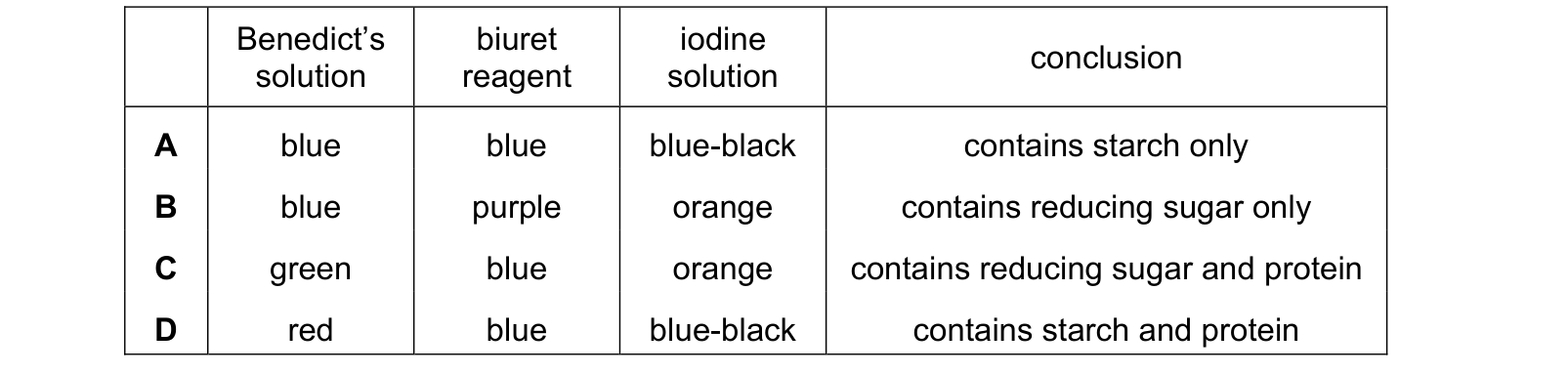
The table shows the observations recorded from tests for biological molecules on four samples, A, B, C and D. Which conclusion is correct? Each answer gives, in order: Benedict’s solution; biuret reagent; iodine solution; conclusion.
Answer: A.
A: Benedict's blue, biuret blue, iodine blue-black. Blue Benedict's means no reducing sugar. Blue biuret means no protein. Blue-black iodine means starch. So the conclusion, contains starch only, matches all three. That is A.
B claims reducing sugar only, but its Benedict's is blue, which is a negative, and its biuret is purple, which says protein is there. Wrong twice.
C claims reducing sugar and protein. The green Benedict's does mean a small amount of reducing sugar, but the biuret is blue, so there is no protein.
D claims starch and protein. The iodine is right, but the biuret is blue again, so no protein, and it also ignores a red Benedict's, which means a lot of reducing sugar.
Three of the four rows fail on the biuret result, which is worth noticing as a pattern. The colours to have memorised are: Benedict's stays blue if negative and runs green to red if positive; biuret stays blue if negative and turns purple if positive; iodine stays orange-brown if negative and turns blue-black if positive.
Question 2
The test for non-reducing sugars requires a second Benedict’s test to be carried out.
Which set of steps is the correct method for carrying out the non-reducing sugar test before carrying out the second Benedict’s test?
Answer: C.
The first Benedict's test must be done and must come out blue, which is the negative result showing no reducing sugar is present. That matters: without it you cannot tell a non-reducing sugar from a reducing one.
Then boil with dilute hydrochloric acid to hydrolyse the glycosidic bond, and neutralise with sodium hydrogencarbonate.
A says warm gently rather than boil, which is not enough to hydrolyse the bond.
B has the first test coming out red, which would mean a reducing sugar was there all along.
D does the steps in the wrong order, neutralising before adding the acid, which leaves nothing for the acid to be neutralised from and no hydrolysis.
Question 3
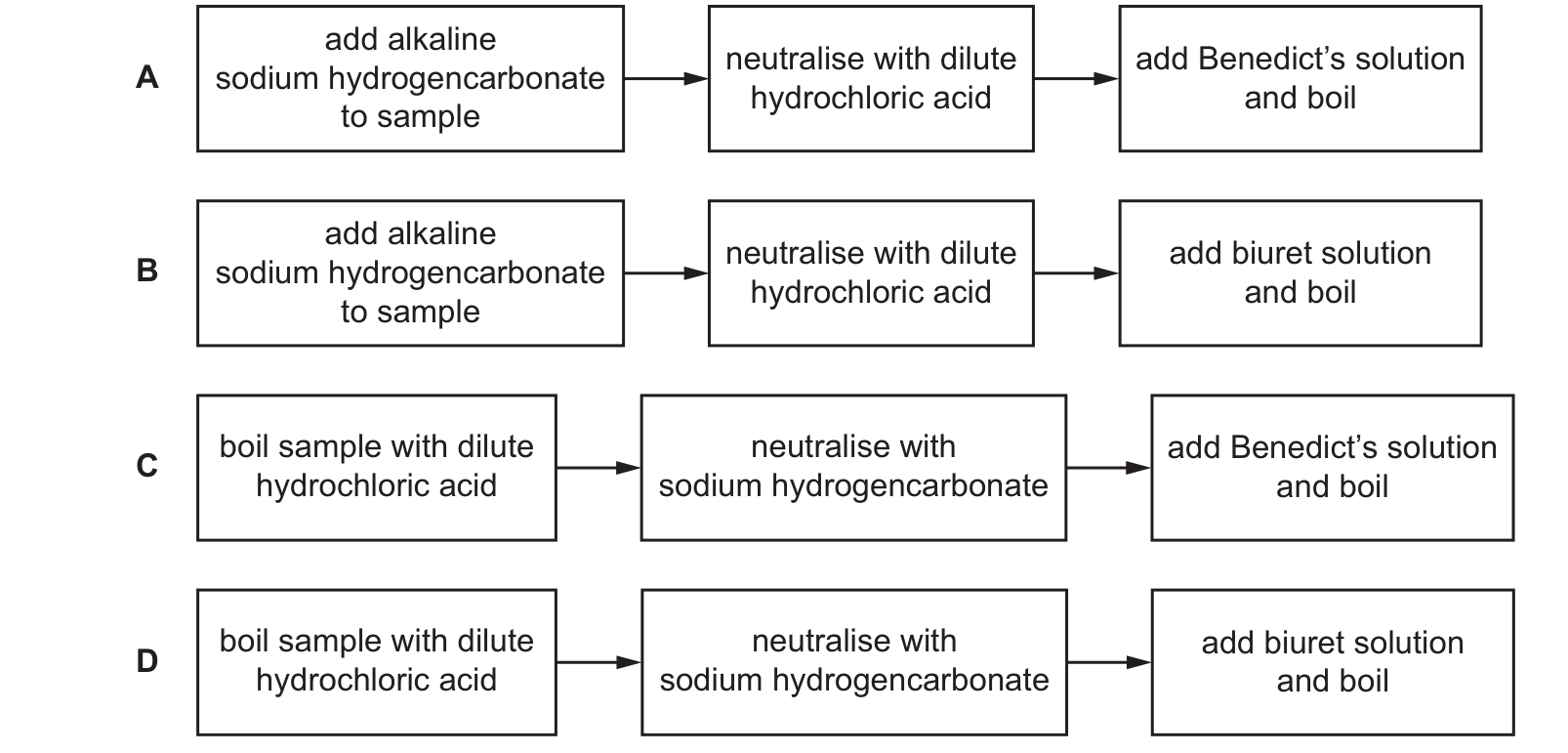
Which flow chart outlining the test for non-reducing sugars is correct?
Answer: C.
Boil the sample with dilute hydrochloric acid to hydrolyse the glycosidic bond. Neutralise with sodium hydrogencarbonate, because Benedict's solution is alkaline and will not react in acid. Then add Benedict's solution and boil.
A and B go wrong at the first box: adding alkali hydrolyses nothing, so there is still no reducing sugar to find. B and D go wrong at the last box, where biuret solution tests for protein, not for sugar. D manages both errors at once.
Read the boxes in order and each wrong chart fails at a step you can name.
Question 4
Steps 1, 2, 3 and 4 are used to test for a non-reducing sugar.
1 Put 5 cm³ of solution into a test-tube.
2 Add a few drops of acid.
3 Neutralise with alkali.
4 Add 6 cm³ of Benedict’s solution.
When is the solution heated or boiled?
Answer: B.
The first heating comes with the acid, between steps 2 and 3. Acid alone does not hydrolyse the glycosidic bond quickly; it needs heat.
The second comes after step 4, once Benedict's has been added, because the Benedict's test does not work at room temperature at all. An unheated tube stays blue whatever is in it.
Step 3, neutralising, sits between them and is the step most often forgotten. Benedict's solution is alkaline and will not work in an acidic tube, so skipping it produces a false negative.
Acid and heat, neutralise, Benedict's and heat.
Question 5
The Benedict’s test and ethanol emulsion test were carried out on a sample of biological molecules. The solution became brick-red during the Benedict’s test and cloudy during the ethanol emulsion test.
Which molecules did the sample contain?
Answer: A.
Brick red in the Benedict's test is a strongly positive result for a reducing sugar.
Cloudy in the ethanol emulsion test is a positive result for lipid.
So reducing sugars and lipids, which is A.
B adds proteins, which would need a biuret test that was never done.
C adds starch, which needs iodine, also not done.
D says non-reducing sugars, but the Benedict's test went brick red without any acid hydrolysis, which is what identifies a reducing sugar.
The discipline here is to conclude only what the tests performed can support, and to notice that a positive Benedict's without pretreatment rules the non-reducing option out rather than in.
What this practice covers
These questions are drawn from past CIE 9700 Biology papers and filtered to testing for biological molecules. You answer, you find out immediately whether you were right, and you get the reasoning for the correct option and for each distractor. Wrong answers go to a mistakes locker so you can come back to exactly those.
Practice is free. You need an account only so your progress and your mistakes are still there next time.
What examiners see students get wrong here
These are the errors that cost marks on testing for biological molecules, taken from our own topic notes. Read them before you practise and you will recognise the traps in the questions.
- Saying "Benedict's turns red" without naming the intermediate colours. A question showing green or yellow is testing the range.
- Forgetting to neutralise after acid hydrolysis in the non-reducing sugar test.
- Heating the Biuret test. It does not need it and the mark scheme does not credit it.
- Saying the Biuret test detects amino acids. It detects the peptide bond.
- Adding water before ethanol in the emulsion test, which gives no emulsion.
Revise it first
If any of the above is unfamiliar, work through the notes before practising: Testing for biological molecules revision notes.