19 past-paper questions on this unit. Five of them are below. Answer on the page: each one is marked the moment you pick, the correct option is shown whether or not you found it, and the full explanation opens either way.
CIE 9706 AccountingPaper 1 MCQsFree account
Unit, job and batch costing: five questions to try now
Real past-paper questions, the answer key from the mark scheme, and the explanation that goes with it. No account needed to answer them.
Question 1
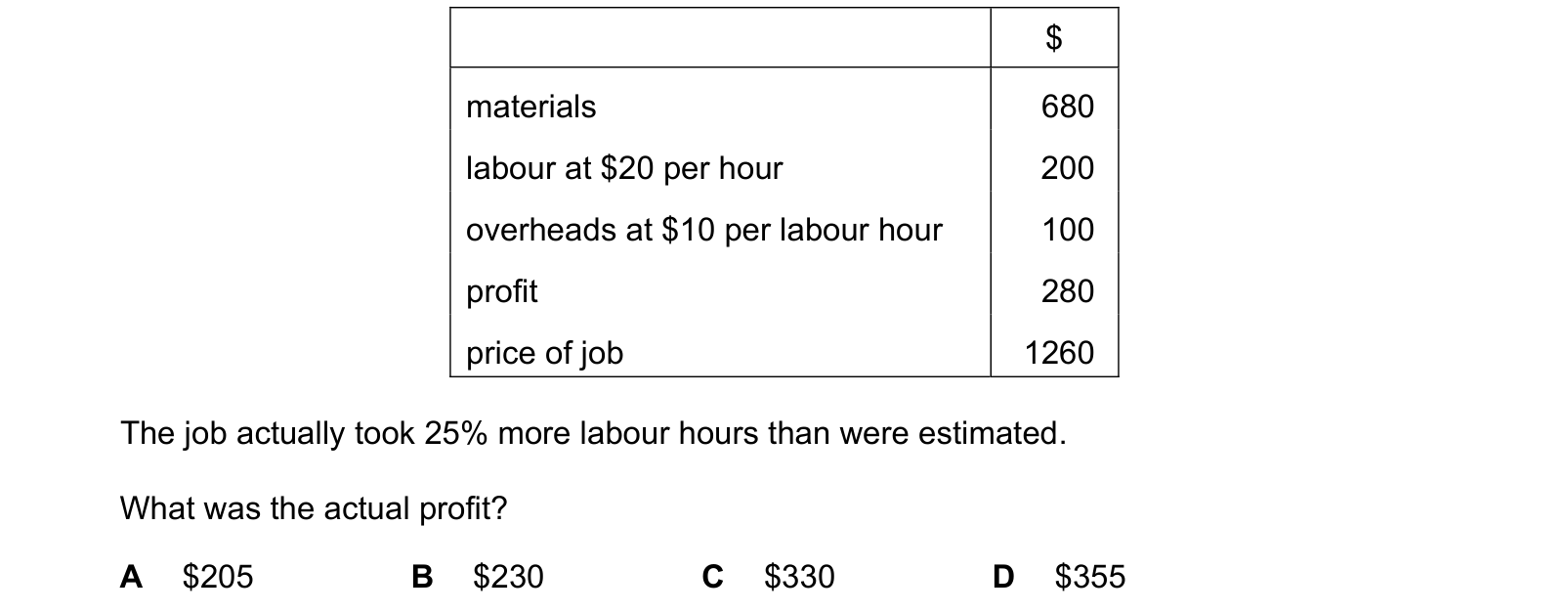
A job cost sheet showed the following estimates. $ materials 680 labour at $20 per hour 200 overheads at $10 per labour hour 100 profit 280 price of job 1260 The job actually took 25% more labour hours than were estimated. What was the actual profit?
Answer: A.
Only the labour and the overhead move, because the overhead is absorbed per labour hour. The estimate implies 10 labour hours, since $200 at $20 an hour, and the overhead of $100 at $10 a labour hour confirms it. Taking 25% longer means 12.5 hours, so labour becomes $250 and overhead $125. Total cost rises from 980 to $1055. The price was fixed at $1260 with the customer, so the profit falls to $205. Charging the customer for the overrun is what the wrong options assume.
Question 2
Jim is a manager in a limited company. He also owns a few of its shares. Why has he been looking at its most recent financial statements?
Answer: B.
He is looking as an EMPLOYEE. A profitable company is more likely to keep employing him, so job security is the interest a manager has in the overall result. A is wrong because published financial statements do not break out one department's profit; that is internal management information. C and D are shareholder interests, and while he does own a few shares, a five-year dividend forecast is not something a set of historic statements provides.
Question 3
Which statements about a job costing system are correct?
Answer: D.
2 and 4. A job is a distinct piece of work made to a customer's own specification, and its costs are collected against that job alone so it can be quoted and its profit measured separately. Statements 1 and 3 are the negations of each: averaging costs across all jobs describes unit or process costing, where output is identical and no single unit can be told from another, and work not made to a customer's specification is precisely what job costing does not cover.
Question 4
A customer places an order for 20000 bricks. Which costing method will the supplier use to price the order?
Answer: A.
Batch costing. The order is for 20 000 identical bricks, so the costs are gathered for the batch as a whole and then divided by the number of bricks to get a unit cost. Job costing suits a single item made to a customer's own specification, which bricks are not. Unit costing suits continuous output not organised into orders at all, and marginal costing is a way of deciding which costs to include rather than a method of costing an order.
Question 5
Which business would use a batch costing system?
Answer: B.
Batch costing is used where identical units are made in separate runs, so each batch is given a number, its costs are collected against that number, and the total is divided by the units in the batch. A footwear manufacturer producing a run of one size and style before switching to another fits this exactly, so B. A and C are a retailer and a wholesaler, which buy in finished goods and have no production costs to collect. D, an oil refinery, produces a continuous flow of identical output with no separable batches, so it uses process costing instead.
These questions are drawn from past CIE 9706 Accounting papers and filtered to unit, job and batch costing. You answer, you find out immediately whether you were right, and you get the reasoning for the correct option and for each distractor. Wrong answers go to a mistakes locker so you can come back to exactly those.
Practice is free. You need an account only so your progress and your mistakes are still there next time.
These are the errors that cost marks on unit, job and batch costing, taken from our own topic notes. Read them before you practise and you will recognise the traps in the questions.
Adding administration overheads before calculating production cost.
Confusing margin with mark-up when pricing.
Dividing the batch cost by the units started rather than the good units produced.
Absorbing overheads on hours when the question gives a machine-hour basis, or the reverse.
Using job costing where the output is identical, or unit costing where every order differs.
Forgetting direct expenses, which are easy to miss because most jobs have none.