Cost-volume-profit analysis: five questions to try now
Real past-paper questions, the answer key from the mark scheme, and the explanation that goes with it. No account needed to answer them.
Question 1
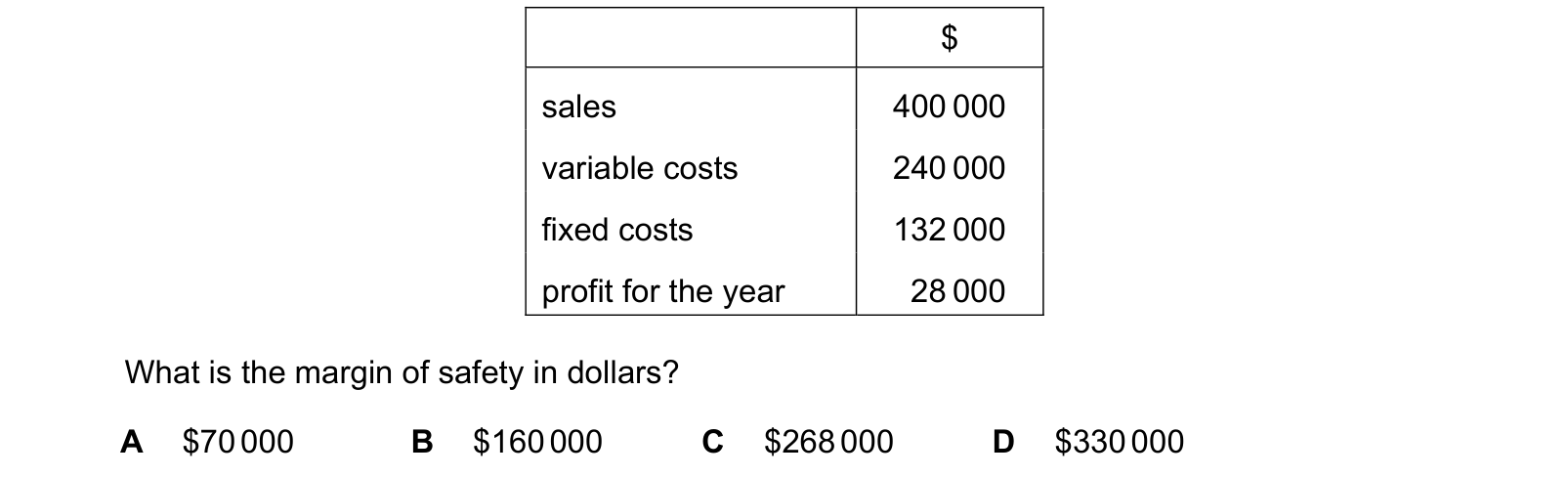
The budgeted income statement of J Limited shows the following. $ sales 400 000
variable costs 240 000
fixed costs 132 000
profit for the year 28 000
What is the margin of safety in dollars?
Answer: A.
Question 2
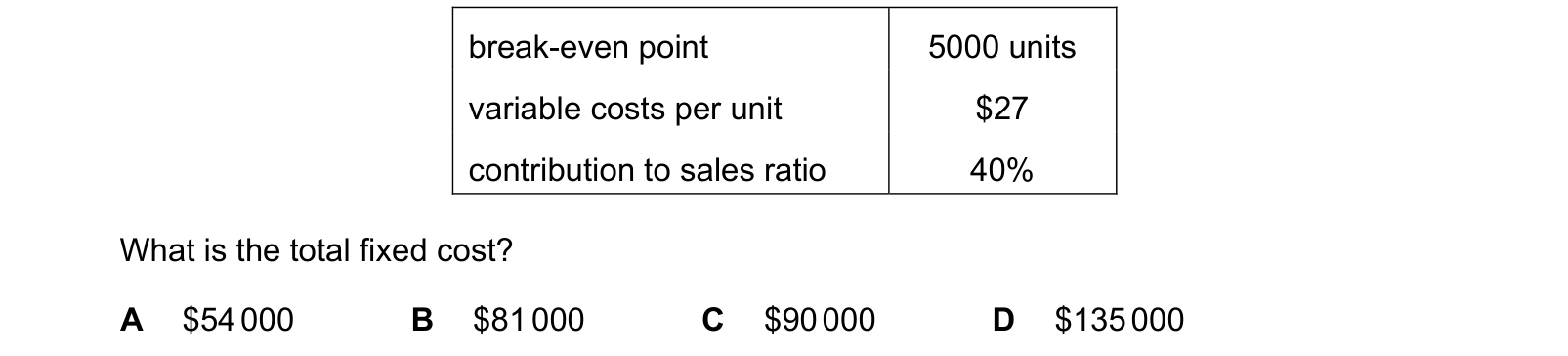
A business has the following information.
break-even point 5000 units
variable costs per unit $27
contribution to sales ratio 40%
What is the total fixed cost?
Answer: C.
Question 3
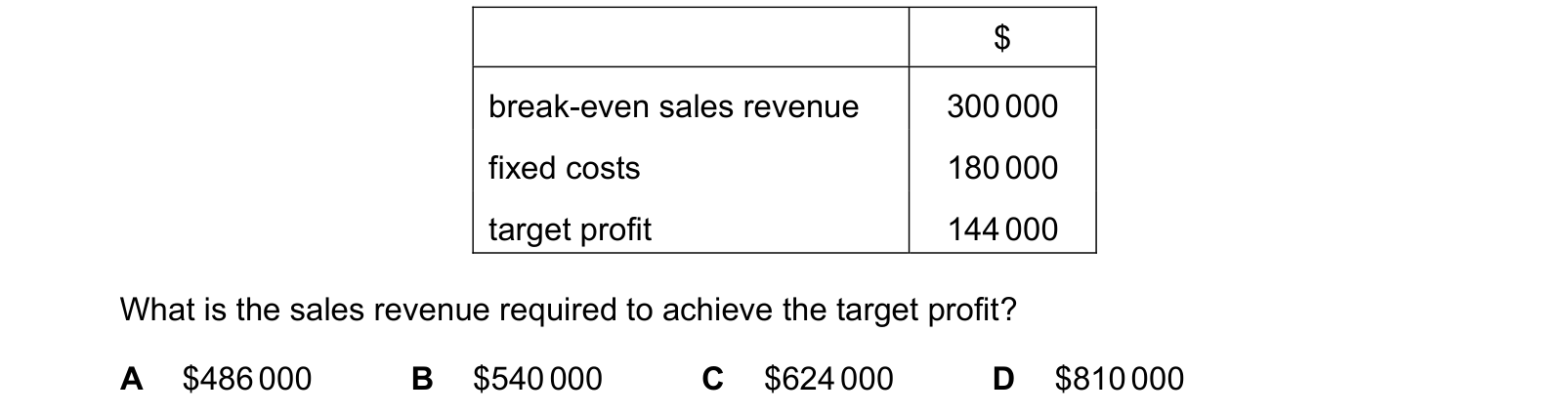
A business provided the following budgeted information. $ break-even sales revenue 300 000
fixed costs 180 000
target profit 144 000
What is the sales revenue required to achieve the target profit?
Answer: B.
Question 4
Gareth makes and sells bread. He has calculated how many loaves he needs to sell each day in order to break even.
Which factor helps him accurately analyse his break-even point?
Answer: A.
Question 5
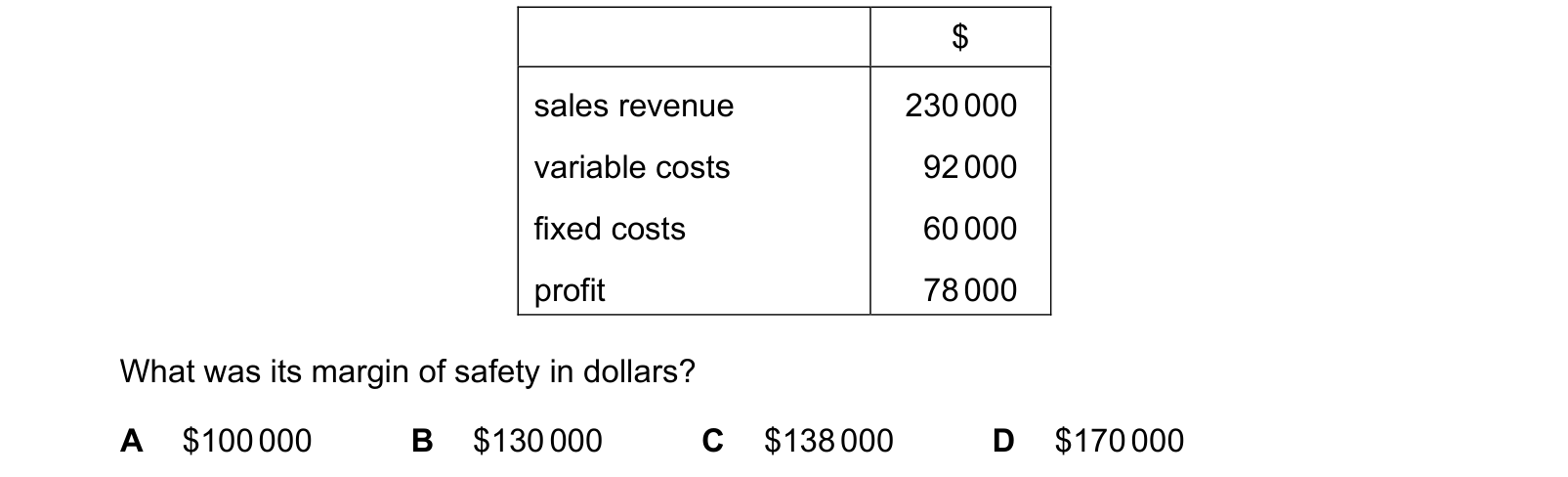
A company had the following results. $ sales revenue 230 000
variable costs 92 000
fixed costs 60 000
profit 78 000
What was its margin of safety in dollars?
Answer: B.
What this practice covers
These questions are drawn from past CIE 9706 Accounting papers and filtered to cost-volume-profit analysis. You answer, you find out immediately whether you were right, and you get the reasoning for the correct option and for each distractor. Wrong answers go to a mistakes locker so you can come back to exactly those.
Practice is free. You need an account only so your progress and your mistakes are still there next time.
What examiners see students get wrong here
These are the errors that cost marks on cost-volume-profit analysis, taken from our own topic notes. Read them before you practise and you will recognise the traps in the questions.
- Dividing fixed costs by the selling price instead of by the contribution.
- Using the C/S ratio and reporting the answer in units, or the reverse.
- Drawing the revenue line from the fixed cost level rather than from the origin.
- Starting the profit-volume line at zero instead of at minus the fixed costs.
- Saying break-even falls when sales volume rises.
- Listing assumptions without saying why each one limits the technique.
- Forgetting to add the target profit to fixed costs before dividing.
Revise it first
If any of the above is unfamiliar, work through the notes before practising: Cost-volume-profit analysis revision notes.