The Circular Flow, Injections and Withdrawals: five questions to try now
Real past-paper questions, the answer key from the mark scheme, and the explanation that goes with it. No account needed to answer them.
Question 1
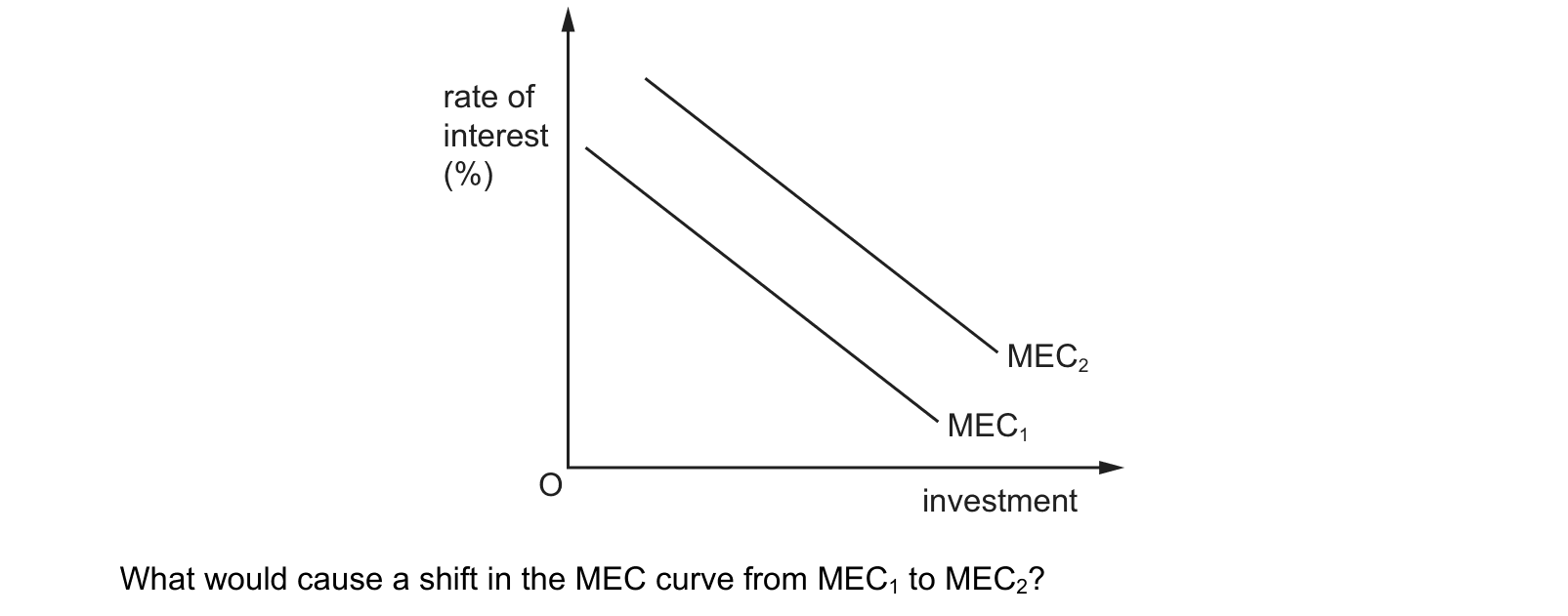
The diagram shows the investment schedule of an economy. O rate of interest (%) investment MEC1 MEC2 What would cause a shift in the MEC curve from MEC1 to MEC2?
Answer: C.
Explanation:
The Marginal Efficiency of Capital (MEC) curve represents the relationship between the rate of interest and the level of investment. When there is an increase in the availability of credit, businesses have easier access to funds for investment purposes. This expansion in credit availability would lead to an increase in investment, causing the MEC curve to shift to the right, from MEC1 to MEC2.
A decrease in the level of household spending (option A) would likely have a negative impact on investment demand as businesses may expect lower sales and, therefore, less need for investment in new capital. This could lead to a leftward shift in the MEC curve, contrary to what the question is asking.
A decrease in the rate of interest (option B) would lower the cost of borrowing for businesses, potentially leading to an increase in investment. However, this scenario would result in movement along the MEC curve, not a shift. A shift in the MEC curve is caused by factors that change the relationship between the rate of interest and the level of investment.
An increase in the rate of inflation (option D) would typically increase the cost of borrowing and potentially reduce the real return on investment. This could lead to a decrease in investment and a leftward shift in the MEC curve.
Therefore, the most appropriate answer is C, an increase in the availability of credit, as it directly influences the level of investment and leads to a shift in the MEC curve.
Question 2
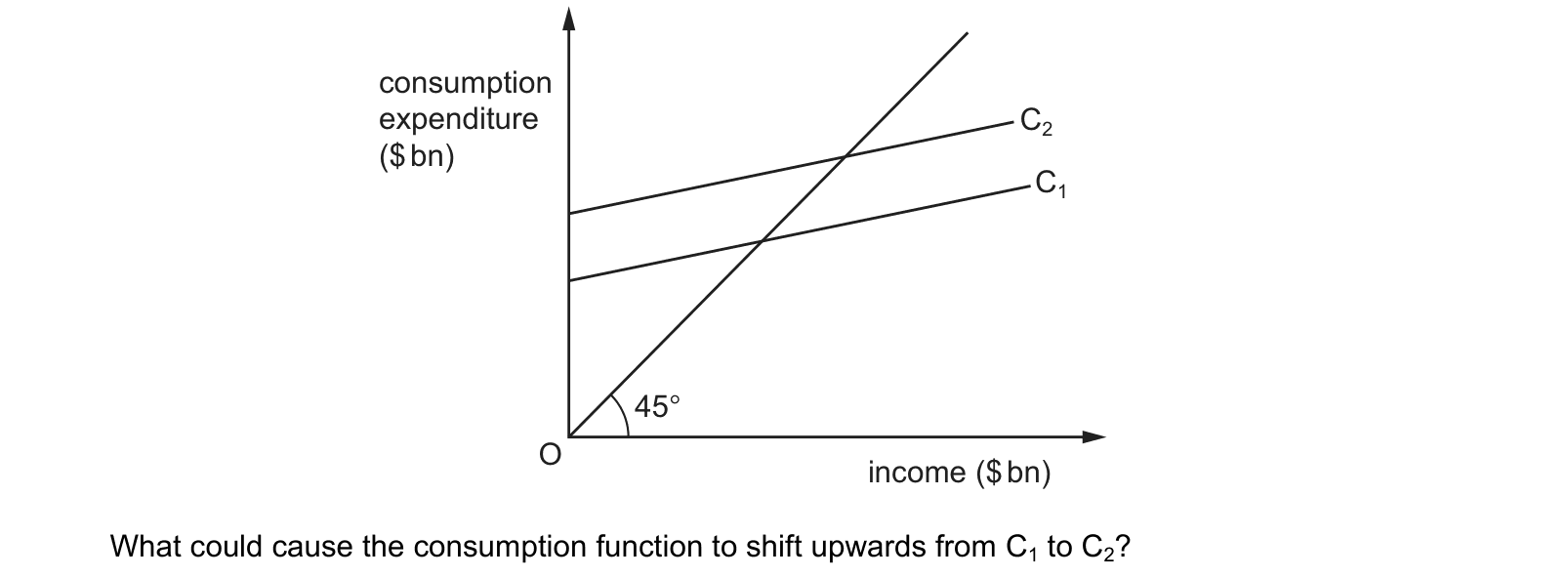
The diagram shows the consumption function of a country. C2 C1 consumption expenditure ($ bn) O income ($ bn) 45° What could cause the consumption function to shift upwards from C1 to C2?
Answer: D.
Explanation:
When considering the consumption function of a country, we are looking at the relationship between income and consumption expenditure. The consumption function shows how much households spend at different levels of income. An upward shift in the consumption function indicates that at each level of income, people are consuming more.
In this case, an increase in the expectation of sales taxes would lead to a potential shift in the consumption function upwards. When people anticipate that sales taxes will increase in the future, they might choose to increase their current consumption in order to avoid paying higher taxes later. This results in a higher overall consumption expenditure at each level of income, leading to an upward shift in the consumption function curve.
Therefore, the correct answer is D - the expectation of an increase in the rate of sales taxes. The other options (A, B, and C) do not directly relate to an upward shift in the consumption function as described in the scenario.
Question 3
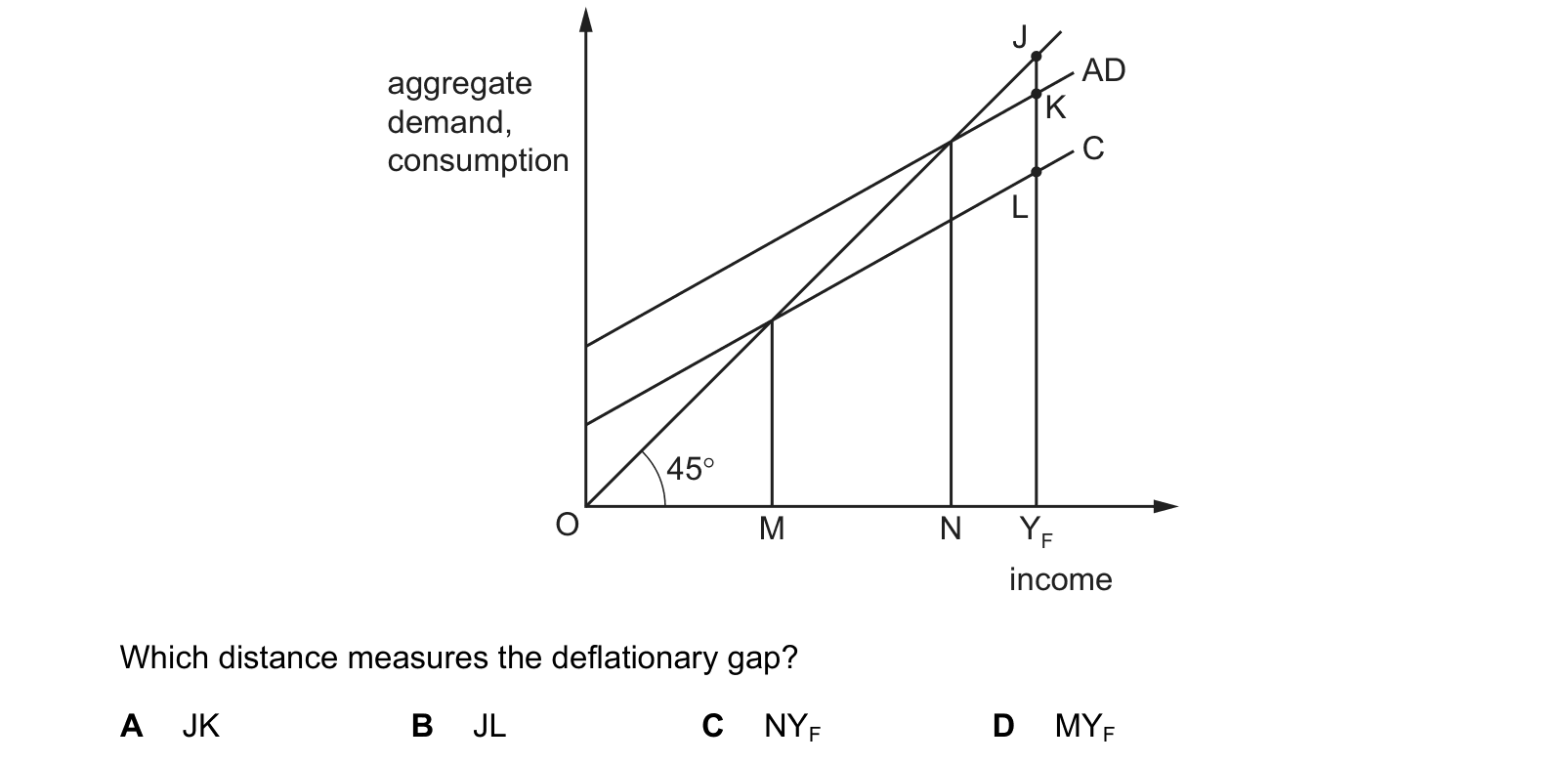
The diagram shows a closed economy in which the full employment level of income is YF. 45° O M N income YF aggregate demand, consumption J AD K C L Which distance measures the deflationary gap?
Answer: A.
Question 4
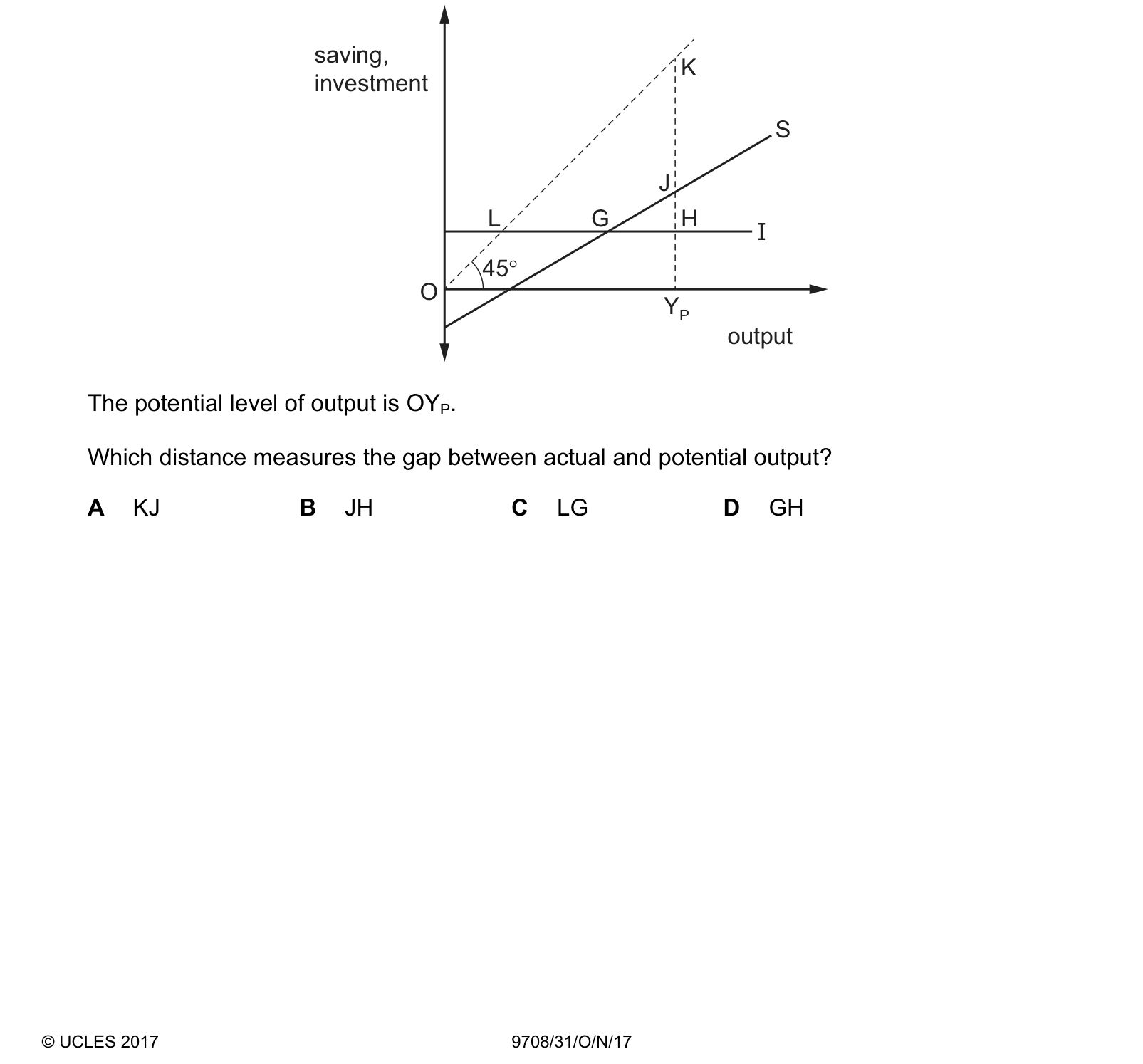
The diagram shows the saving and investment curves of a closed economy with no government. The potential level of output is OYP. Which distance measures the gap between actual and potential output?
Answer: D.
Question 5
Increased borrowing by the government results in higher interest charges and this leads to less private investment expenditure. Of what is this an example?
Answer: B.
Crowding out occurs when increased government borrowing leads to higher interest rates, which in turn reduces private sector investment. This happens because when the government borrows more, it increases the demand for funds in the financial market, causing interest rates to rise. As interest rates rise, it becomes more expensive for businesses to borrow money for investment purposes, leading to a decrease in private investment expenditure.
Automatic stabilisers refer to government programs that automatically help stabilise the economy during economic fluctuations. These programs provide assistance during economic downturns and automatically scale back during expansions.
The accelerator effect is a theory that suggests that as demand for goods and services increases, businesses will invest more in capital goods to meet this demand.
The substitution effect is an economic term that refers to the change in consumption patterns as a result of a change in the relative prices of goods.
What this practice covers
These questions are drawn from past CIE 9708 papers and filtered to the circular flow, injections and withdrawals. You answer, you find out immediately whether you were right, and you get the reasoning for the correct option and for each distractor. Wrong answers go to a mistakes locker so you can come back to exactly those.
Practice is free. You need an account only so your progress and your mistakes are still there next time.
What examiners see students get wrong here
These are the errors that cost marks on the circular flow, injections and withdrawals, taken from our own topic notes. Read them before you practise and you will recognise the traps in the questions.
- Assuming saving must equal investment because both appear in the model. Planned saving and planned investment are decided by different agents and need not be equal; it is the adjustment of income that brings them into line.
- Treating equilibrium as full employment.
- Classifying a transfer payment as a government injection. Transfers are not spending on goods and services; they redistribute income and affect the flow through consumption instead.
- Forgetting that imports are a withdrawal and exports an injection, and reversing them.
- Confusing average and marginal propensities.
- Saying the adjustment happens through prices when the Keynesian mechanism is through output.
Revise it first
If any of the above is unfamiliar, work through the notes before practising: The Circular Flow, Injections and Withdrawals revision notes.