Economic Growth and Sustainability: five questions to try now
Real past-paper questions, the answer key from the mark scheme, and the explanation that goes with it. No account needed to answer them.
Question 1
The diagram shows an economy’s production possibility curve. What causes a movement from point X to point Y?
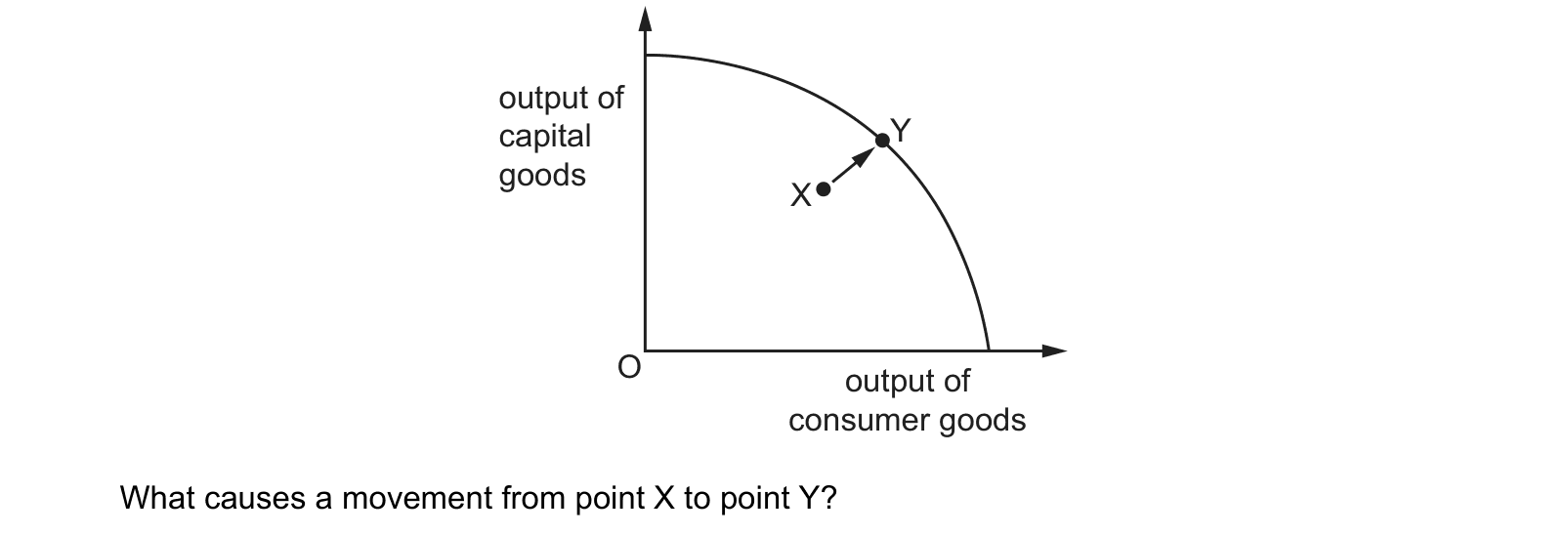
Answer: C.
Question 2
The following statistics are for Pakistan and refer to 2016. % GDP growth 5.7 population growth 2.0 rate of inflation 3.8 What was the approximate rate of growth of real GDP per capita for Pakistan in 2016?
Answer: A.
Question 3
What is likely to make the national income of a country less reliable as an indicator of the standard of living?
Answer: B.
Question 4
On a diagram showing a production possibility curve, what definitely represents long-run economic growth?
Answer: D.
Explanation:
- A production possibility curve (PPC) represents the maximum combination of goods and services that can be produced in an economy given its resources and technology.
- Long-run economic growth refers to the sustained increase in the economy's capacity to produce goods and services over time. This is represented by an outward shift of the PPC.
- When the PPC shifts outward, it signifies an increase in the economy's potential to produce more goods and services. This can result from factors such as technological advancement, increased capital investment, improved education and skills of the workforce, or better infrastructure.
- A change in the slope of the curve (A) typically represents a change in the opportunity cost of producing one good in terms of the quantity of the other good foregone. It does not necessarily indicate long-run economic growth.
- A movement from a point below the frontier to a point on the curve (B) represents the economy operating at full capacity, utilising all its resources efficiently. While it is a positive movement, it does not necessarily capture the concept of long-term economic growth.
- A movement from one point to another along a given curve (C) represents a change in the allocation of resources within the current production possibilities. It does not capture the idea of expanding the economy's capacity to produce more goods and services in the long run.
Question 5
What is the difference between a country’s gross domestic product and its gross national income?
Answer: C.
Explanation:
- Gross Domestic Product (GDP) is the total monetary or market value of all finished goods and services produced within a country's borders in a specific time period, usually annually. It measures the value of economic activity within a country's borders regardless of who owns the productive assets.
- Gross National Income (GNI), on the other hand, is the total income earned by a country's residents, including income earned from abroad. It is calculated by adding the income earned by the country's residents from abroad and subtracting the income earned by non-residents from the country. GNI includes GDP with net property income from abroad.
In the given options:
- A) Capital consumption refers to the depreciation or reduction in the value of fixed assets due to wear and tear or obsolescence. It is not the difference between GDP and GNI.
- B) Gross fixed capital formation refers to the net increase in physical assets within an economy. It is not the difference between GDP and GNI.
- D) The value of exports less imports is known as the trade balance or net exports, which is not the difference between GDP and GNI.
What this practice covers
These questions are drawn from past CIE 9708 papers and filtered to economic growth and sustainability. You answer, you find out immediately whether you were right, and you get the reasoning for the correct option and for each distractor. Wrong answers go to a mistakes locker so you can come back to exactly those.
Practice is free. You need an account only so your progress and your mistakes are still there next time.
What examiners see students get wrong here
These are the errors that cost marks on economic growth and sustainability, taken from our own topic notes. Read them before you practise and you will recognise the traps in the questions.
- Explaining potential growth with a rise in aggregate demand.
- Treating a negative output gap as the normal state and a positive one as impossible.
- Assuming a rising budget deficit in a recession proves fiscal mismanagement, when automatic stabilisers produce exactly that.
- Describing the phases of the cycle without explaining any cause.
- Confusing inclusive growth with sustainable growth. One is about who gets the gains, the other about whether they last.
- Using GDP per head to argue that ordinary people are better off, forgetting it is a mean.
- Asserting that growth always damages the environment, ignoring both abatement technology and the funding of it.
- Recommending international agreements without acknowledging the free-rider problem that weakens them.
Revise it first
If any of the above is unfamiliar, work through the notes before practising: Economic Growth and Sustainability revision notes.