Employment and Unemployment: five questions to try now
Real past-paper questions, the answer key from the mark scheme, and the explanation that goes with it. No account needed to answer them.
Question 1
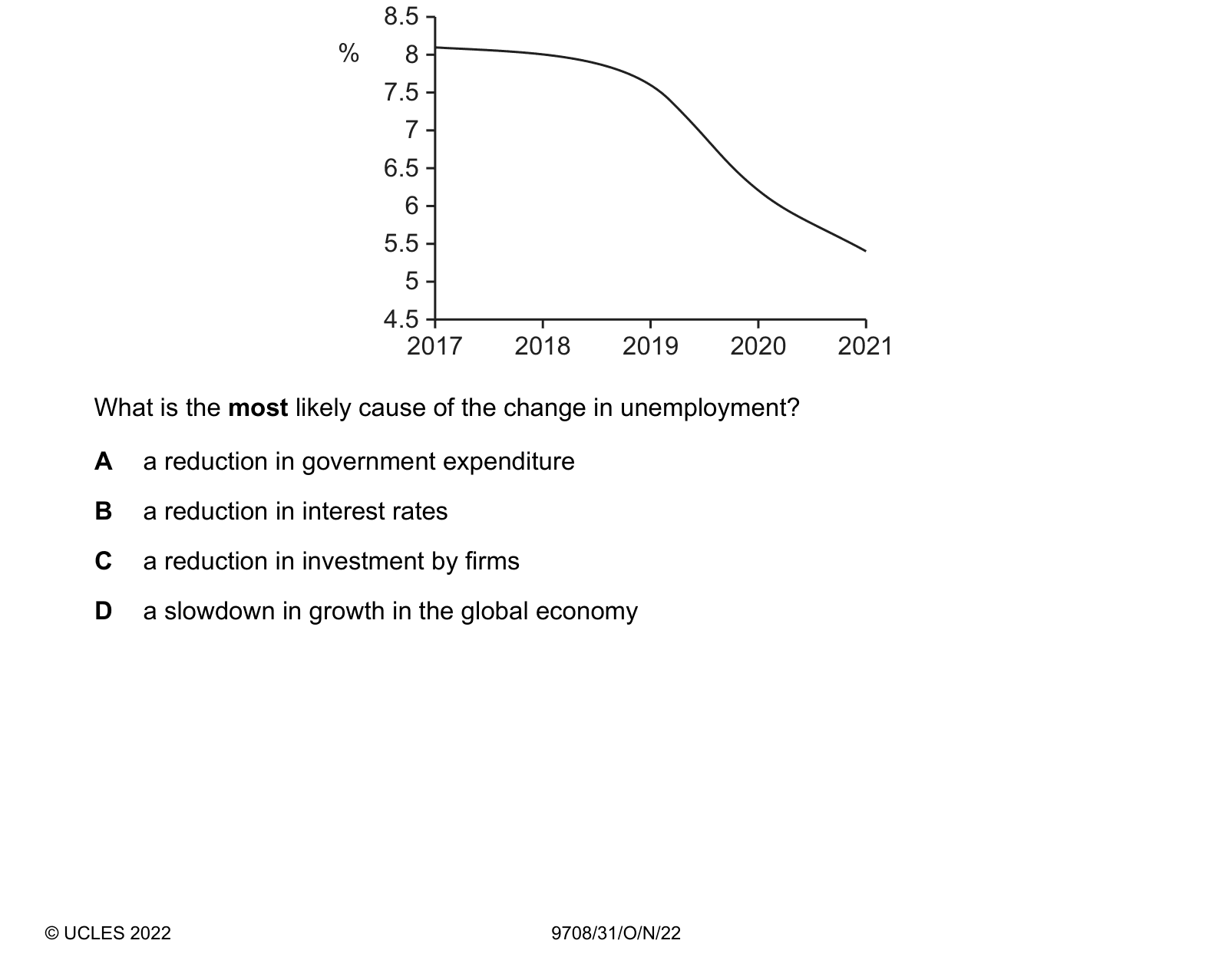
The graph shows the percentage unemployed in a country for the period 2017–2021. 8.5 8 7.5 7 6.5 6 5.5 5 4.5 2017 2018 2019 2020 2021 % What is the most likely cause of the change in unemployment?
Answer: B.
Explanation:
- A reduction in government expenditure (option A) would likely lead to a decrease in economic activity and may result in an increase in unemployment rather than a decrease in the percentage of unemployed people.
- A reduction in investment by firms (option C) would also typically lead to lower economic growth, potentially causing higher unemployment rates, rather than a decrease in unemployment.
- A slowdown in growth in the global economy (option D) would have negative implications for the country's economy, potentially increasing unemployment rates.
Therefore, in the context of the decreasing unemployment shown in the graph, a reduction in interest rates would be the most likely cause as it can stimulate economic activity and contribute to a decrease in the percentage of unemployed individuals.
Question 2
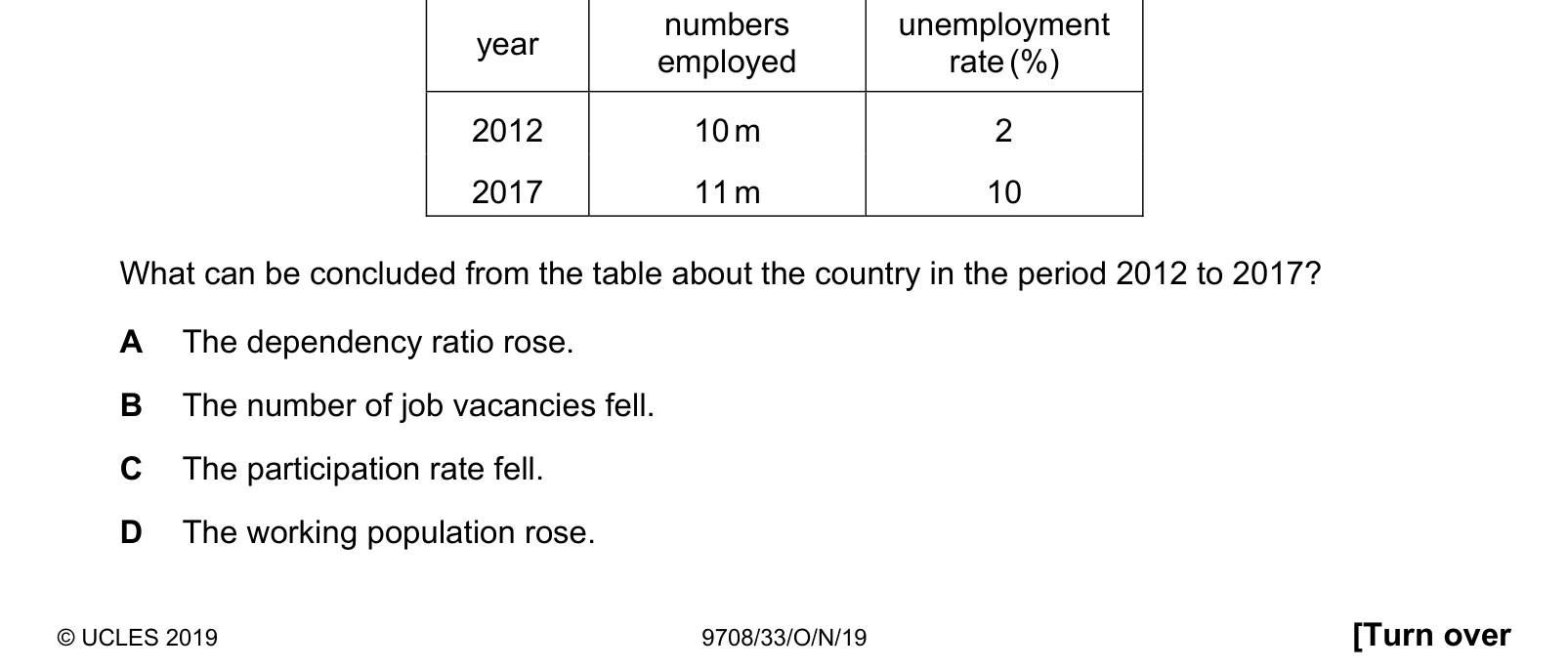
The table shows information about employment in a country. year numbers employed unemployment rate (%) 2012 10 m 2 2017 11 m 10 What can be concluded from the table about the country in the period 2012 to 2017?
Answer: D.
Explanation:
1. The table shows an increase in the number of people employed from 10 million in 2012 to 11 million in 2017. This indicates an increase in the working population over the period.
2. The unemployment rate also increased from 2% in 2012 to 10% in 2017, which suggests that more people were actively seeking employment during this period.
3. The increase in both the employed and unemployed populations signifies a growth in the overall working-age population or the labour force in the country.
4. A rising working population implies more individuals are engaged in economic activities, which could have various implications for the country's economy and development.
Therefore, based on the data provided in the table, it can be concluded that the working population of the country rose during the period from 2012 to 2017.
Question 3
The unemployment rate in an economy may continue to rise even after the economy has recovered from a recession.
Which explanation for this trend is not correct?
Answer: B.
Abolishing a minimum wage would reduce unemployment, not raise it. With no wage floor, firms can employ workers whose marginal revenue product falls below the previous minimum, so the demand for low-skilled labour increases. Whatever objections there are to abolishing a minimum wage, and there are serious ones on equity grounds; it cannot explain unemployment continuing to rise.
Why the other options are valid explanations:
- A, foreign businesses leaving the country, removes jobs permanently. The recovery in aggregate demand does not restore employers who have relocated abroad, so the unemployment is structural rather than cyclical.
- C, net migration of low-skilled workers, increases the labour force. Even with employment rising, the unemployment rate can climb if the workforce grows faster than the number of jobs, a point about the denominator that is easy to miss.
- D, workers losing skills, is hysteresis. Long spells out of work erode skills, currency with working practices and professional networks, so workers who were employable when they lost their jobs are no longer matched to the vacancies the recovery creates.
Question 4
An economist once said “if you pay people not to work and tax them when they do, don’t be surprised if you get unemployment”. What is this an example of?
Answer: D.
Question 5
In country X, unemployment is rising at the same time as the number of job vacancies is increasing.
What is the most likely reason for this?
Answer: D.
The puzzle is that unemployment and vacancies are rising together. If the problem were deficient demand, vacancies would be falling as firms stopped recruiting. Vacancies increasing while unemployment increases means jobs exist but the unemployed cannot fill them, which is a mismatch: the unemployed lack the skills the vacancies require. That is occupational immobility, and it produces structural unemployment.
Why the other options are wrong:
- A, falling economic growth, would cause cyclical unemployment. Unemployment would rise, but vacancies would fall as demand for labour weakened.
- B, rising economic growth, would raise vacancies but reduce unemployment as firms expanded.
- C, rising geographical mobility, would help workers move to where jobs are, so it would reduce unemployment and help fill vacancies. Falling geographical mobility would be a plausible answer; rising mobility is the wrong direction.
What this practice covers
These questions are drawn from past CIE 9708 papers and filtered to employment and unemployment. You answer, you find out immediately whether you were right, and you get the reasoning for the correct option and for each distractor. Wrong answers go to a mistakes locker so you can come back to exactly those.
Practice is free. You need an account only so your progress and your mistakes are still there next time.
What examiners see students get wrong here
These are the errors that cost marks on employment and unemployment, taken from our own topic notes. Read them before you practise and you will recognise the traps in the questions.
- Treating the original Phillips curve as a stable menu still available today.
- Failing to distinguish the short run curves from the vertical long run curve.
- Saying expectations shift the economy along the curve rather than shifting the curve itself.
- Confusing the natural rate with zero unemployment, or treating it as fixed forever.
- Explaining stagflation only by supply shocks and omitting expectations, or the reverse.
- Forgetting that reducing inflation has a cost in unemployment above the natural rate.
- Ignoring hysteresis, which leaves the answer unable to justify any demand-side response.
Revise it first
If any of the above is unfamiliar, work through the notes before practising: Employment and Unemployment revision notes.