Protectionism: one question to try now
Real past-paper questions, the answer key from the mark scheme, and the explanation that goes with it. No account needed to answer them.
Question 1
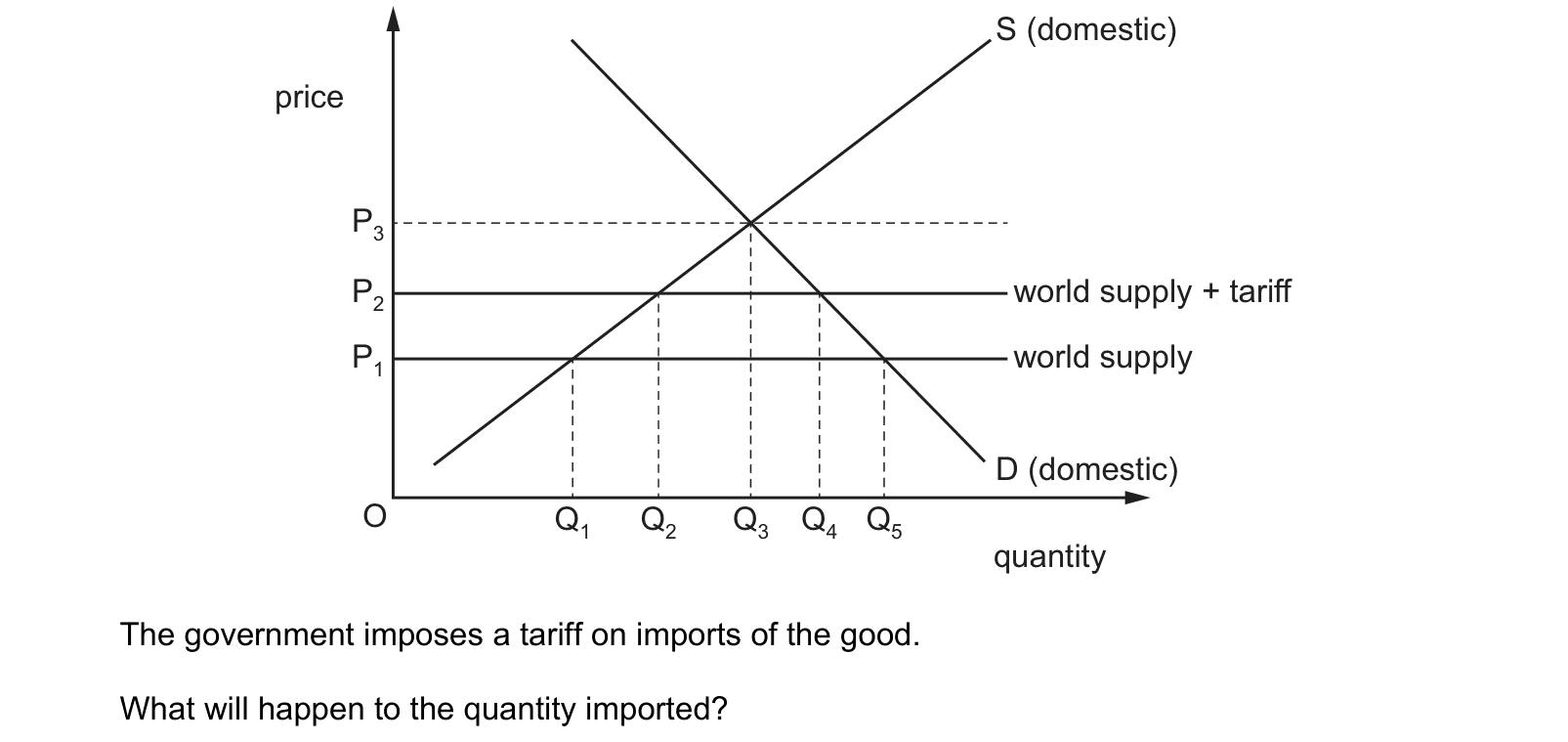
The diagram shows the domestic and world demand and supply for a good. The government imposes a tariff on imports of the good. What will happen to the quantity imported?
Answer: B.
Explanation: When a tariff is imposed on imports of a good, the domestic price of the good will rise relative to the world price. This leads to a decrease in the quantity demanded by domestic consumers and an increase in the quantity supplied by domestic producers.
In the diagram, the initial quantity imported is represented by the difference between Q1Q5 (world supply) and Q1Q3 (domestic demand). After the imposition of the tariff, the domestic price will increase to P2, leading to a decrease in the quantity demanded domestically to Q4. At the same time, domestic producers will increase their quantity supplied to Q2.
The new quantity imported after the imposition of the tariff is the difference between Q2Q4 (domestic supply) and Q2Q3 (domestic demand), which is represented as a decrease from Q1Q5 to Q2Q4. This means that the correct answer is B.
Therefore, option B is the correct answer as it accurately reflects the decrease in the quantity imported due to the imposition of a tariff.
What this practice covers
These questions are drawn from past CIE 9708 papers and filtered to protectionism. You answer, you find out immediately whether you were right, and you get the reasoning for the correct option and for each distractor. Wrong answers go to a mistakes locker so you can come back to exactly those.
Practice is free. You need an account only so your progress and your mistakes are still there next time.
What examiners see students get wrong here
These are the errors that cost marks on protectionism, taken from our own topic notes. Read them before you practise and you will recognise the traps in the questions.
- Saying all protection benefits the whole domestic economy.
- Treating government tariff revenue as a net welfare gain.
- Assuming quota rents always go to the government.
- Confusing an import quota with an export quota.
- Treating export subsidies as ordinary production subsidies.
- Saying export subsidies necessarily lower the domestic price.
- Calling every safety regulation protectionist.
- Defining dumping simply as any import sold cheaply.
Revise it first
If any of the above is unfamiliar, work through the notes before practising: Protectionism revision notes.