Types of Markets: five questions to try now
Real past-paper questions, the answer key from the mark scheme, and the explanation that goes with it. No account needed to answer them.
Question 1
The table shows characteristics of a market. What are the characteristics of a perfectly competitive market?
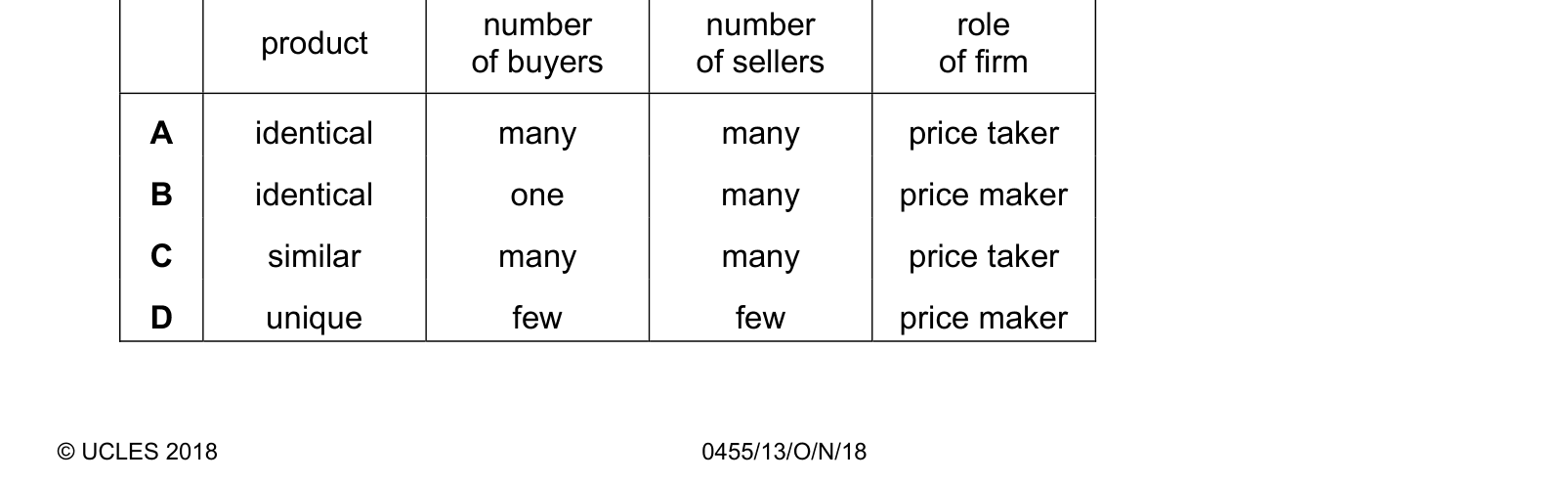
Answer: A.
Question 2
A private sector firm is the only supplier of rail services between two cities. What will stop the firm charging very high ticket prices?
Answer: B.
A firm can only exploit its position if consumers have no alternative. A rail operator between two cities may be the sole rail supplier, but travellers can go by bus, coach or car instead. Those substitutes make demand for rail travel more price elastic: push fares too high and passengers switch to the road, so revenue falls. The threat of losing customers to a different mode of transport is what restrains the firm's pricing, and it is why competition authorities define markets by what consumers can substitute rather than by industry labels.
Why the other options are wrong:
- A, barriers to entry into rail services, is what protects the firm's position. Barriers keep potential rail competitors out, so they enable high prices rather than preventing them.
- C, government policy encouraging monopoly power, would again support high prices. (Policy restraining monopoly, regulation or a price cap, would restrain them, which is the opposite of what the option says.)
- D, high costs of maintaining rail track, raises the firm's costs, which pushes prices up rather than holding them down.
Question 3
A private firm is one of a few suppliers of electricity in an economy. It is fined by the government for pollution from its coal-fired power stations which affect the health of those living nearby. What does this situation involve?
Answer: D.
Pollution from the coal-fired power stations harms the health of nearby residents. Those residents are third parties: they are neither the firm nor its customers, and they took no part in the transaction, yet they bear a real cost. A cost falling on people outside the transaction is an external cost, or negative externality. The fine is the government's attempt to make the firm bear that cost itself, so that private cost moves closer to social cost.
Why the other options are wrong:
- B says the market structure is perfect competition. The question describes "one of a few suppliers", which is an oligopoly. Perfect competition requires very many firms.
- C says a monopoly supplier ignoring government controls. It is not a monopoly, since there are several suppliers, and the firm has been fined rather than shown to be ignoring the rules, the fine is the control working.
- A says a policy of nationalising an electricity supplier. Nothing suggests a transfer to state ownership; the firm remains private and has simply been penalised.
Question 4
Which statement explains why firms in perfect competition are not able to exploit consumers?
Answer: D.
In perfect competition consumers and producers know everything relevant about the market, the prices every firm charges and the quality of every product. That knowledge is what prevents exploitation: if any firm tried to charge above the market price, buyers would know immediately and switch to a competitor selling the identical product for less. The firm would lose all its custom, so it has no power to overcharge and must accept the market price. Perfect information, combined with a homogeneous product and many sellers, is what makes each firm a price taker.
Why the other options are wrong:
- A, firms restricting output, is what a monopolist does to raise price. In perfect competition each firm is too small a part of the market to affect price by changing its own output.
- B, differentiated products, describes monopolistic competition. In perfect competition products are identical, which is precisely why consumers can switch costlessly.
- C, barriers to entry, are a feature of monopoly and oligopoly. Perfect competition assumes free entry and exit, which is what competes abnormal profits away in the long run.
Question 5
Which characteristic can exist both in monopoly and in perfect competition?
Answer: B.
Monopoly and perfect competition sit at opposite ends of the spectrum on the supply side, one seller against very many, but nothing in either model restricts the number of buyers. A monopolist typically sells to a large market of consumers; a perfectly competitive industry does the same. Many buyers is therefore the characteristic they share.
Why the other options are wrong:
- A, freedom of entry, is a defining feature of perfect competition and the very thing monopoly lacks. Barriers to entry are what allow a monopolist's profits to persist.
- C, many sellers, is the essence of perfect competition and the direct opposite of monopoly, which has one.
- D, a perfectly elastic demand curve, applies to the individual perfectly competitive firm: it can sell any quantity at the market price, so its demand curve is horizontal. A monopolist faces a downward-sloping demand curve, which is precisely what gives it the power to set price.
What this practice covers
These questions are drawn from past Cambridge IGCSE papers and filtered to types of markets. You answer, you find out immediately whether you were right, and you get the reasoning for the correct option and for each distractor. Wrong answers go to a mistakes locker so you can come back to exactly those.
Practice is free. You need an account only so your progress and your mistakes are still there next time.
What examiners see students get wrong here
These are the errors that cost marks on types of markets, taken from our own topic notes. Read them before you practise and you will recognise the traps in the questions.
- Saying monopoly is always bad, mention economies of scale and natural monopoly.
- Forgetting barriers to entry, which are what allow a monopoly to persist.
- Saying competitive firms make no profit. They make normal profit; abnormal profit is competed away.
- Confusing a monopoly with a large firm. What matters is the lack of competition, not size alone.
- Listing government policies without giving a drawback of any.
Revise it first
If any of the above is unfamiliar, work through the notes before practising: Types of Markets revision notes.