Current Account of the Balance of Payments: five questions to try now
Real past-paper questions, the answer key from the mark scheme, and the explanation that goes with it. No account needed to answer them.
Question 1
The table shows components of Japan’s current account balance in trillion Yen (¥) for 2011 and
2012.
year balance of goods
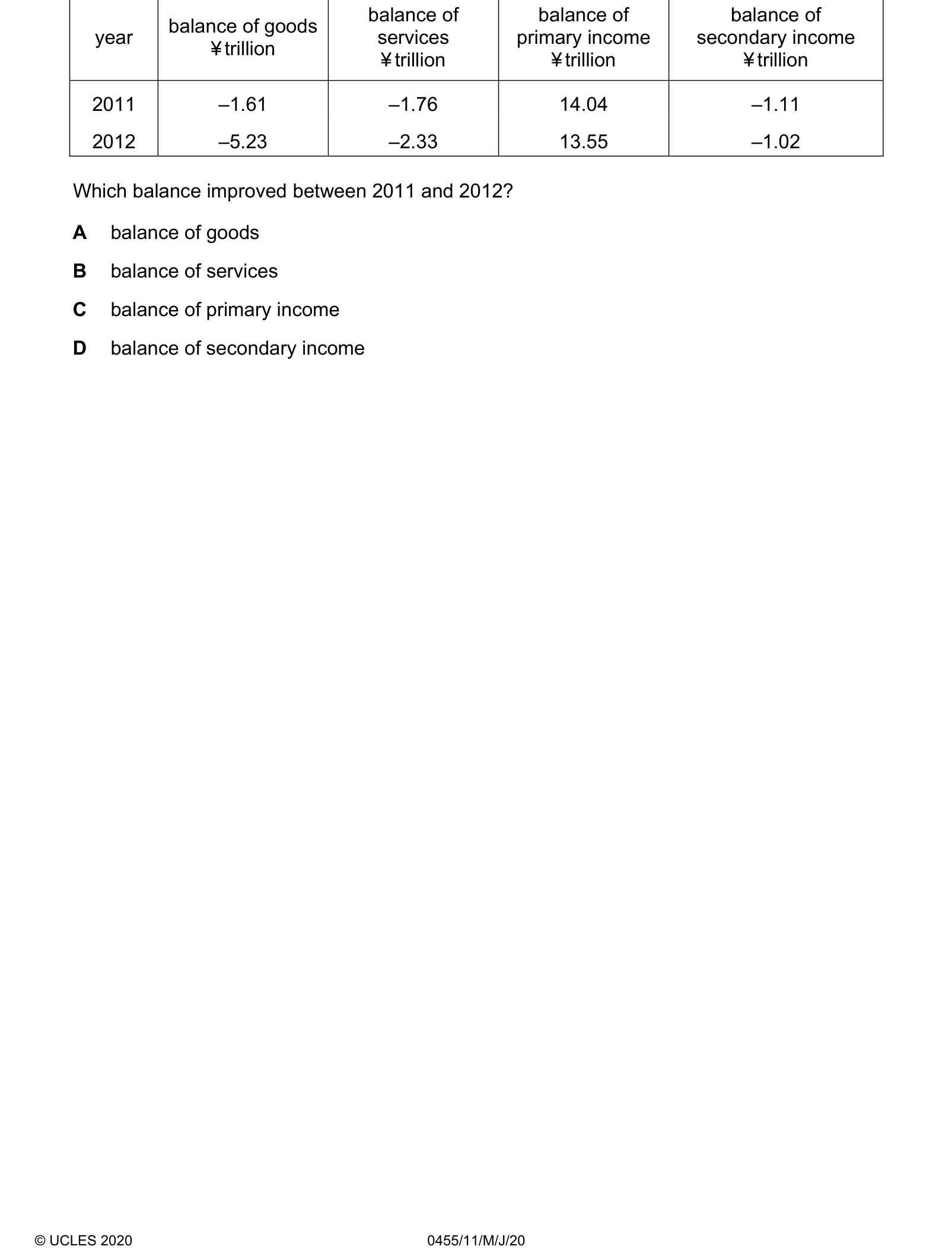
Answer: D.
An improvement means the balance moved in a favourable direction, which for a deficit means becoming smaller and for a surplus means becoming larger. Take each in turn. Secondary income moved from minus 1.11 to minus 1.02 trillion yen, so the deficit shrank by 0.09 trillion. That is the only one of the four that improved.
Why the other options are wrong:
- A, the balance of goods, went from minus 1.61 to minus 5.23 trillion yen. The deficit more than trebled, which is much the largest deterioration in the table.
- B, the balance of services, went from minus 1.76 to minus 2.33 trillion yen, so that deficit widened too.
- C, the balance of primary income, went from plus 14.04 to plus 13.55 trillion yen. It is still comfortably in surplus, which makes it the most tempting wrong answer, but a surplus that shrinks by 0.49 trillion has got worse, not better.
Question 2
A person in country X receives a dividend payment on shares that they hold in a firm in
country Y.
In which section of the current account of the balance of payments for country X will this dividend
appear?
Answer: A.
Primary income records cross-border returns to factors of production, profits, dividends, interest and wages earned abroad. A dividend is a return on capital supplied to a firm in another country, so a resident of country X receiving a dividend from a firm in country Y is earning primary income, and it appears as a credit in X's current account.
Why the other options are wrong:
- B, secondary income, records transfers: payments made with nothing supplied in return, such as foreign aid and workers' remittances. A dividend is payment for capital supplied, so something was contributed.
- C, trade in goods, records physical products crossing the border. No good has moved.
- D, trade in services, records services supplied to non-residents, tourism, transport, insurance, banking. Owning shares is not supplying a service.
Question 3
In trying to achieve one of its aims a government may make it difficult to achieve another aim. What is an example of this conflict?
Answer: C.
This is the classic conflict between macroeconomic objectives. Pushing unemployment down requires raising aggregate demand, and as the economy approaches full capacity, spare resources run out. Firms compete for a shrinking pool of available workers and bid wages up, input costs rise, and because output cannot easily expand, the extra demand shows up in prices. Lower unemployment is therefore bought at the cost of higher inflation, the short-run Phillips curve trade-off.
Why the other options are wrong:
- A says a more even income distribution may prevent rising average living standards. Redistribution can weaken incentives, so there is an efficiency argument here, but it is contested and indirect, and transferring income towards those with a higher propensity to consume can raise demand and output.
- B says higher economic growth may prevent full employment. These objectives are complementary, not conflicting: producing more output requires more workers, so growth and employment normally move together.
- D says stable prices may prevent a current account surplus. Low inflation actually helps the current account, by keeping exports price competitive against foreign rivals.
Question 4
Which item will register as an outflow on the services section of the current account of the US balance of payments?
Answer: D.
An outflow on the services section means money leaving the country to pay foreign suppliers of a service. US tourists paying for entrance fees, hotels and meals abroad are buying foreign services, so this is an import of services and a debit in the current account.
Why the other options are wrong:
- A, money paid for foreign oil, is an outflow, but oil is a good. It belongs in trade in goods, not services.
- B, money paid by foreign firms for US cars, is an inflow: and of goods, not services. It is a credit in trade in goods.
- C, money paid by migrant workers to families overseas, is an outflow, but a remittance is a transfer with nothing supplied in return. Transfers belong in secondary income, not services.
Question 5
What is a country said to have if the value of its exported goods exceeds the value of its imported
goods?
Answer: B.
The balance of trade compares the value of exports with the value of imports. When exported goods are worth more than imported goods, the balance of trade in goods is in surplus. That is precisely what the question describes, so B is the exact term.
Why the other options are wrong:
- D, a surplus on the current account, is broader. The current account is trade in goods plus trade in services, primary income and secondary income. A goods surplus does not guarantee a current account surplus, because a large deficit on services or income could outweigh it.
- A, a surplus on the balance of payments, is broader still, it covers the current account and the financial account together. The overall balance of payments balances by construction, so a "surplus" on it is not a meaningful description of a goods position.
- C, a surplus on the capital account, concerns transfers of capital assets. It has nothing to do with trade in goods.
What this practice covers
These questions are drawn from past Cambridge IGCSE papers and filtered to current account of the balance of payments. You answer, you find out immediately whether you were right, and you get the reasoning for the correct option and for each distractor. Wrong answers go to a mistakes locker so you can come back to exactly those.
Practice is free. You need an account only so your progress and your mistakes are still there next time.
What examiners see students get wrong here
These are the errors that cost marks on current account of the balance of payments, taken from our own topic notes. Read them before you practise and you will recognise the traps in the questions.
- Confusing the balance of trade (goods and services only) with the whole current account.
- Forgetting primary and secondary income, especially remittances.
- Saying a deficit is always harmful, without asking what is causing it.
- Saying a surplus is always good.
- Recommending protection without mentioning retaliation.
- Ignoring that expenditure-reducing policies raise unemployment.
Revise it first
If any of the above is unfamiliar, work through the notes before practising: Current Account of the Balance of Payments revision notes.