7 past-paper questions on this unit. Five of them are below. Answer on the page: each one is marked the moment you pick, the correct option is shown whether or not you found it, and the full explanation opens either way.
CIE 0620 ChemistryPaper 1 and Paper 2 MCQsFree account
Transition elements: five questions to try now
Real past-paper questions, the answer key from the mark scheme, and the explanation that goes with it. No account needed to answer them.
Question 1
The properties of an element are listed. Its melting point is 3414 °C. Some of its compounds are catalysts. It has variable oxidation states. Where is the element found in the Periodic Table?
Answer: D.
Three separate clues all point the same way. A melting point of 3414 °C is extraordinarily high, far above any alkali metal, and such melting points come from the strong metallic bonding of transition metals. Compounds acting as catalysts and the existence of variable oxidation states are both characteristic transition metal behaviour and are close to defining features. Alkali metals melt at low temperatures and form only a single positive ion, so they fail two clues out of three. Halogens and noble gases are non metals with low melting points and no catalytic role of this kind.
Question 2
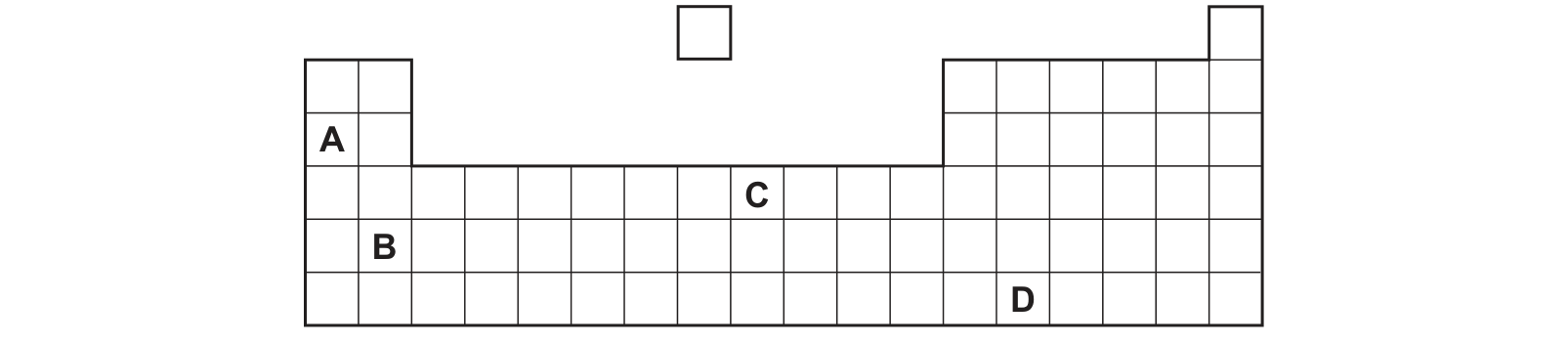
Part of the Periodic Table is shown. Which element is a transition element? Use the source image for W21 Paper 12, question 23.
Answer: C.
Transition elements occupy the central block lying between Group II and Group III, so the letter to look for is the one sitting in that middle section rather than in the tall columns on either side. Only one of the four letters is placed there. The letter in the first column on the left is in Group I, an alkali metal, and the one in the second column is in Group II, both main group metals rather than transition elements. The letter in the block on the right is a main group element too. Position alone answers this, since occupying the central block is what defines a transition element.
Question 3
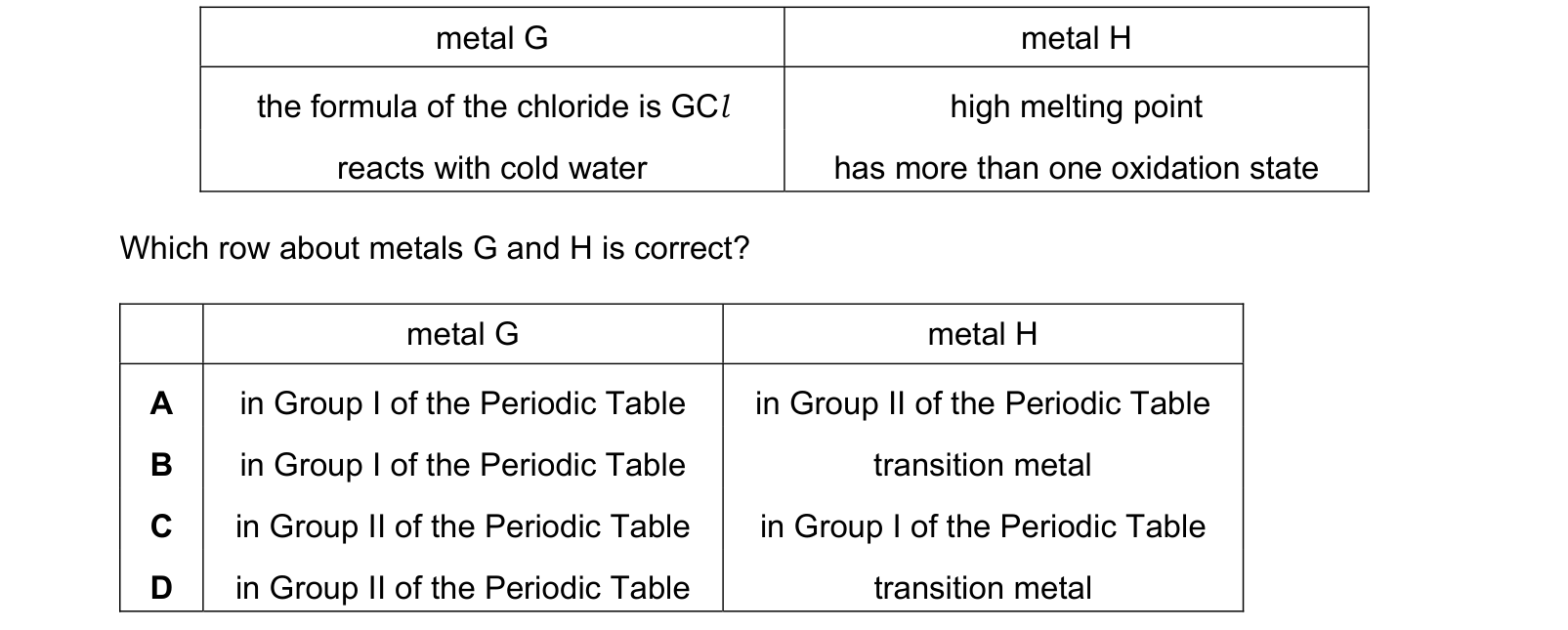
Some properties of two metals, G and H, are shown. metal G metal H the formula of the chloride is GCl high melting point reacts with cold water has more than one oxidation state Which row about metals G and H is correct? Each answer gives, in order: metal G; metal H.
Answer: B.
The formula GCl shows a one to one ratio with chloride, so G forms a single positive ion, and reacting with cold water on top of that is alkali metal behaviour, which places G in Group I. Metal H has a high melting point and more than one oxidation state, and variable oxidation state is a defining property of the transition metals while a high melting point fits their strong metallic bonding. Group I with transition metal is therefore the row. A Group II metal would give a chloride of formula GCl2 rather than GCl, which rules out both rows beginning there.
Question 4
Which elements have both a high melting point and variable oxidation states?
Answer: B.
High melting points and variable oxidation states are two of the standard characteristics of the transition elements, alongside coloured compounds and catalytic behaviour; iron, melting at 1538 °C and appearing as both Fe2+ and Fe3+, is the classic example. Alkali metals have metallic bonding but only one outer electron to contribute, so they melt at low temperatures and form a single ion only. Halogens are non metals with low melting points and no metallic character at all. Noble gases have the lowest melting points in the table and form essentially no compounds, so they have no oxidation states to vary.
Question 5
Which property of transition elements is different from the properties of Group I metals?
Answer: C.
Group I metals and transition metals share most metallic properties: both conduct electricity, both are malleable and both form basic oxides. What separates them is that transition metals form coloured compounds, such as blue copper(II) sulfate and green iron(II) salts, while Group I compounds are almost all white solids giving colourless solutions. Conductivity and malleability follow from metallic bonding, which both kinds of metal have. Forming basic oxides follows from being a metal at all, which again both are, so neither of those can tell them apart.
These questions are drawn from past CIE 0620 Chemistry papers and filtered to transition elements. You answer, you find out immediately whether you were right, and you get the reasoning for the correct option and for each distractor. Wrong answers go to a mistakes locker so you can come back to exactly those.
Practice is free. You need an account only so your progress and your mistakes are still there next time.
These are the errors that cost marks on transition elements, taken from our own topic notes. Read them before you practise and you will recognise the traps in the questions.
Saying transition elements are more reactive than Group I metals.
Expecting all transition metal compounds to be coloured, when zinc compounds are white or colourless.
Giving iron(II) hydroxide as red-brown and iron(III) hydroxide as green, which is the wrong way round.
Saying copper(II) hydroxide dissolves in excess sodium hydroxide, when it does not.
Leaving the Roman numeral out of a name where the oxidation number varies.
Saying transition elements always form +2 ions.
Naming a catalyst without naming the process it catalyses, which is usually where the mark is.