33 past-paper questions on this unit. Five of them are below. Answer on the page: each one is marked the moment you pick, the correct option is shown whether or not you found it, and the full explanation opens either way.
CIE 9706 AccountingPaper 1 MCQsFree account
Efficiency ratios: five questions to try now
Real past-paper questions, the answer key from the mark scheme, and the explanation that goes with it. No account needed to answer them.
Question 1
The trade receivables turnover of a business has been calculated for two years. turnover in days this year 60 last year 50 What is a possible reason for the change?
Answer: D.
The collection period has lengthened from 50 days to 60, so customers are taking longer to settle their accounts, and the likeliest reason is that they are short of cash, which is D. A is about discounts RECEIVED, which arise on what the business pays its own suppliers and never touch the receivables ratio. B is wrong because a bigger margin changes the profit earned on each sale, not the speed at which the customer pays for it. C points the wrong way twice over, since cash sales are excluded from this ratio altogether and a shift towards cash would if anything suggest faster collection. Read the direction carefully here, because more days always means slower payment even though the word turnover sounds like something speeding up.
Question 2
The following information is available. sales $250 000 purchases $120 000 average inventory $20 000 mark-up 25% What is the rate of inventory turnover?
Answer: C.
Mark-up is on COST, so a mark-up of 25% means the $250 000 of sales is 125% of cost, and cost of sales is $250 000 over 1.25, which is $200 000. Average inventory is handed to you as $20 000, so the rate of inventory turnover is $200 000 over $20 000, which is 10.0 times, giving C. B of 9.4 times is the wrong base and the whole point of the question: it takes 25% off sales as though the figure were a margin, leaving cost of sales of $187 500 and 9.375 times. D of 12.5 times divides sales straight by inventory without converting to cost at all. A of 6.0 times uses the $120 000 of purchases in place of cost of sales, which ignores the inventory movement completely.
Question 3
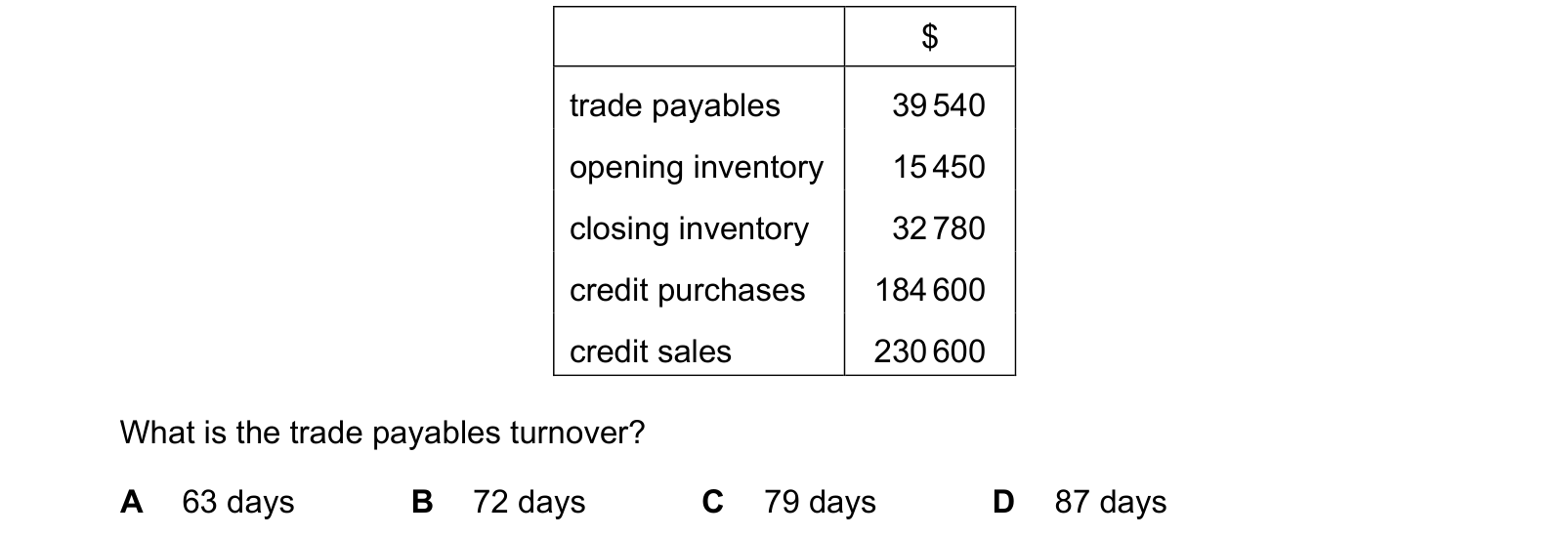
A business provides the following information. $ trade payables 39 540 opening inventory 15 450 closing inventory 32 780 credit purchases 184 600 credit sales 230 600 What is the trade payables turnover?
Answer: C.
Payables days pair the trade payables balance with CREDIT PURCHASES, and this syllabus uses the closing balance rather than an average. $39 540 over $184 600 times 365 is 78.2, which the paper gives as 79 days, so C. D of 87 days puts payables over cost of sales, $15 450 plus $184 600 less $32 780, or $167 270, but cost of sales belongs in the inventory ratio and not in this one. B of 72 days does the same thing while adding and deducting the inventories the wrong way round, reaching $201 930. A of 63 days pairs payables with the $230 600 of credit sales, which measures nothing at all, because the suppliers you owe have no connection to what your customers bought.
Question 4
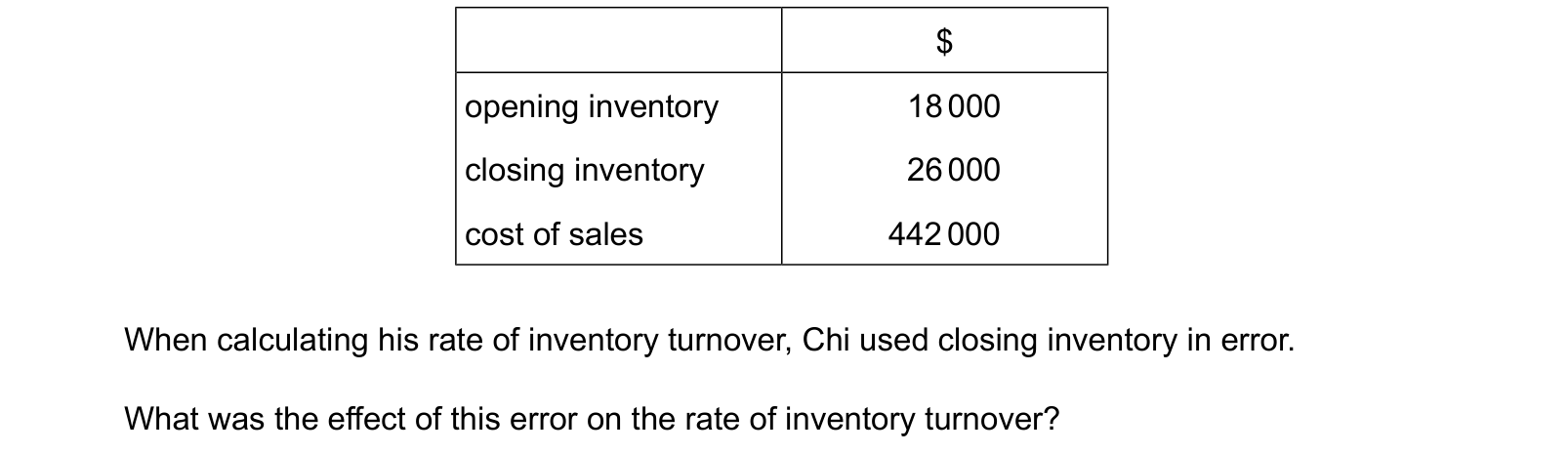
The following information is available about Chi’s business. When calculating his rate of inventory turnover, Chi used closing inventory in error. What was the effect of this error on the rate of inventory turnover?
Answer: B.
The rate of inventory turnover is cost of sales over AVERAGE inventory, so it should be $442 000 over $18 000 plus $26 000 over 2, that is $442 000 over $22 000, which is 20.09 times. Chi divided by the closing inventory of $26 000 instead, giving exactly 17 times. Inventory grew across the year, so closing inventory is bigger than the average, and a bigger denominator makes the rate SMALLER: his figure is 3.09 times too low, which is B. A carries the right size with the wrong direction, and that is the easiest mark to lose here. C and D of 7.55 measure the gap from the opening inventory figure of 24.56 times, comparing Chi's answer with another wrong calculation rather than with the correct one.
Question 5
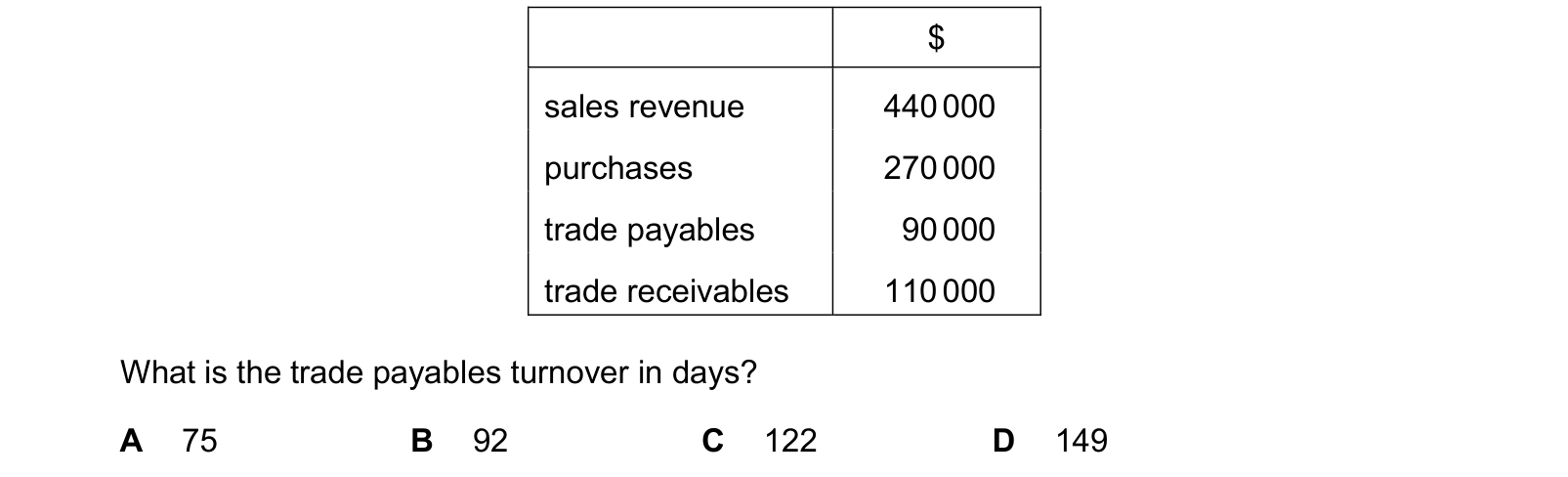
A company purchases its inventory on credit. The following information is available. $ sales revenue 440 000 purchases 270 000 trade payables 90 000 trade receivables 110 000 What is the trade payables turnover in days?
Answer: C.
Payables days put the trade payables balance over CREDIT PURCHASES, and the stem states that all inventory is bought on credit, so the base is the whole $270 000. $90 000 over $270 000 times 365 is 121.7, given here as 122 days, so C. A of 75 sets the same $90 000 against sales revenue of $440 000, which is the wrong base entirely, because what you owe your suppliers has nothing to do with what you sold. B of 92 is the receivables ratio, $110 000 over $440 000, answering a question that was not asked. D of 149 crosses the two, putting the $110 000 owed BY customers over purchases.
These questions are drawn from past CIE 9706 Accounting papers and filtered to efficiency ratios. You answer, you find out immediately whether you were right, and you get the reasoning for the correct option and for each distractor. Wrong answers go to a mistakes locker so you can come back to exactly those.
Practice is free. You need an account only so your progress and your mistakes are still there next time.
These are the errors that cost marks on efficiency ratios, taken from our own topic notes. Read them before you practise and you will recognise the traps in the questions.
Using revenue instead of cost of sales in the inventory ratios.
Using total sales when credit sales are given.
Multiplying by 12 and calling the answer days, or by 365 and calling it months.
Confusing the inventory turnover period in days with the rate of turnover in times per year. They are reciprocals of each other.
Saying a shorter receivables period is always better, with no mention of losing customers.
Ignoring the credit terms actually offered when judging the receivables period.
Reporting each ratio separately and never connecting them.