31 past-paper questions on this unit. Five of them are below. Answer on the page: each one is marked the moment you pick, the correct option is shown whether or not you found it, and the full explanation opens either way.
CIE 0452 AccountingPaper 1 MCQsFree account
Incomplete records: five questions to try now
Real past-paper questions, the answer key from the mark scheme, and the explanation that goes with it. No account needed to answer them.
Question 1
Sami maintains a full set of accounting records. Why does Sami find it useful to complete the cheque counterfoil when he pays a credit supplier by cheque?
Answer: C.
A cheque counterfoil is the stub left when the cheque is written, carrying the date, payee and amount, so it is the record the business uses to enter that payment on the credit side of the cash book. C is correct. A names the purchases account, which is written up from the purchases journal when the goods arrive, not when they are paid for. B describes the bank statement's role. D claims too much: a counterfoil is the trader's own note of what he wrote, so it can prove what he intended but not that the amount was right.
Question 2
The capital of a business is higher at the end of year 2 than it was at the end of year 1. No additional capital has been introduced during year 2. What does this mean?
Answer: B.
Capital rises through profit and falls through drawings, and it rises through capital introduced, which the question has ruled out. So if capital is higher at the end of year 2, the business must have earned a profit, and B is correct. A states the opposite. C is wrong because selling a non-current asset at book value simply swaps one asset for another and leaves capital where it was. D is wrong because a loan increases the assets and the liabilities equally, so capital is unchanged.
Question 3
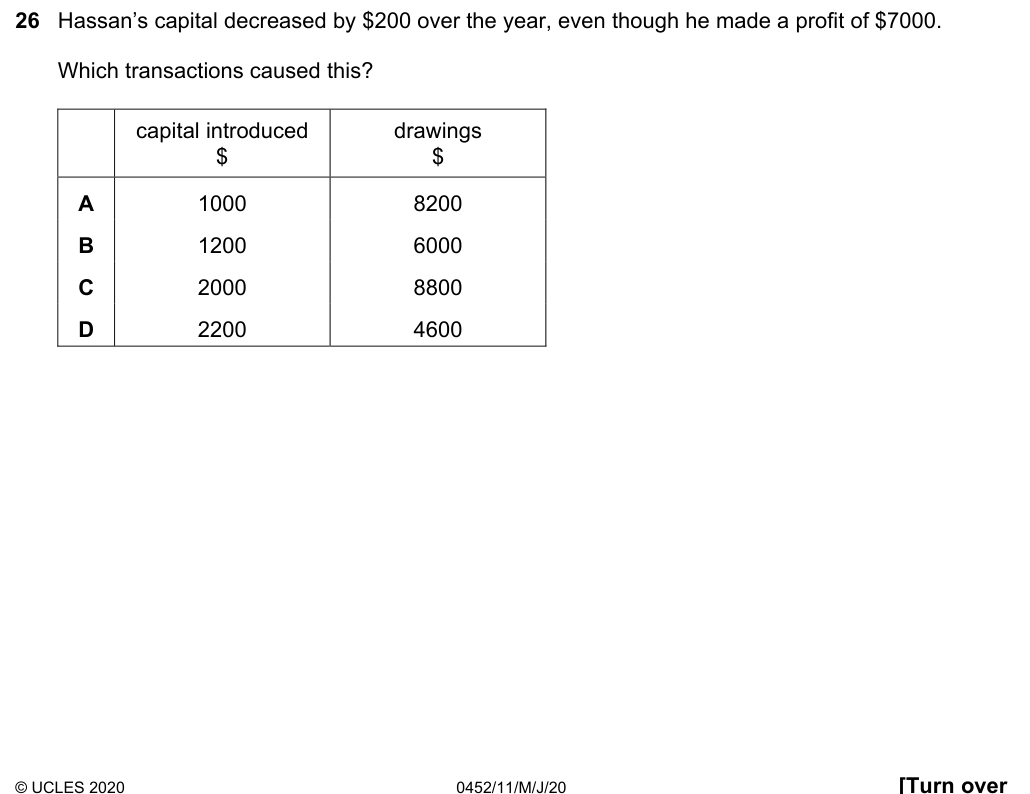
Hassan’s capital decreased by $200 over the year, even though he made a profit of $7000. Which transactions caused this? Use the complete source image for the question and answer choices. Source reference: S20 Paper 11, Q26.
Answer: A.
Capital changes by the profit, plus anything the owner puts in, less anything he takes out. Hassan's capital fell by 200 despite a profit of 7000, so the introductions less the drawings must come to minus 7200. Only A satisfies that: 1000 introduced against 8200 of drawings is exactly minus 7200. B gives minus 4800, C minus 6800 and D minus 2400, so none of them leaves the capital 200 lower. The quickest route is to test each pair against the 7200 rather than to work each option through in full.
Question 4
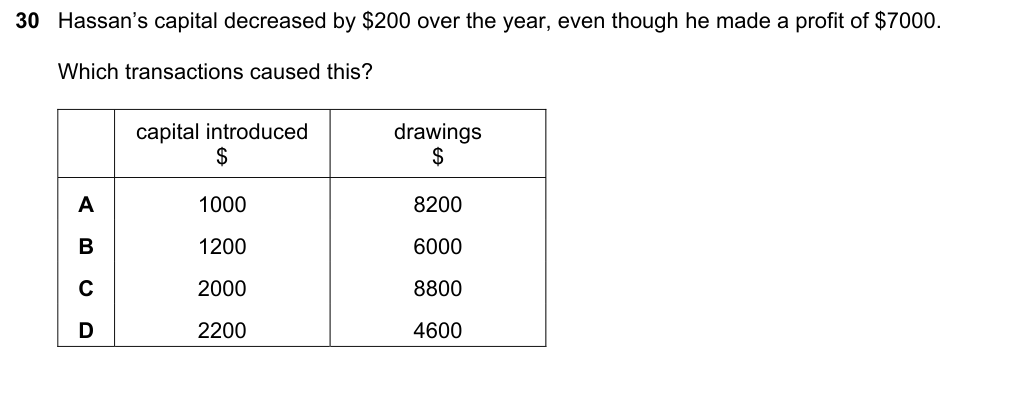
Hassan’s capital decreased by $200 over the year, even though he made a profit of $7000. Which transactions caused this? Use the complete source image for the question and answer choices. Source reference: S23 Paper 11, Q30.
Answer: A.
Capital changes by the profit, plus anything the owner puts in, less anything he takes out. Hassan's capital fell by 200 despite a profit of 7000, so the introductions less the drawings must come to minus 7200. Only A satisfies that: 1000 introduced against 8200 of drawings is exactly minus 7200. B gives minus 4800, C minus 6800 and D minus 2400, so none of them leaves the capital 200 lower. The quickest route is to test each pair against the 7200 rather than to work each option through in full.
Question 5
Sumit does not maintain a full set of accounting records. What does Sumit not need to calculate his credit sales?
Answer: C.
Credit sales are reconstructed from the trade receivables account, so Sumit needs everything that passes through a customer's balance: the returns that cancel part of a sale, the discount allowed on settlement, and a dishonoured cheque that puts a debt back. Discounts RECEIVED come from suppliers and belong in the trade payables account, so they never touch a customer's balance and C is correct. The test for every one of these questions is the same: ask which account the item would be posted to, and if it is not the receivables account it plays no part in finding credit sales.
These questions are drawn from past CIE 0452 Accounting papers and filtered to incomplete records. You answer, you find out immediately whether you were right, and you get the reasoning for the correct option and for each distractor. Wrong answers go to a mistakes locker so you can come back to exactly those.
Practice is free. You need an account only so your progress and your mistakes are still there next time.
These are the errors that cost marks on incomplete records, taken from our own topic notes. Read them before you practise and you will recognise the traps in the questions.
Using mark-up where the question gives margin, or the reverse.
Forgetting to add back drawings when calculating profit from the change in capital.
Adding capital introduced instead of deducting it in that same calculation.
Calling a statement of affairs a statement of financial position.
Treating cash received from customers as the sales figure.
Forgetting the opening balances when reconstructing an account.
Giving only the final answer, when each step of the reconstruction carries its own mark.