153 past-paper questions on this unit. Five of them are below. Answer on the page: each one is marked the moment you pick, the correct option is shown whether or not you found it, and the full explanation opens either way.
CIE 0625 PhysicsPaper 1 and Paper 2 MCQsFree account
Electric circuits: five questions to try now
Real past-paper questions, the answer key from the mark scheme, and the explanation that goes with it. No account needed to answer them.
Question 1
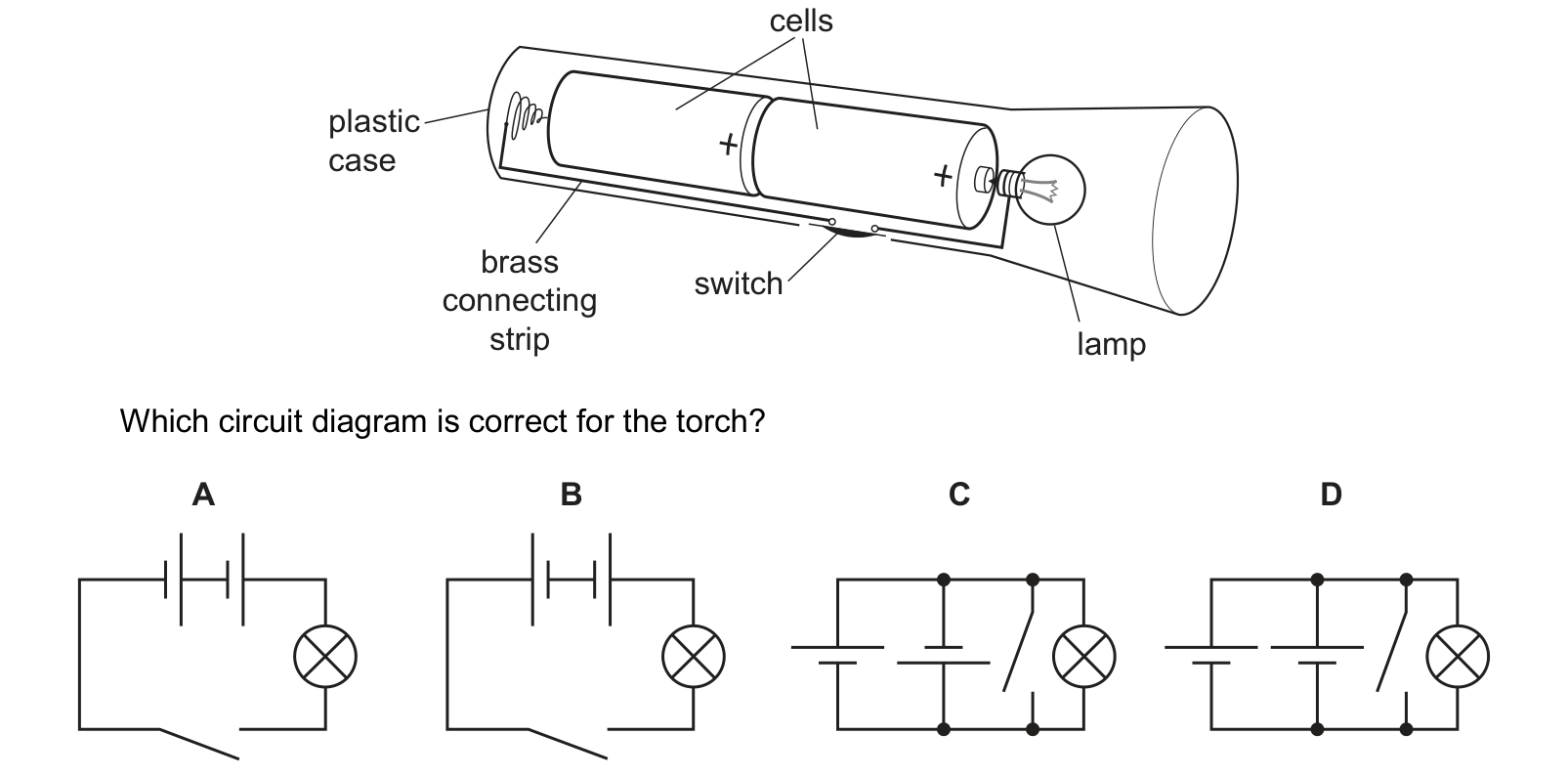
The diagram shows a torch containing two cells, a switch and a lamp. Which circuit diagram is correct for the torch? Use the source image for W24 Paper 13, question 28.
Answer: A.
In the torch the two cells lie end to end with both plus terminals facing the same way, and the brass strip carries the current on through the switch to the lamp, so all four parts sit on one series loop. A is the only diagram that matches: the two cell symbols are drawn end to end with the long plate of each on the same side, so their e.m.f.s add, and the switch and lamp are in series with them. In B the second cell symbol is turned round, so the two short plates face each other, the cells oppose and the net e.m.f. would be zero. C and D both connect the two cells side by side across the same pair of junctions, which is a parallel arrangement rather than the end to end one shown, and it would give the lamp only the voltage of a single cell.
Question 2
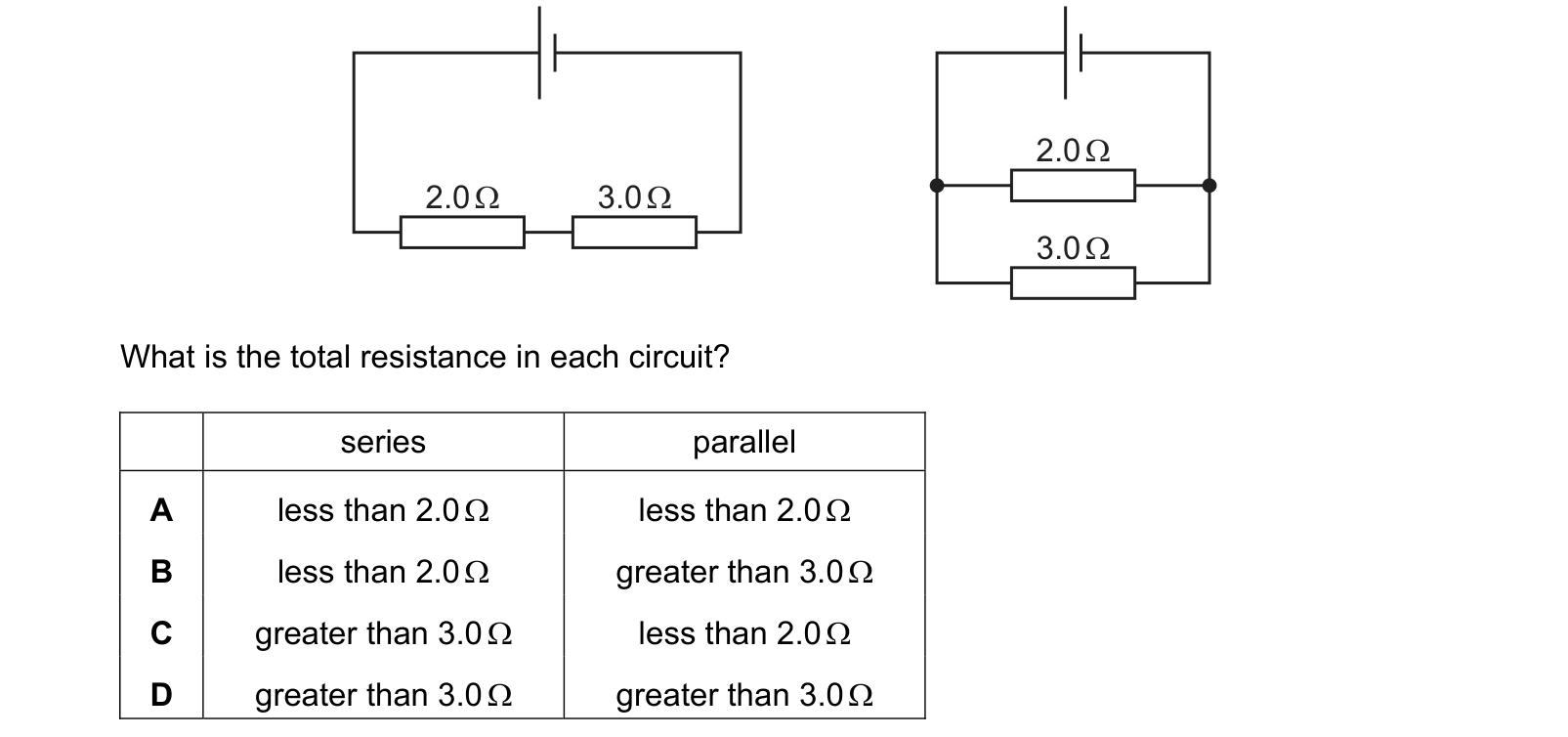
Resistors of resistance 2.0 Ω and 3.0 Ω are connected in two different circuits. What is the total resistance in each circuit? Each answer gives, in order: series; parallel.
Answer: C.
Resistors in series simply add, so the series circuit has 2.0 + 3.0 = 5.0 Ohm, which is greater than 3.0 Ohm and rules out A and B. In parallel the current has two routes instead of one, so the total resistance is always LESS than the smaller branch on its own: 1/R = 1/2.0 + 1/3.0 gives R = 1.2 Ohm, which is less than 2.0 Ohm. Greater than 3.0 Ohm in series and less than 2.0 Ohm in parallel is C. D treats the parallel pair as though their resistances added, which only happens in series. As a general check, adding another resistor in parallel always lowers the total resistance while adding one in series always raises it.
Question 3
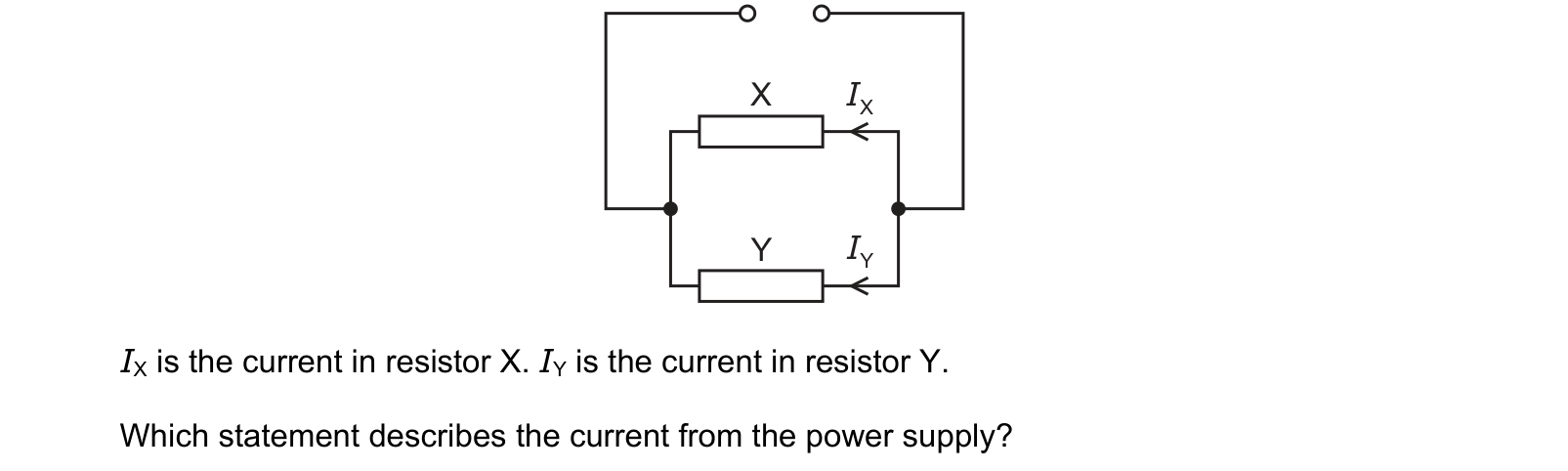
The diagram shows an electric circuit. IX is the current in resistor X. IY is the current in resistor Y. Which statement describes the current from the power supply?
Answer: A.
X and Y are drawn as two separate branches between the same pair of junction dots, so they are connected in parallel and the current from the supply splits between them at the first junction and recombines at the second. The supply current is therefore the sum of the two branch currents, IX + IY, and a sum of two positive quantities is always larger than either one on its own. So the supply current is greater than IX and greater than IY, which is A. B and C would need one branch to carry more than the total, which is impossible, and D describes a series circuit, where there is only one current and no junctions at all.
Question 4
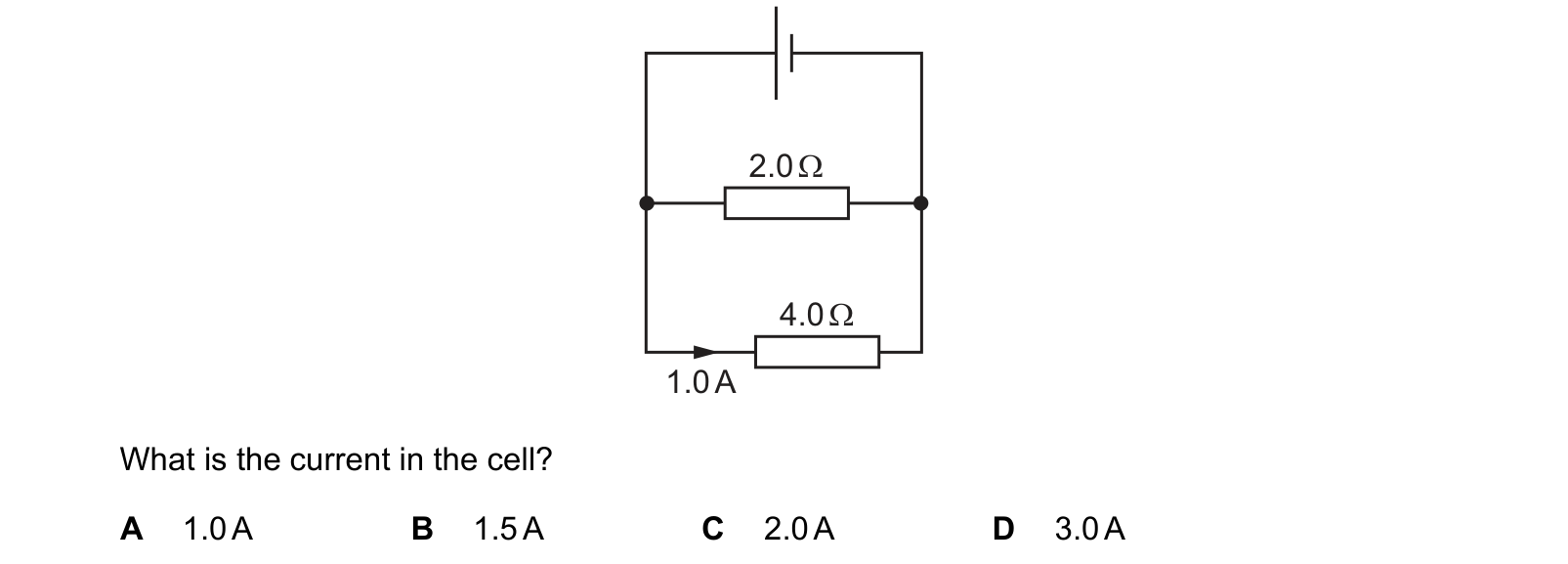
A cell is connected to a parallel combination of a 2.0 Ω resistor and a 4.0 Ω resistor. The current in the 4.0 Ω resistor is 1.0 A. What is the current in the cell?
Answer: D.
The 2.0 ohm and 4.0 ohm resistors are drawn as two separate branches between the same pair of junctions, so they are in parallel and each has the whole cell pd across it. The arrow marks 1.0 A in the 4.0 ohm branch, so that pd is V = IR = 1.0 x 4.0 = 4.0 V. The same 4.0 V sits across the 2.0 ohm resistor, giving I = V/R = 4.0/2.0 = 2.0 A in the other branch. The cell has to supply both branches, so the current in the cell is 1.0 + 2.0 = 3.0 A, which is D. A treats the circuit as series with one current everywhere, C is only the current in the 2.0 ohm branch, and B is the average of the two branch currents, which has no meaning here.
Question 5
Two resistors, with resistances R1 and R2, are connected in parallel. The resistance R1 is greater than the resistance R2. R1 What is the resistance of the parallel combination?
Answer: A.
Adding a resistor in parallel gives the current an extra route, so more charge gets through for the same p.d. and the combined resistance is always smaller than the smallest branch on its own. Since R2 is the smaller of the two, the combination must come out below R2, and below R1 as well, which is A. B and C are wrong for that reason: the pair can never be equal to one of its own branches unless the other branch carries no current at all. D is the trap of treating parallel resistors like an average, which is what happens with series resistors sharing a p.d., not with a parallel pair sharing a current.
These questions are drawn from past CIE 0625 Physics papers and filtered to electric circuits. You answer, you find out immediately whether you were right, and you get the reasoning for the correct option and for each distractor. Wrong answers go to a mistakes locker so you can come back to exactly those.
Practice is free. You need an account only so your progress and your mistakes are still there next time.
These are the errors that cost marks on electric circuits, taken from our own topic notes. Read them before you practise and you will recognise the traps in the questions.
Saying current is used up as it flows round a series circuit.
Adding resistances in parallel instead of adding reciprocals.
Forgetting the final reciprocal, so 1/R is quoted as R.
Giving a parallel combined resistance larger than one of the resistors.
Saying a thermistor's resistance rises with temperature.
Saying an LDR's resistance rises in bright light.
Assuming a parallel branch has a different voltage from the supply.
Saying adding a lamp in parallel makes the others dimmer; it does not change their voltage.