182 past-paper questions on this unit. Five of them are below. Answer on the page: each one is marked the moment you pick, the correct option is shown whether or not you found it, and the full explanation opens either way.
CIE 0654 Co-ordinated SciencesPaper 1 and Paper 2 MCQsFree account
Motion, forces and energy: five questions to try now
Real past-paper questions, the answer key from the mark scheme, and the explanation that goes with it. No account needed to answer them.
Question 1
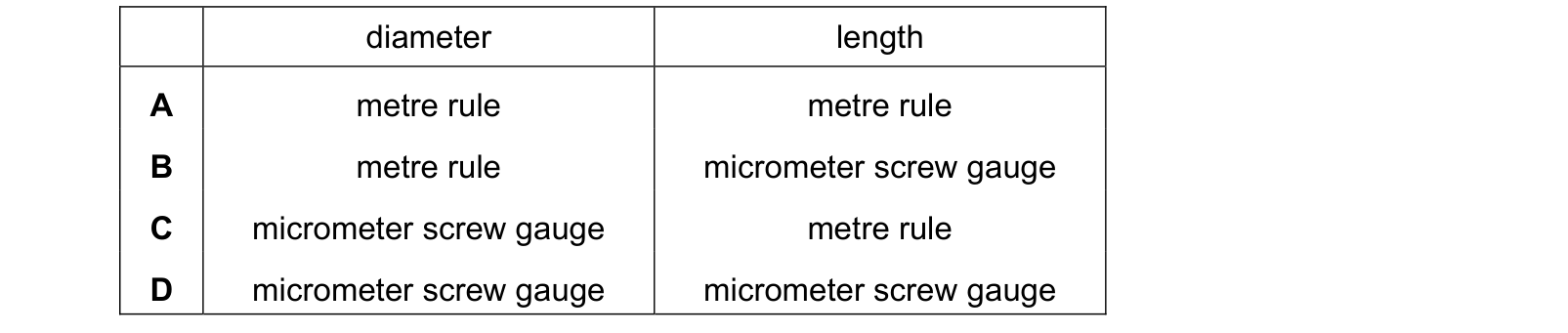
A student measures the diameter and the length of a long, thin wire. Which apparatus is used to give accurate measurements? Each answer gives, in order: diameter; length.
Answer: C.
The right instrument is the one whose resolution matches the size being measured. A thin wire has a diameter well under a millimetre, so a micrometer screw gauge reading to 0.01 mm is needed, whereas a metre rule marked in millimetres could not resolve it at all. The length of a long wire is best taken with a metre rule, since that is the instrument whose range covers the distance. D uses a micrometer for the length, but its jaws open by only a couple of centimetres, so it physically cannot span a long wire, and A uses a metre rule for the diameter, which would round a wire of, say, 0.4 mm to either 0 mm or 1 mm.
Question 2
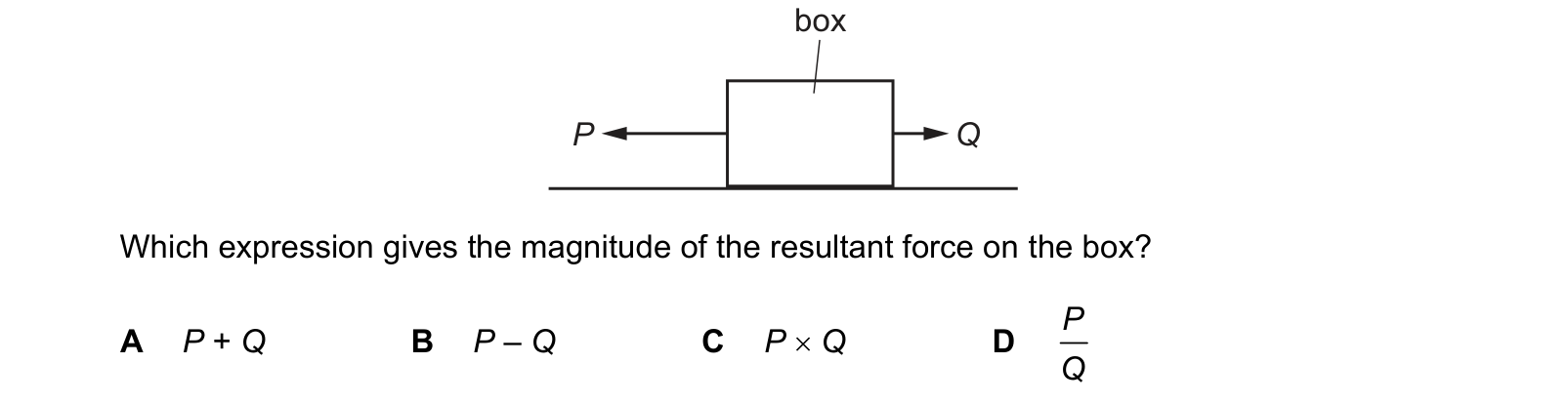
The diagram shows a large force of magnitude P and a small force of magnitude Q acting on a box. Which expression gives the magnitude of the resultant force on the box?
Answer: B.
The two forces act along the same line but in opposite directions, so they partly cancel and the resultant is the difference between them, acting in the direction of the larger force. Since P is the larger, the magnitude of the resultant is P minus Q. Adding them would be right only if both pushed the same way, which the arrows show they do not. Multiplying two forces together gives a quantity with units of newtons squared, which is not a force at all, and the same objection rules out dividing one by the other, which gives a pure number. Combining forces along one line is always a matter of adding when they agree in direction and subtracting when they oppose.
Question 3
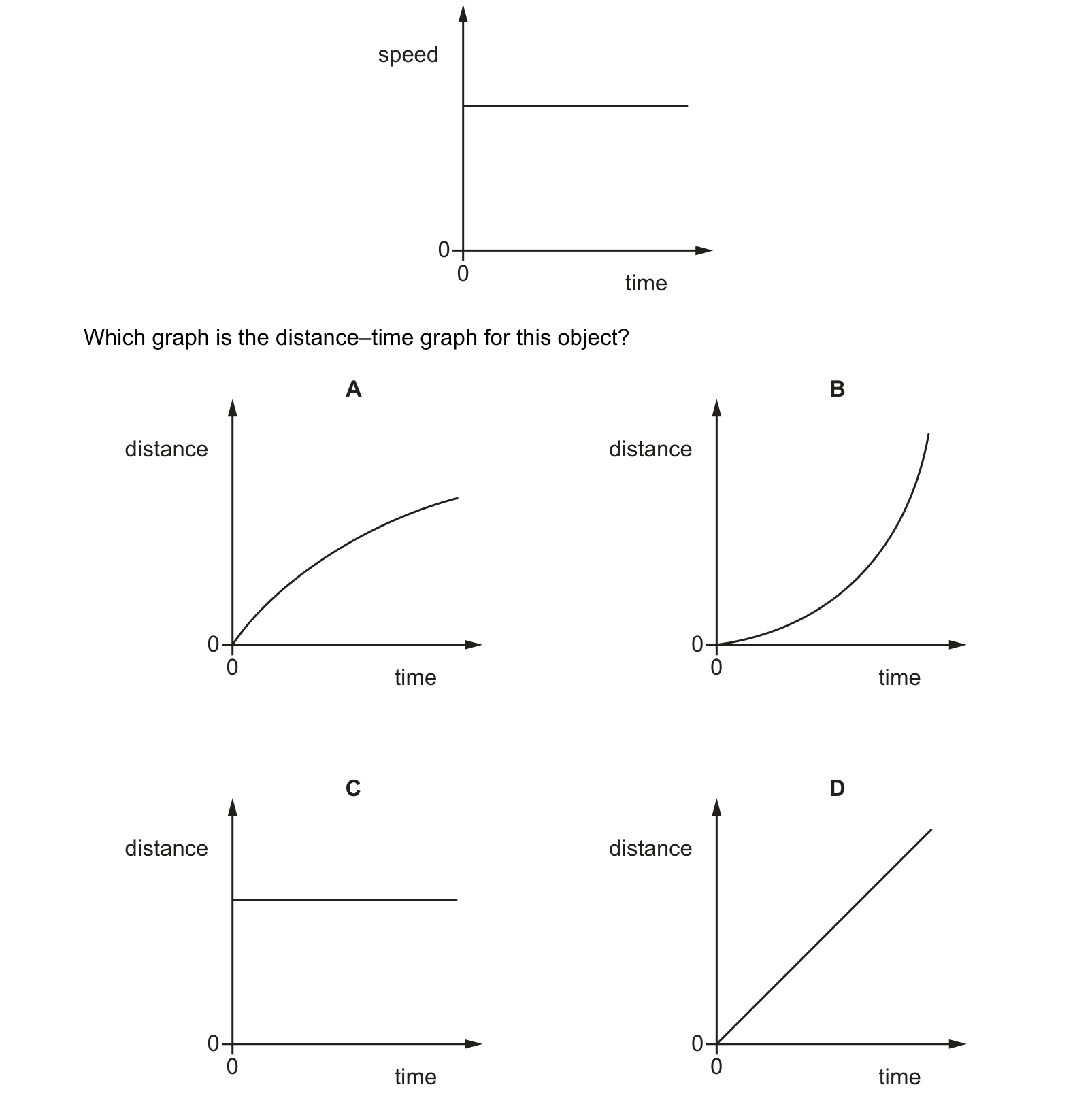
The graph shows how the speed of an object varies with time. Which graph is the distance–time graph for this object? Use the source image for W22 Paper 11, question 28.
Answer: D.
The speed against time graph is a horizontal line at a value above zero, so the object is moving at a constant speed and never changes it. On a distance against time graph the gradient is the speed, so a constant speed means a constant gradient, which is a straight line rising steadily from the origin. That is the graph to choose. The curve that flattens off shows the gradient decreasing, so the object would be slowing down. The curve that steepens shows the gradient increasing, so the object would be speeding up. The horizontal distance line shows a gradient of zero, which would mean the object was standing still, and it is the trap here because it looks like the speed graph given in the question.
Question 4
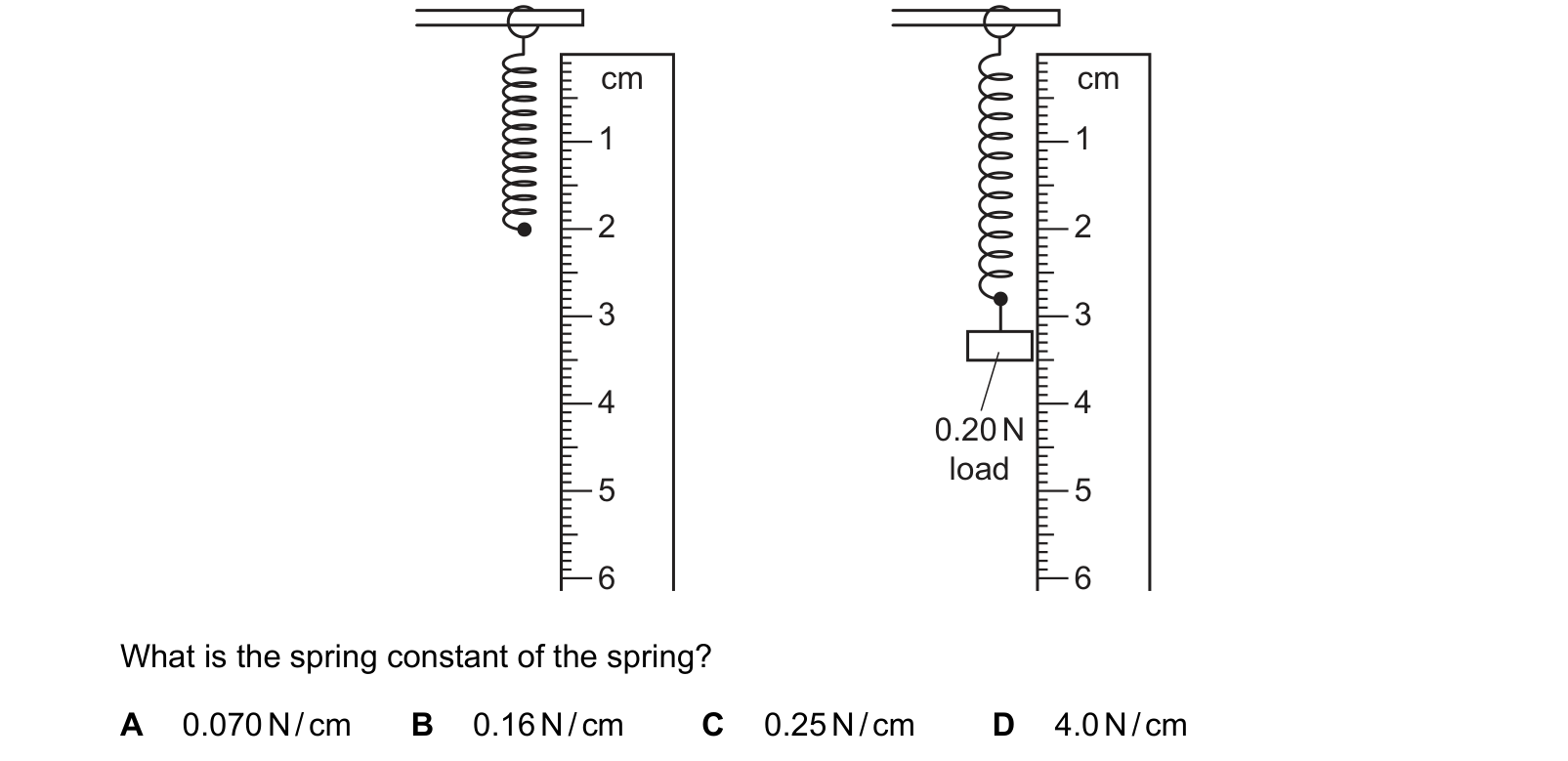
A student is investigating the extension of a spring. The diagrams show the spring before and after a 0.20 N load is added. What is the spring constant of the spring?
Answer: C.
The spring constant is the force applied divided by the extension it produces, and extension means the increase in length, read as the difference between the two scale readings rather than the loaded length itself. The 0.20 N load stretches the spring by 0.8 cm, so the spring constant is 0.20 divided by 0.8, which is 0.25 N/cm. The answer of 4.0 N/cm is the reciprocal, dividing the extension by the force, which measures how far the spring stretches per newton rather than how stiff it is. The answers of 0.070 and 0.16 N/cm come from using the total loaded length of the spring instead of the extension, which is the commonest error in this experiment.
Question 5
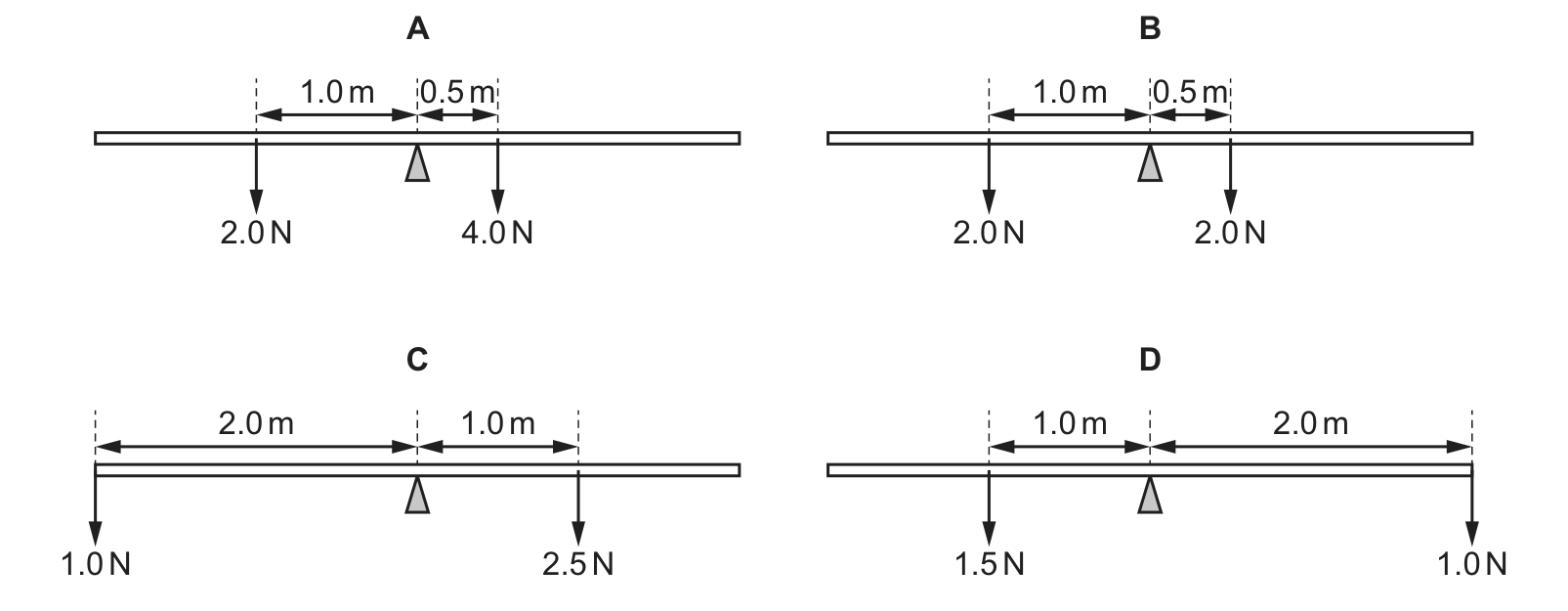
The diagrams show four uniform beams, each supported by a pivot at its centre. Which diagram shows a beam that is balanced? Use the source image for W20 Paper 23, question 29.
Answer: A.
A beam balances when the total clockwise moment about the pivot equals the total anticlockwise moment, and a moment is force multiplied by perpendicular distance from the pivot. Taking each diagram in turn, the balanced one has 2.0 N at 1.0 m on one side, giving 2.0 N m, and 4.0 N at 0.5 m on the other, giving 2.0 N m as well, so the two match. The beam with 2.0 N at 1.0 m against 2.0 N at 0.5 m has 2.0 N m against 1.0 N m and tips towards the longer arm. The beam with 1.0 N at 2.0 m against 2.5 N at 1.0 m has 2.0 N m against 2.5 N m. The beam with 1.5 N at 1.0 m against 1.0 N at 2.0 m has 1.5 N m against 2.0 N m. Equal forces do not balance a beam unless their distances are equal too, and equal distances do not balance it unless the forces match.
These questions are drawn from past CIE 0654 Co-ordinated Sciences papers and filtered to motion, forces and energy. You answer, you find out immediately whether you were right, and you get the reasoning for the correct option and for each distractor. Wrong answers go to a mistakes locker so you can come back to exactly those.
Practice is free. You need an account only so your progress and your mistakes are still there next time.
These are the errors that cost marks on motion, forces and energy, taken from our own topic notes. Read them before you practise and you will recognise the traps in the questions.
Reading a horizontal line on a speed-time graph as stationary.
Taking the area under a distance-time graph, which means nothing.
Saying a body moving at constant speed has a resultant force pushing it along.
Using mass in newtons or weight in kilograms.
Forgetting to square the speed in the kinetic energy formula, or to halve it.