Thermal physics
Contents: 6 sections
The particle model
| Arrangement | Spacing | Movement | |
|---|---|---|---|
| Solid | Regular, fixed pattern | Very close | Vibrate about fixed positions |
| Liquid | Irregular, close together | Close | Move around each other |
| Gas | Random, far apart | Far apart | Fast, random, in all directions |
Almost every particle question is answered from that table, so learn it as three rows rather than three paragraphs.
Two things stay the same in all three states: the particles themselves do not change size, and they do not change mass. Heating a solid does not make the particles expand; it makes them vibrate further apart.
Gas pressure comes from particles colliding with the walls of the container. More collisions per second, or harder collisions, means more pressure. So:
- Heating a gas at fixed volume raises the pressure, because particles move faster and hit the walls harder and more often.
- Squeezing a gas into a smaller volume raises the pressure, because the same number of particles hit a smaller area more often.
Thermal expansion
Solids, liquids and gases all expand when heated, and gases expand most, solids least. The particles do not grow; they simply move further apart.
Consequences worth knowing: gaps are left between railway rails and in bridges, overhead cables are hung slack in summer, and a bimetallic strip bends because two metals expand by different amounts.
Transferring thermal energy
Thermal energy always flows from a hotter place to a colder one.
Conduction passes energy along by particle vibration, and in metals also by free electrons, which is why metals conduct far better than anything else. It needs particles in contact, so it works well in solids, poorly in liquids and gases, and not at all in a vacuum.
Convection happens in fluids only, which means liquids and gases. Heated fluid expands, becomes less dense, and rises; cooler denser fluid sinks to take its place, and a convection current forms. This is why a heater is placed low in a room and a freezer compartment high in a fridge.
Radiation is infrared waves. It is the only method that works through a vacuum, which is how energy reaches us from the Sun.
- Dull black surfaces are the best emitters and the best absorbers.
- Shiny silver surfaces are the worst emitters and the worst absorbers, and the best reflectors.
The vacuum flask is the standard question because it defeats all three: a vacuum between the walls stops conduction and convection, and silvered surfaces cut radiation.
Melting, boiling and evaporation
Melting and boiling happen at a fixed temperature for a given substance. While a substance is changing state its temperature stays constant, even though energy is still being supplied. That energy separates the particles instead of speeding them up, which is why a heating curve has flat sections.
Evaporation is different and is examined most often:
- It happens at any temperature, not just the boiling point.
- It happens only at the surface, where the fastest particles escape.
- Because the fastest particles leave, the average energy of those remaining falls, so evaporation cools the liquid left behind.
Evaporation is faster when the temperature is higher, the surface area is larger, or there is a draught over the surface.
Common mistakes
- Saying particles expand when heated. The spacing increases, not the particles.
- Saying convection happens in solids.
- Saying radiation needs particles. It is the only method that does not.
- Saying a shiny surface is a good absorber.
- Saying temperature rises while ice is melting.
- Confusing boiling with evaporation, or saying evaporation happens throughout the liquid.
- Saying a hot object "has more heat". It has more internal energy, and energy is what transfers.
Check you have it
Question 1
A liquid starts to evaporate. Which molecules escape and what happens to the temperature of the remaining liquid? Each answer gives, in order: molecules that escape; temperature of remaining liquid.
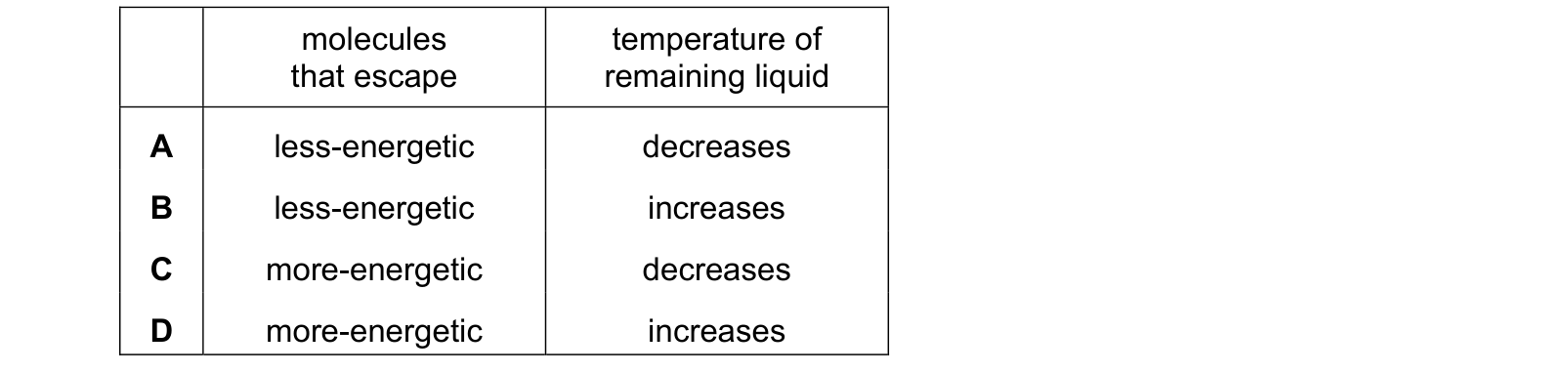
Answer: C.
Question 2
A liquid starts to evaporate. Which molecules escape, and what happens to the temperature of the remaining liquid? Each answer gives, in order: molecules that escape; temperature of the remaining liquid.
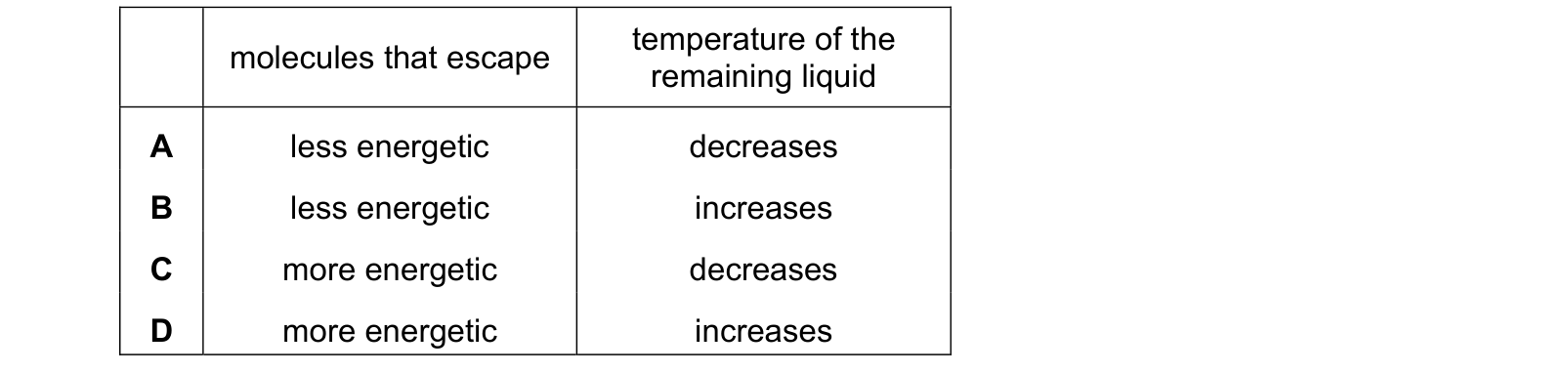
Answer: C.
Question 3
What are used as the fixed points on the Celsius scale of temperature? Each answer gives, in order: lower fixed point; upper fixed point.
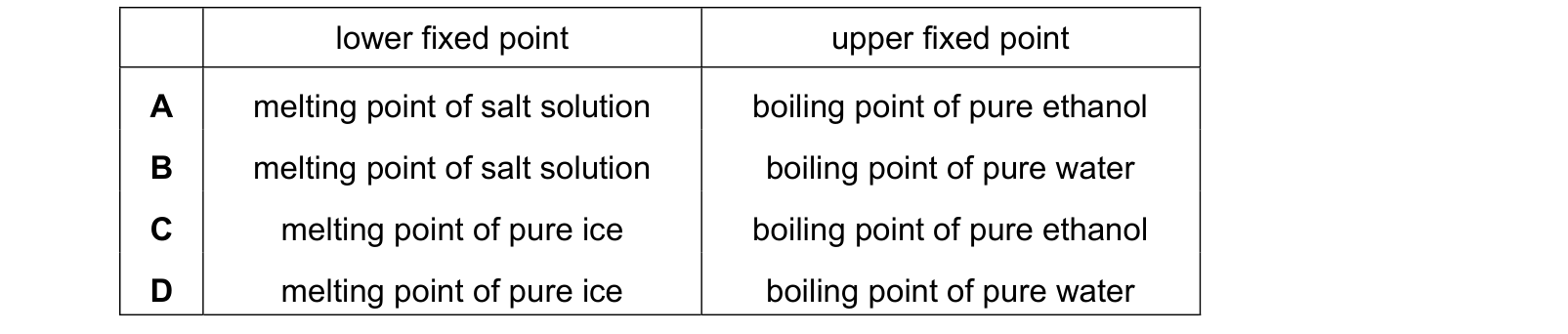
Answer: D.
What the syllabus asks for on this topicSyllabus points
Syllabus points
- Describe the particle model of solids, liquids and gases.
- Explain thermal expansion and its consequences.
- Describe conduction, convection and radiation, and how each is reduced or encouraged.
- Explain melting, boiling and evaporation in terms of particles.
Related CIE 0654 Co-ordinated Sciences topics
Not the topic you were looking for? Describe what you are stuck on in your own words and we will take you to the notes that answer it.