Chemical reactions
Contents: 8 sections
Collision theory
A reaction happens when particles collide with enough energy. So the rate rises whenever collisions become more frequent or more energetic.
| Change | Effect on rate | Why |
|---|---|---|
| Higher concentration | Faster | More particles in the same volume, so more frequent collisions |
| Higher temperature | Faster | Particles move faster, so collisions are more frequent and more energetic |
| Smaller pieces (larger surface area) | Faster | More particles exposed, so more frequent collisions |
| Catalyst added | Faster | Provides a route needing less energy |
| Higher pressure (gases only) | Faster | Particles pushed closer, so more frequent collisions |
Temperature is the one that does two things at once, and saying both is what separates a full answer from a half one.
A catalyst speeds a reaction up without being used up. It does not change the amount of product, only how quickly it arrives.
Reading a rate graph
Plot product formed, or mass lost, against time.
- The steeper the line, the faster the reaction.
- The line is steepest at the start, because that is when the reactants are most concentrated.
- It levels off when the reaction stops, because a reactant has run out.
- The height of the level part shows how much product formed in total.
Two curves compared: the one that rises more steeply is faster. If both level off at the same height, the same amount of reactant was used and only the rate differed, which is exactly what a catalyst or a temperature change does. If they level off at different heights, the amounts of reactant were different.
That distinction between steepness and final height is the most commonly examined idea in this topic.
Physical and chemical change
A physical change alters form but produces no new substance, and it is usually easy to reverse: melting, boiling, dissolving.
A chemical change produces a new substance, is usually hard to reverse, and is often accompanied by an energy change, a colour change, a gas being given off, or a precipitate forming.
Oxidation and reduction
Oxidation is gain of oxygen, or loss of electrons. Reduction is loss of oxygen, or gain of electrons.
The mnemonic is OIL RIG: Oxidation Is Loss, Reduction Is Gain, of electrons.
The two always happen together, because electrons lost by one substance are gained by another. A reaction in which both occur is a redox reaction.
When copper oxide reacts with hydrogen to give copper and water, the copper oxide loses oxygen so it is reduced, and the hydrogen gains oxygen so it is oxidised.
Energy changes
An exothermic reaction releases energy to the surroundings, so the temperature rises. Combustion, neutralisation and respiration are all exothermic.
An endothermic reaction takes in energy, so the temperature falls. Thermal decomposition and photosynthesis are endothermic.
The test in a practical is simply whether the thermometer goes up or down.
Reversible reactions
Some reactions go both ways, shown by the sign ⇌.
Heating hydrated copper(II) sulfate drives off water and turns it from blue to white. Adding water turns it back from white to blue, releasing heat. That colour change is used as a test for water.
In a closed container a reversible reaction reaches equilibrium, where the forward and backward reactions happen at the same rate and the amounts of each substance stop changing. Equilibrium does not mean the reactions have stopped, and it does not mean the amounts are equal.
Common mistakes
- Saying a catalyst increases the amount of product.
- Saying higher temperature works only because particles collide more often, and missing the energy of the collisions.
- Confusing a steeper curve with a higher final level on a rate graph.
- Saying dissolving is a chemical change.
- Getting OIL RIG backwards.
- Saying an exothermic reaction takes in heat because it feels hot.
- Saying that at equilibrium the reactions have stopped, or that the quantities are equal.
Check you have it
Question 1
Which row shows the conditions used in the Haber process? Each answer gives, in order: temperature / °C; pressure / atm; catalyst.
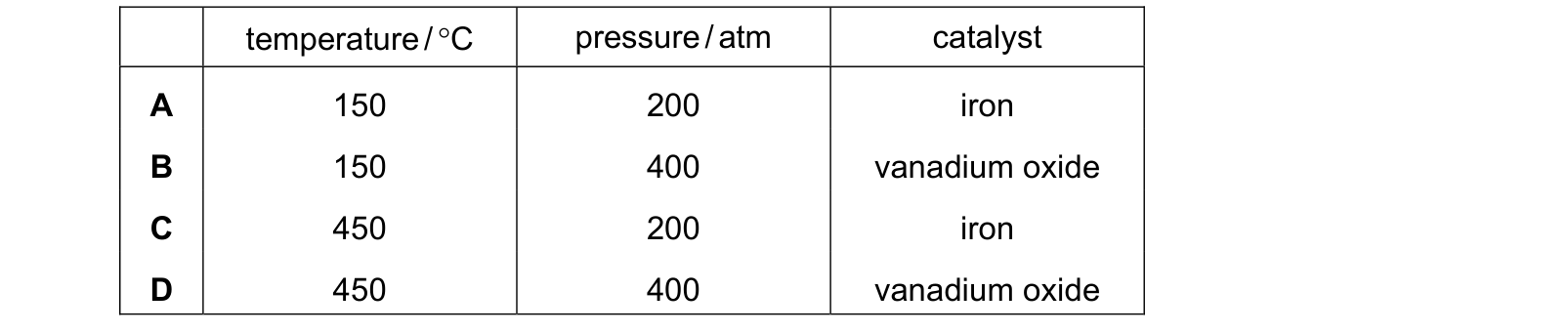
Answer: C.
Question 2
The catalytic converter in the exhaust of a car brings about the reaction shown. 2NO + 2CO → 2CO2 + N2 Which row about this reaction is correct? oxidation reduction Use the source image for S21 Paper 11, question 18.
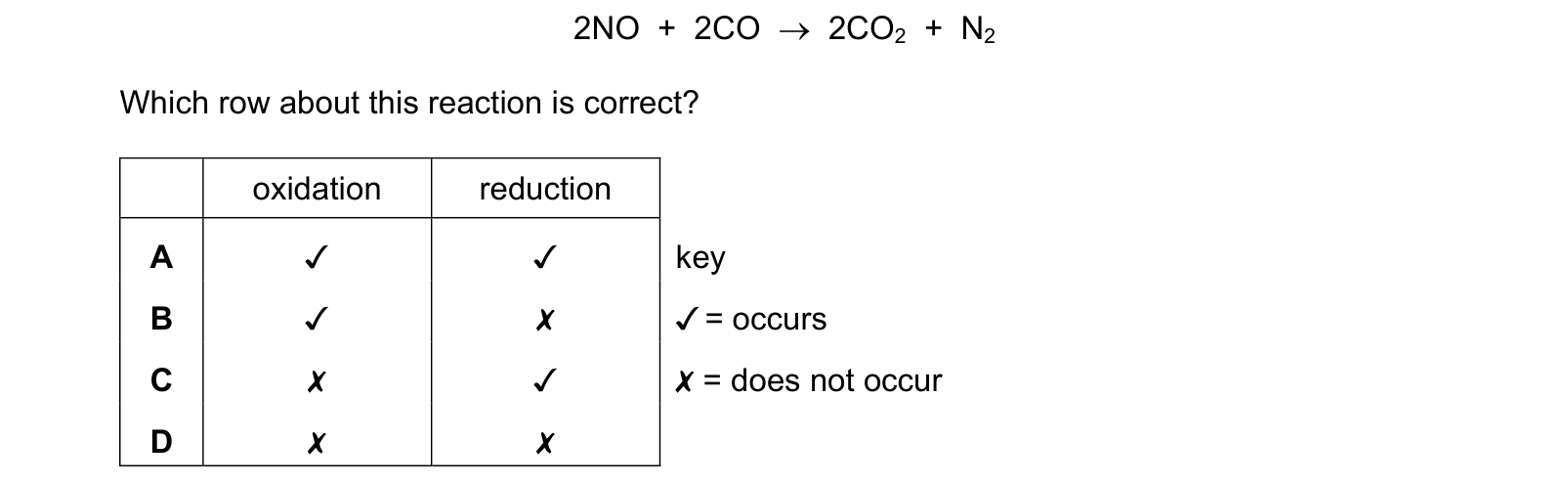
Answer: A.
Question 3
The catalytic converter in the exhaust of a car brings about the reaction shown. 2NO + 2CO → 2CO2 + N2 Which row about this reaction is correct? oxidation reduction Use the source image for S21 Paper 12, question 18.
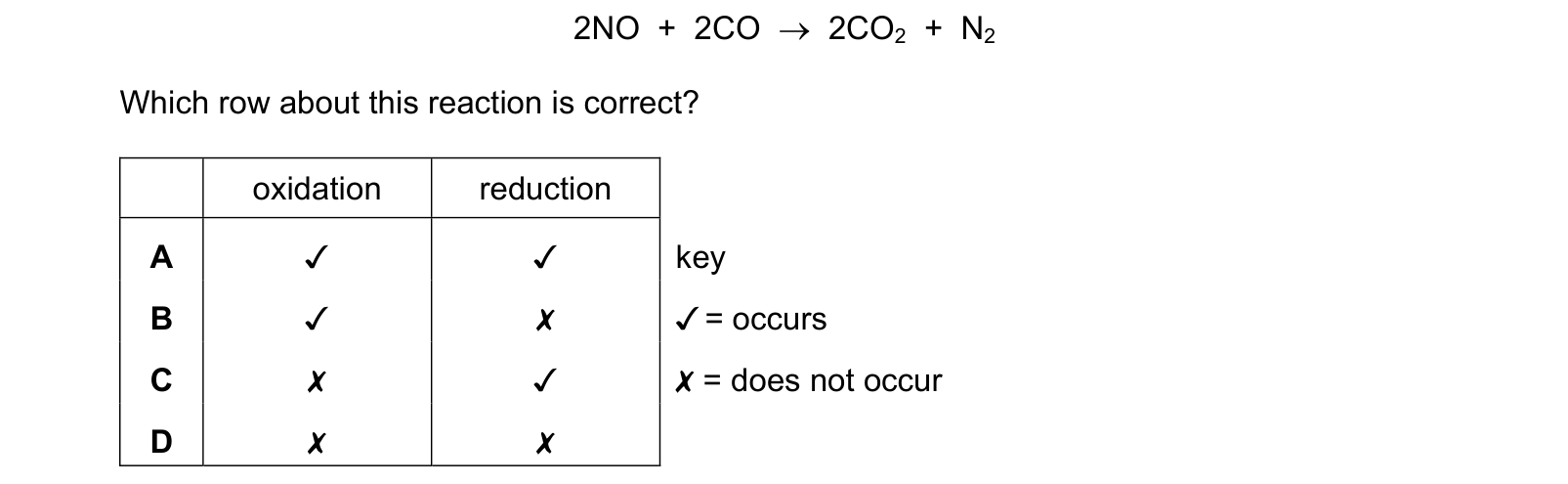
Answer: A.
What the syllabus asks for on this topicSyllabus points
Syllabus points
- Describe the effect of concentration, temperature, surface area and catalysts on rate of reaction.
- Explain rate using collision theory.
- Interpret rate graphs.
- Describe physical and chemical changes, oxidation and reduction, and reversible reactions.
Related CIE 0654 Co-ordinated Sciences topics
Not the topic you were looking for? Describe what you are stuck on in your own words and we will take you to the notes that answer it.