Enzymes
Contents: 7 sections
What an enzyme is
An enzyme is a protein that works as a biological catalyst: it speeds up a chemical reaction and is not used up in the process.
Every word there is examinable.
Protein. Enzymes are chains of amino acids, so they contain carbon, hydrogen, oxygen and nitrogen. The nitrogen is not incidental: the peptide bonds joining amino acids to each other run through nitrogen atoms, so a molecule without nitrogen could not be a protein at all. A question asking which elements are in an enzyme has nitrogen in the answer, and the tempting wrong option is carbon, hydrogen and oxygen alone, which is the composition of a carbohydrate or a fat.
Catalyst. It speeds the reaction up by lowering the energy needed to get it started, which is what lets reactions that would otherwise be far too slow run fast enough at body temperature.
Not used up. The substrate is used up. The enzyme comes out of the reaction unchanged and goes straight on to the next substrate molecule, so one enzyme molecule can handle thousands in a row. That is why a cell needs only tiny amounts of each.
Do not confuse enzymes with the other proteins in the syllabus. Antibodies are made by lymphocytes and bind to pathogens. Hormones are chemical messengers carried in the blood. Platelets are cell fragments involved in clotting. Only enzymes are catalysts.
Specificity and the active site
An enzyme has a groove in its surface called the active site. The active site has a shape complementary to one particular substrate, so only that substrate fits into it. The substrate slots in, the enzyme holds it in a way that makes the reaction happen easily, and the product leaves.
This is why cells contain hundreds of different enzymes. A cell carries out thousands of different reactions, each with a different substrate, and one enzyme shape can only serve one of them.
Say complementary, not "the same shape". A key is not the same shape as a lock. The two fit together because their shapes are opposites.
Some enzymes build large molecules from small ones, and others break large molecules down. Both count as catalysis.
Temperature
The graph rises to a peak and then falls away sharply. The two sides have completely different explanations, and giving the same reason for both is the commonest way to lose the marks.
Below the optimum, warming speeds the reaction up. Heat gives the enzyme and substrate molecules more kinetic energy, so they move faster and collide more often. More collisions means more enzyme-substrate complexes formed each second, so more product. Cooling does the reverse: fewer collisions, slower reaction.
Above the optimum, heating destroys the enzyme. The extra energy shakes apart the bonds holding the protein chain in its folded shape. The enzyme denatures, the active site changes shape, and the substrate no longer fits. Collisions are actually more frequent at high temperature, but a collision that cannot form a complex achieves nothing.
The two halves are not mirror images, and this is the point students most often miss.
Cooling is reversible. Heating past the optimum is not. An enzyme cooled to 5 °C is slow but undamaged, and warming it back to its optimum restores the original rate exactly. An enzyme heated past its optimum is permanently ruined and never recovers, however carefully it is cooled.
That difference explains two everyday facts. Food is kept in a refrigerator at about 4 °C because the low temperature slows the enzymes of the food and of spoilage bacteria, without denaturing them or killing anything. Cut apple is dropped in boiling water to stop it browning because boiling denatures the enzyme responsible, permanently.
The optimum is not always about 37 °C. Human enzymes have an optimum near body temperature because that is the temperature they work at. Bacteria living in hot springs at 80 °C have enzymes with an optimum near 80 °C, because natural selection shapes an enzyme to be stable and active in the conditions the organism actually lives in. If those enzymes had an optimum of 20 °C the bacteria could not survive where they do.
pH
Each enzyme also has an optimum pH, and moving away from it in either direction slows the reaction. Far enough away, an extreme pH breaks the bonds holding the folded shape together and the enzyme denatures, exactly as excessive heat does.
The values are worth knowing because they follow the conditions in each part of the gut.
| Enzyme | Where it works | Optimum pH |
|---|---|---|
| Pepsin | Stomach | About 2, strongly acidic |
| Amylase | Mouth and small intestine | About 7, neutral |
| Lipase and trypsin | Small intestine | About 8, slightly alkaline |
Pepsin in the stomach and trypsin in the small intestine both digest protein, yet one needs acid and the other needs alkali. That is not a contradiction: it is the clearest evidence that the optimum belongs to the enzyme rather than to the job.
This is why bile matters. The stomach contents arriving in the small intestine are acidic, and bile is alkaline, so it raises the pH to the value the intestinal enzymes need.
Denaturation, precisely
Denaturation is a permanent change in the shape of the enzyme's active site, so that the substrate no longer fits. It is caused by high temperature or by extremes of pH.
Three details decide marks:
- It is the enzyme that is denatured, never the substrate. A substrate has no active site.
- It is permanent. "Temporarily denatured" is a contradiction.
- The enzyme is not killed. It was never alive. Nor is it "melted" or "broken up"; the chain is intact, it has simply lost its folded shape.
Common mistakes
- Calling enzymes carbohydrates, fats or hormones. They are proteins.
- Leaving nitrogen off the list of elements in an enzyme.
- Saying enzymes are used up in the reaction.
- Saying low temperatures denature enzymes. Low temperatures only slow them down.
- Explaining the fall after the optimum by "fewer collisions". Collisions are more frequent; the active site has changed shape.
- Saying a denatured enzyme recovers on cooling.
- Saying the active site is the same shape as the substrate rather than complementary to it.
- Saying the substrate is denatured.
- Assuming every enzyme has an optimum of 37 °C and pH 7.
- Writing that an enzyme is killed.
Check you have it
Question 1
Which graph shows the effect of temperature on the activity of a mammalian enzyme? Use the source image for S20 Paper 11, question 4.
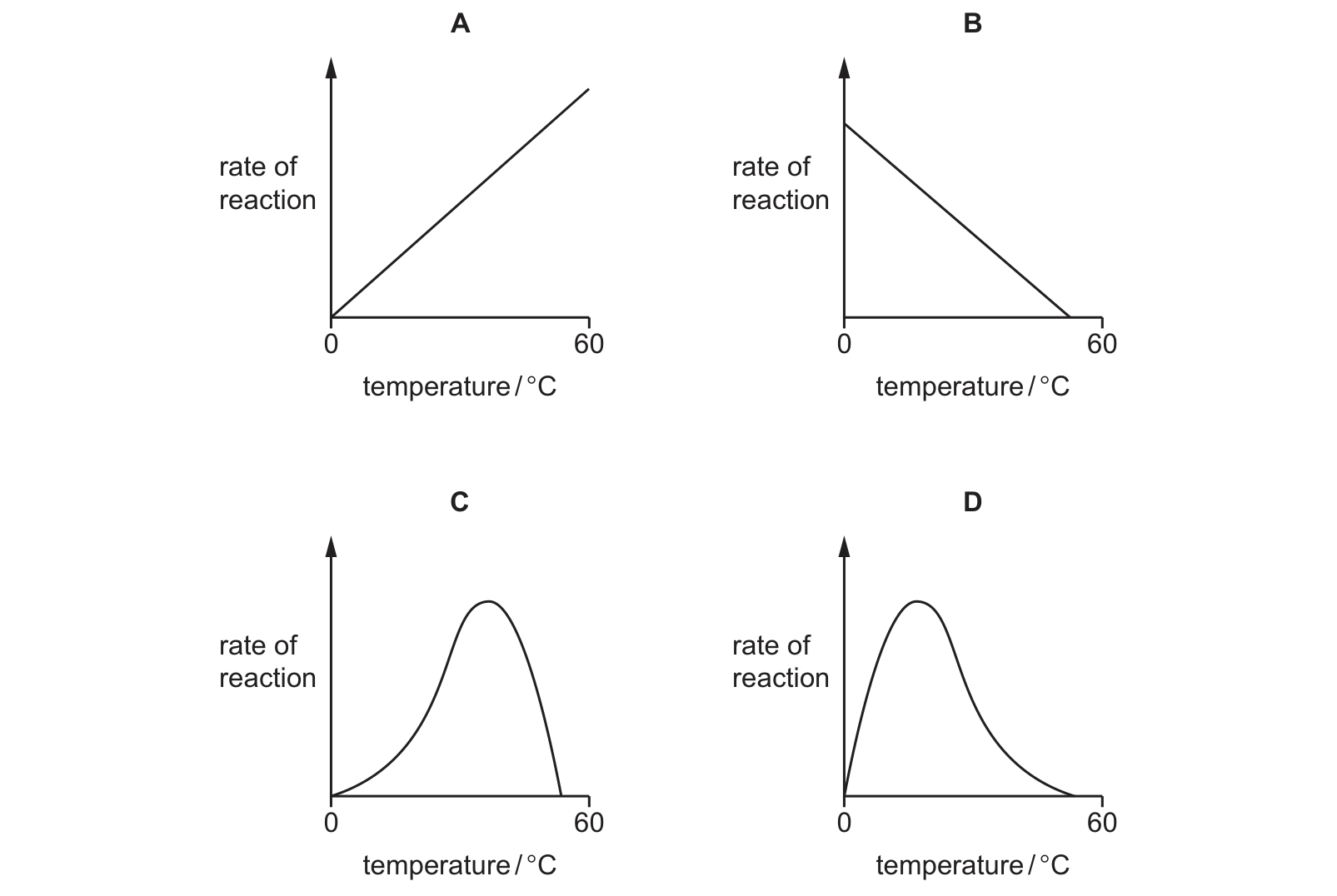
Answer: C.
Question 2
The diagram shows the effect of temperature on enzyme activity. What has increased the enzyme activity between points X and Y?

Answer: D.
Question 3
Which graph shows the effect of pH on the rate of activity of an enzyme? Use the source image for W21 Paper 13, question 4.
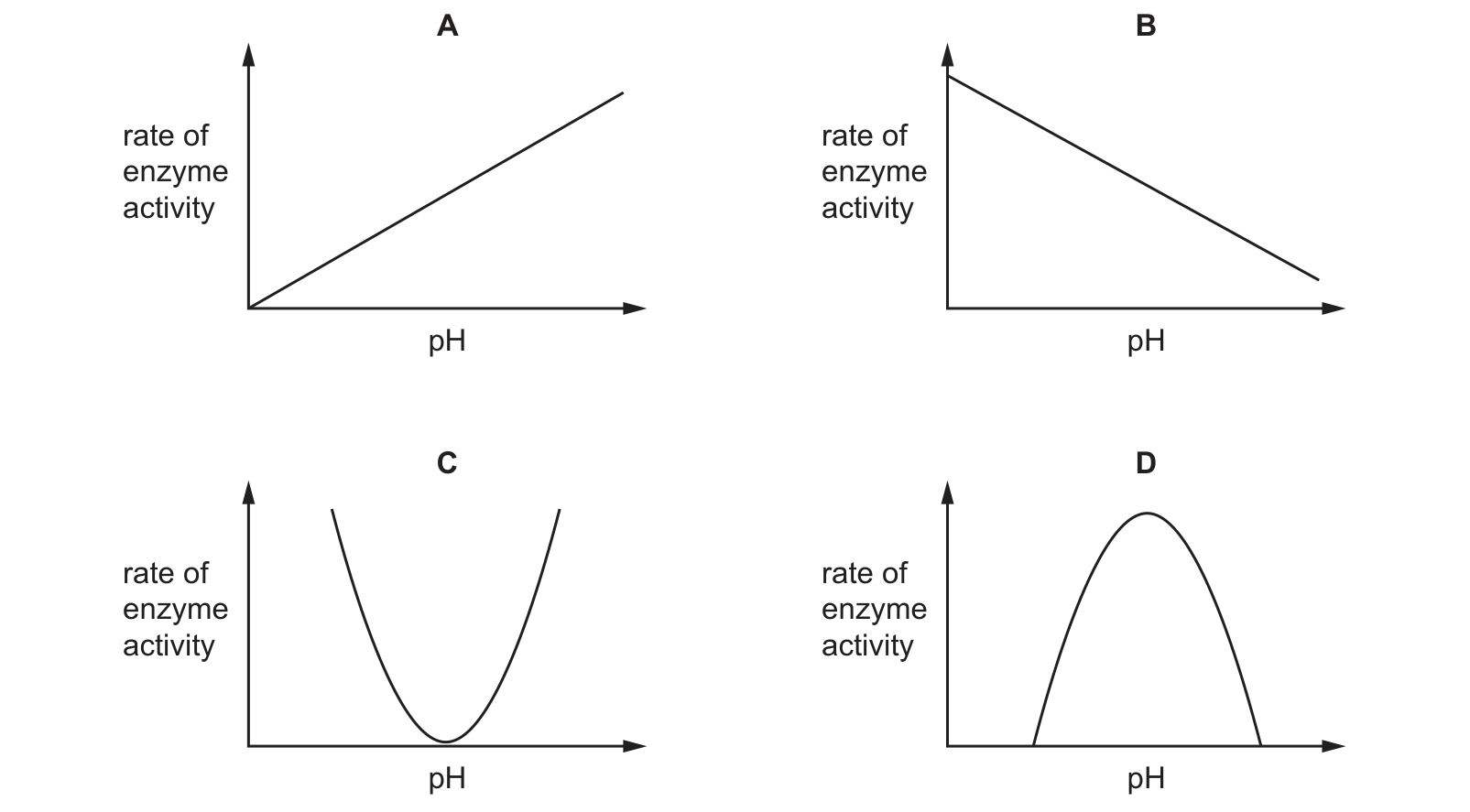
Answer: D.
What the syllabus asks for on this topicSyllabus points
Syllabus points
- Define an enzyme as a protein that acts as a biological catalyst.
- Explain enzyme specificity using the complementary shape of the active site and its substrate.
- Describe and explain the effect of temperature on the rate of an enzyme-controlled reaction.
- Describe and explain the effect of pH on the rate of an enzyme-controlled reaction.
- Explain denaturation in terms of a permanent change in the shape of the active site.
Related CIE 0654 Co-ordinated Sciences topics
Not the topic you were looking for? Describe what you are stuck on in your own words and we will take you to the notes that answer it.