Human nutrition
Contents: 6 sections
A balanced diet
| Nutrient | Function | A source |
|---|---|---|
| Carbohydrate | Energy | Bread, rice, potatoes |
| Protein | Growth and repair | Meat, fish, beans |
| Fat | Energy store, insulation | Butter, oils, nuts |
| Vitamin C | Healthy skin and gums | Citrus fruit |
| Vitamin D | Helps calcium absorption | Oily fish, sunlight on skin |
| Calcium | Bones and teeth | Milk, cheese |
| Iron | Making haemoglobin | Red meat, spinach |
| Fibre | Keeps food moving through the gut | Vegetables, wholemeal bread |
| Water | Solvent for reactions, transport | Drinks, most foods |
Deficiencies follow from the functions: too little vitamin C causes scurvy, too little vitamin D or calcium causes rickets, and too little iron causes anaemia.
Fibre is not digested and provides no energy, and that is exactly why it works: it gives the muscles of the gut something to push against.
The alimentary canal
Food passes through, in order: mouth, oesophagus, stomach, small intestine (duodenum then ileum), large intestine (colon then rectum), anus.
- Mouth: teeth chew (mechanical digestion), saliva adds amylase.
- Oesophagus: carries food to the stomach by peristalsis, waves of muscle contraction.
- Stomach: churns food, makes hydrochloric acid and protease.
- Small intestine: most digestion is completed and absorption happens.
- Large intestine: water is absorbed and faeces are formed.
The liver and pancreas are not part of the canal but feed into it. The pancreas makes amylase, protease and lipase; the liver makes bile.
Digestion
Mechanical digestion breaks food into smaller pieces without changing it chemically: chewing, and churning in the stomach. It matters because it increases the surface area for enzymes.
Chemical digestion uses enzymes to break large insoluble molecules into small soluble ones.
| Enzyme | Breaks down | Into |
|---|---|---|
| Amylase | Starch | Maltose, then glucose |
| Protease | Protein | Amino acids |
| Lipase | Fats | Fatty acids and glycerol |
Enzymes work best at a particular pH, so the conditions change along the gut. The stomach is acidic, around pH 2, which suits protease and also kills most bacteria in food. The small intestine is alkaline, which suits the enzymes working there.
Bile is made in the liver, stored in the gall bladder, and released into the small intestine. It does two things and contains no enzymes:
- It neutralises the acid arriving from the stomach, giving the alkaline conditions the intestinal enzymes need.
- It emulsifies fats, breaking large droplets into many small ones. This increases the surface area for lipase, so digestion is faster. It does not chemically digest the fat.
That last distinction is the most examined point in the topic.
Absorption and assimilation
Absorption is small soluble molecules passing through the gut wall into the blood, and it happens mostly in the small intestine.
The small intestine is adapted for it: it is very long, and its lining is folded into millions of villi, each covered in microvilli. Together these give an enormous surface area. Each villus has a thin wall, one cell thick, so the diffusion distance is short, and a rich blood supply that carries absorbed molecules away and keeps the concentration gradient steep.
Glucose and amino acids enter the blood capillaries; fatty acids and glycerol enter the lacteal, a lymph vessel.
Assimilation is what happens next: the absorbed molecules are built into the cells and used, for example amino acids becoming new proteins.
Common mistakes
- Saying bile is an enzyme, or that it digests fat.
- Saying emulsification breaks fat into fatty acids.
- Saying the stomach is alkaline.
- Confusing absorption with digestion, or with assimilation.
- Saying water is absorbed in the small intestine only. Most is, but the large intestine absorbs the rest.
- Saying fibre is digested for energy.
- Listing villi as an adaptation without saying they increase surface area.
Check you have it
Question 1
The diagram shows the human alimentary canal. In which labelled organs are large insoluble molecules broken down into small soluble molecules?
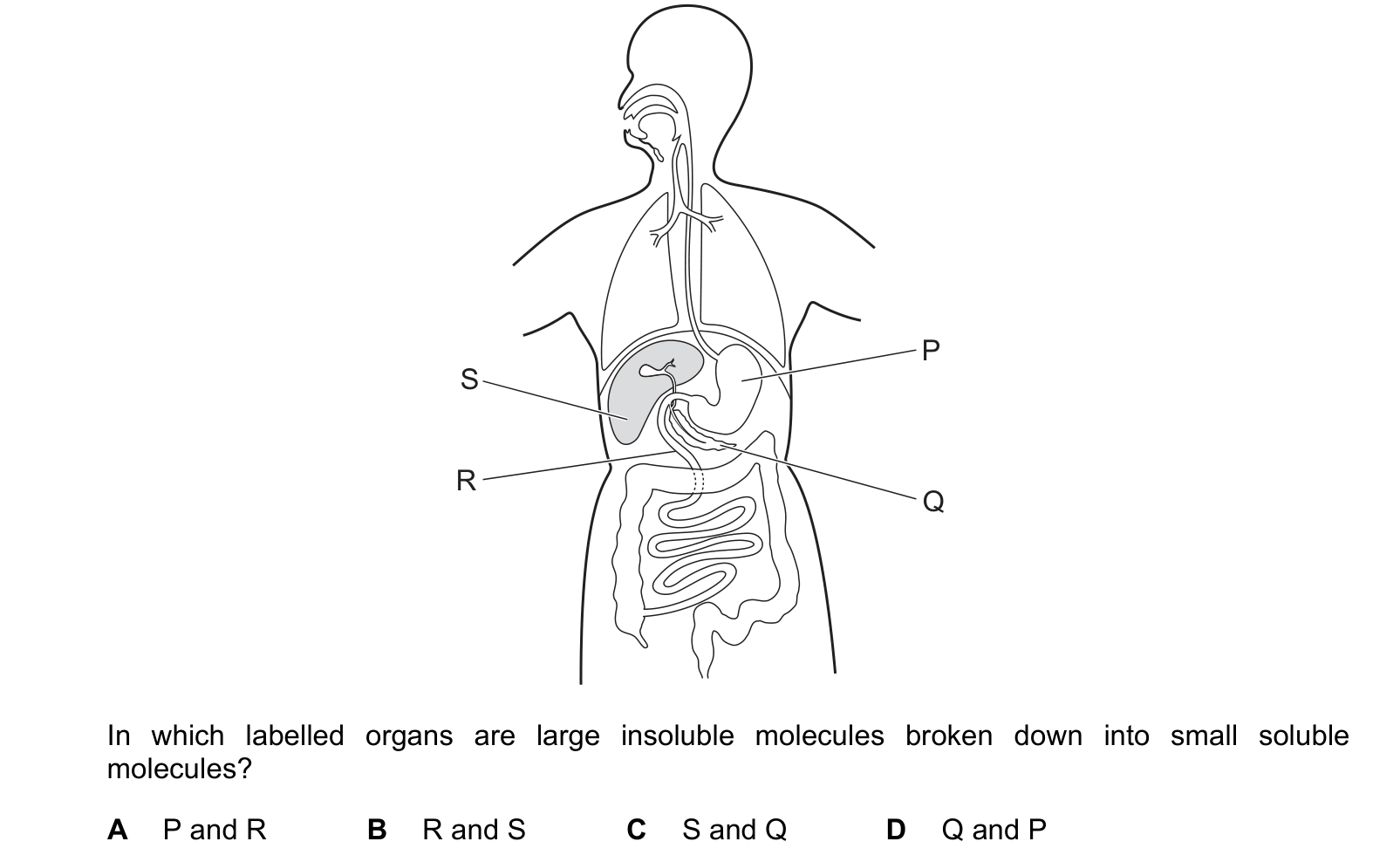
Answer: A.
Question 2
Dogs are mammals and have the same types of teeth as humans. Which tooth is a canine? Use the source image for W22 Paper 11, question 6.

Answer: D.
Question 3
Dogs are mammals and have the same types of teeth as humans. Which tooth is a canine? Use the source image for W22 Paper 21, question 6.

Answer: D.
What the syllabus asks for on this topicSyllabus points
Syllabus points
- Describe a balanced diet and the sources and functions of each nutrient.
- Identify the parts of the alimentary canal and their functions.
- Describe digestion, absorption and assimilation.
- Describe the action of the digestive enzymes and of bile.
Related CIE 0654 Co-ordinated Sciences topics
Not the topic you were looking for? Describe what you are stuck on in your own words and we will take you to the notes that answer it.