Inheritance
Contents: 8 sections
The vocabulary
Nearly a third of the questions on this topic are pure definitions, so these are worth learning word for word.
| Term | Definition |
|---|---|
| Chromosome | A thread of DNA, made up of many genes |
| Gene | A length of DNA that codes for a protein |
| Allele | A different version of a gene |
| Genotype | The alleles an organism has |
| Phenotype | The observable features of an organism |
| Homozygous | Having two identical alleles of a gene, such as AA or aa |
| Heterozygous | Having two different alleles of a gene, such as Aa |
| Dominant | An allele that is always expressed if it is present |
| Recessive | An allele expressed only when no dominant allele is present |
| Haploid | A nucleus with one set of chromosomes |
| Diploid | A nucleus with two sets, in pairs |
Three of those are worth extra attention.
A gene codes for a protein, not for fats and not for a characteristic directly. Genes control characteristics because so many of the proteins they code for are enzymes, and enzymes control the reactions of the cell.
An allele is a version of a gene, not a different gene. There is one gene for flower colour; red and yellow are two alleles of it.
The difference between genotype and phenotype is the difference between the alleles present and what you can see. Two organisms with different genotypes, AA and Aa, have the same phenotype if A is dominant.
Chromosome numbers
In humans, a body cell has 46 chromosomes, in 23 pairs, so it is diploid. A gamete has 23 chromosomes, so it is haploid.
Fertilisation joins two haploid gametes and restores the diploid number in the zygote: 23 + 23 = 46.
That restoration is why gametes must be haploid. If both gametes were diploid the chromosome number would double at every generation, which is the argument to give when a question asks why.
The same reasoning handles any species. A chimpanzee gamete has one more chromosome than a human gamete, so it has 24, and a chimpanzee body cell has 2 × 24 = 48.
Mitosis and meiosis
| Mitosis | Meiosis | |
|---|---|---|
| Divisions | One | Two |
| Cells produced | 2 | 4 |
| Chromosome number | Diploid → diploid | Diploid → haploid |
| Daughter cells | Genetically identical to the parent cell | Genetically different from one another |
| Used for | Growth, repair, replacement, asexual reproduction | Making gametes |
The whole table follows from what each division is for. Mitosis has to produce cells identical to the original, because a replacement skin cell must be a skin cell with the same genes. Meiosis has to halve the chromosome number, because fertilisation is about to double it again, and it has to shuffle the alleles, because that variation is what natural selection acts on.
Meiosis is the source of genetic variation in sexual reproduction. That is why no child is identical to either parent, and why offspring differ from one another.
Monohybrid crosses
Use a Punnett square, and set it out the same way every time.
Worked example. In a plant, red flowers (R) are dominant to yellow (r). Two heterozygous red plants are crossed.
Parents: Rr × Rr
| R | r | |
|---|---|---|
| R | RR | Rr |
| r | Rr | rr |
Offspring genotypes: 1 RR : 2 Rr : 1 rr.
Offspring phenotypes: RR and Rr both look red, because R is dominant, so 3 red : 1 yellow, which is 75% red and 25% yellow.
That 3 : 1 ratio from two heterozygous parents is the single most examined result in the topic.
Worked example. Two long-haired cats are bred. Short hair is dominant.
Long hair is the recessive characteristic, so a long-haired cat must be homozygous recessive, ll. There is no other genotype it could have. Both parents can only pass on l, so every kitten is ll and all of them are long-haired.
That reasoning generalises. An organism showing the recessive phenotype must be homozygous recessive, because a single dominant allele would have shown. It is the most useful deduction in the whole topic, because it tells you a genotype from a phenotype with no further information at all. It is also why the only cross guaranteed to give all-recessive offspring is homozygous recessive × homozygous recessive.
Worked example. Cystic fibrosis is caused by a recessive allele. Two parents who do not have the condition have a child who does. What is the chance their next child has it?
The child has the condition, so the child is ff. Each parent must have given an f. Neither parent has the condition, so neither can be ff. Each parent must therefore be Ff, a carrier.
Ff × Ff is the same cross as the flowers above: 1 FF : 2 Ff : 1 ff, so the chance of an affected child is 1 in 4, which is 25%.
Note the two things this example teaches. Two unaffected parents can have an affected child, which is the signature of a recessive condition. And the probability is 25% for every pregnancy independently; a previous affected child does not use up the risk or make the next one safer.
Sex determination
Females are XX. Males are XY.
An egg always carries an X. A sperm carries either an X or a Y, so it is the sperm that determines the sex of the child.
| X (egg) | X (egg) | |
|---|---|---|
| X (sperm) | XX | XX |
| Y (sperm) | XY | XY |
Two XX and two XY, so the ratio is 1 : 1, a 50% chance of each.
Variation from mutation
A mutation is a change in the sequence of bases in DNA. Mutations are the original source of every new allele, which means that without them there would be nothing for natural selection to select between.
Most mutations are random and have no effect or a harmful one; occasionally one is useful. Their rate is increased by ionising radiation, such as X-rays and gamma rays, and by certain chemicals, including the carcinogens in tar.
Common mistakes
- Saying a gene codes for a characteristic or for fats, rather than for a protein.
- Saying an allele is a different gene.
- Confusing genotype with phenotype.
- Saying gametes are diploid, or that a zygote is haploid.
- Saying meiosis makes two cells, or that mitosis makes four.
- Saying meiosis is used for growth and repair.
- Reading a 3 : 1 ratio as 3 : 1 genotypes. The genotypes are 1 : 2 : 1; the phenotypes are 3 : 1.
- Giving an organism with the recessive phenotype a heterozygous genotype.
- Saying that after one affected child the next is safe. Each pregnancy carries the same probability.
- Saying the mother determines the sex of the baby.
Check you have it
Question 1
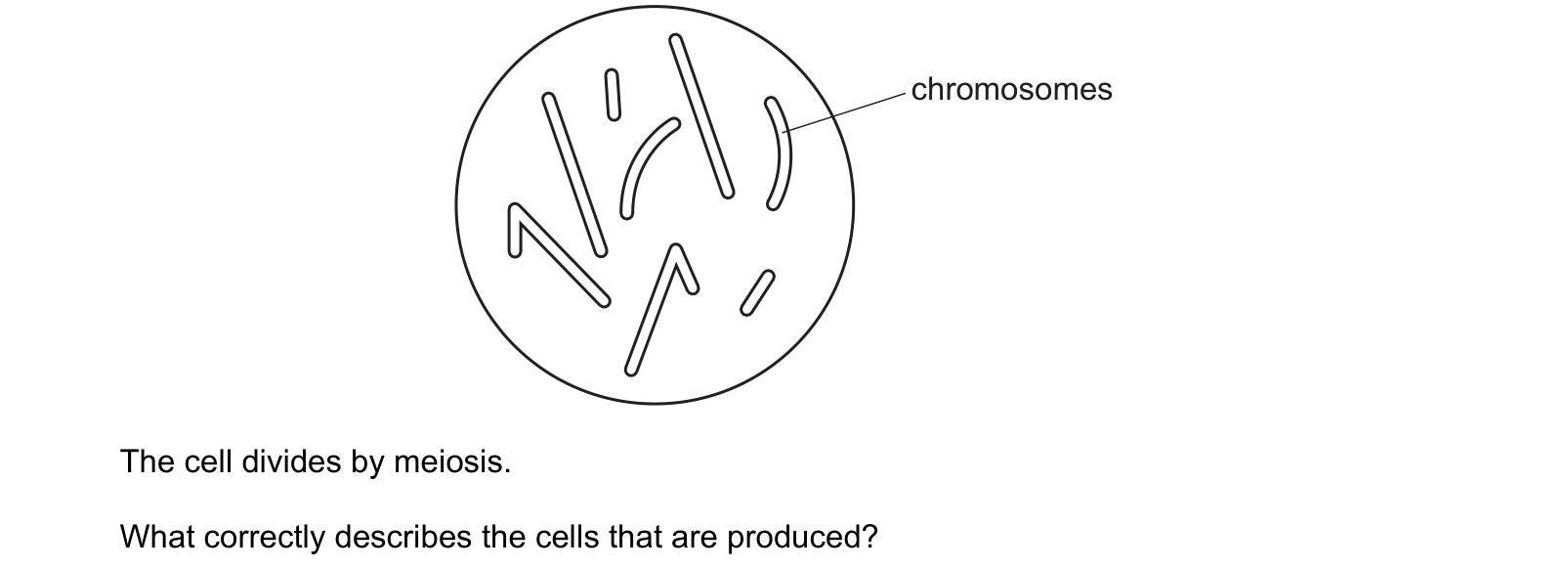
The diagram shows the chromosomes present in a cell. The cell divides by meiosis.
What correctly describes the cells that are produced?
Answer: B.
Question 2
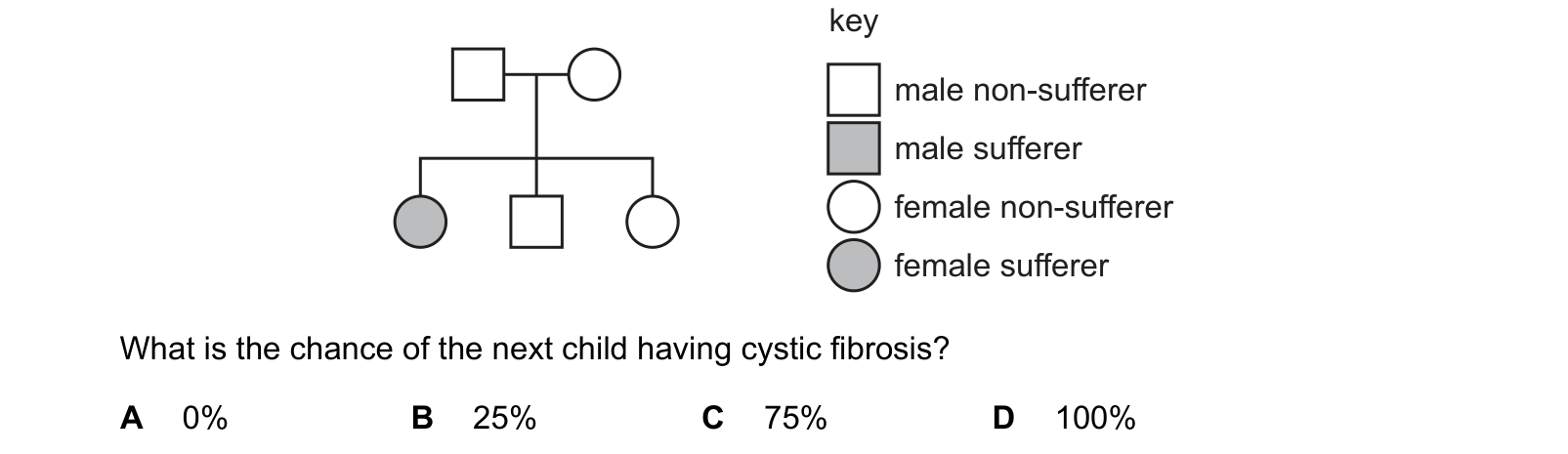
Cystic fibrosis is a genetic condition.
The allele for cystic fibrosis is recessive.
The diagram shows inheritance of cystic fibrosis in a family.
key What is the chance of the next child having cystic fibrosis?
Answer: B.
Question 3
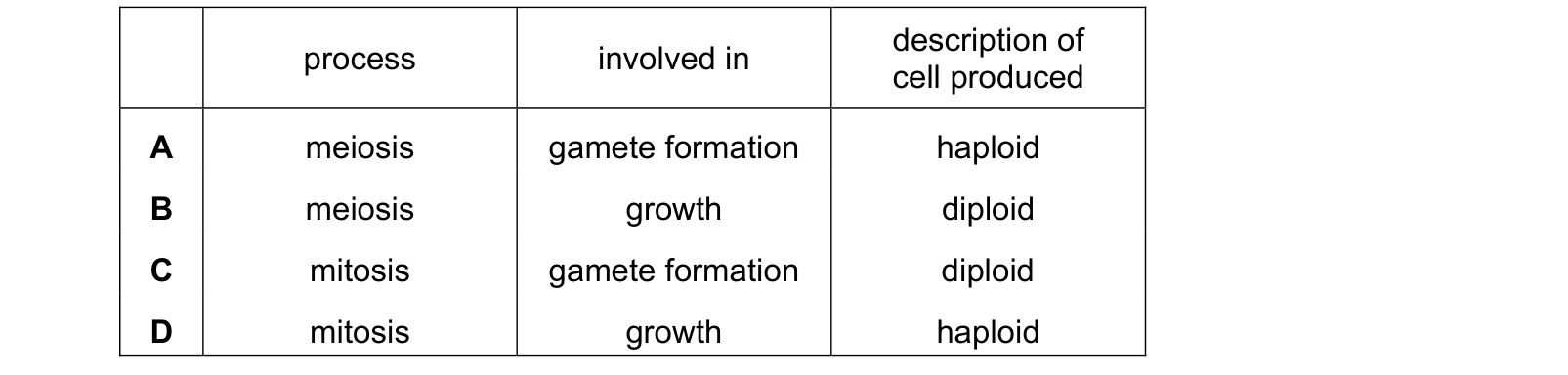
Which row about meiosis or mitosis is correct? Each answer gives, in order: process; involved in; description of cell produced.
Answer: A.
What the syllabus asks for on this topicSyllabus points
Syllabus points
- Define chromosome, gene, allele, genotype, phenotype, homozygous, heterozygous, dominant and recessive.
- State the chromosome numbers of human body cells and gametes.
- Compare mitosis and meiosis, and state where each is used.
- Complete and interpret a genetic diagram for a monohybrid cross.
- Predict the ratios and probabilities of offspring from a cross.
- Explain the inheritance of sex in humans.
Related CIE 0654 Co-ordinated Sciences topics
Not the topic you were looking for? Describe what you are stuck on in your own words and we will take you to the notes that answer it.