41 past-paper questions on this unit. Five of them are below. Answer on the page: each one is marked the moment you pick, the correct option is shown whether or not you found it, and the full explanation opens either way.
CIE 0654 Co-ordinated SciencesPaper 1 and Paper 2 MCQsFree account
Inheritance: five questions to try now
Real past-paper questions, the answer key from the mark scheme, and the explanation that goes with it. No account needed to answer them.
Question 1
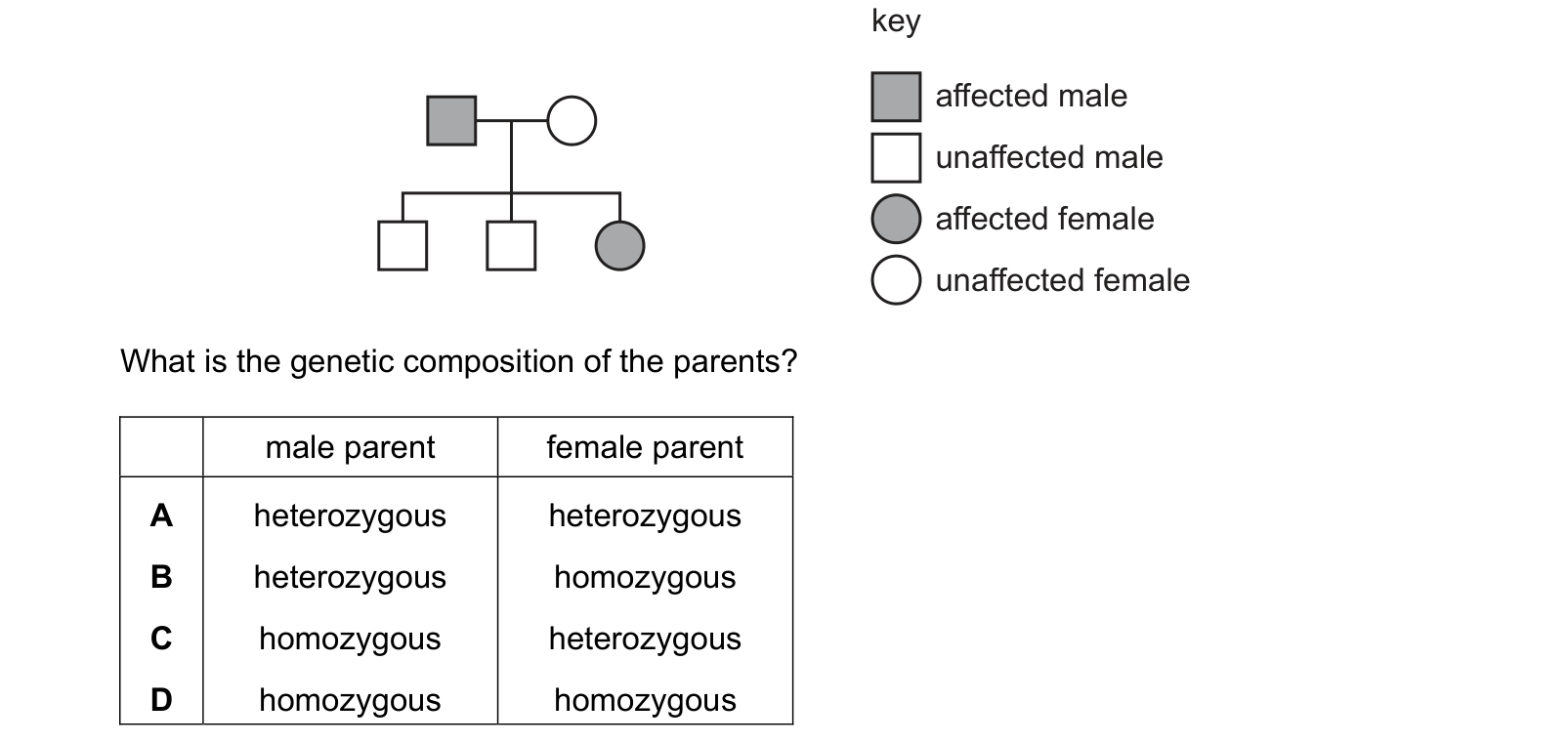
Cystic fibrosis is a genetic disease caused by a recessive allele. key What is the genetic composition of the parents? Each answer gives, in order: male parent; female parent.
Answer: C.
Cystic fibrosis is recessive, so anyone who has the disease carries two copies of the faulty allele and no dominant one to mask them. The father is shaded and therefore affected, which makes him homozygous recessive. The mother is unaffected, so she has at least one dominant allele, yet her daughter is affected and must have inherited a recessive allele from each parent, so the mother is carrying one hidden recessive allele and is heterozygous. The two rows that make the father heterozygous would give him a dominant allele and so leave him free of the disease, which the shading rules out. The row making both parents homozygous would give the mother either two recessive alleles and the disease she plainly does not have, or two dominant alleles, in which case no child of hers could be affected.
Question 2
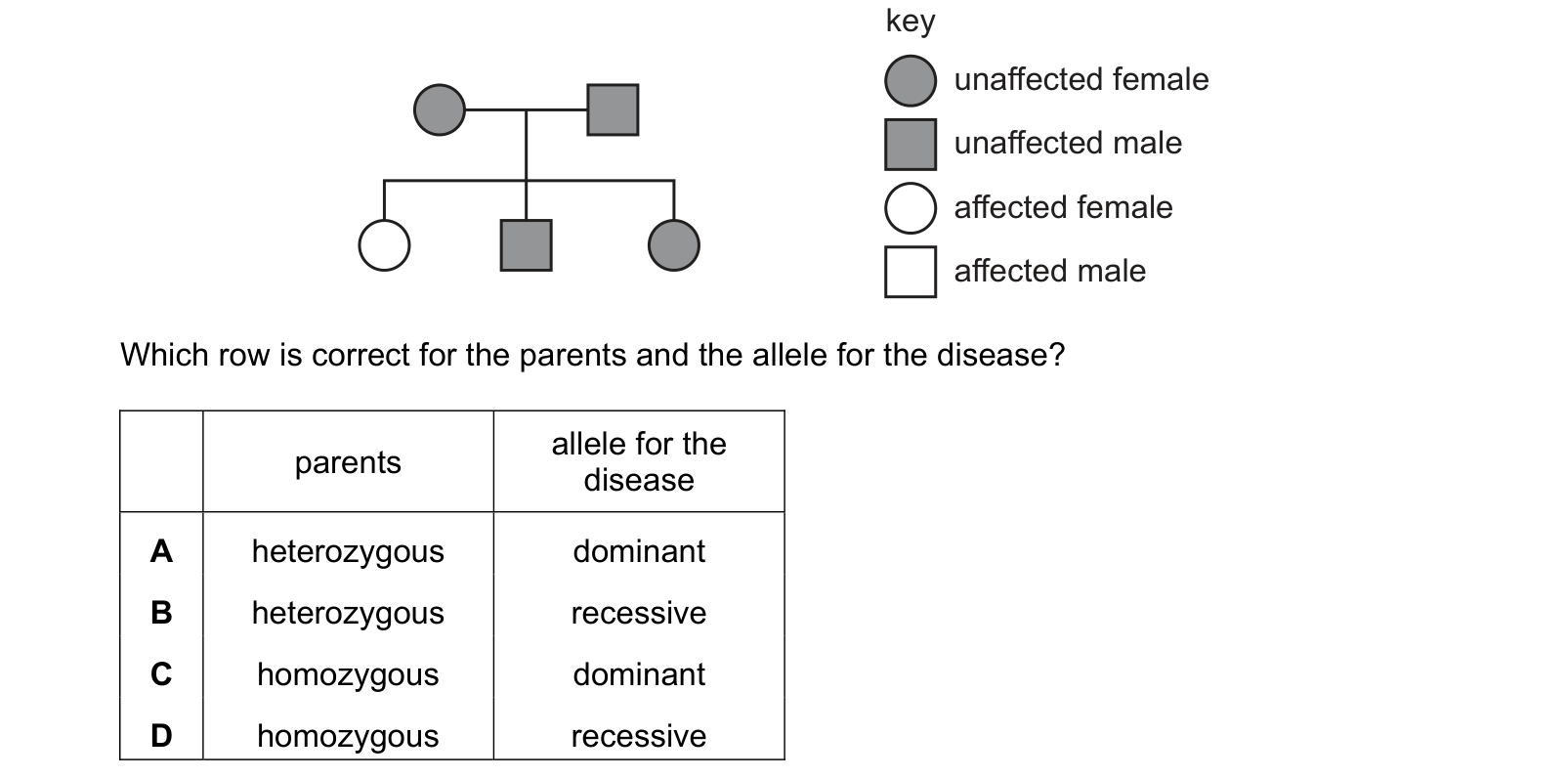
The diagram shows the inheritance of a disease. key Which row is correct for the parents and the allele for the disease? Each answer gives, in order: parents; allele for the disease.
Answer: B.
The key beside this pedigree is the reverse of the usual one, with the shaded symbols marking the unaffected people and the unshaded symbols marking those with the disease. Both parents are shaded and so neither has the disease, yet one of their daughters is unshaded and does have it, and an allele that can hide in one generation and appear in the next must be recessive. For an unaffected couple to produce an affected child, each parent has to carry one copy of that recessive allele masked by a dominant healthy allele, which makes both parents heterozygous. The two rows calling the allele dominant fail because a dominant allele shows in everyone who carries it, so at least one parent would have the disease. The row that keeps recessive but calls the parents homozygous leaves only two possibilities, two sufferers or two people with no copy of the allele at all, and the first is ruled out by the shading while the second could produce no affected child.
Question 3
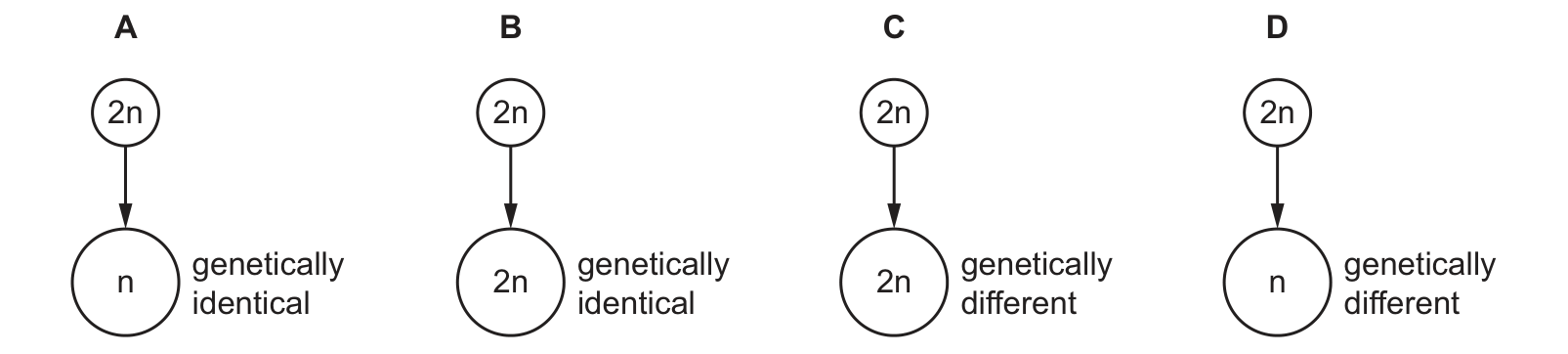
If 2n is the diploid number of chromosomes in a nucleus, which diagram is correct for meiosis? Use the source image for W22 Paper 22, question 11.
Answer: D.
Meiosis is the reduction division that produces gametes, so it must do two things: halve the chromosome number from the diploid 2n to the haploid n, and yield cells that differ genetically, because homologous pairs assort independently and cross over. Only D shows both, an arrow from 2n leading to n, with the daughter cells labelled genetically different. A halves the number correctly but calls the products identical, ignoring the shuffling of alleles that gives gametes their variety. B keeps 2n and identical daughters, which is the description of mitosis rather than meiosis. C is the odd mixture that claims variation without any reduction, so its cells would carry the full diploid set and fertilisation would then double the number every generation.
Question 4
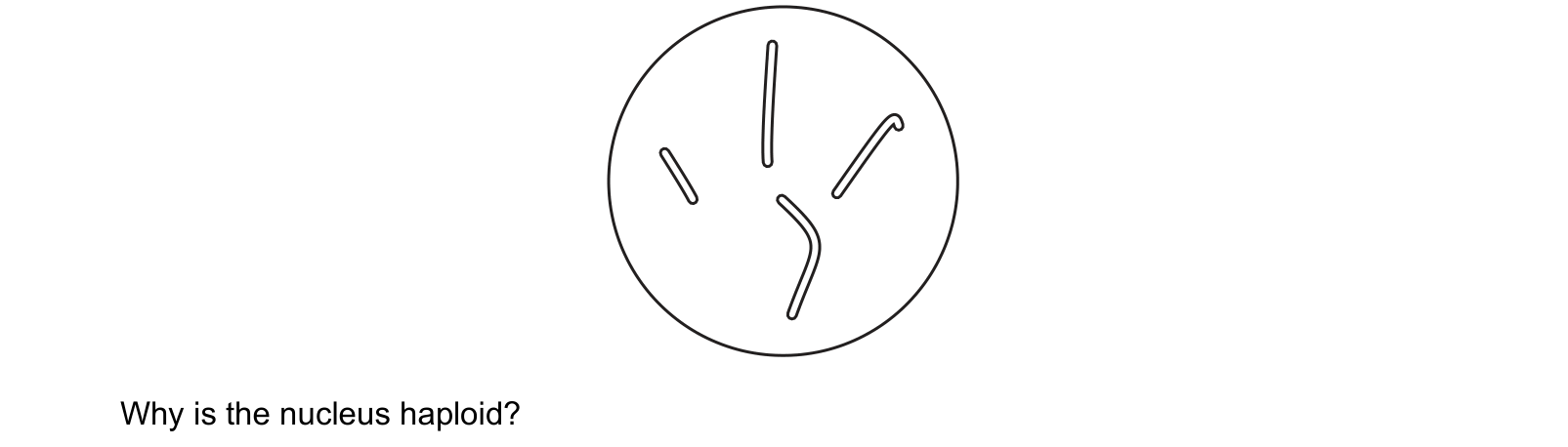
The diagram shows a nucleus from a cell of an organism. The structures shown within the nucleus are chromosomes. Why is the nucleus haploid?
Answer: D.
Haploid means a nucleus carries one single set of chromosomes rather than matching pairs, and the diagram shows four chromosomes of different shapes and sizes, none of which has a partner. D states exactly that, a single unpaired set. C gives the definition of diploid, two matching sets, which is what a body cell holds before meiosis. B leans on the count of four, but ploidy is never fixed by a number, since a diploid nucleus could equally contain four chromosomes arranged as two pairs. A confuses ploidy with replication, because the number of DNA copies inside one chromosome changes when it is copied into two chromatids and says nothing about how many sets are present.
Question 5
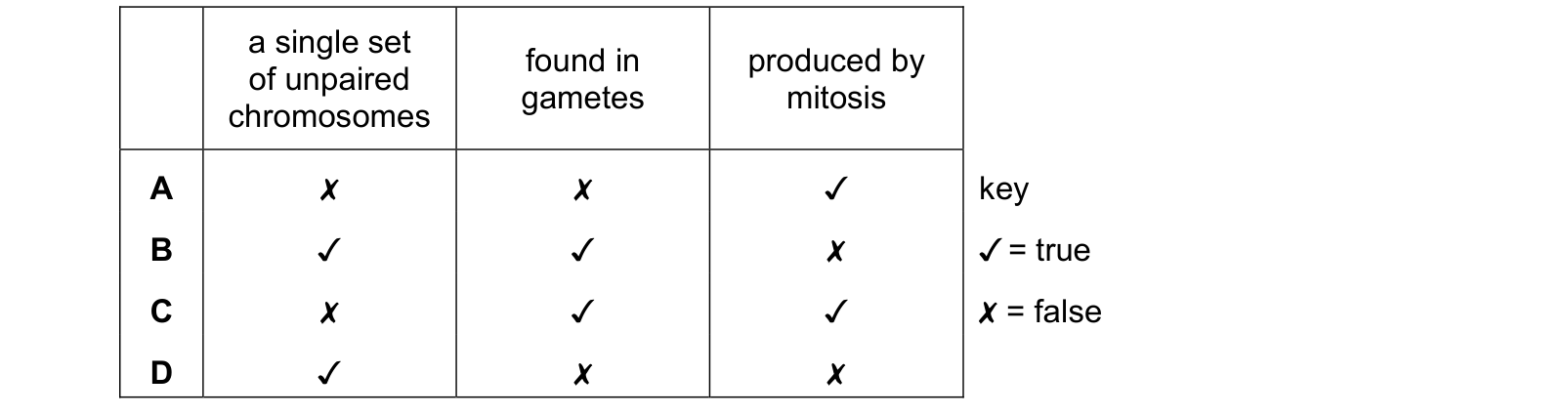
The table gives statements about a human haploid nucleus. Which row is correct? a single set found in produced by of unpaired gametes mitosis chromosomes Use the source image for M22 Paper 22, question 11.
Answer: B.
A haploid nucleus holds a single set of chromosomes that are not in matching pairs, which is the state of a human sperm or egg with 23 chromosomes rather than 23 pairs. Haploid nuclei are produced by meiosis, the division that halves the chromosome number, whereas mitosis copies every chromosome and gives daughter cells the same number as the parent cell. The correct row therefore marks the first two statements true and the mitosis statement false. The two rows that mark the mitosis statement true have chosen the wrong division, since mitosis conserves the chromosome number and cannot turn a diploid cell into a haploid one. The remaining wrong row accepts the single unpaired set but denies that haploid nuclei occur in gametes, which strips away the only human cells that are haploid at all.
These questions are drawn from past CIE 0654 Co-ordinated Sciences papers and filtered to inheritance. You answer, you find out immediately whether you were right, and you get the reasoning for the correct option and for each distractor. Wrong answers go to a mistakes locker so you can come back to exactly those.
Practice is free. You need an account only so your progress and your mistakes are still there next time.
These are the errors that cost marks on inheritance, taken from our own topic notes. Read them before you practise and you will recognise the traps in the questions.
Saying a gene codes for a characteristic or for fats, rather than for a protein.
Saying an allele is a different gene.
Confusing genotype with phenotype.
Saying gametes are diploid, or that a zygote is haploid.
Saying meiosis makes two cells, or that mitosis makes four.
Saying meiosis is used for growth and repair.
Reading a 3 : 1 ratio as 3 : 1 genotypes. The genotypes are 1 : 2 : 1; the phenotypes are 3 : 1.
Giving an organism with the recessive phenotype a heterozygous genotype.
Revise it first
If any of the above is unfamiliar, work through the notes before practising: Inheritance revision notes.