Human influences on ecosystems
Contents: 8 sections
Matching the cause to the effect
Most questions in this topic are a matching exercise, and they are built by pairing the right activity with the wrong effect. Learn this table in both directions.
| Human activity | Effect |
|---|---|
| Overuse of nitrogen-containing fertiliser, and untreated sewage | Eutrophication |
| Burning fossil fuels containing sulfur | Acid rain |
| Burning fossil fuels, and deforestation | Rising carbon dioxide and the enhanced greenhouse effect |
| Deforestation | Soil erosion, flooding, loss of habitat, extinction, rising carbon dioxide |
| Discarded plastics | Physical pollution, harm to wildlife, waste that does not break down |
The pair that appears most often is fertiliser with eutrophication. Deforestation does not cause acid rain and does not cause eutrophication, and those two distractors are in almost every version of the question.
Deforestation
Effects on the atmosphere. Trees remove carbon dioxide from the air by photosynthesis and lock the carbon away in wood. Fell them and two things happen at once: that uptake stops, and the carbon stored in the timber returns to the air as it is burnt or left to rot. Carbon dioxide rises and oxygen falls.
Both halves of that sentence matter. Photosynthesis is the reaction that takes carbon dioxide in and gives oxygen out, so the two gases must move in opposite directions. A row showing both rising cannot be right, however familiar the link between deforestation and carbon dioxide is.
It is also tempting to argue that fewer trees means less respiration by trees, so carbon dioxide should fall. A growing tree takes in far more carbon dioxide in photosynthesis than it releases in respiration, which is exactly why a forest is a net store of carbon in the first place.
Effects on the land. Roots hold the soil together and keep it open, and the canopy intercepts rain before it reaches the ground. Remove the trees and:
- Soil erosion. Bare topsoil is washed away by rain and blown away by wind, so the land loses its fertility.
- Flooding. Rain that would have been intercepted or soaked up now runs straight off the surface into rivers, so floods become more frequent and more severe.
- Loss of habitat, leading to loss of biodiversity and to extinction of species that lived nowhere else.
- Disruption of the water cycle, since less water is returned to the air by transpiration.
Providing land for agriculture is why deforestation happens. It is a reason rather than an undesirable effect, and offering it as one is a standard wrong answer.
Water pollution
Eutrophication is the sequence to know in order:
- Excess nitrate enters the water from fertiliser leached off fields, or from untreated sewage.
- Algae and other producers grow rapidly into a bloom.
- The bloom blocks light, and the producers die.
- Decomposers multiply and respire aerobically as they break the dead material down.
- Dissolved oxygen falls.
- Fish and other aquatic organisms die from lack of oxygen.
They suffocate rather than being poisoned, and it is the decomposers rather than the fertiliser that consume the oxygen. Both points are examined.
Other water pollutants include untreated sewage, which also carries pathogens such as the cholera bacterium, and chemical waste from industry.
Air pollution
Acid rain. Burning fossil fuels that contain sulfur releases sulfur dioxide, and the high temperatures in engines produce oxides of nitrogen. These dissolve in water in the atmosphere and fall as acid rain, which:
- Kills trees, by damaging leaves and by releasing aluminium ions from the soil that damage roots.
- Acidifies lakes and rivers, killing fish and their eggs.
- Erodes limestone buildings and statues, since acid reacts with the carbonate.
The enhanced greenhouse effect. Carbon dioxide and methane in the atmosphere absorb the heat radiated from the Earth's surface and re-radiate some of it back down. A natural greenhouse effect keeps the planet warm enough to live on; the problem is that human activity has increased the concentration of these gases, so more heat is trapped than before.
Carbon dioxide comes mainly from burning fossil fuels and from deforestation. Methane comes from cattle, rice fields and landfill.
The consequences are rising average temperatures, melting ice and rising sea levels, changed rainfall patterns and more extreme weather, and species that cannot move or adapt fast enough dying out.
Say enhanced greenhouse effect. The greenhouse effect itself is natural and necessary, so blaming warming on its existence rather than on its increase misses the point of the question.
Plastics
Most plastics are non-biodegradable, meaning decomposers have no enzymes that will break them down, so they persist for hundreds of years. Discarded plastic:
- Kills marine animals that swallow it or become entangled in it.
- Breaks into microplastics that enter food chains and accumulate along them.
- Fills landfill sites, which take up land.
Burning plastic waste avoids the landfill but releases carbon dioxide and often toxic gases as well.
Conservation and sustainable resources
A sustainable resource is one that is produced as fast as it is used, so it will not run out.
Fish stocks and forests can both be managed sustainably:
- Fish: quotas limiting the catch, a minimum net mesh size so young fish escape and can breed, and closed seasons during breeding.
- Forests: replanting to replace felled trees, and selective felling of mature trees rather than clearing a whole area.
Conservation of species and habitats is done by creating national parks and protected areas, by captive breeding programmes and by seed banks, and by laws banning hunting or trade in endangered species.
Why conservation matters is a common short-answer question, and there are several defensible reasons: species may have medical or agricultural value not yet discovered, removing one species disrupts food webs and harms others, biodiversity keeps a large pool of alleles available, and habitats have value for tourism and for their own sake.
Recycling reduces the demand on raw materials, uses less energy than making things from scratch, and cuts the amount going to landfill.
Common mistakes
- Pairing deforestation with acid rain, or with eutrophication.
- Saying deforestation lowers carbon dioxide because fewer trees respire.
- Saying deforestation raises both carbon dioxide and oxygen.
- Giving "provides land for farming" as an undesirable effect of deforestation.
- Saying eutrophication poisons the fish, rather than removing their oxygen.
- Saying the algae themselves use up the oxygen. The decomposers do, as they break the dead algae down.
- Blaming warming on the greenhouse effect existing, rather than on its enhancement.
- Saying carbon dioxide causes acid rain. Sulfur dioxide and oxides of nitrogen do.
- Saying plastics are broken down slowly by decomposers. Non-biodegradable means they are not broken down by them at all.
Check you have it
Question 1
The diagram shows a river and four farms. The numbers in the river show relative oxygen concentrations. From which farm is untreated sewage leaking into the river? Use the source image for W20 Paper 12, question 13.
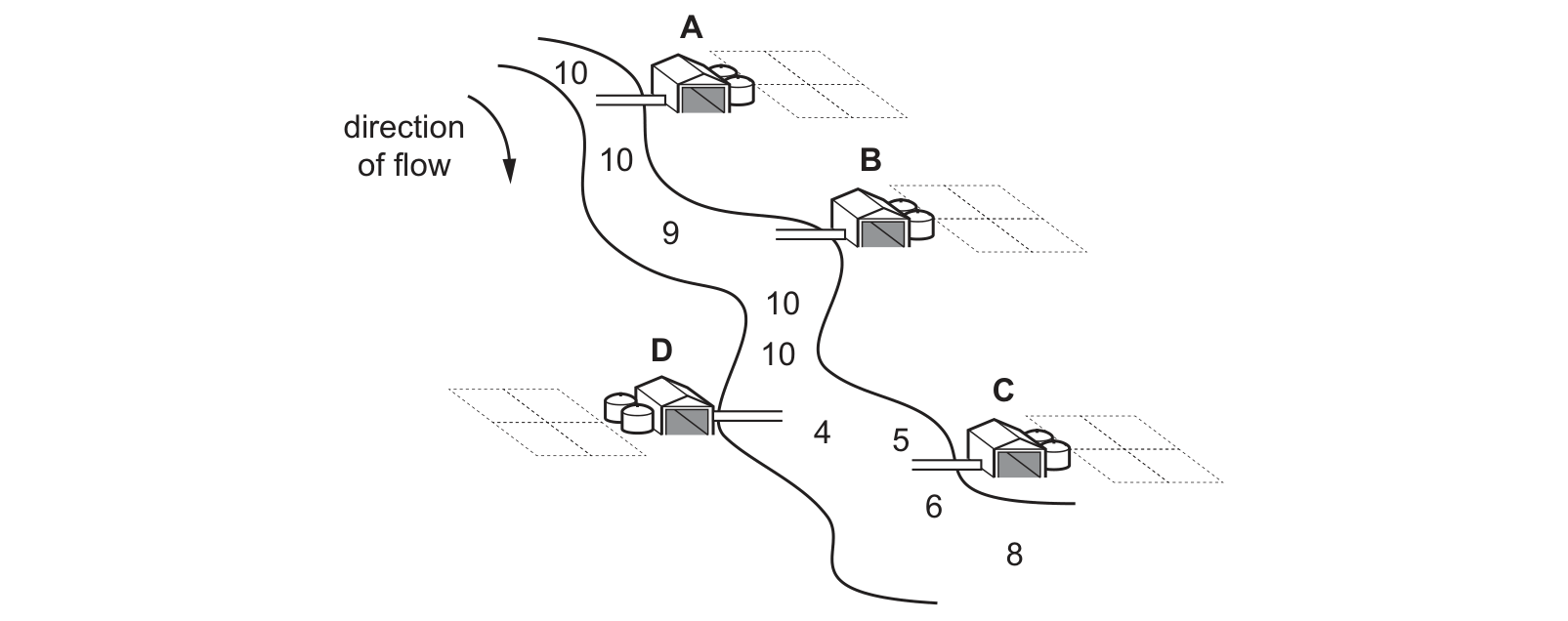
Answer: D.
Question 2
The diagram shows a river and four farms. The numbers in the river show relative oxygen concentrations. From which farm is untreated sewage leaking into the river? Use the source image for W20 Paper 13, question 13.
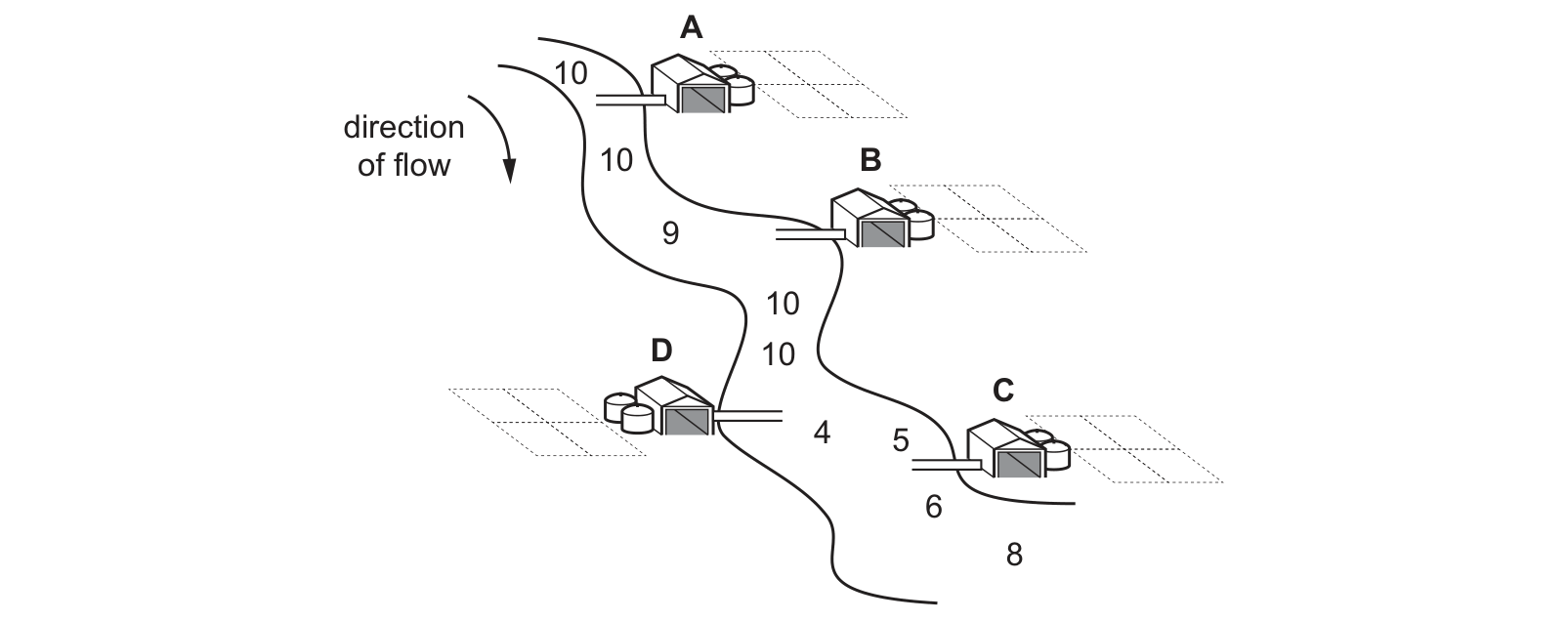
Answer: D.
Question 3
Putting too much fertiliser on soil can lead to eutrophication in water.
Which substance, dissolved in water, is reduced in concentration as a result of eutrophication?
Answer: D.
What the syllabus asks for on this topicSyllabus points
Syllabus points
- Describe the undesirable effects of deforestation.
- Describe the causes and effects of water pollution, including eutrophication.
- Describe the causes and effects of air pollution, including acid rain and the enhanced greenhouse effect.
- Describe the effects of non-biodegradable plastics on the environment.
- Explain how habitats and species can be conserved and how resources can be used sustainably.
Related CIE 0654 Co-ordinated Sciences topics
Not the topic you were looking for? Describe what you are stuck on in your own words and we will take you to the notes that answer it.