Electrochemistry
Contents: 9 sections
The words, and why they matter
Electrolysis is the breakdown of an ionic compound, when molten or in solution, by the passage of electricity.
| Term | Meaning |
|---|---|
| Electrolyte | The molten or dissolved ionic compound that conducts |
| Cathode | The negative electrode |
| Anode | The positive electrode |
| Cation | A positive ion, so it moves to the cathode |
| Anion | A negative ion, so it moves to the anode |
Opposite charges attract, and everything else in this topic follows from that.
- Positive ions go to the cathode, where they gain electrons. Gaining electrons is reduction.
- Negative ions go to the anode, where they lose electrons. Losing electrons is oxidation.
So reduction always happens at the cathode and oxidation always happens at the anode, in every electrolysis without exception. A large family of questions is answered from that sentence alone, because the wrong options are made by swapping the two or by pairing reduction with the loss of electrons.
Two more points settle the rest:
- Electrons never travel through the electrolyte. In the wires, electrons flow from the power supply into the cathode and back from the anode to the supply. In the liquid, the charge is carried by moving ions.
- An electrolyte must be molten or dissolved, because the ions have to be free to move. A solid ionic compound does not conduct, since its ions are locked in the lattice.
Molten compounds
With a molten compound the only ions present are those of the compound itself, so the products are simply the metal and the non-metal.
Molten lead(II) bromide gives lead at the cathode and bromine at the anode.
Cathode: Pb²⁺ + 2e⁻ → Pb
Anode: 2Br⁻ → Br₂ + 2e⁻
How to check a half-equation before thinking about the chemistry at all. The charge must balance across the arrow, and the electrons must be on the correct side. A cathode half-equation always has the electrons on the left, being gained. An anode half-equation always has them on the right, being lost. Pb²⁺ → Pb + 2e⁻ has an overall charge of 2+ on the left and 0 on the right, so it fails on charge and can be rejected instantly.
Aqueous solutions
This is where the marks are, because water supplies H⁺ and OH⁻ ions in addition to the ions of the dissolved salt. Two ions now compete at each electrode, and there are rules for which one wins.
At the cathode: the LESS reactive positive ion is discharged.
- If the metal is below hydrogen in the reactivity series, such as copper or silver, the metal is deposited.
- If the metal is above hydrogen, such as sodium, potassium or calcium, hydrogen is released instead and the metal stays in solution as ions.
At the anode: a halide ion is discharged if the solution is concentrated; otherwise oxygen is released from the hydroxide ions.
- Concentrated chloride solution gives chlorine.
- Dilute solutions, and solutions of sulfates and nitrates, give oxygen.
Worked examples.
| Electrolyte | Cathode | Anode | Reasoning |
|---|---|---|---|
| Aqueous copper(II) sulfate, inert electrodes | Copper | Oxygen | Copper is below hydrogen, so it wins at the cathode; sulfate is never discharged, so oxygen comes from the hydroxide ions |
| Dilute potassium chloride | Hydrogen | Oxygen | Potassium is far above hydrogen; the solution is dilute, so oxygen not chlorine |
| Concentrated sodium chloride | Hydrogen | Chlorine | Sodium is above hydrogen; the chloride is concentrated |
The half-equations for the copper(II) sulfate cell are:
Cathode: Cu²⁺ + 2e⁻ → Cu
Anode: 4OH⁻ → O₂ + 2H₂O + 4e⁻
The trap to watch is the phrase "negative electrode". Questions often ask whether oxygen is produced at the negative electrode. It is not. Oxygen comes off at the positive anode, because it comes from negatively charged hydroxide ions, which are attracted to the positive plate. Oxygen never appears at a cathode, since a cathode is where positive ions gain electrons.
Testing the gases
| Gas | Test | Result |
|---|---|---|
| Hydrogen | Lighted splint | Burns with a squeaky pop |
| Oxygen | Glowing splint | Relights it |
| Chlorine | Damp litmus paper | Bleaches it white |
| Carbon dioxide | Limewater | Turns it milky |
Chlorine turns damp blue litmus red first, because it is acidic, and then bleaches it white. A gas that turns damp red litmus blue is alkaline, such as ammonia, and is never an electrolysis product of a chloride solution.
The chlor-alkali process
Electrolysing concentrated sodium chloride solution industrially gives three useful products: chlorine at the anode, hydrogen at the cathode, and sodium hydroxide solution left behind.
The sodium hydroxide collects around the cathode, and the reason is worth following. Hydrogen ions are being removed there, taken out of the water as hydrogen gas. That leaves an excess of hydroxide ions in that region, and the sodium ions, which were never discharged, are still there too. Sodium hydroxide solution is what remains.
Chlorine is used to sterilise water and to make bleach and PVC; hydrogen for making ammonia and margarine; sodium hydroxide for soap, paper and bleach.
Electroplating and refining
Electroplating coats an object with a thin layer of metal, for appearance or to prevent corrosion.
- The object to be plated is the cathode, because that is where metal is deposited.
- The anode is made of the plating metal, so it dissolves and replaces what is deposited.
- The electrolyte is a solution of a salt of the plating metal.
Refining copper uses the same arrangement. The anode is impure copper and dissolves; the cathode is pure copper and grows as pure copper plates onto it; the electrolyte is aqueous copper(II) sulfate. The impurities fall to the bottom as a sludge.
Say clearly which electrode does which. Pure copper is deposited at the cathode, not at the anode, and the anode is impure copper rather than an inert material. Both errors appear as options in the same question. With copper electrodes the two half-equations are mirror images, which is why they are so easy to attach to the wrong electrode:
Anode: Cu → Cu²⁺ + 2e⁻ (the anode dissolves and loses mass)
Cathode: Cu²⁺ + 2e⁻ → Cu (the cathode gains mass)
Extracting aluminium
Aluminium is above carbon in the reactivity series, so it cannot be extracted by reduction with carbon and must be extracted by electrolysis.
- The ore is bauxite, from which pure aluminium oxide is obtained.
- The aluminium oxide is dissolved in molten cryolite, which lowers the melting point and so saves a great deal of energy. Cryolite is not the ore.
- At the cathode, Al³⁺ + 3e⁻ → Al, and molten aluminium collects at the bottom.
- At the anode, 2O²⁻ → O₂ + 4e⁻. The oxygen attacks the carbon anodes, which burn away and have to be replaced regularly.
Contrast this with iron, which is below carbon and is therefore extracted from hematite by reduction with carbon in a blast furnace. A question offering "aluminium is extracted from hematite" or "aluminium is extracted by heating with carbon" is testing both halves of that comparison at once.
Common mistakes
- Saying oxidation happens at the cathode.
- Saying the anode is negative.
- Saying anions are oxidised by gaining electrons. Oxidation is losing electrons.
- Saying oxygen is produced at the negative electrode.
- Putting the metal at the anode, when metal ions are positive and are repelled by a positive electrode.
- Saying electrons travel through the electrolyte.
- Applying the molten rule to a solution, so that sodium appears at the cathode from sodium chloride solution.
- Forgetting that a dilute chloride solution gives oxygen rather than chlorine.
- Writing a cathode half-equation with the electrons on the right.
- Saying cryolite is the ore of aluminium, or that aluminium is extracted with carbon.
- Saying pure copper is deposited at the anode during refining.
Check you have it
Question 1
An experiment is set up to test the effect of electricity on solution R. What are the names of P, Q and R? Each answer gives, in order: P; Q; R.
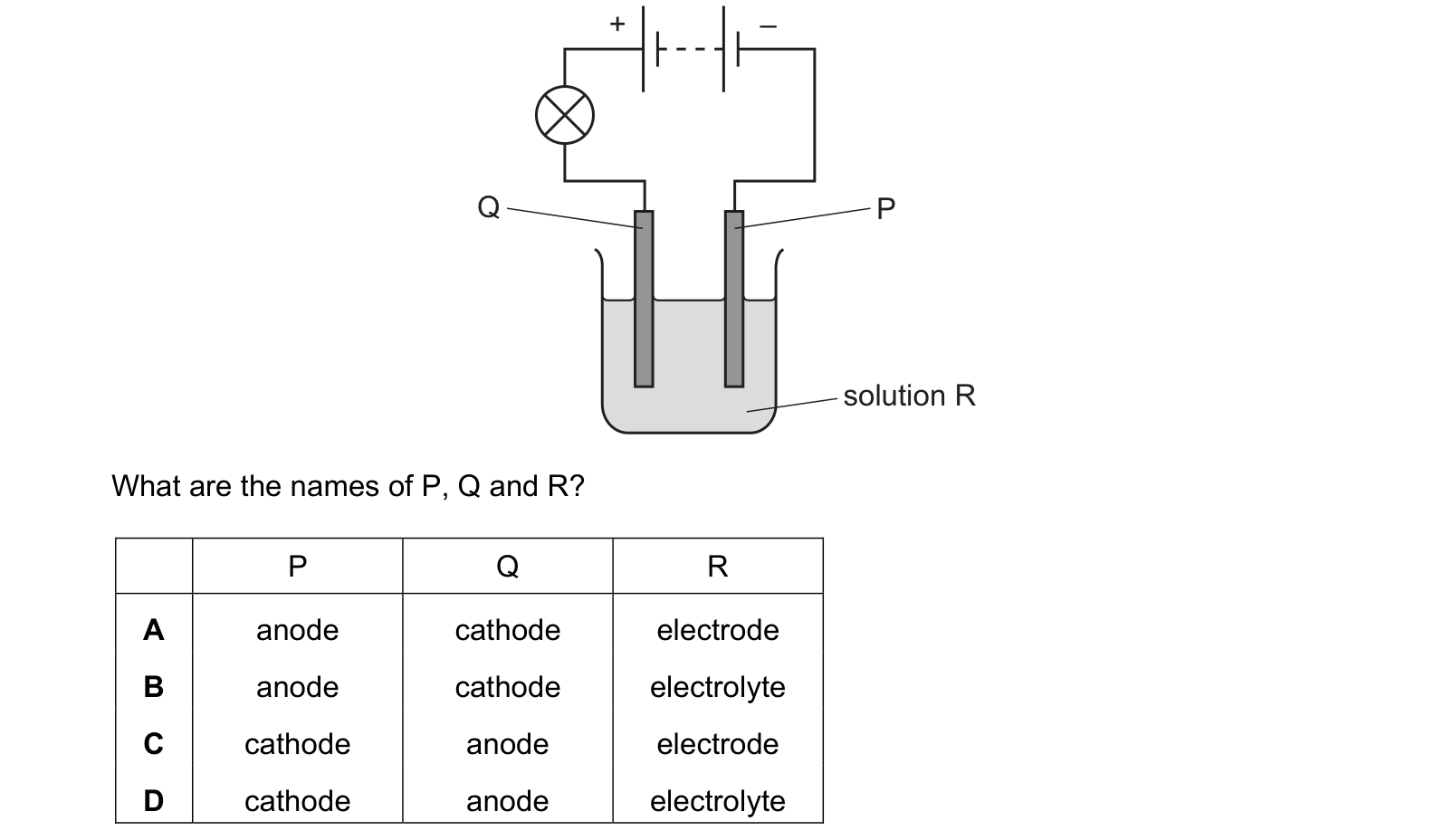
Answer: D.
Question 2
The diagram shows the electrolysis of molten lead(II) bromide using inert electrodes. Which statement about this experiment is correct?
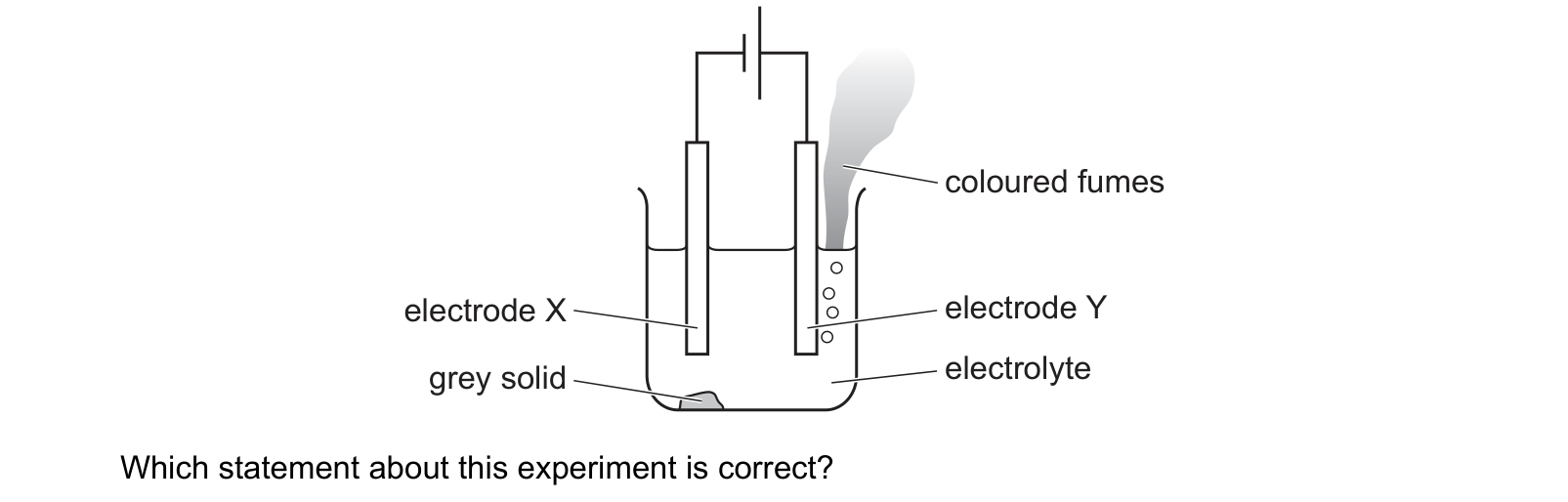
Answer: C.
Question 3
Apparatus used for electrolysis is shown. Which label identifies the electrolyte? Use the source image for S21 Paper 11, question 17.

Answer: D.
What the syllabus asks for on this topicSyllabus points
Syllabus points
- Define electrolysis and identify the anode, cathode, electrolyte and the ions present.
- Identify the products of electrolysing molten compounds and aqueous solutions.
- Write half-equations for the reactions at each electrode.
- Describe electroplating and the electrolytic refining of copper.
- Describe the extraction of aluminium by electrolysis.
Related CIE 0654 Co-ordinated Sciences topics
Not the topic you were looking for? Describe what you are stuck on in your own words and we will take you to the notes that answer it.