Transport in plants
Contents: 7 sections
Xylem and phloem
| Xylem | Phloem | |
|---|---|---|
| Carries | Water and dissolved mineral ions | Sucrose and amino acids |
| Direction | Roots to leaves, upwards only | From the leaves to wherever they are needed, both up and down |
| Living? | Dead, hollow, no end walls | Living, with sieve plates and companion cells |
| Wall | Strengthened with lignin | Thin, no lignin |
| Process | Transpiration | Translocation |
The one-line way to keep them apart: phloem carries food, xylem carries water. Cambridge sets a question almost every year that describes both journeys correctly and then swaps the vessels over, so it is worth having that sentence ready.
Xylem being dead is not an accident. A xylem vessel is a stack of cells whose end walls and contents have broken down, leaving a continuous open pipe. Nothing blocks the water's path, and the lignin in the walls stops the tube collapsing under the tension the water column is held at. Phloem has to stay alive because translocation needs energy from respiration, which is why each sieve tube has a companion cell packed with mitochondria beside it.
In a stem the vascular bundles are near the outside, with the xylem on the inside of each bundle and the phloem on the outside. In a root they sit in the centre, which helps the root resist being pulled.
The pathway of water
soil → root hair cell → root cortex cells → xylem → up the stem → mesophyll cells in the leaf → evaporates → out through the stomata
Water enters the root hair cell by osmosis, because the soil water is more dilute than the cell sap, so it has the higher water potential. The root hair cell is long and thin, which gives a large surface area for absorption.
Mineral ions travel with the water in the xylem, but they get into the root by a different route: active transport, because ions are usually more concentrated inside the root than in the soil water outside. Same journey, two different mechanisms, and mixing them up is a reliable way to lose a mark.
Transpiration
Transpiration is the loss of water vapour from the leaves. More fully: water evaporates from the surfaces of the mesophyll cells into the air spaces of the leaf, and the vapour then diffuses out through the stomata.
Two separate steps sit inside that definition, and questions test which happens where.
- Evaporation happens from the wet cell walls of the mesophyll cells, inside the leaf. Not from the stomata, and not from the xylem.
- Diffusion carries the vapour from the air spaces out through the stomata, down a concentration gradient into the drier air outside.
Losing water this way is what pulls the rest of the water up the plant. As mesophyll cells lose water, their water potential falls, so they draw water from neighbouring cells and ultimately from the xylem. Water molecules stick to one another, so the whole column is pulled up the xylem as an unbroken thread. That pull is called the transpiration stream, and it is the reason a plant can move water to the top of a tall tree with no pump at all.
Transpiration is not only a cost. The same stream delivers mineral ions to the leaves, and the evaporation cools the plant, which is why leaves in the sun are cooler than the air around them.
What changes the rate
Every factor here works by changing either how fast water evaporates or how steep the gradient of water vapour is just outside the stomata.
| Factor | Effect on rate | Why |
|---|---|---|
| Higher temperature | Faster | Water molecules have more energy, so they evaporate more readily |
| Lower humidity | Faster | Drier air outside means a steeper water vapour gradient across the stomata |
| Higher wind speed | Faster | Wind sweeps the humid air away from the leaf, keeping the gradient steep |
| Higher light intensity | Faster | Light makes the stomata open for photosynthesis, and open stomata lose water |
So the fastest transpiration happens in conditions that are warm, dry and windy, and the slowest in conditions that are cool, humid and still.
The one that catches people out is still air. Temperature is remembered first, so a hot but still day feels like the obvious answer. In still air the water vapour lost from the leaf simply piles up around it, the gradient flattens, and further evaporation almost stops. A breeze is doing something a high temperature cannot do on its own.
Light intensity works indirectly, through the stomata. In darkness the stomata close, so transpiration falls almost to nothing even if the night is warm and dry.
How it is measured. A potometer measures the rate at which a shoot takes up water, by timing how far an air bubble travels along a capillary tube. Strictly it measures uptake rather than loss, and a small amount of the water taken up is used in photosynthesis and to keep cells turgid rather than transpired, so the two are close but not identical. That distinction is worth a mark when a question asks what the potometer actually measures.
Wilting happens when water is lost faster than it can be taken up. Cells lose turgor and become flaccid, so the pressure that held the leaves out is gone and the plant droops. Closing the stomata reduces the loss, but it also shuts off the carbon dioxide supply, so photosynthesis stops as well.
Translocation
Translocation is the movement of sucrose and amino acids in the phloem, from the parts of the plant that make or store them to the parts that need them.
A source is where the substances enter the phloem, usually a photosynthesising leaf or a storage organ being emptied in spring. A sink is where they are used or stored, such as a growing root tip, a developing fruit, or a potato tuber being filled.
Two features distinguish it from transpiration and are worth stating explicitly. Translocation goes in either direction, because a sink can be above or below the source, whereas the transpiration stream only goes up. And translocation needs energy from respiration, whereas transpiration is driven by evaporation and costs the plant no energy at all.
Sugar travels as sucrose rather than glucose because sucrose is not used directly in respiration, so it can be moved about without being consumed on the way.
Common mistakes
- Putting water in the phloem or sugar in the xylem.
- Saying xylem is living, or that phloem is dead.
- Saying transpiration is evaporation from the stomata. The evaporation is from the mesophyll cell surfaces; the stomata are where the vapour diffuses out.
- Saying water is absorbed by the roots by active transport. Water enters by osmosis; the mineral ions use active transport.
- Answering "high temperature and still air" for the fastest transpiration.
- Saying high humidity speeds transpiration up because there is more water about. It slows it down, because the gradient is shallower.
- Describing translocation as one-way, from roots to leaves.
- Saying a potometer measures the rate of transpiration exactly, rather than the rate of water uptake.
- Calling the transpiration stream a push from the roots. It is a pull created by evaporation at the top.
Check you have it
Question 1
Which row names the substances carried by xylem vessels and the direction of travel? Each answer gives, in order: substances; direction of travel.
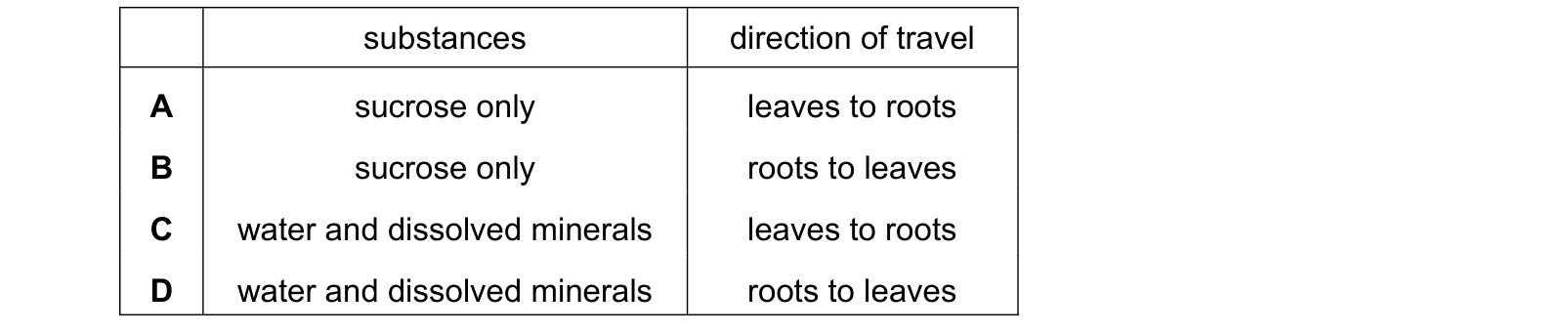
Answer: D.
Question 2
Which graph shows the concentration of sugar solution found in phloem and xylem? Use the source image for S21 Paper 11, question 7.
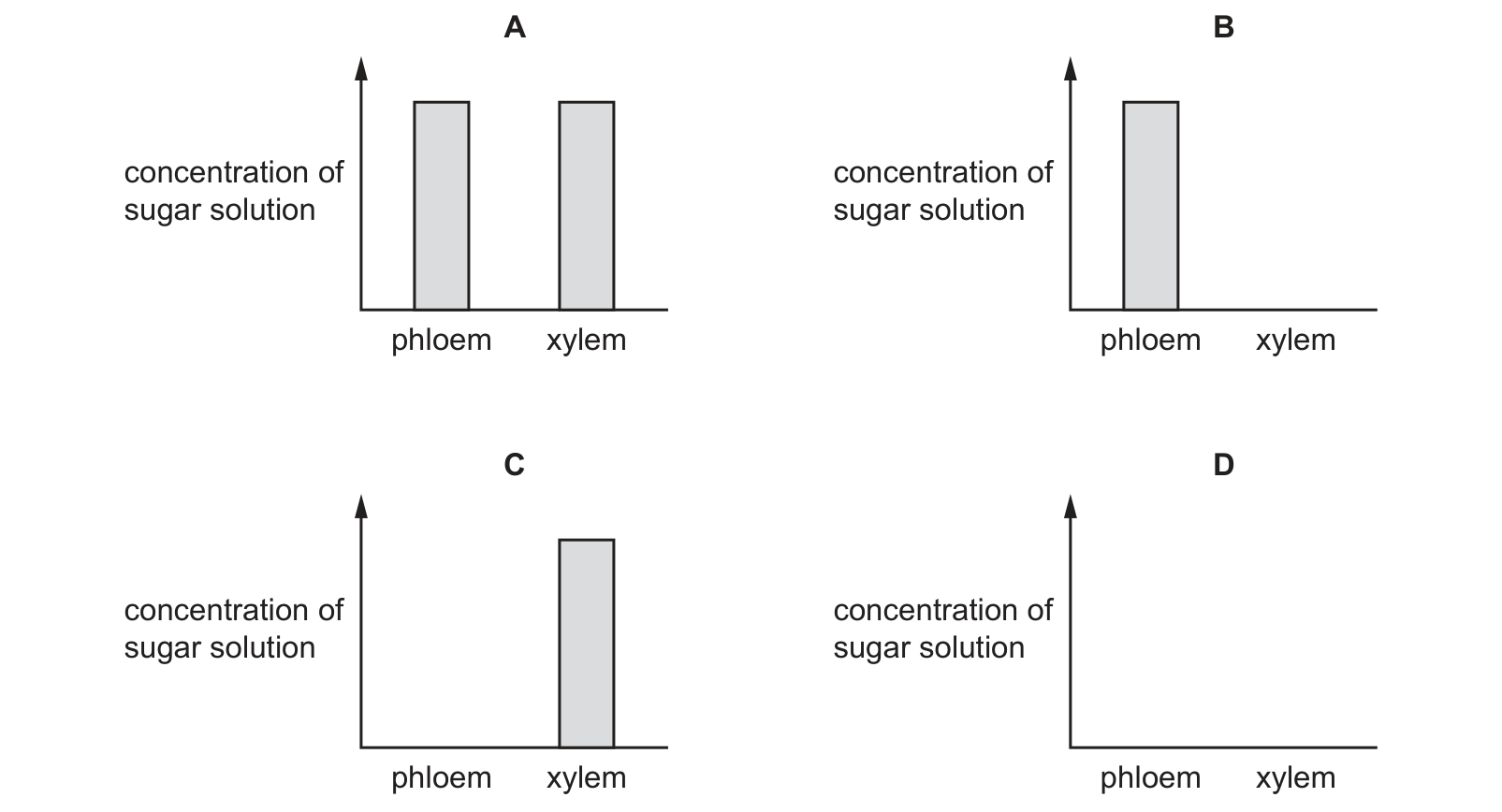
Answer: B.
Question 3
Which conditions cause the highest rate of transpiration in a plant? Each answer gives, in order: temperature; wind speed.
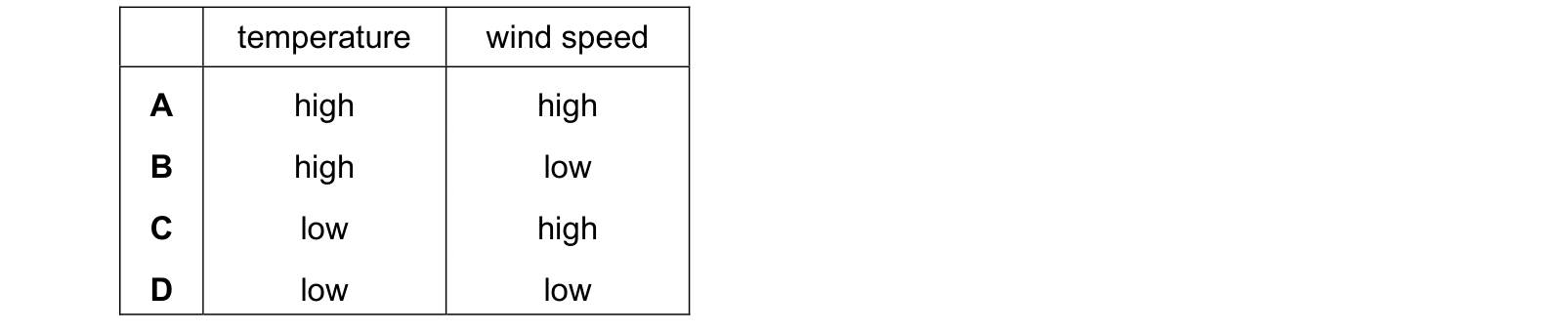
Answer: A.
What the syllabus asks for on this topicSyllabus points
Syllabus points
- State the functions of xylem and phloem, and identify them in a root, stem and leaf.
- Describe the pathway of water from the soil to the leaf.
- Define transpiration and explain how it moves water up the plant.
- Explain the effect of temperature, humidity, wind speed and light intensity on the rate of transpiration.
- Define translocation as the movement of sucrose and amino acids in the phloem.
Related CIE 0654 Co-ordinated Sciences topics
Not the topic you were looking for? Describe what you are stuck on in your own words and we will take you to the notes that answer it.