25 past-paper questions on this unit. Five of them are below. Answer on the page: each one is marked the moment you pick, the correct option is shown whether or not you found it, and the full explanation opens either way.
CIE 0654 Co-ordinated SciencesPaper 1 and Paper 2 MCQsFree account
Transport in plants: five questions to try now
Real past-paper questions, the answer key from the mark scheme, and the explanation that goes with it. No account needed to answer them.
Question 1
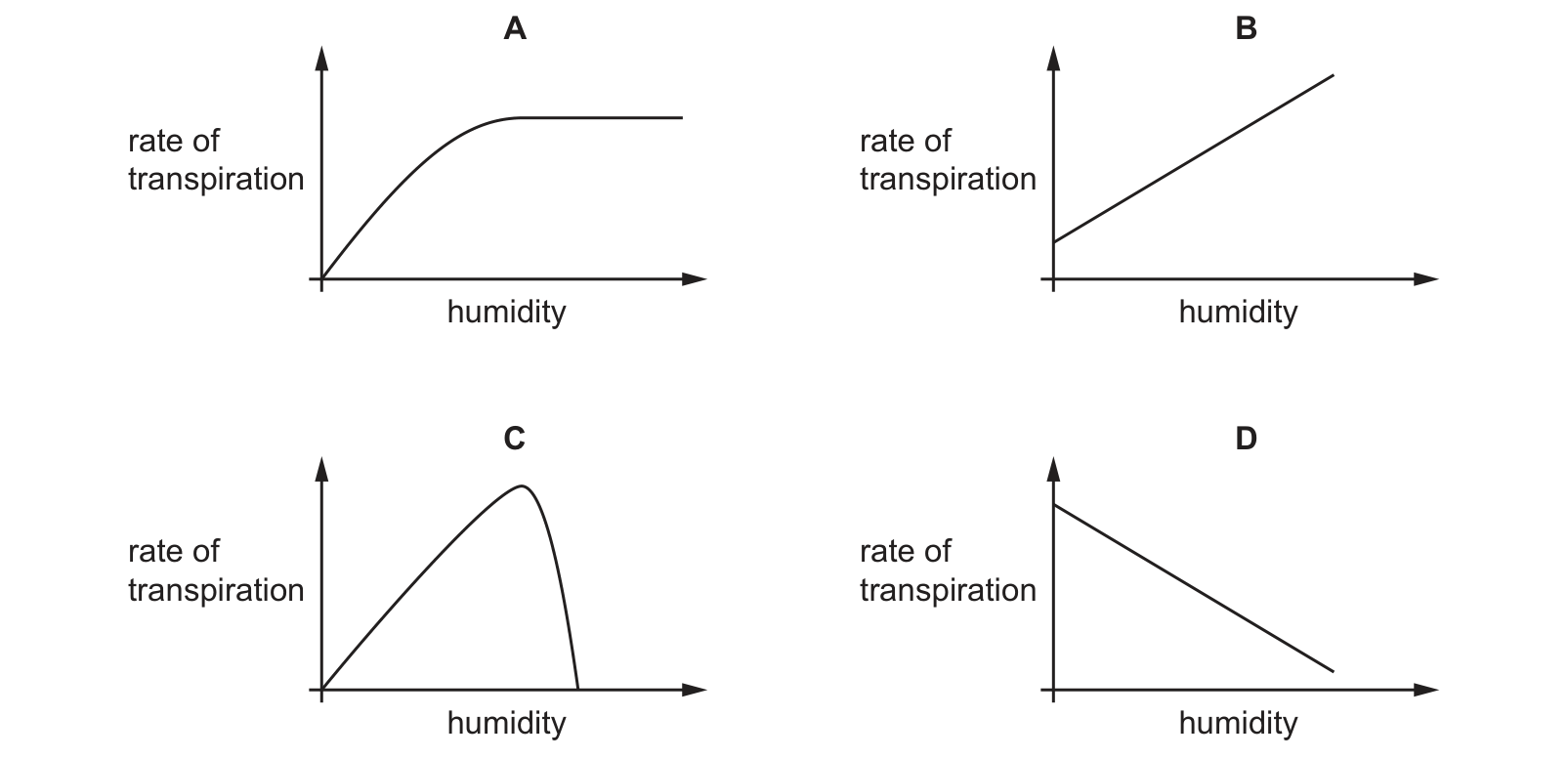
Which graph shows the effect of atmospheric humidity on the rate of transpiration if all other factors are kept constant? Use the source image for S21 Paper 22, question 7.
Answer: D.
Transpiration depends on the difference in water vapour concentration between the air spaces inside the leaf and the air outside, so the wetter the surrounding air the smaller that difference and the slower the loss of water. The graph that falls steadily as humidity rises is the only one that shows this. The rising line, and the line that rises and then levels off, both claim that damp air draws more water out of the leaf, which reverses the direction of the gradient. The curve that climbs to a peak and then plunges to zero would make transpiration fastest at middling humidity, whereas dry air is exactly the condition in which water escapes fastest.
Question 2
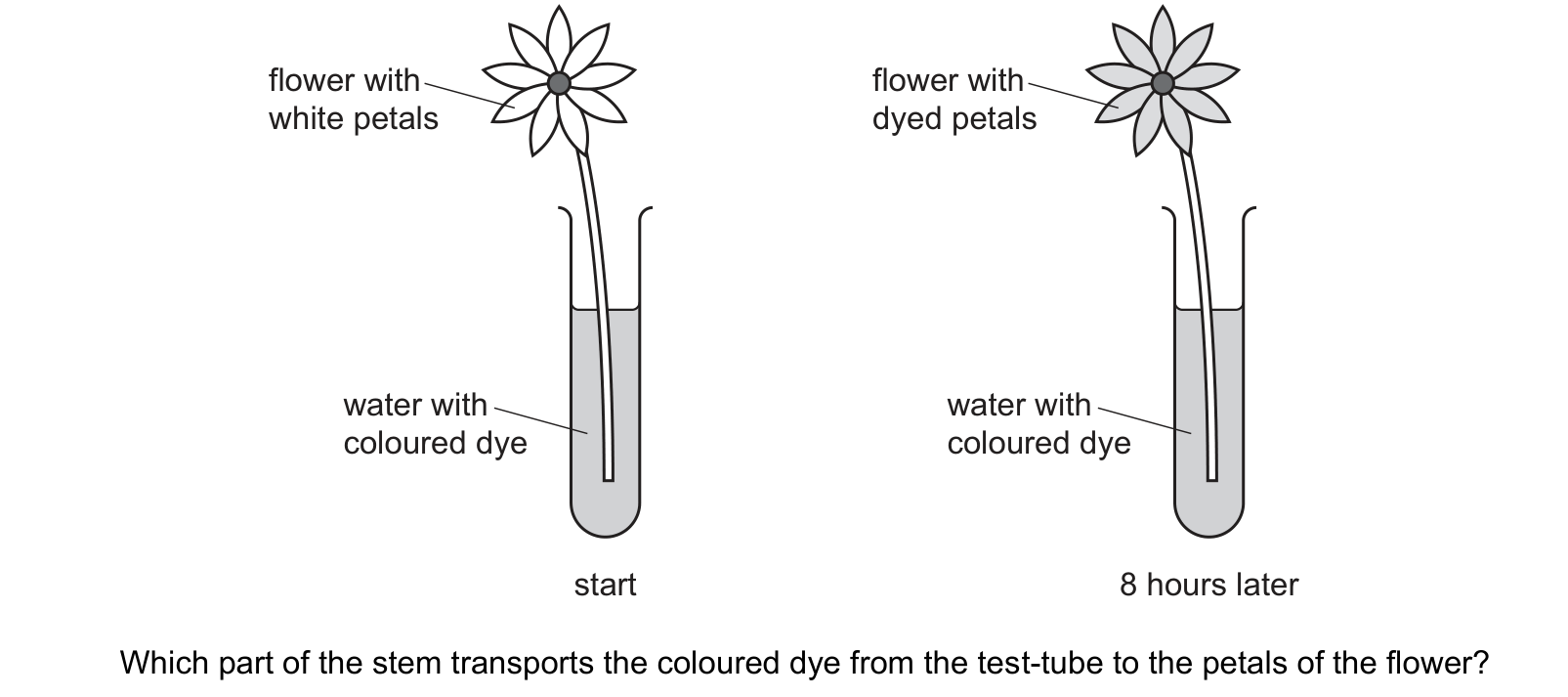
The diagram shows an investigation into water transport in plants. Which part of the stem transports the coloured dye from the test-tube to the petals of the flower?
Answer: D.
Xylem vessels are the dead hollow tubes that carry water and dissolved mineral ions up the stem from the roots to the leaves and flowers, so the dye dissolved in the water travels in the xylem and stains the petals, making D correct. The pull comes from transpiration at the petals and leaves, which draws the whole column of water upwards. B, phloem, transports sucrose and amino acids made by the plant, moving them in either direction to wherever they are needed, so it is not the tissue lifting water. A, mesophyll cells, are photosynthetic leaf cells rather than a transport tissue running through the stem. C, root hair cells, do absorb water, but they belong to a root, and this cut stem stands in the tube with no roots at all.
Question 3
Which label shows the position of the xylem in the cross-section of the root of a dicotyledonous plant? Use the source image for W23 Paper 11, question 7.
Answer: C.
In the root of a dicotyledonous plant the xylem lies right in the centre of the stele, forming the star shape whose arms reach outwards, and C points to that star. Xylem sits centrally because its thick lignified walls resist the pull of transpiration and help the root withstand bending. B points to one of the rounded patches lying between the arms of the star, and those patches are phloem, which carries dissolved sugars rather than water. A points into the wide ring of cortex outside the stele, a packing tissue of large thin walled cells that stores starch and passes water inwards from the root hairs. Remember the star for xylem and the gaps between its arms for phloem.
Question 4
Which label shows the position of the xylem in the cross-section of the root of a dicotyledonous plant? Use the source image for W23 Paper 21, question 7.
Answer: C.
In the root of a dicotyledonous plant the xylem lies right in the centre of the stele, forming the star shape whose arms reach outwards, and C points to that star. Xylem sits centrally because its thick lignified walls resist the pull of transpiration and help the root withstand bending. B points to one of the rounded patches lying between the arms of the star, and those patches are phloem, which carries dissolved sugars rather than water. A points into the wide ring of cortex outside the stele, a packing tissue of large thin walled cells that stores starch and passes water inwards from the root hairs. Remember the star for xylem and the gaps between its arms for phloem.
Question 5
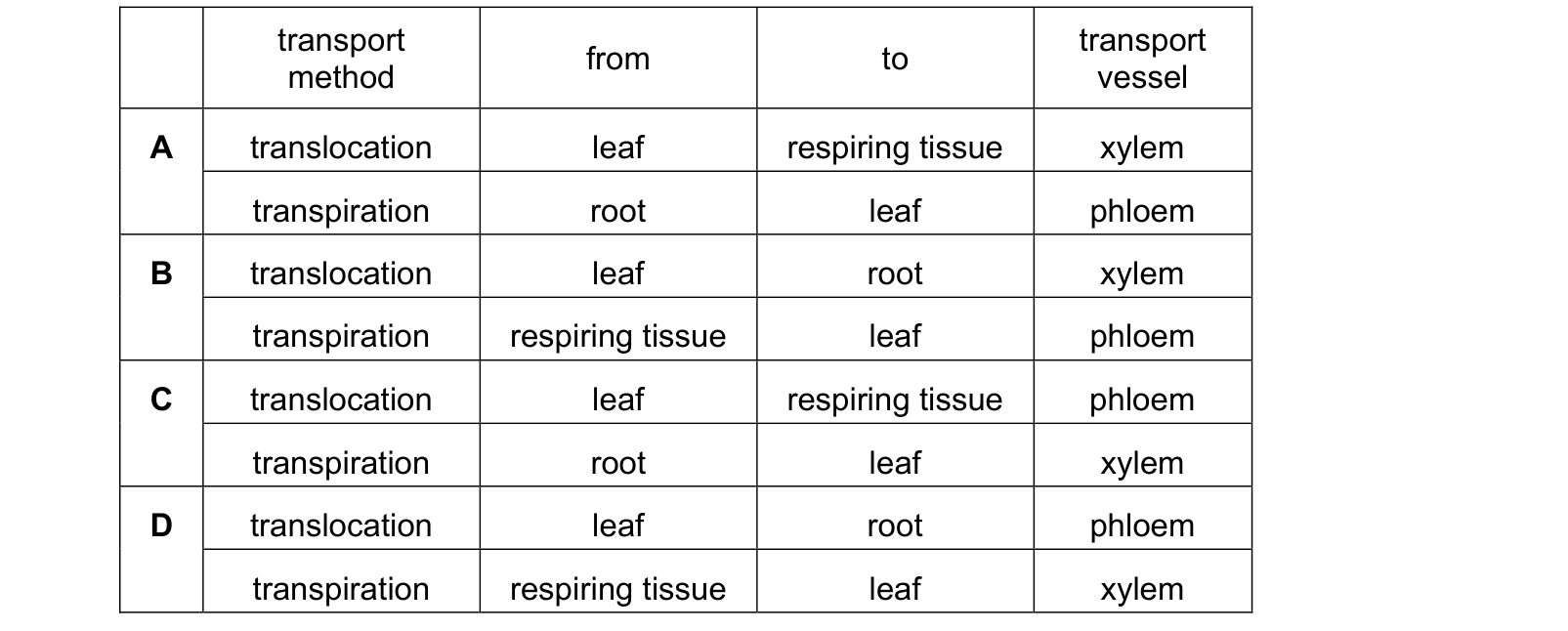
Which row correctly describes translocation and transpiration in plants? Each answer gives, in order: transport method; from; to; transport vessel.
Answer: C.
The two processes move different substances in different vessels and in opposite directions. Translocation carries sucrose and amino acids in the phloem from the leaves, where photosynthesis makes them, to respiring tissues that need them or to storage organs, while transpiration is the pull of water and dissolved mineral ions up the xylem from the roots to the leaves, driven by evaporation from the leaf surface. The tempting row is the one that gets both journeys right but swaps the vessels over, putting translocation in the xylem and transpiration in the phloem, and the way to keep them apart is that phloem carries food while xylem carries water. Any row that has transpiration starting anywhere other than the roots has the water going the wrong way, since water enters the plant through the root hairs and leaves it through the stomata.
These questions are drawn from past CIE 0654 Co-ordinated Sciences papers and filtered to transport in plants. You answer, you find out immediately whether you were right, and you get the reasoning for the correct option and for each distractor. Wrong answers go to a mistakes locker so you can come back to exactly those.
Practice is free. You need an account only so your progress and your mistakes are still there next time.
These are the errors that cost marks on transport in plants, taken from our own topic notes. Read them before you practise and you will recognise the traps in the questions.
Putting water in the phloem or sugar in the xylem.
Saying xylem is living, or that phloem is dead.
Saying transpiration is evaporation from the stomata. The evaporation is from the mesophyll cell surfaces; the stomata are where the vapour diffuses out.
Saying water is absorbed by the roots by active transport. Water enters by osmosis; the mineral ions use active transport.
Answering "high temperature and still air" for the fastest transpiration.
Saying high humidity speeds transpiration up because there is more water about. It slows it down, because the gradient is shallower.
Describing translocation as one-way, from roots to leaves.
Saying a potometer measures the rate of transpiration exactly, rather than the rate of water uptake.