Organisation of the organism
Contents: 6 sections
What every cell has, and what only plants have
| Structure | Present in | What it does |
|---|---|---|
| Cell membrane | Both | Partially permeable, so it controls what enters and leaves |
| Cytoplasm | Both | The jelly where the chemical reactions of the cell happen |
| Nucleus | Both | Contains the DNA, so it controls the cell's activities |
| Cell wall | Plant only | Made of cellulose, fully permeable, gives support and stops the cell bursting |
| Chloroplast | Plant only | Contains chlorophyll, so it is the site of photosynthesis |
| Large permanent vacuole | Plant only | Filled with cell sap, pushes out on the wall and keeps the cell firm |
Three points in that table are examined again and again.
**A plant cell has a wall and a membrane, one inside the other.** The commonest error is to treat them as alternatives, so that a plant cell is imagined to have a wall instead of a membrane. It has both. The wall is outside, and it never touches the cytoplasm because the membrane lies between them. A question asking what is not in contact with cytoplasm has the cell wall as its answer.
The wall is fully permeable and the membrane is partially permeable. That difference is the whole reason osmosis happens at the membrane and not at the wall. Anything crossing into a plant cell from outside meets the structures in this order: cell wall, then cell membrane, then cytoplasm, then vacuole.
"Large permanent vacuole", not "vacuole". Animal cells can contain small temporary vacuoles, so the plant feature is the size and the permanence, not the existence of a vacuole at all.
Bacteria are different again. They have a cell wall, but it is not made of cellulose, and they have no nucleus: their DNA sits loose in the cytoplasm as a circular chromosome, often with small extra rings called plasmids.
Specialised cells
A specialised cell has a structure that fits one job. In the exam you are asked to match a cell to an adaptation, so learn them as pairs of structure and reason.
| Cell | Adaptation | Why that helps |
|---|---|---|
| Root hair cell | A long, thin projection | Huge surface area for taking in water by osmosis and mineral ions by active transport |
| Palisade mesophyll cell | Packed with chloroplasts, at the top of the leaf, column shaped | Absorbs as much light as possible for photosynthesis |
| Red blood cell | No nucleus, biconcave disc, full of haemoglobin | More room for haemoglobin and a large surface area for loading oxygen |
| Ciliated cell | Hair-like cilia that beat | Sweeps mucus and trapped dirt up and out of the airways |
| Nerve cell | Very long, with an insulating sheath | Carries electrical impulses quickly over a distance |
| Sperm cell | Tail, many mitochondria, enzymes in the head | Swims to the egg, and the enzymes digest a way into it |
| Egg cell | Large, with a store of energy in the cytoplasm | Feeds the embryo in the days after fertilisation |
| Muscle cell | Fibres that shorten, many mitochondria | Contracts, and the mitochondria supply the energy for it |
| Xylem vessel | Dead, hollow, no end walls, lignin in the walls | An open tube for water, strengthened so it does not collapse |
Two traps live in this table. A root hair cell has no chloroplasts, because roots are buried in dark soil and chloroplasts there would be useless. And a red blood cell is an animal cell, so it has no cell wall, only a flexible membrane that lets it bend through capillaries.
Levels of organisation
Organelle → cell → tissue → organ → organ system → organism.
- A tissue is a group of cells with similar structures, working together to perform a shared function. Muscle and xylem are tissues.
- An organ is a structure made of several different tissues, working together to perform a function. The stomach and the leaf are organs.
- An organ system is a group of organs with related functions, working together. The digestive system and the transport system are organ systems.
The word that earns the mark at each level is the one naming what the level is made of: a tissue is made of cells, an organ is made of tissues, a system is made of organs.
Magnification
$magnification = (image size) ÷ (actual size)$
Magnification tells you how many times bigger the drawing or photograph is than the real thing. Rearranged:
$actual size = (image size) ÷ (magnification)$
Worked example. A drawing of a cell measures 60 mm across. The real cell is 0.05 mm across. What is the magnification?
magnification = 60 / 0.05 = 1200
So the drawing is 1200 times life size, written ×1200.
Worked example. A photograph of a cell at ×400 shows the cell as 20 mm wide. How wide is the cell really?
actual size = 20 / 400 = 0.05 mm
That is 50 micrometres, since 1 mm = 1000 μm.
Two habits stop nearly every lost mark here. Convert both lengths to the same unit before dividing, because a millimetre divided by a micrometre gives an answer a thousand times out. And once they are in the same unit the units cancel, so magnification has no unit: it is written as ×1200, never as 1200 mm.
Common mistakes
- Saying plant cells have a cell wall instead of a cell membrane.
- Saying the nucleus is the structure found only in plant cells. That line separates bacteria from plants and animals, not plants from animals.
- Forgetting the words "large" and "permanent" in front of vacuole.
- Giving root hair cells chloroplasts, or red blood cells a cell wall.
- Saying the nucleus carries out photosynthesis because it controls the cell. Controlling a process is not the same as being the site of it.
- Writing the magnification formula upside down as actual size divided by image size, which gives an answer below 1 for anything magnified.
- Dividing a measurement in millimetres by one in micrometres without converting.
- Calling a group of different tissues a tissue rather than an organ.
Check you have it
Question 1
The diagram shows an incomplete plant cell.
Which structure is not shown?
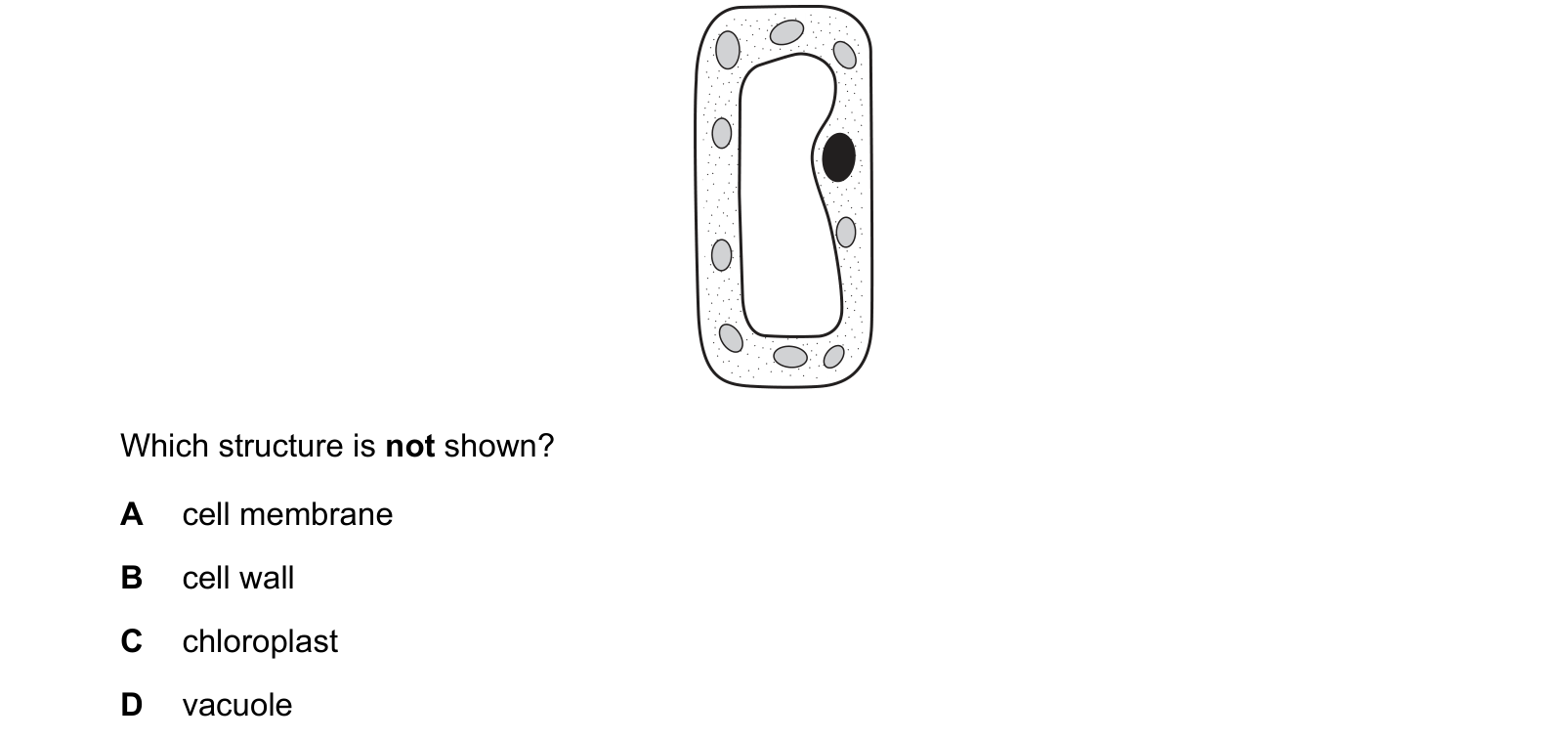
Answer: B.
Question 2
The diagram shows a specialised cell from a plant. Which structures not found in animal cells are shown in the diagram and which structure often found in other plant cells is missing? Each answer gives, in order: structures not found in animal cells; structure found in other plant cells.
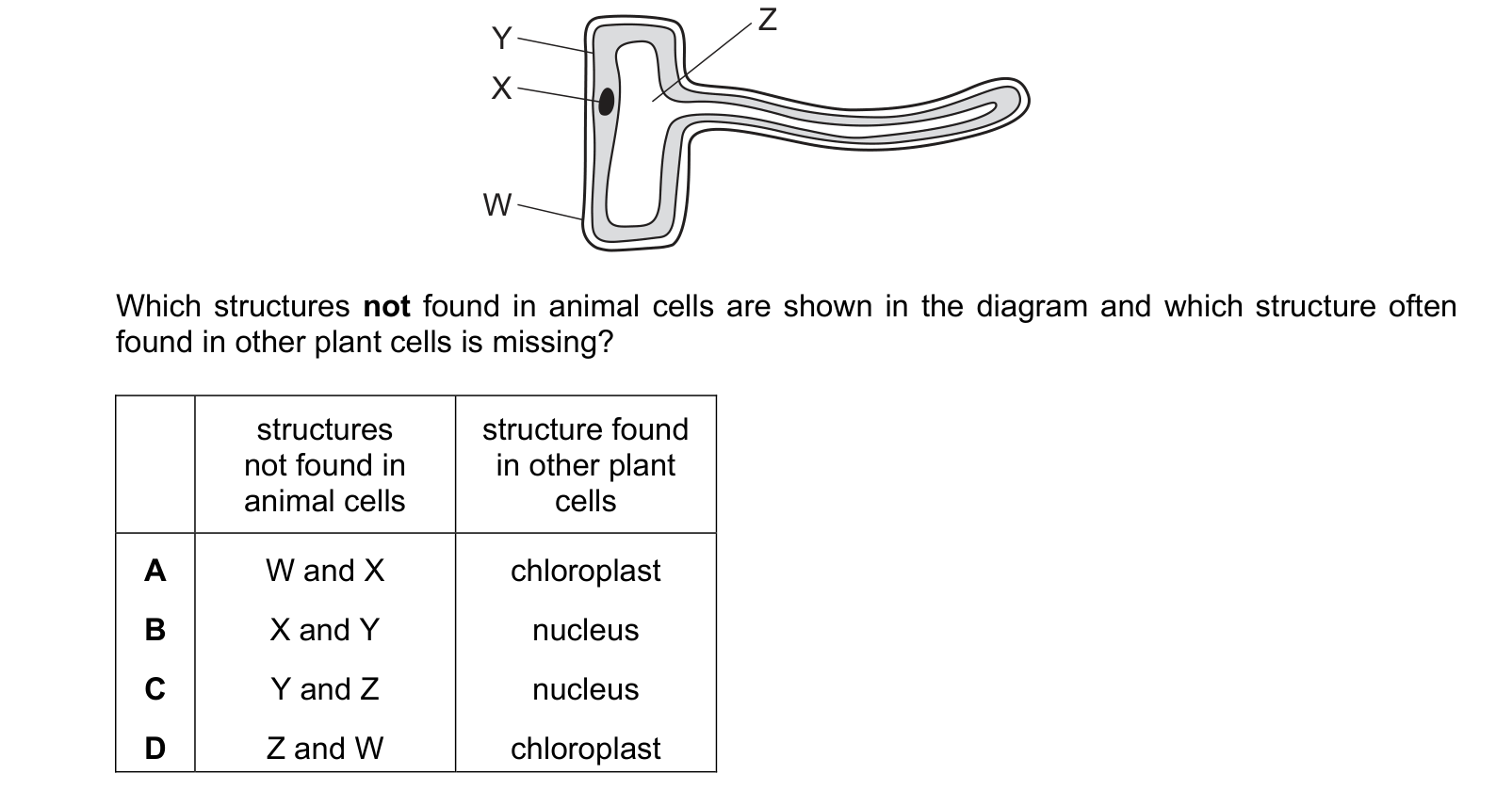
Answer: D.
Question 3
Which structure in a plant cell makes organic nutrients?
Answer: C.
What the syllabus asks for on this topicSyllabus points
Syllabus points
- Identify the structures of a plant cell and an animal cell, and state the function of each.
- State which structures are found in plant cells only.
- Describe how specialised cells are adapted to their functions.
- Define tissue, organ and organ system, and put them in order of size.
- Calculate magnification, image size or actual size.
Related CIE 0654 Co-ordinated Sciences topics
Not the topic you were looking for? Describe what you are stuck on in your own words and we will take you to the notes that answer it.