Respiration
Contents: 8 sections
What respiration is
Respiration is the series of chemical reactions in cells that break down nutrient molecules and release energy for metabolism.
Two words in that sentence are load-bearing.
Cells. Respiration happens inside cells, in every living cell of every organism, all the time. That includes plant cells, day and night. Plants respire constantly; in daylight photosynthesis simply runs faster than respiration, which is why a plant appears to be giving out oxygen rather than taking it in.
Not breathing. Breathing is the muscular movement of air in and out of the lungs. Respiration is the chemical reaction. A plant respires and does not breathe. Confusing the two is the single most common error in this topic.
Aerobic respiration takes place mainly in the mitochondria, which is why cells that need a lot of energy, such as muscle cells and sperm cells, contain large numbers of them.
Aerobic respiration
glucose + oxygen → carbon dioxide + water, releasing energy.
C₆H₁₂O₆ + 6O₂ → 6CO₂ + 6H₂O
Check the balance: six carbons on each side, twelve hydrogens on each side, and eighteen oxygens on each side, six from the glucose and twelve from the six oxygen molecules.
Everything on the left is used up and everything on the right is produced. That single observation answers a whole family of questions asking which of four substances are used and which are made.
The energy comes from the glucose, not the oxygen. Oxygen is the strongest distractor when a question asks which molecule holds the energy released, because respiration certainly cannot proceed without it. But oxygen is what makes the full breakdown of glucose possible; the energy was already stored in the bonds of the glucose. Energy is released overall because carbon dioxide and water hold less energy in their bonds than glucose and oxygen did.
Notice too that respiration is photosynthesis run backwards, using the same four substances in the opposite direction. A question offering "carbon dioxide + water → glucose + oxygen" as a respiration equation is offering the photosynthesis equation. A quick check that never fails: oxygen is used up in respiration, so any equation with oxygen on the right cannot be respiration.
Glucose is the fuel, not glycogen or starch. Both of those are stores built from many glucose units, and each has to be broken down into glucose before a cell can respire it. Glycogen is the animal store, held in the liver and muscles; starch is the plant store.
Anaerobic respiration
Anaerobic respiration is the release of energy from food without using oxygen. It gives a much smaller amount of energy per glucose molecule.
In human muscle:
glucose → lactic acid, releasing energy.
In yeast:
glucose → alcohol (ethanol) + carbon dioxide, releasing energy.
The yeast equation is the basis of brewing, where the alcohol is wanted, and of bread making, where the carbon dioxide is wanted and makes the dough rise.
Why the energy yield is so much lower. In anaerobic respiration the glucose is only partly broken down. Lactic acid and ethanol are still substantial molecules with plenty of energy left locked in their bonds, whereas aerobic respiration breaks glucose all the way down to carbon dioxide and water and gets everything out of it.
So the advantage of anaerobic respiration is speed, not quantity. It lets a sprinter keep going when the heart and lungs cannot deliver oxygen fast enough, but the yield per glucose molecule is far smaller.
Oxygen debt
During vigorous exercise the muscles need energy faster than oxygen can be delivered, so they respire anaerobically as well as aerobically and lactic acid builds up in them. Lactic acid causes muscle fatigue and pain.
The oxygen debt is the extra oxygen needed afterwards to break down that lactic acid. This is why you carry on breathing hard and fast for several minutes after you stop running: the deep breathing continues to supply oxygen so that the lactic acid can be oxidised to carbon dioxide and water, or converted back into glucose in the liver.
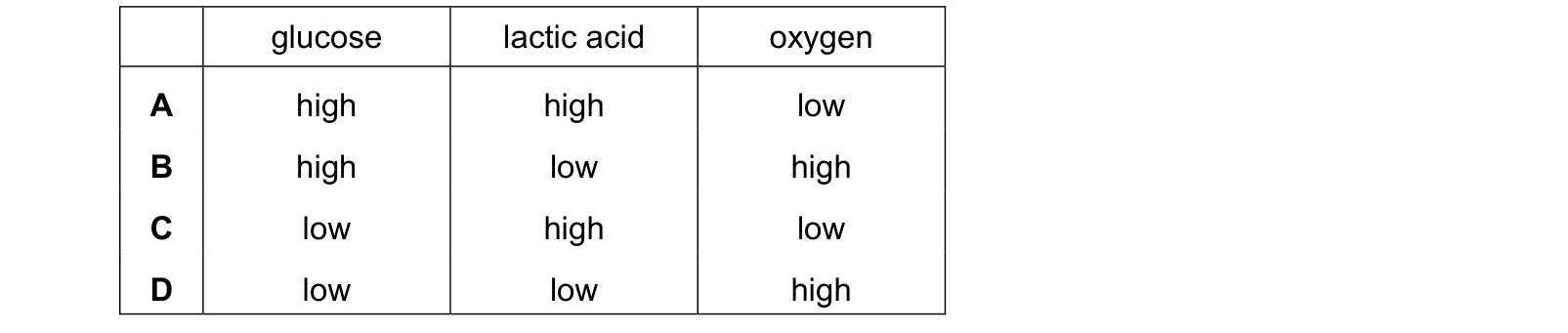
Worked example. Immediately after extreme exercise, what are the relative levels of glucose, lactic acid and oxygen in the muscle?
Glucose is low, because it has been used as fuel. Oxygen is low, because it has been used faster than it could be delivered, which is precisely why the muscle switched to anaerobic respiration. Lactic acid is high, because it is the product of that anaerobic respiration and has not yet been broken down.
Anaerobic respiration does cause an oxygen debt rather than avoiding one, and that reversal is a standard distractor.
What the energy is used for
Respiration does not create energy. It transfers energy from glucose into a form the cell can use, and the cell then spends it on:
- Muscle contraction
- Active transport
- Cell division and growth
- Protein synthesis, and the building of other large molecules
- Passing nerve impulses
- Maintaining a constant body temperature in mammals and birds
Diffusion and osmosis are not on that list. They are passive, driven by the random movement the particles already have.
Investigating respiration
Germinating seeds or small living organisms in a sealed tube will show the three signs of respiration:
- Carbon dioxide produced, shown by limewater turning milky, or hydrogencarbonate indicator turning from red to yellow.
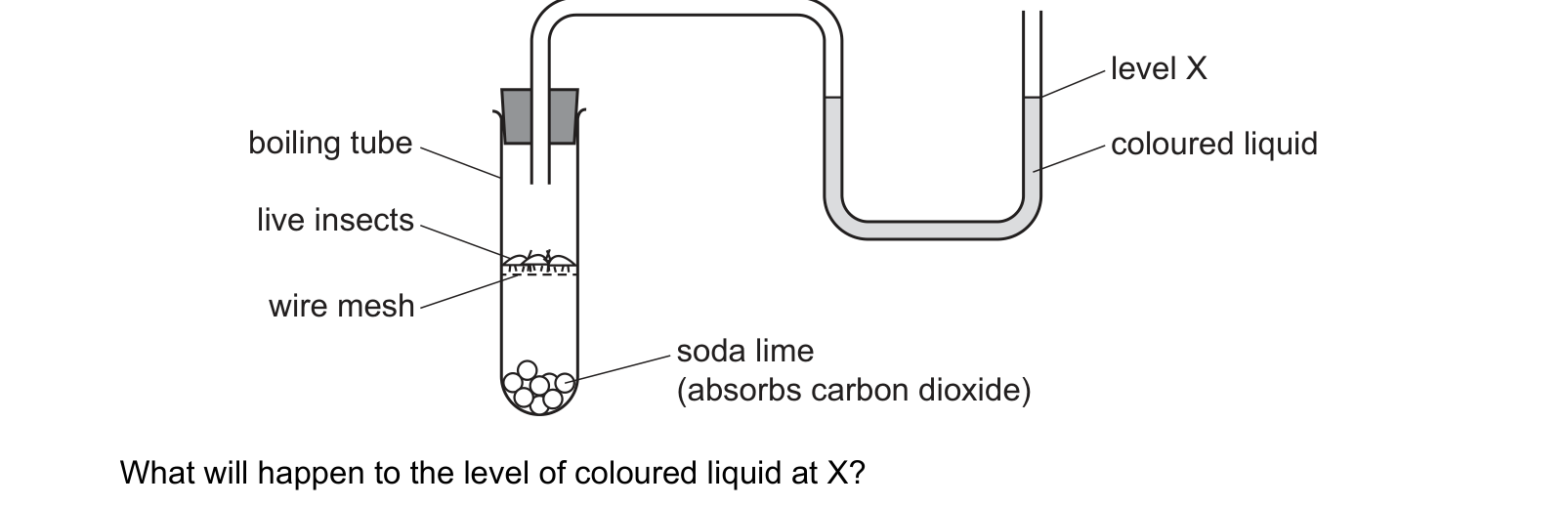
- Oxygen used, shown by the fall in gas volume once the carbon dioxide has been absorbed by soda lime.
- Heat released, shown by a rise in temperature in a vacuum flask of germinating seeds.
Every one of these experiments needs a control of dead seeds, boiled and cooled, treated identically. Without it, the result could be attributed to the seeds simply being present rather than to their being alive.
Common mistakes
- Saying respiration is breathing.
- Saying plants respire only at night.
- Writing the photosynthesis equation as the respiration equation, so that oxygen appears as a product.
- Saying oxygen is the molecule that holds the energy released.
- Writing glycogen or starch in the respiration equation instead of glucose.
- Saying anaerobic respiration releases more energy because it is used in a hard sprint.
- Saying anaerobic respiration in muscle produces alcohol, or that yeast produces lactic acid.
- Saying the oxygen debt is the oxygen you failed to breathe in during the exercise, rather than the extra oxygen needed afterwards to clear the lactic acid.
- Saying respiration produces energy. It releases energy that was already stored in the glucose.
- Leaving the dead-seed control out of a respiration experiment.
Check you have it
Question 1
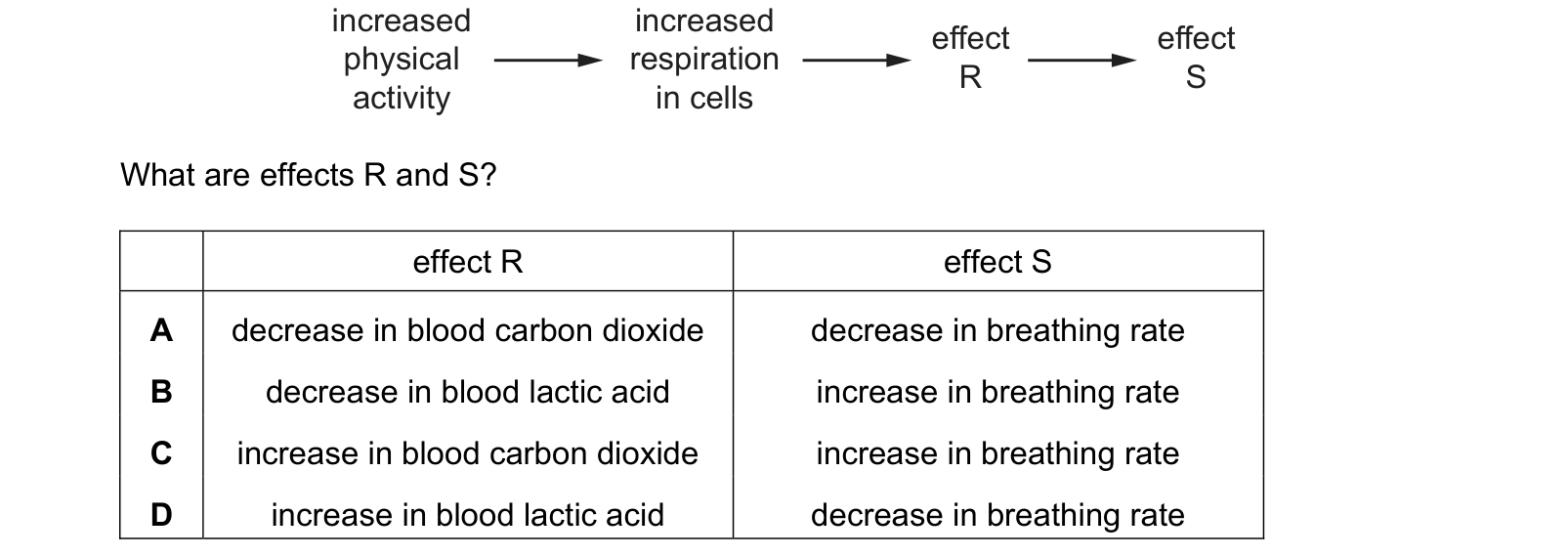
Changes in the body occur as a result of increased physical activity. increased increased effect effect physical respiration R S activity in cells What are effects R and S? Each answer gives, in order: effect R; effect S.
Answer: C.
Question 2
What is the relative concentration of glucose, lactic acid and oxygen in the muscles immediately after extreme exercise? Each answer gives, in order: glucose; lactic acid; oxygen.
Answer: C.
Question 3
An experiment is set up, as shown. What will happen to the level of coloured liquid at X?
Answer: A.
What the syllabus asks for on this topicSyllabus points
Syllabus points
- Define respiration and state that it happens in all living cells.
- State the word equation and the balanced symbol equation for aerobic respiration.
- State the word equations for anaerobic respiration in muscle and in yeast.
- Compare the energy released by aerobic and anaerobic respiration.
- Explain oxygen debt and how it is repaid.
- Describe the uses of the energy released by respiration.
Related CIE 0654 Co-ordinated Sciences topics
Not the topic you were looking for? Describe what you are stuck on in your own words and we will take you to the notes that answer it.