Electricity and magnetism
Contents: 7 sections
The three quantities
Current is the rate of flow of charge, measured in amperes with an ammeter in series.
Potential difference is the energy given to each unit of charge, measured in volts with a voltmeter in parallel across the component.
Resistance opposes the current.
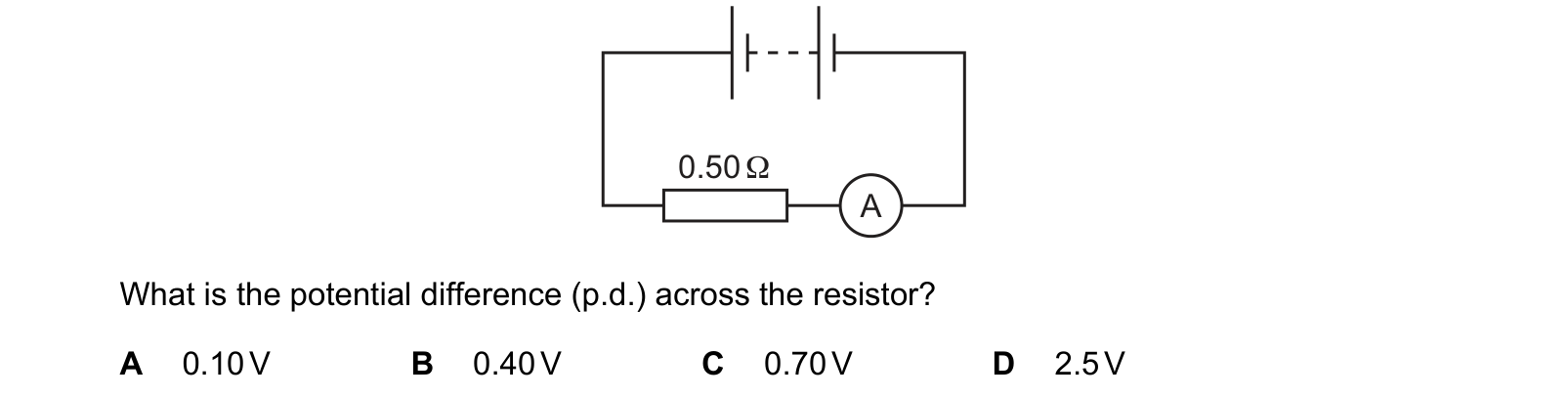
V = I x R
A 12 V supply driving 0.5 A through a lamp means the lamp has a resistance of 12 divided by 0.5, which is 24 Ω.
Where the meters go is examined constantly, and the reason is worth holding: an ammeter measures what passes through, so it must be in the path; a voltmeter measures the difference across, so it must bridge the component.
Series and parallel
| Series | Parallel | |
|---|---|---|
| Current | Same everywhere | Splits between branches |
| Potential difference | Shares between components | Same across each branch |
| Total resistance | Sum of the resistances | Less than the smallest one |
| One lamp fails | All go out | The others stay on |
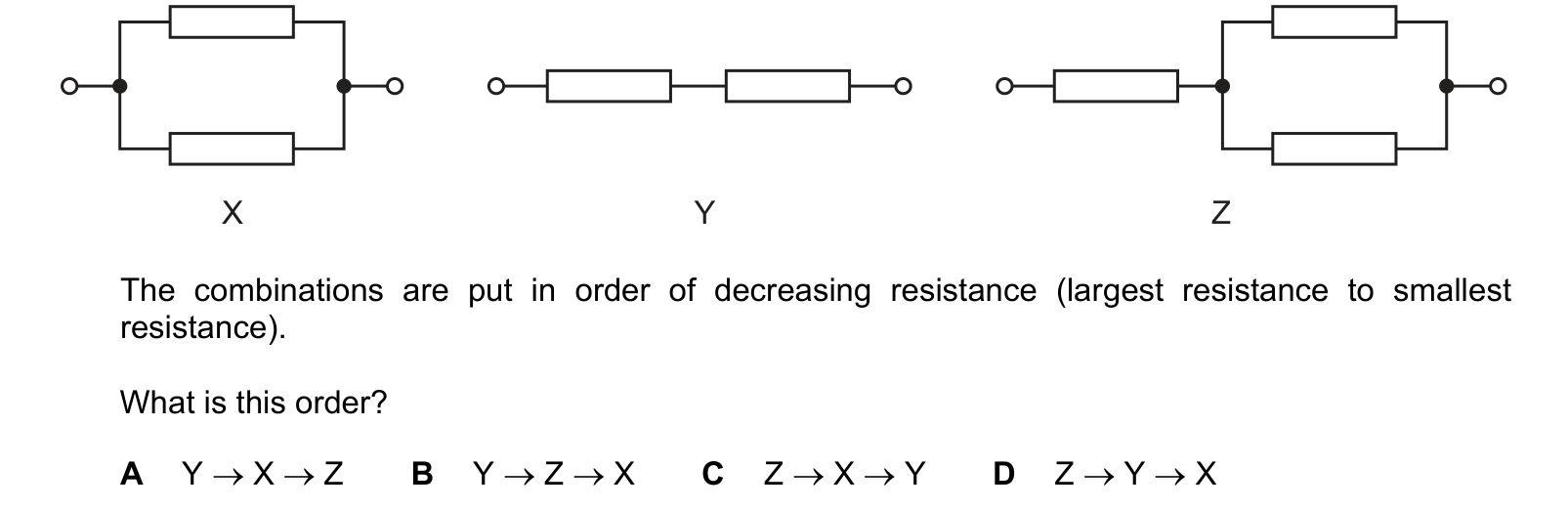
Two resistors of 6 Ω in series give 12 Ω. The same two in parallel give 3 Ω, which is less than either of them. That result surprises people, and the reason is that a second branch gives the charge an extra route, so more current flows in total.
Household lighting is wired in parallel so each lamp gets the full mains voltage and one failure does not darken the house.
Electrical energy and power
power = current x potential difference
energy = power x time
A 2 kW heater running for 3 hours transfers 2 times 3, which is 6 kWh. In joules that is 2000 W times 10 800 s, which is 21 600 000 J, and the kilowatt-hour exists precisely because the second number is unwieldy.
A fuse or circuit breaker protects the circuit by melting or tripping if the current gets too high. The fuse goes in the live wire, so the appliance is isolated from the high voltage when it blows. The earth wire carries current safely away if a fault makes the metal case live.
Magnetism
A magnetic field runs from north to south outside the magnet, and field lines never cross. Like poles repel, unlike poles attract.
A current-carrying wire produces a magnetic field around it. Wind the wire into a coil around an iron core and you have an electromagnet, whose strength increases with more turns, more current, or a soft iron core. Its advantage over a permanent magnet is that it can be switched off, which is what makes relays, circuit breakers and scrapyard cranes work.
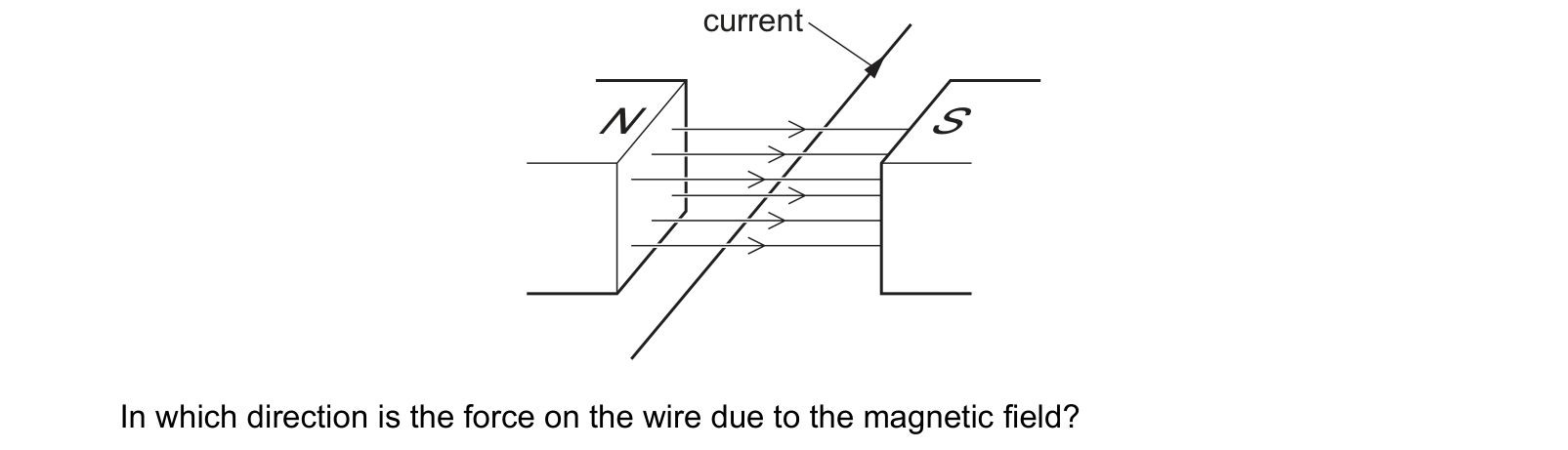
The motor effect: a current-carrying wire in a magnetic field experiences a force. The force is larger with a bigger current or a stronger field, and it reverses if either the current or the field is reversed. This is what turns a motor.
Induction and transformers
Moving a magnet into a coil, or a wire through a field, induces a potential difference. Nothing is induced while the magnet is held still inside the coil, because inducing requires the field through the coil to be changing. That stationary case is the standard trap.
A transformer works only on alternating current, because a.c. keeps the field changing. A step-up transformer has more turns on the secondary coil and raises the voltage; a step-down transformer has fewer and lowers it.
Electricity is transmitted at high voltage because that means low current for the same power, and the energy wasted heating the cables depends on the current. Lower current, far less waste.
Common mistakes
- Putting the ammeter in parallel or the voltmeter in series.
- Saying current is used up as it goes round a circuit. It is the same all the way round a series circuit.
- Saying parallel resistors give a larger total resistance.
- Putting the fuse in the neutral wire.
- Saying a transformer works on direct current.
- Saying a potential difference is induced while a magnet sits still inside a coil.
- Saying high-voltage transmission reduces losses because voltage is lost. It is the current that matters.
Check you have it
Question 1
The diagram shows a battery connected to a 0.50 Ω resistor and an ammeter. The reading on the ammeter is 0.20 A. What is the potential difference (p.d.) across the resistor?
Answer: A.
Question 2
X, Y and Z are combinations of identical resistors. The combinations are put in order of decreasing resistance (largest resistance to smallest resistance).
What is this order?
Answer: B.
Question 3
The diagram shows a current-carrying conductor in a magnetic field. The direction of the current is shown. In which direction is the force on the wire due to the magnetic field?
Answer: A.
What the syllabus asks for on this topicSyllabus points
Syllabus points
- Describe current, potential difference and resistance, and use V = IR.
- Compare series and parallel circuits.
- Calculate electrical energy and power.
- Describe magnetic fields, electromagnets and the motor effect.
- Describe electromagnetic induction and the transformer.
Related CIE 0654 Co-ordinated Sciences topics
Not the topic you were looking for? Describe what you are stuck on in your own words and we will take you to the notes that answer it.