209 past-paper questions on this unit. Five of them are below. Answer on the page: each one is marked the moment you pick, the correct option is shown whether or not you found it, and the full explanation opens either way.
CIE 0654 Co-ordinated SciencesPaper 1 and Paper 2 MCQsFree account
Electricity and magnetism: five questions to try now
Real past-paper questions, the answer key from the mark scheme, and the explanation that goes with it. No account needed to answer them.
Question 1
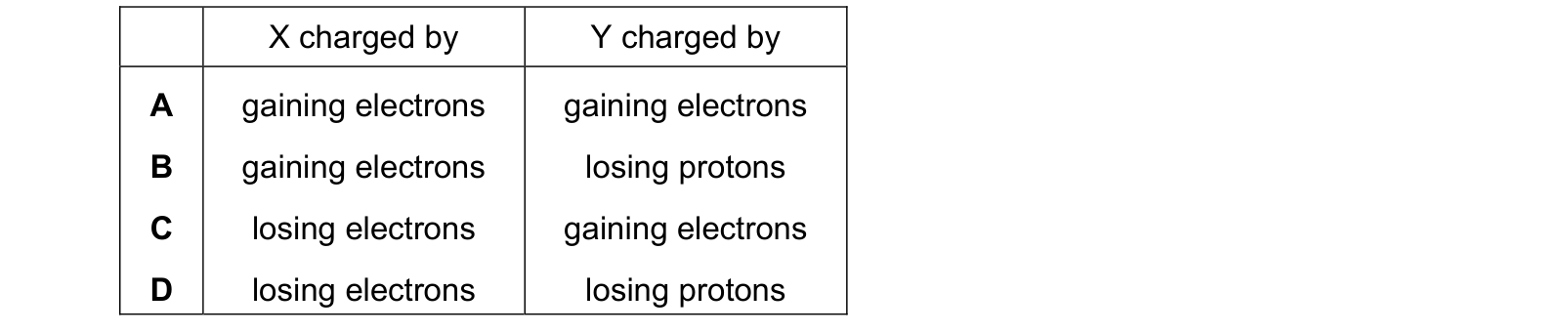
Two charged rods X and Y repel each other. Which row gives a possible description of how the rods became charged? Each answer gives, in order: X charged by; Y charged by.
Answer: A.
Two rods repel only if they carry the same sign of charge, so whatever happened to one must have happened to the other. Charging also involves electrons alone, because protons are locked in the nuclei of the solid and cannot be transferred. Both rods gaining electrons leaves both negative, so they repel, which fits. C is the tempting alternative because it correctly moves only electrons, but one rod gaining while the other loses gives them opposite charges, and opposite charges attract rather than repel. B and D can be dismissed together because each involves protons being lost from a rod, and there is no mechanism for removing protons from nuclei by rubbing.
Question 2
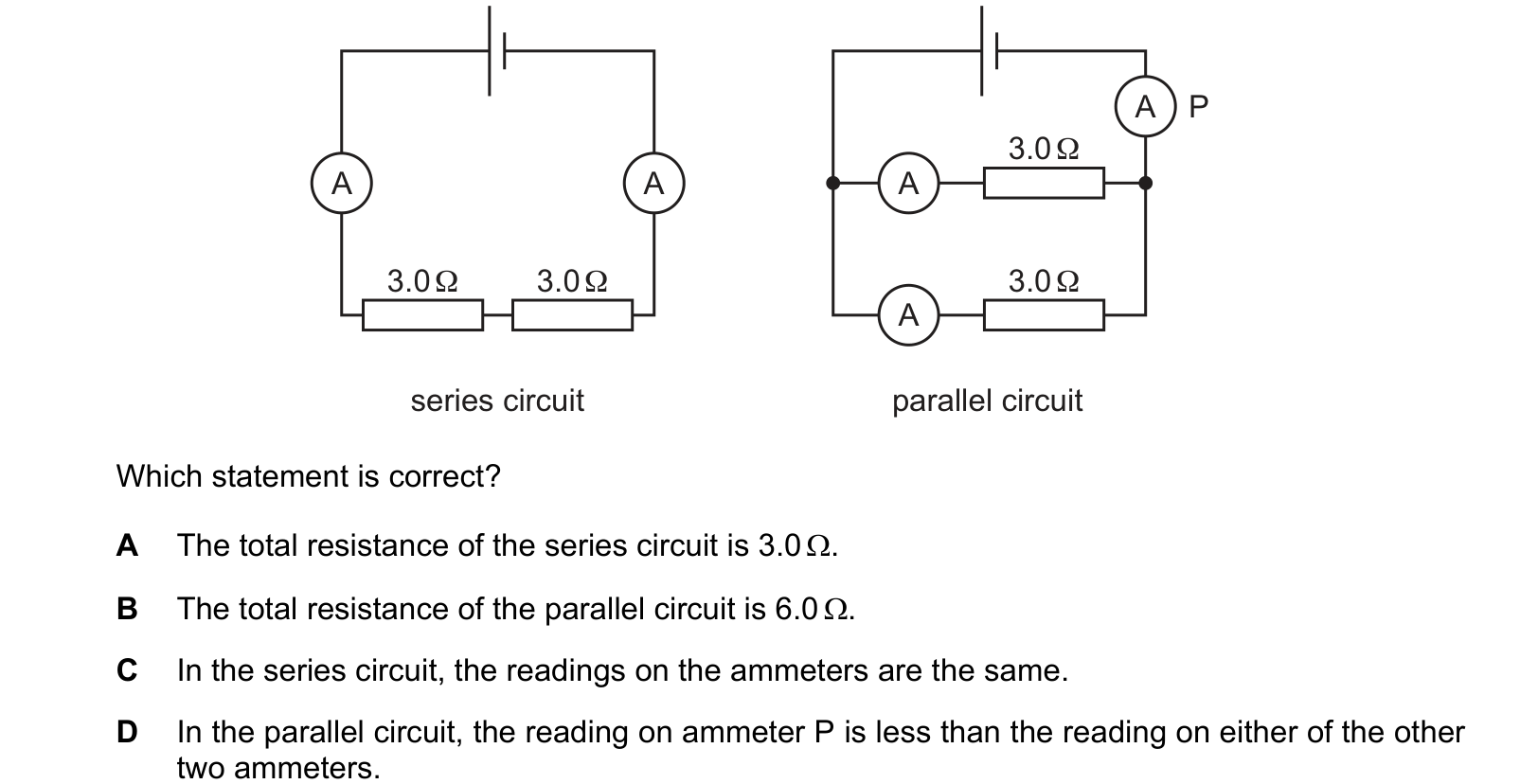
The diagrams show a series circuit and a parallel circuit. One ammeter in the parallel circuit is labelled P. series circuit parallel circuit Which statement is correct?
Answer: C.
Current is the same at every point in a series circuit, because the charge has only one path and cannot pile up anywhere, so both ammeters in the series circuit read the same value and C is correct. A gives the series total as 3.0 ohms, yet resistances in series add, so two 3.0 ohm resistors give 6.0 ohms. B gives the parallel total as 6.0 ohms, whereas two equal resistors in parallel give half the value of one, which is 1.5 ohms and is always less than either branch. D says ammeter P reads less than the branch ammeters, yet P sits in the main circuit where the two branch currents have joined, so it reads their sum.
Question 3
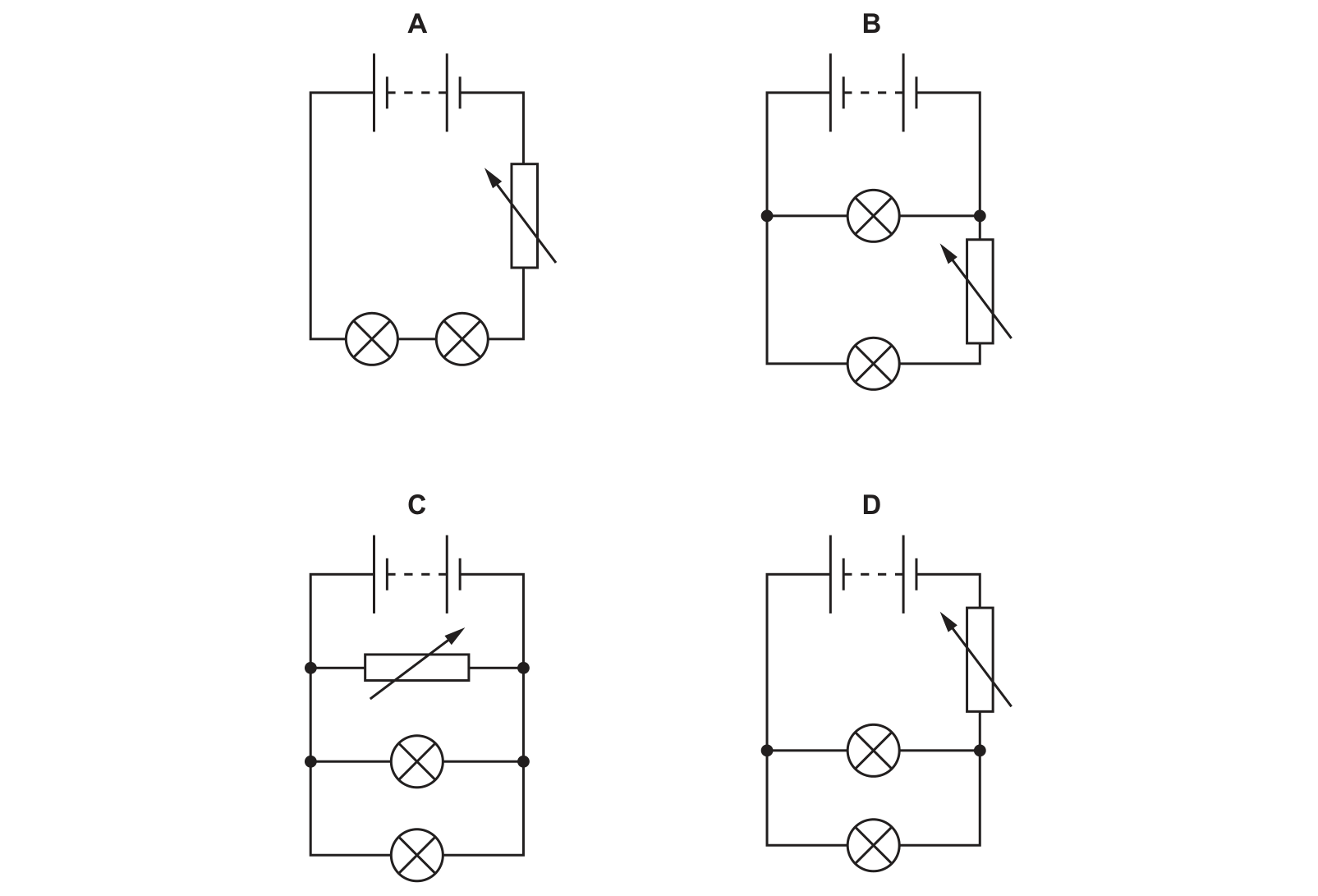
In which circuit is it possible to change the brightness of one lamp without changing the brightness of the other lamp? Use the source image for W22 Paper 11, question 37.
Answer: B.
For one lamp to be dimmed while the other is unaffected, the two lamps must be on separate parallel branches, so that each keeps the full supply voltage across it whatever happens in the other branch, and the variable resistor must sit in one branch only. Changing that resistor then changes the current in its own lamp alone. The circuit built that way is the one to choose. A circuit with the lamps in series has one current through both, so anything that dims one dims the other equally. A circuit with the variable resistor in the main branch before the junction changes the current supplied to both branches, so both lamps change together, which defeats the purpose.
Question 4
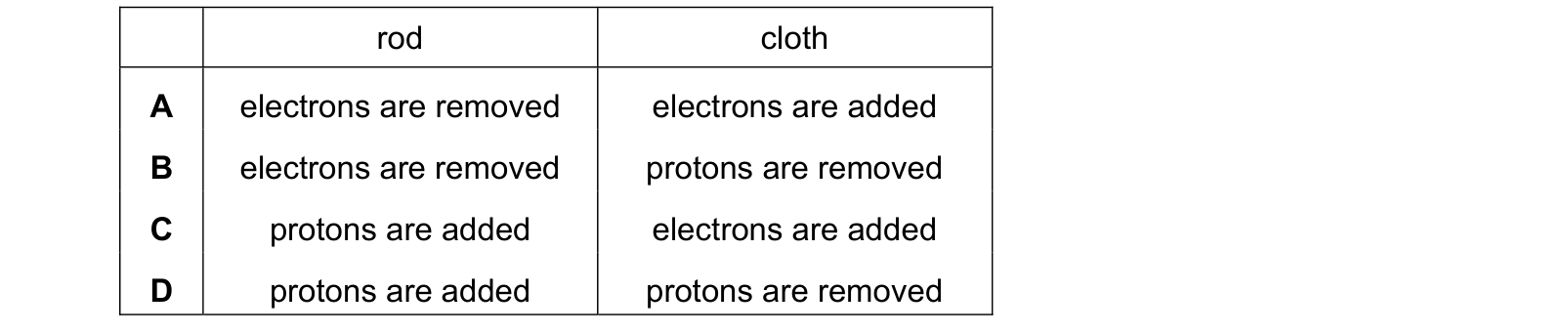
A plastic rod is rubbed with a cloth. The rod becomes positively charged. What happens to the rod and what happens to the cloth? Each answer gives, in order: rod; cloth.
Answer: A.
Charging by friction transfers electrons only, because protons are held in the nuclei of atoms fixed in the solid and cannot be rubbed off. A rod that becomes positive must therefore have had electrons removed, and those electrons are not destroyed but end up on the cloth, so the cloth gains electrons and becomes equally negative. B starts correctly for the rod but then removes protons from the cloth, which is impossible and would in any case leave both surfaces positive, when the two must always end up with opposite charges. C and D both add protons to the rod, and since protons cannot move between surfaces there is no mechanism for this at all.
Question 5
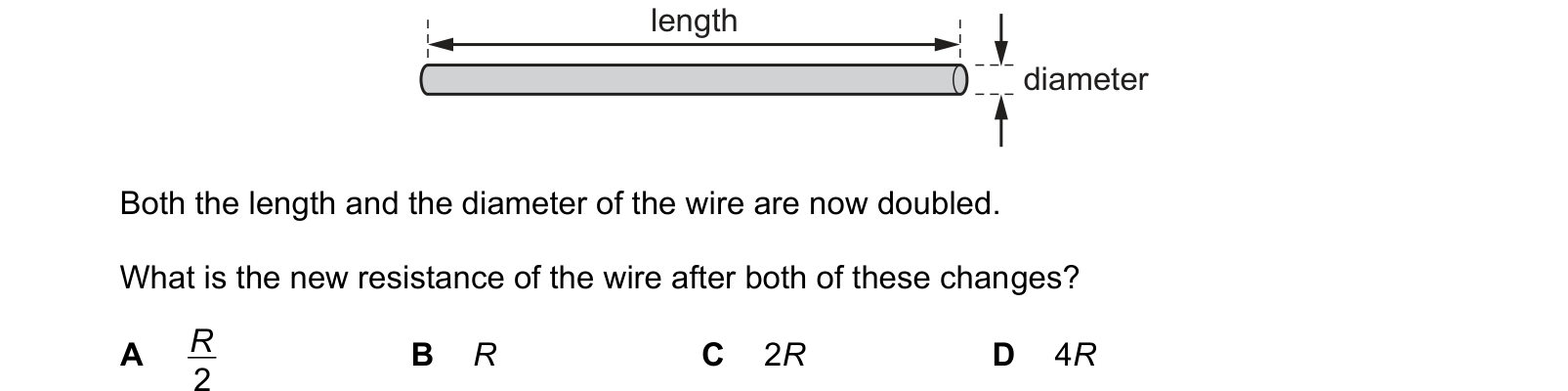
The diagram shows a wire with resistance R. Both the length and the diameter of the wire are now doubled. What is the new resistance of the wire after both of these changes?
Answer: A.
Resistance is proportional to the length of a wire and inversely proportional to its cross sectional area, and that area depends on the square of the diameter. Doubling the length doubles the resistance, while doubling the diameter multiplies the area by four and so divides the resistance by four, and the two changes together give 2R/4, which is R/2 and makes A correct. C, 2R, counts only the change in length and forgets the thicker wire. D, 4R, treats both changes as increases. B, R, assumes the two effects cancel exactly, which would hold only if the area grew in step with the length rather than with the square of the diameter.
These questions are drawn from past CIE 0654 Co-ordinated Sciences papers and filtered to electricity and magnetism. You answer, you find out immediately whether you were right, and you get the reasoning for the correct option and for each distractor. Wrong answers go to a mistakes locker so you can come back to exactly those.
Practice is free. You need an account only so your progress and your mistakes are still there next time.
These are the errors that cost marks on electricity and magnetism, taken from our own topic notes. Read them before you practise and you will recognise the traps in the questions.
Putting the ammeter in parallel or the voltmeter in series.
Saying current is used up as it goes round a circuit. It is the same all the way round a series circuit.
Saying parallel resistors give a larger total resistance.
Putting the fuse in the neutral wire.
Saying a transformer works on direct current.
Saying a potential difference is induced while a magnet sits still inside a coil.
Saying high-voltage transmission reduces losses because voltage is lost. It is the current that matters.