Nuclear physics
Contents: 10 sections
The nucleus and nuclide notation
An atom has a tiny central nucleus containing protons (charge 1+) and neutrons (no charge), surrounded by electrons (charge 1−). Almost all the mass is in the nucleus, and almost all the atom is empty space.
A nuclide is written with two numbers:
- The lower number is the proton number (atomic number), the number of protons.
- The upper number is the nucleon number (mass number), the number of protons plus neutrons.
So:
$neutrons = nucleon number - proton number$
The nucleon number is always the larger of the two, because it includes the protons as well as the neutrons. That check settles most notation questions on its own.
Worked example. An atom of fluorine is written as nucleon number 15, proton number 9. How many neutrons?
15 − 9 = 6
Not 10. Ten is the neutron count of the common fluorine-19 isotope, and it is the answer of anyone working from memory rather than from the symbol in front of them.
Worked example. A gold nucleus contains 79 protons and 118 neutrons. What is its nuclide symbol?
The proton number is 79, and the nucleon number is 79 + 118 = 197, so it is written with 197 on top and 79 below.
In a neutral atom the number of electrons equals the number of protons.
Isotopes
Isotopes are atoms of the same element with the same number of protons but different numbers of neutrons.
They have the same chemical properties, because chemistry depends on the electrons, and the electron arrangement is set by the proton number. They have different physical properties such as density, and some isotopes are radioactive while others of the same element are not.
Alpha, beta and gamma
| What it is | Charge | Stopped by | Ionising effect | Penetrating power | |
|---|---|---|---|---|---|
| Alpha (α) | A helium nucleus, 2 protons and 2 neutrons | 2+ | A sheet of paper, or a few cm of air | Most ionising | Least penetrating |
| Beta (β) | A fast electron from the nucleus | 1− | A few mm of aluminium | Moderate | Moderate |
| Gamma (γ) | A high-energy electromagnetic wave | 0 | Thick lead or concrete | Least ionising | Most penetrating |
The two columns run in opposite directions, and understanding why is the point of the topic.
An alpha particle is thousands of times more massive than a beta particle and carries twice the charge, so it interacts very strongly with the atoms it passes and knocks electrons off them readily. That heavy ionisation is exactly what drains its energy, so it is stopped within a few centimetres of air. A gamma ray is uncharged and interacts only weakly, so it ionises very little and therefore keeps going through centimetres of lead.
So the tempting assumption, that whatever ionises most strongly must also push furthest into matter, is precisely backwards. Ionising strongly is what stops you.
Alpha and beta are charged, so both are deflected by electric and magnetic fields, and they are deflected in opposite directions because their charges are opposite. Alpha is deflected less than beta because it is so much heavier. Gamma is uncharged, so it is not deflected at all.
Decay equations
| Emission | Proton number | Nucleon number |
|---|---|---|
| Alpha | Decreases by 2 | Decreases by 4 |
| Beta | Increases by 1 | Unchanged |
| Gamma | Unchanged | Unchanged |
Alpha decay loses a helium nucleus, which is 2 protons and 2 neutrons, so 2 comes off the proton number and 4 off the nucleon number. Note that the nucleon number cannot fall by 2 while the proton number falls by 2, because the protons that left are themselves nucleons.
Beta decay happens when a neutron in the nucleus turns into a proton and an electron, and the electron is thrown out as the beta particle. The nucleus is left with one more proton and one fewer neutron, so the proton number rises by 1 while the total number of nucleons is unchanged. The element changes to the next one along in the Periodic Table.
Gamma emission carries away energy but no charge and no nucleons, so neither number changes.
A useful check on any answer: the nucleon number can only ever fall by 4 or stay the same, because those are the only two things alpha and beta decay can do to it.
Half-life
The half-life is the time taken for half the undecayed nuclei in a sample to decay, or equivalently for the count rate to fall to half its value.
Decay is random: it is impossible to say which nucleus will decay next, or when. Half-life works because a sample contains an enormous number of nuclei, so the average behaviour is predictable even though each individual event is not.
The crucial consequence is that decay removes a fixed fraction, not a fixed amount. That is why every half-life calculation is a matter of repeated halving rather than division.
Worked example. A radioactive isotope has a half-life of 18 years. A sample contains 80 million atoms. How long until 10 million are left?
Halve repeatedly: 80 → 40 → 20 → 10 million. That is three halvings, so the time is
3 × 18 = 54 years
The wrong answers here are instructive. Dividing 18 by 3 would have the sample decaying faster than its own half-life allows. Multiplying 18 by 8 uses the factor by which the atoms fell rather than the number of halvings that factor represents.
Worked example. A sample emits 1280 beta particles per second. After 20 minutes it emits 80 per second. What is the half-life?
Halve from 1280: 1280 → 640 → 320 → 160 → 80. That is four halvings in 20 minutes, so
20 / 4 = 5.0 minutes
Worked example. Americium-241 has a half-life of 430 years and a sample emits 36 000 counts per minute. What is the rate 1290 years later?
Number of half-lives = 1290 / 430 = 3
Halve three times: 36 000 → 18 000 → 9000 → 4500 counts per minute.
Dividing 36 000 by 3 would treat decay as steady subtraction, which is the single most common error in the topic.
Background radiation
Background radiation is the low level of ionising radiation always present in the environment. Its sources:
- Radon gas from rocks, which is the largest single source in most places.
- Rocks, soil and building materials.
- Cosmic rays from space.
- Food and drink.
- Medical uses, such as X-rays.
- A small contribution from nuclear power and weapons testing.
Most background radiation is natural. Any experiment measuring a source must subtract the background count first, or every reading is too high.
Dangers and safety
Ionising radiation damages living cells: it can kill them outright, or it can damage the DNA and cause mutations that lead to cancer.
Which type is most dangerous depends on where the source is.
- Outside the body, gamma and beta are the more dangerous, because alpha cannot get through skin or clothing.
- Inside the body, swallowed or breathed in, alpha is by far the most dangerous, because it is the most ionising and all of that damage is now delivered directly to living tissue with nothing to absorb it first.
Safety precautions: keep exposure time short, keep as far away as possible, handle sources with tongs rather than fingers, store them in lead-lined containers, point them away from people, and wear film badges to monitor the dose received.
Fission, fusion and uses
Nuclear fission is the splitting of a large nucleus, such as uranium-235, into smaller ones, releasing energy. It is the reaction in a nuclear power station.
Nuclear fusion is the joining of small nuclei, such as hydrogen into helium, releasing energy. It is the process that powers the Sun and the other stars, and it needs enormous temperature and pressure to make the nuclei approach closely enough.
Do not swap them. The Sun is almost entirely hydrogen and helium, so there is nothing heavy there to split, and a chemical reaction such as burning releases millions of times less energy per kilogram and could not keep the Sun shining for billions of years.
Uses of radioactivity: smoke detectors, which use an alpha source; thickness monitoring in paper and metal production, using beta because it partly penetrates; sterilising medical instruments and food with gamma; medical tracers and cancer treatment; and carbon-14 dating of once-living material.
The choice of source is always argued from penetration and half-life. A thickness gauge needs beta, because alpha would be stopped by any thickness at all and gamma would pass through every thickness unchanged, so neither would register a difference.
Common mistakes
- Adding the two numbers in a nuclide symbol instead of subtracting them.
- Putting the nucleon number below and the proton number above.
- Saying isotopes have different chemical properties.
- Saying gamma is the least penetrating, or that alpha is the least ionising.
- Saying alpha is the most penetrating because it is the most ionising.
- Saying the nucleon number is unchanged in alpha decay.
- Saying the proton number falls in beta decay.
- Describing a beta particle as an electron knocked from the outer shell rather than produced in the nucleus.
- Dividing by the number of half-lives instead of halving repeatedly.
- Forgetting to subtract the background count.
- Saying alpha is always the safest because it is stopped by paper, without distinguishing a source outside the body from one inside it.
- Saying the Sun releases energy by fission, or by burning.
Check you have it
Question 1
The diagrams represent pairs of nuclei of some atoms. Which pair shows nuclei of different isotopes of the same element? Use the source image for W22 Paper 23, question 40.
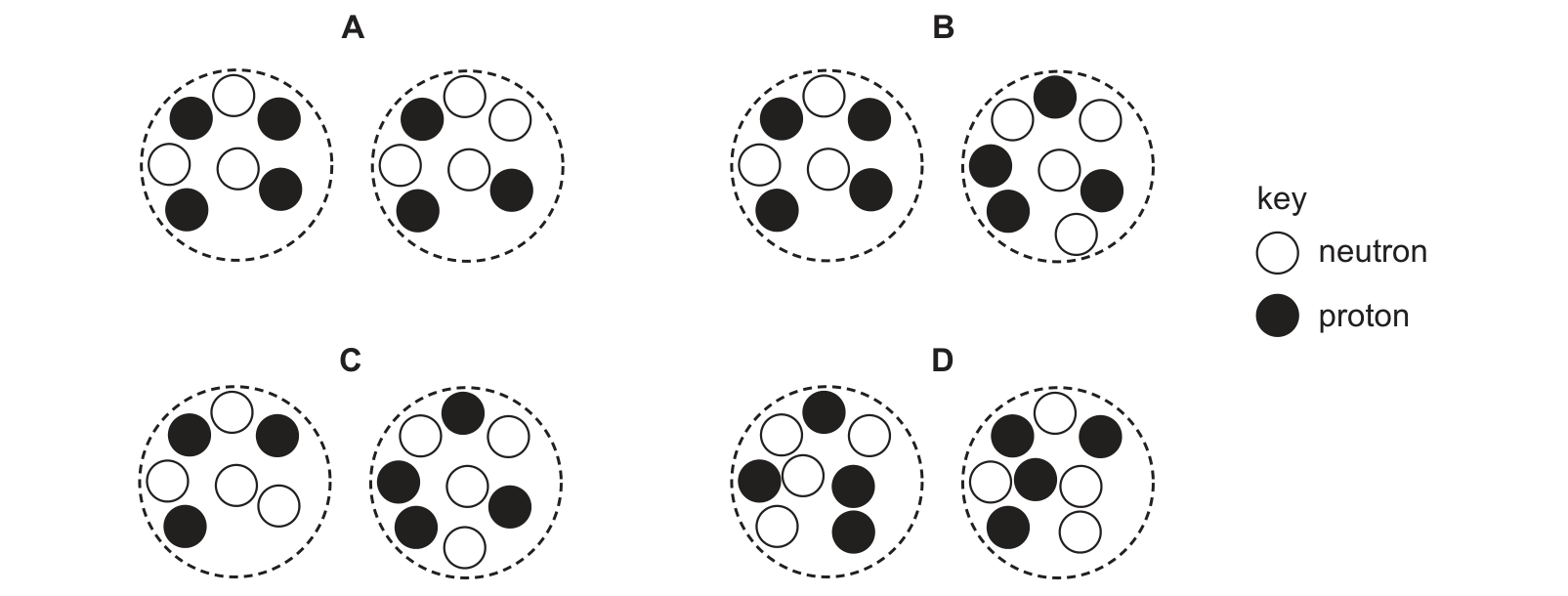
Answer: B.
Question 2
A beam of γ-rays passes into an electric field between two charged plates. Which diagram shows what happens to the γ-rays? Use the source image for S22 Paper 22, question 40.
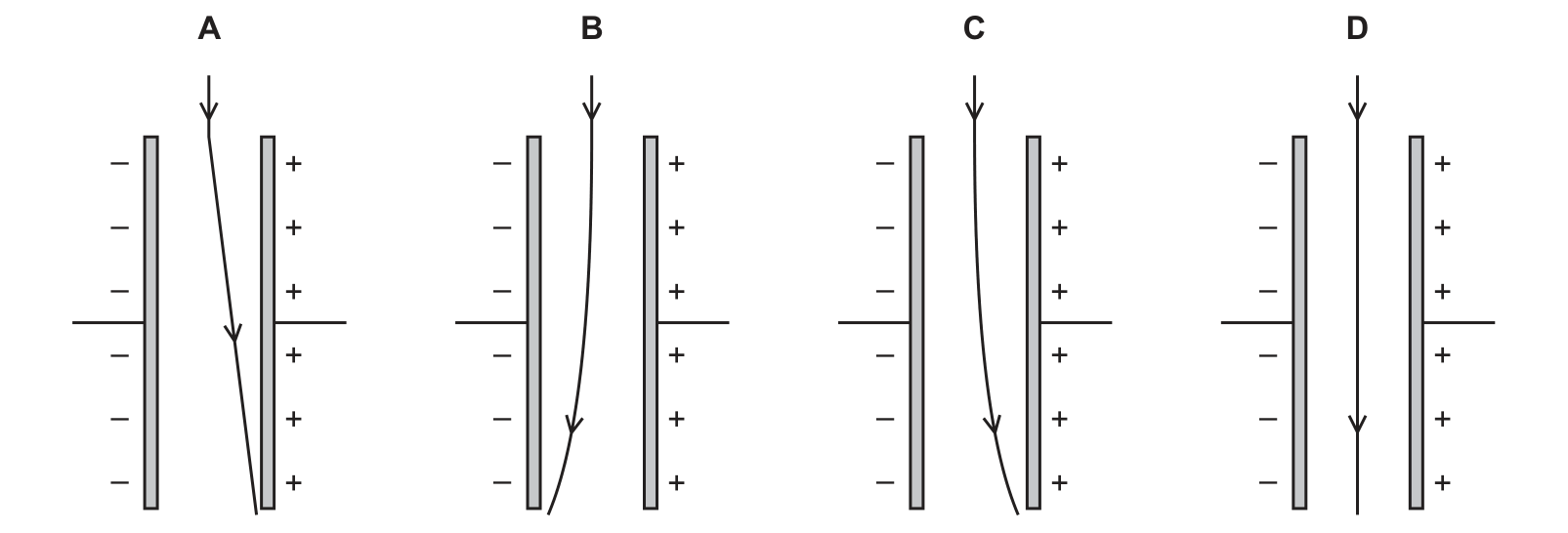
Answer: D.
Question 3
A nuclide of hydrogen is represented by 3 H. 1 Which row shows the number of protons and the number of neutrons in this nuclide? Each answer gives, in order: protons; neutrons.
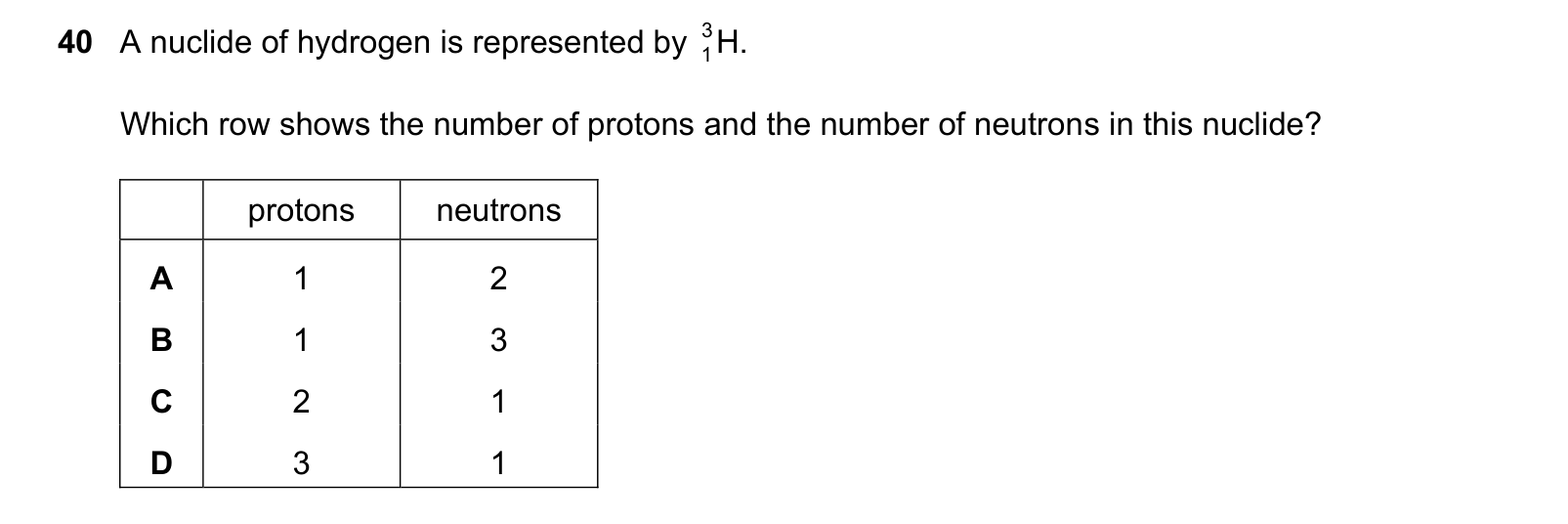
Answer: A.
What the syllabus asks for on this topicSyllabus points
Syllabus points
- Describe the structure of the atom and use nuclide notation to find protons, neutrons and electrons.
- Define an isotope.
- Describe the nature, penetrating power and ionising effect of alpha, beta and gamma radiation.
- State how the proton number and nucleon number change in alpha and beta decay.
- Define half-life and use it in calculations.
- Describe the sources of background radiation, the dangers of ionising radiation and the safety precautions taken.
Related CIE 0654 Co-ordinated Sciences topics
Not the topic you were looking for? Describe what you are stuck on in your own words and we will take you to the notes that answer it.