56 past-paper questions on this unit. Five of them are below. Answer on the page: each one is marked the moment you pick, the correct option is shown whether or not you found it, and the full explanation opens either way.
CIE 0654 Co-ordinated SciencesPaper 1 and Paper 2 MCQsFree account
Nuclear physics: five questions to try now
Real past-paper questions, the answer key from the mark scheme, and the explanation that goes with it. No account needed to answer them.
Question 1
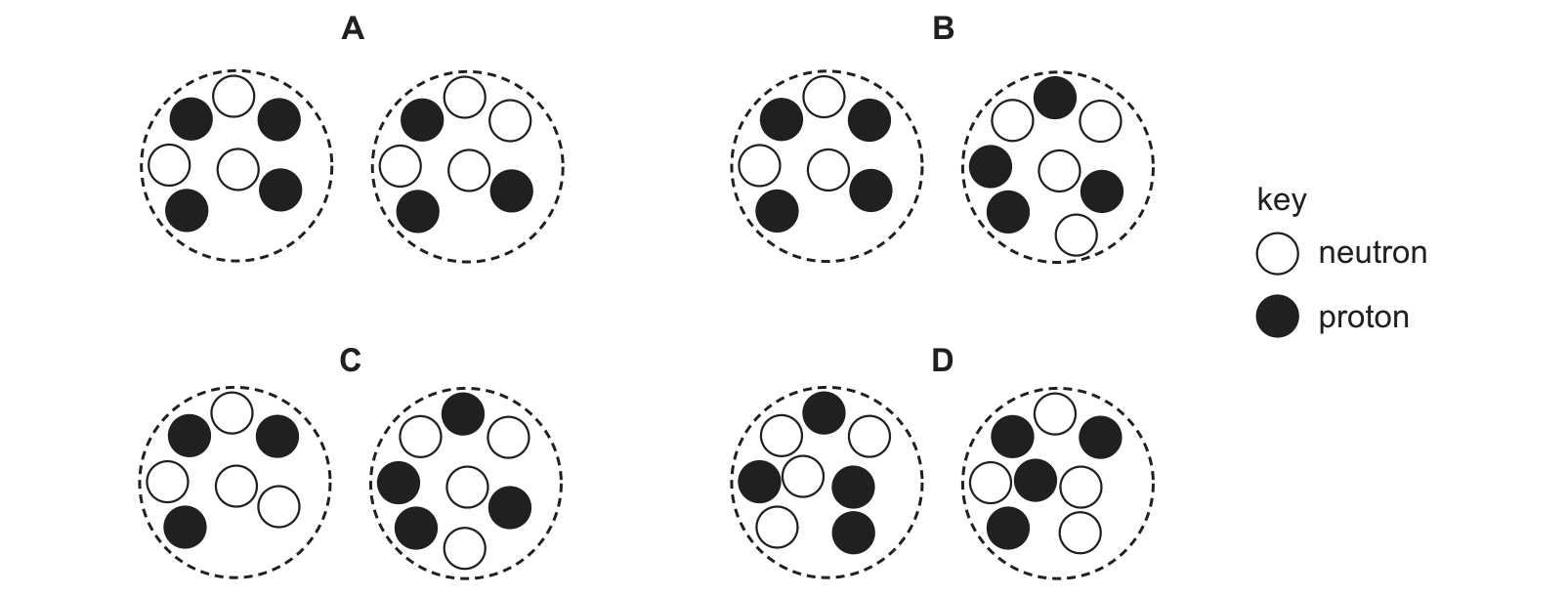
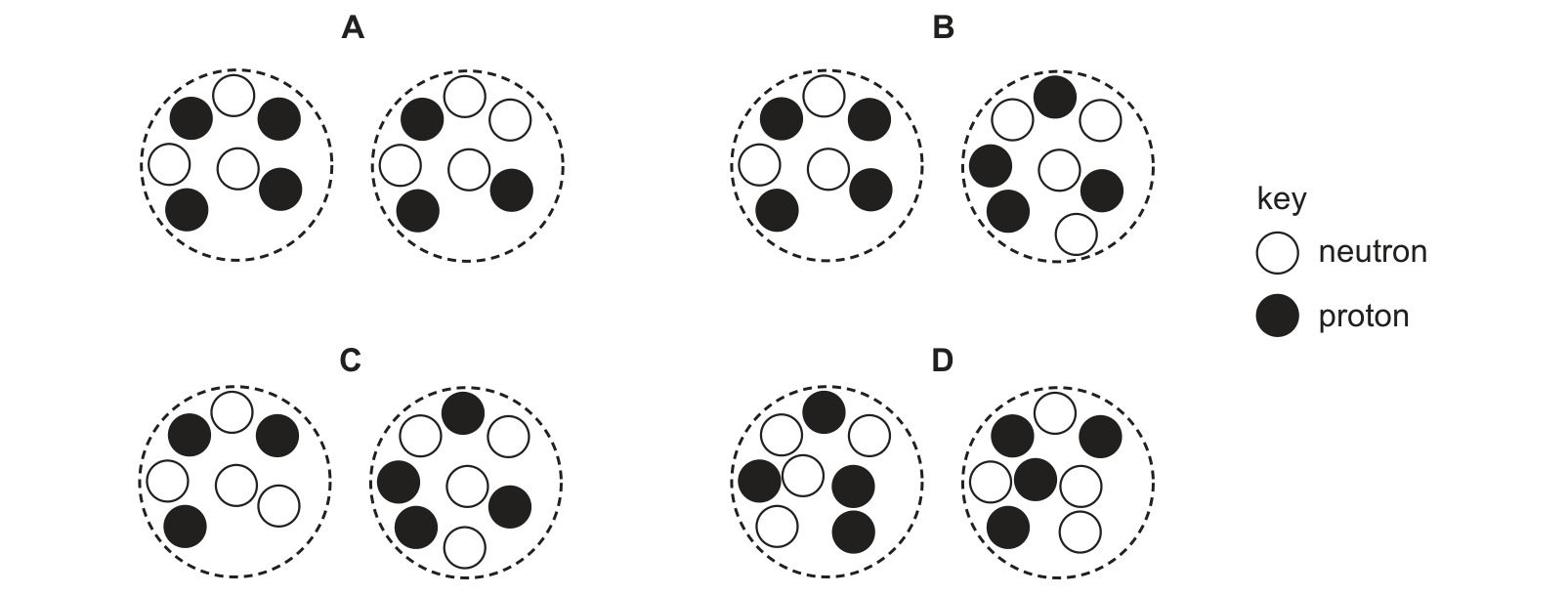
The diagrams represent pairs of nuclei of some atoms. Which pair shows nuclei of different isotopes of the same element? Use the source image for W22 Paper 11, question 40.
Answer: B.
Isotopes of the same element must have the same number of protons but different numbers of neutrons, so the pair to choose is the one where the count of protons matches in both nuclei while the count of neutrons does not. Counting the two kinds of particle in each pair, only one pair meets both conditions. A pair with different proton numbers shows two different elements, whatever their neutron counts, because the proton number is what defines the element. A pair in which both counts match shows two nuclei of the very same isotope rather than different isotopes. A pair with the same total number of particles but different proton numbers is the classic trap, since the nuclei look the same size while being different elements.
Question 2
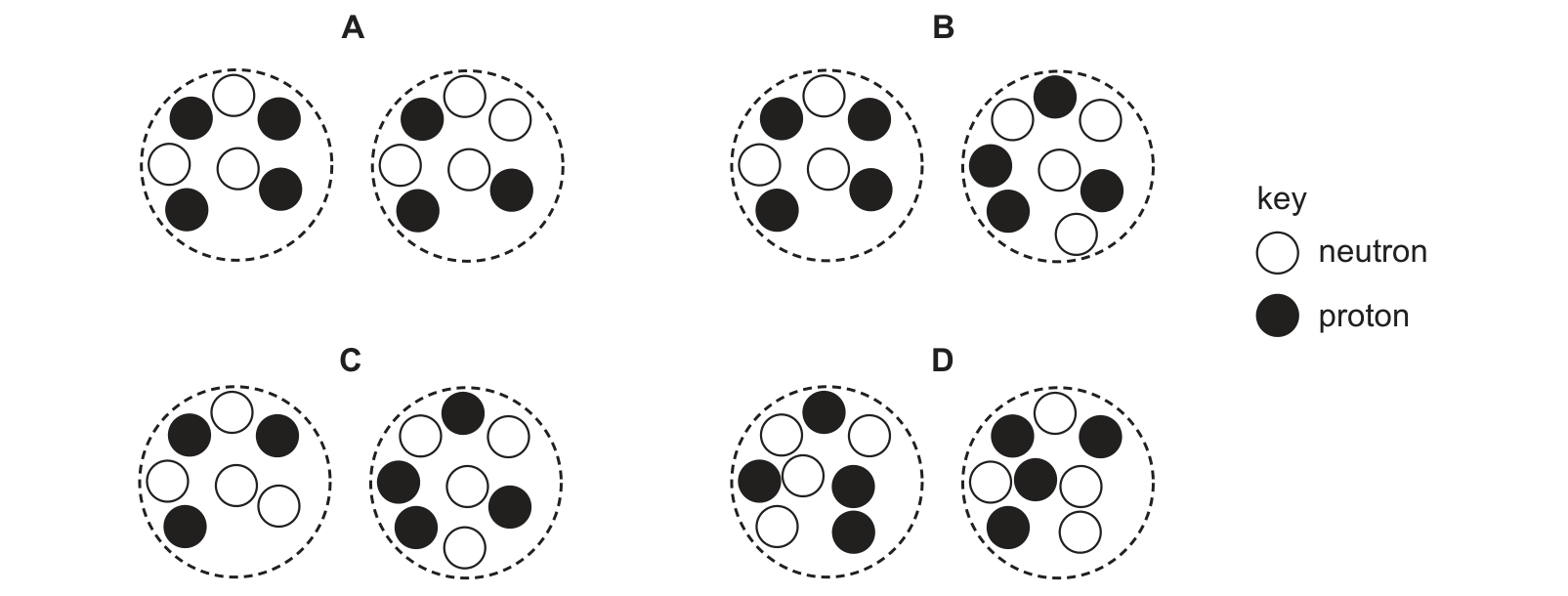
The diagrams represent pairs of nuclei of some atoms. Which pair shows nuclei of different isotopes of the same element? Use the source image for W22 Paper 12, question 40.
Answer: B.
Isotopes of the same element must have the same number of protons but different numbers of neutrons, so the pair to choose is the one where the count of protons matches in both nuclei while the count of neutrons does not. Counting the two kinds of particle in each pair, only one pair meets both conditions. A pair with different proton numbers shows two different elements, whatever their neutron counts, because the proton number is what defines the element. A pair in which both counts match shows two nuclei of the very same isotope rather than different isotopes. A pair with the same total number of particles but different proton numbers is the classic trap, since the nuclei look the same size while being different elements.
Question 3
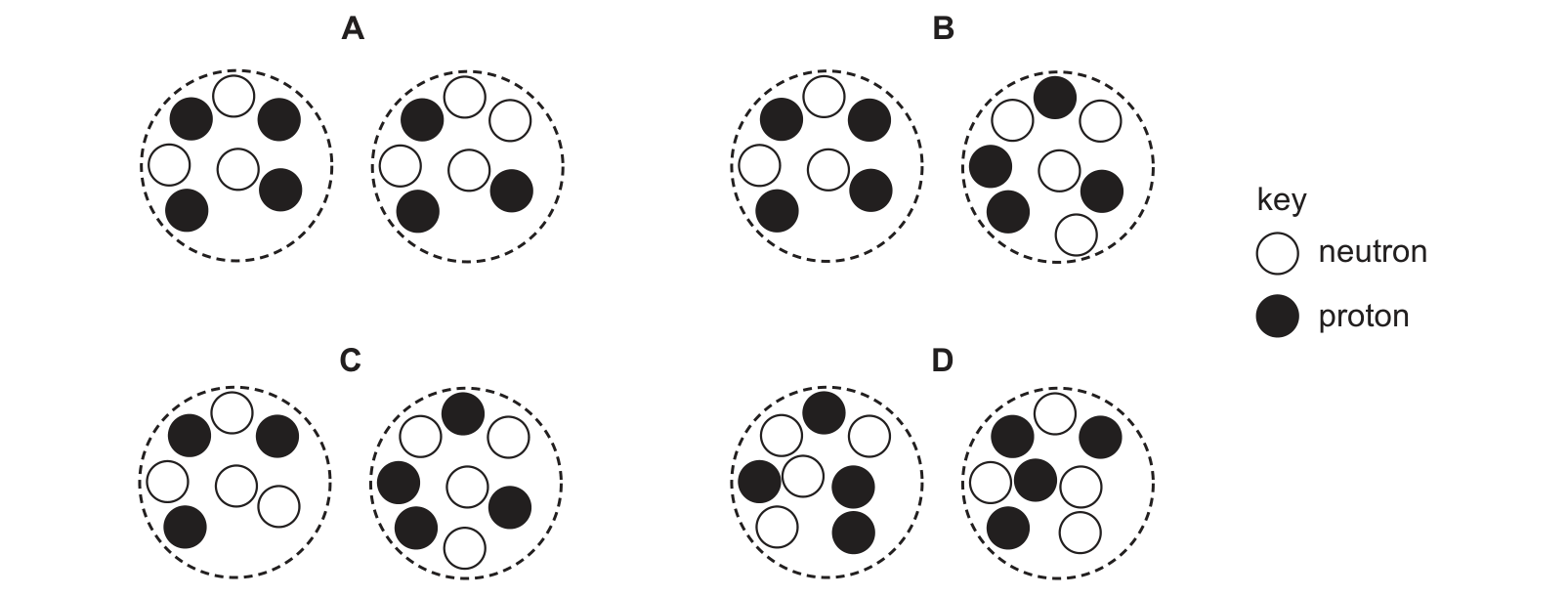
The diagrams represent pairs of nuclei of some atoms. Which pair shows nuclei of different isotopes of the same element? Use the source image for W22 Paper 13, question 40.
Answer: B.
Isotopes of the same element must have the same number of protons but different numbers of neutrons, so the pair to choose is the one where the count of protons matches in both nuclei while the count of neutrons does not. Counting the two kinds of particle in each pair, only one pair meets both conditions. A pair with different proton numbers shows two different elements, whatever their neutron counts, because the proton number is what defines the element. A pair in which both counts match shows two nuclei of the very same isotope rather than different isotopes. A pair with the same total number of particles but different proton numbers is the classic trap, since the nuclei look the same size while being different elements.
Question 4
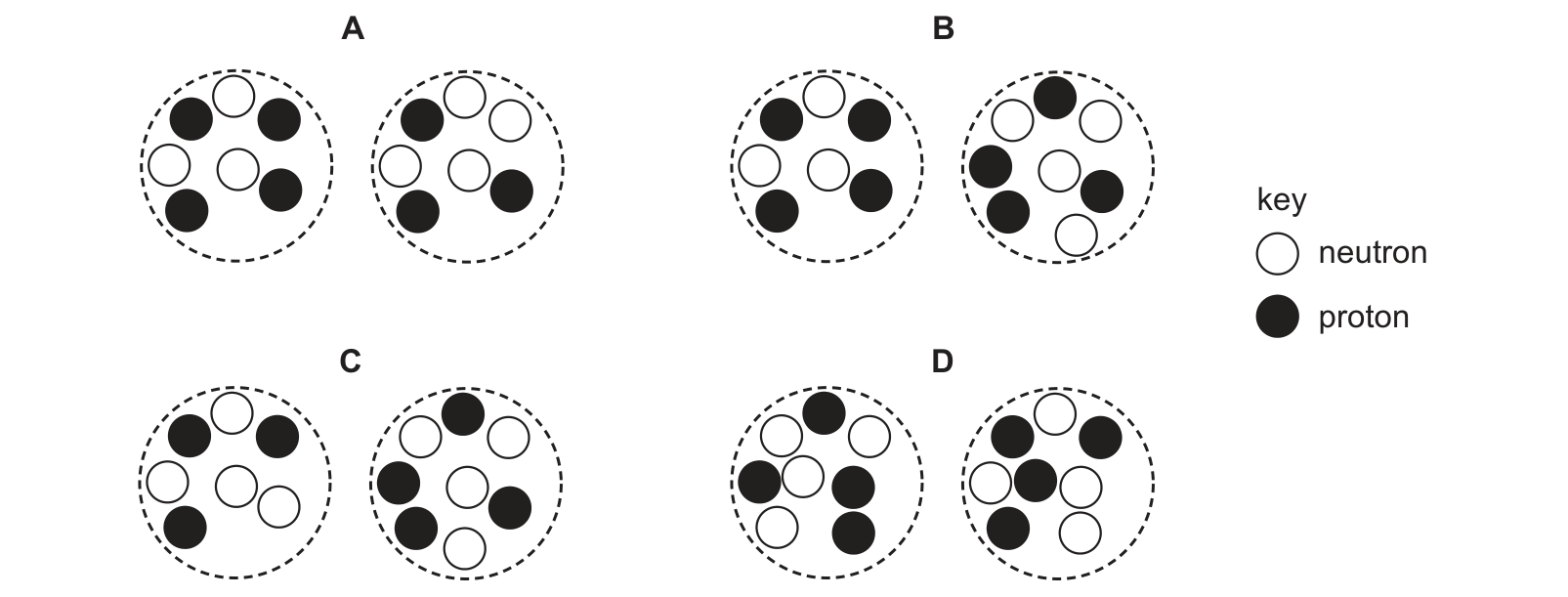
The diagrams represent pairs of nuclei of some atoms. Which pair shows nuclei of different isotopes of the same element? Use the source image for W22 Paper 21, question 40.
Answer: B.
Isotopes of the same element must have the same number of protons but different numbers of neutrons, so the pair to choose is the one where the count of protons matches in both nuclei while the count of neutrons does not. Counting the two kinds of particle in each pair, only one pair meets both conditions. A pair with different proton numbers shows two different elements, whatever their neutron counts, because the proton number is what defines the element. A pair in which both counts match shows two nuclei of the very same isotope rather than different isotopes. A pair with the same total number of particles but different proton numbers is the classic trap, since the nuclei look the same size while being different elements.
Question 5
The diagrams represent pairs of nuclei of some atoms. Which pair shows nuclei of different isotopes of the same element? Use the source image for W22 Paper 22, question 40.
Answer: B.
Isotopes of the same element must have the same number of protons but different numbers of neutrons, so the pair to choose is the one where the count of protons matches in both nuclei while the count of neutrons does not. Counting the two kinds of particle in each pair, only one pair meets both conditions. A pair with different proton numbers shows two different elements, whatever their neutron counts, because the proton number is what defines the element. A pair in which both counts match shows two nuclei of the very same isotope rather than different isotopes. A pair with the same total number of particles but different proton numbers is the classic trap, since the nuclei look the same size while being different elements.
These questions are drawn from past CIE 0654 Co-ordinated Sciences papers and filtered to nuclear physics. You answer, you find out immediately whether you were right, and you get the reasoning for the correct option and for each distractor. Wrong answers go to a mistakes locker so you can come back to exactly those.
Practice is free. You need an account only so your progress and your mistakes are still there next time.
These are the errors that cost marks on nuclear physics, taken from our own topic notes. Read them before you practise and you will recognise the traps in the questions.
Adding the two numbers in a nuclide symbol instead of subtracting them.
Putting the nucleon number below and the proton number above.
Saying isotopes have different chemical properties.
Saying gamma is the least penetrating, or that alpha is the least ionising.
Saying alpha is the most penetrating because it is the most ionising.
Saying the nucleon number is unchanged in alpha decay.
Saying the proton number falls in beta decay.
Describing a beta particle as an electron knocked from the outer shell rather than produced in the nucleus.