Waves
Contents: 6 sections
Describing a wave
- Wavelength is the distance between two matching points on neighbouring waves.
- Frequency is the number of waves passing a point each second, in hertz.
- Amplitude is the maximum distance from the undisturbed position, and it measures how much energy the wave carries.
Those three are linked by the wave equation, which appears in almost every calculation on this topic:
wave speed = frequency x wavelength
A wave of frequency 50 Hz and wavelength 6 m travels at 50 times 6, which is 300 m/s.
Transverse waves vibrate at right angles to the direction of travel: light, all electromagnetic waves, water waves. Longitudinal waves vibrate along the direction of travel, in compressions and rarefactions: sound.
A wave transfers energy, not matter. A cork on a ripple bobs up and down and does not move along with the wave, and that observation is the standard way the point is examined.
Light
Reflection from a plane mirror: the angle of incidence equals the angle of reflection, both measured from the normal, the line at right angles to the surface. The image is upright, the same size, as far behind the mirror as the object is in front, laterally inverted, and virtual.
Refraction is the change of direction when light crosses into a different medium, and it happens because the light changes speed.
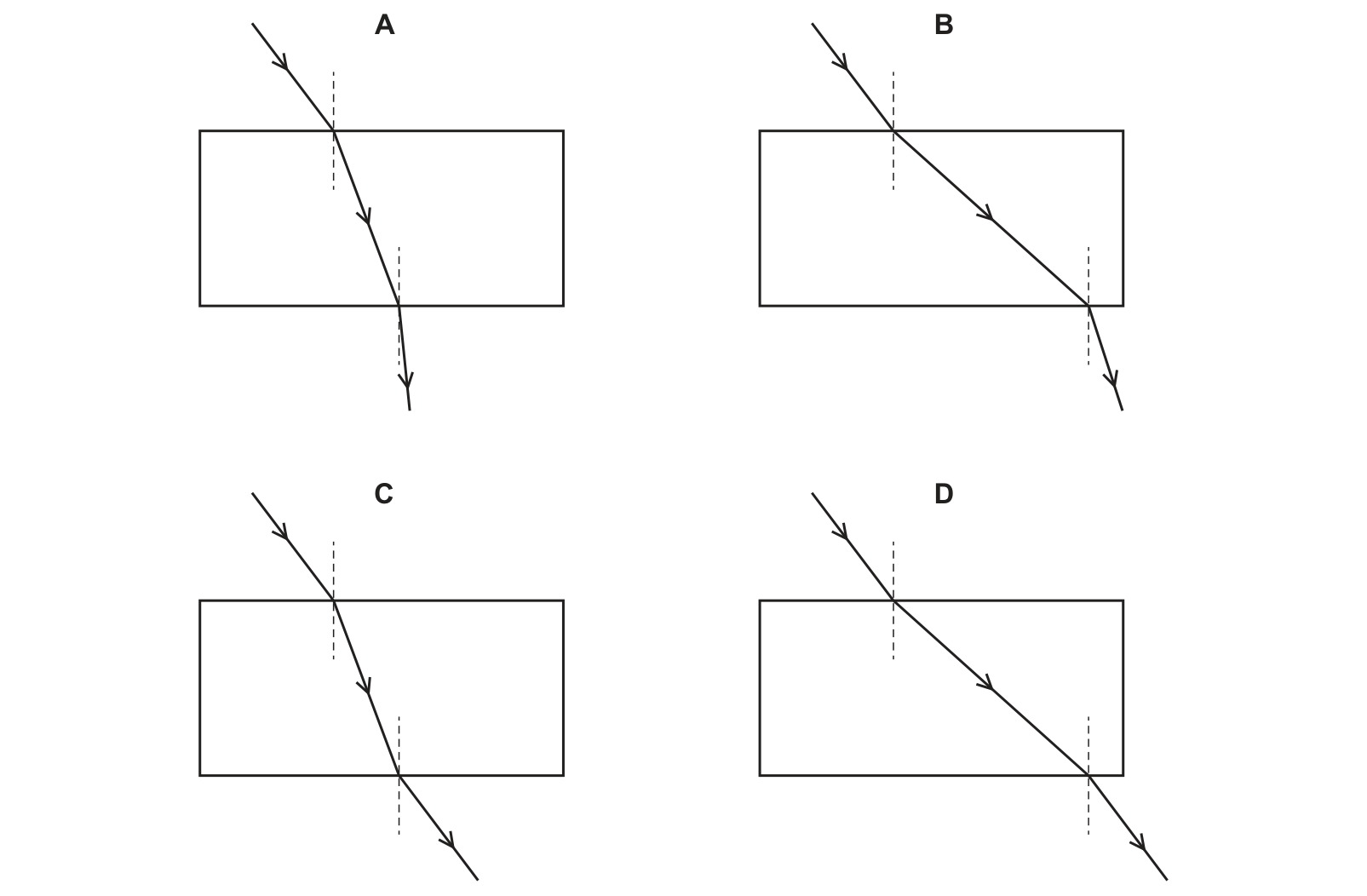
- Entering a denser medium such as glass, light slows and bends towards the normal.
- Leaving into a less dense medium, it speeds up and bends away from the normal.
- Light meeting the surface along the normal carries straight on with no bending, though it still changes speed.
Past the critical angle, light travelling from denser to less dense is completely reflected back instead of leaving. This total internal reflection is what carries signals along optical fibres.
Dispersion is white light separating into a spectrum through a prism, because each colour refracts by a different amount. Red bends least and violet most.
The electromagnetic spectrum
In order of increasing frequency and decreasing wavelength:
radio waves, microwaves, infrared, visible light, ultraviolet, X-rays, gamma rays
All of them are transverse, all travel at the same speed in a vacuum, and all transfer energy.
| Region | A use | A hazard |
|---|---|---|
| Radio | Broadcasting, communications | |
| Microwave | Cooking, mobile phones, satellites | Internal heating of tissue |
| Infrared | Remote controls, thermal imaging, grills | Burns |
| Visible | Sight, photography, fibre optics | |
| Ultraviolet | Sterilising, security marking | Skin cancer, eye damage |
| X-ray | Medical imaging, security scanning | Cell mutation |
| Gamma | Sterilising equipment, treating cancer | Cell mutation |
The pattern is that hazard rises with frequency, because higher-frequency waves carry more energy per unit.
Sound
Sound is a longitudinal wave made by a vibrating source, and it needs a medium, so it cannot travel through a vacuum. That is the difference from light most often tested.
Sound travels fastest in solids, slower in liquids, slowest in gases, because the particles are closer together and pass the vibration on more quickly. That is the opposite order from light, which travels fastest in a vacuum.
- Pitch depends on frequency: higher frequency, higher pitch.
- Loudness depends on amplitude: larger amplitude, louder.
The audible range for a human is roughly 20 Hz to 20 000 Hz. Ultrasound is above that range and is used for scanning and for depth sounding, where the time for an echo to return gives the distance.
Common mistakes
- Measuring angles from the surface instead of from the normal.
- Saying light bends because it changes direction, rather than because it changes speed.
- Saying sound travels fastest in air.
- Saying sound can travel through a vacuum.
- Swapping pitch and loudness, or linking pitch to amplitude.
- Saying a wave carries matter along with it.
- Putting the electromagnetic spectrum in the wrong order, especially swapping infrared and ultraviolet, which sit either side of visible light.
Check you have it
Question 1
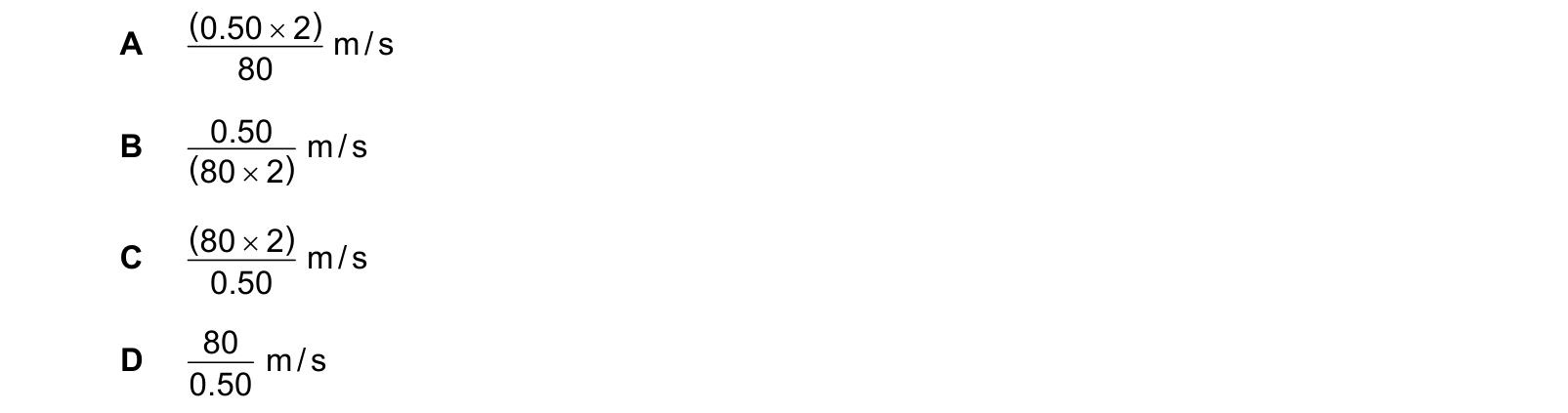
A person stands 80 m from a high wall and claps his hands. He hears an echo 0.50 s later.
Using this information, how is the speed of sound in air calculated? ( 0.50 × 2 )
Answer: C.
Question 2
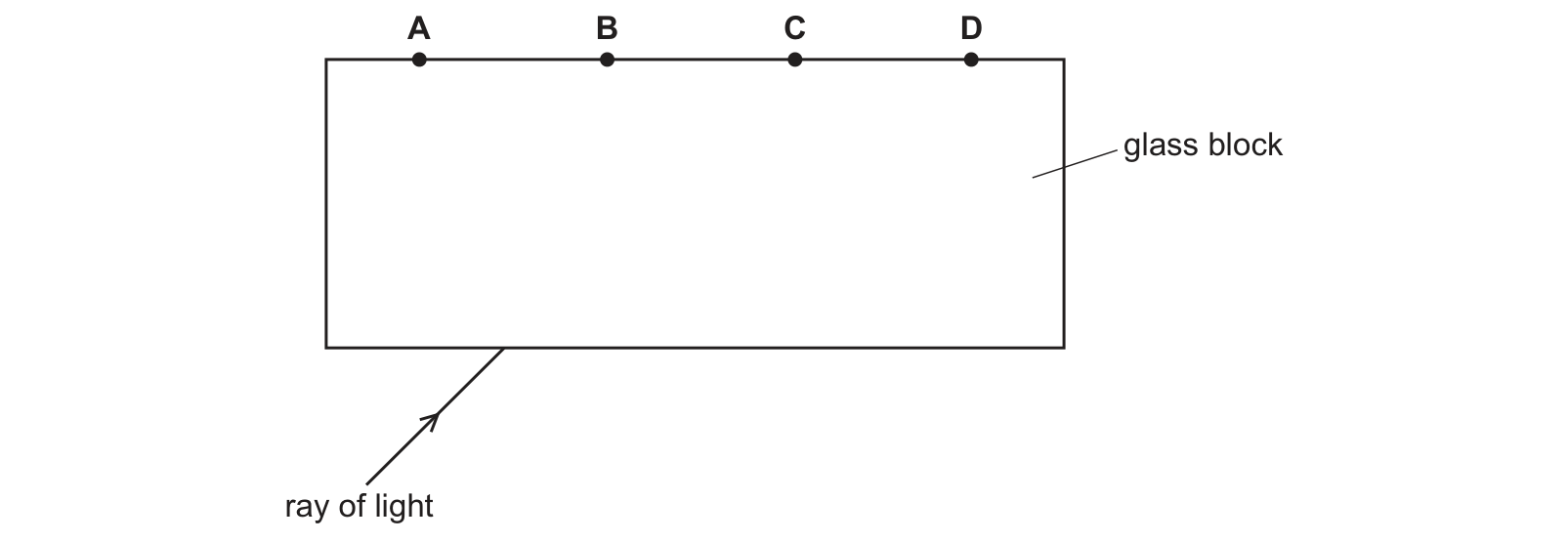
A ray of light enters a parallel-sided glass block. At which labelled point does the ray leave the block? Use the source image for W23 Paper 11, question 34.
Answer: B.
Question 3
A ray of light travels from air into a parallel-sided glass block and then back into air. Which diagram shows the path of the light? Use the source image for W24 Paper 11, question 33.
Answer: C.
What the syllabus asks for on this topicSyllabus points
Syllabus points
- Describe transverse and longitudinal waves and use the wave equation.
- Describe reflection, refraction and dispersion of light.
- State the regions of the electromagnetic spectrum and their uses.
- Describe the production and properties of sound.
Related CIE 0654 Co-ordinated Sciences topics
Not the topic you were looking for? Describe what you are stuck on in your own words and we will take you to the notes that answer it.