98 past-paper questions on this unit. Five of them are below. Answer on the page: each one is marked the moment you pick, the correct option is shown whether or not you found it, and the full explanation opens either way.
CIE 0654 Co-ordinated SciencesPaper 1 and Paper 2 MCQsFree account
Waves: five questions to try now
Real past-paper questions, the answer key from the mark scheme, and the explanation that goes with it. No account needed to answer them.
Question 1
Light travelling in air strikes the surface of water and is refracted. In which labelled direction is the light refracted? Use the source image for W20 Paper 13, question 34.
Answer: C.
Water is optically denser than air, so light crossing from air into water slows down, and a ray that slows down bends towards the normal. The refracted ray therefore continues into the water on the same side as before but at a smaller angle to the normal than the incident ray made. The direction showing that is the correct one. The direction that stays in the air is a reflected ray rather than a refracted one. The direction bending away from the normal in the water is what would happen if the light were speeding up, which is the journey from water into air. The direction continuing straight on without any change describes light meeting the surface along the normal, which is not the case here.
Question 2
The diagram shows a ray of light travelling from glass into air. Which labelled arrow shows the path of the light in the air? Use the source image for S24 Paper 12, question 33.
Answer: D.
Light travels faster in air than in glass, so on crossing from glass into air it bends away from the normal, which means the angle it makes with the normal in the air is larger than the angle it made inside the glass. The arrow showing the ray continuing on into the air on the same side of the normal but at a wider angle is therefore the correct path. The arrow bending towards the normal shows what happens on entering glass rather than leaving it. The arrow continuing straight on with no change of direction would need the two materials to slow light equally. The arrow turned back into the glass is a reflection, and although some light really is reflected at the boundary, the question asks for the path of the light in the air.
Question 3
The diagram shows a ray of light travelling from glass into air. Which labelled arrow shows the path of the light in the air? Use the source image for S24 Paper 13, question 33.
Answer: D.
Light travels faster in air than in glass, so on crossing from glass into air it bends away from the normal, which means the angle it makes with the normal in the air is larger than the angle it made inside the glass. The arrow showing the ray continuing on into the air on the same side of the normal but at a wider angle is therefore the correct path. The arrow bending towards the normal shows what happens on entering glass rather than leaving it. The arrow continuing straight on with no change of direction would need the two materials to slow light equally. The arrow turned back into the glass is a reflection, and although some light really is reflected at the boundary, the question asks for the path of the light in the air.
Question 4
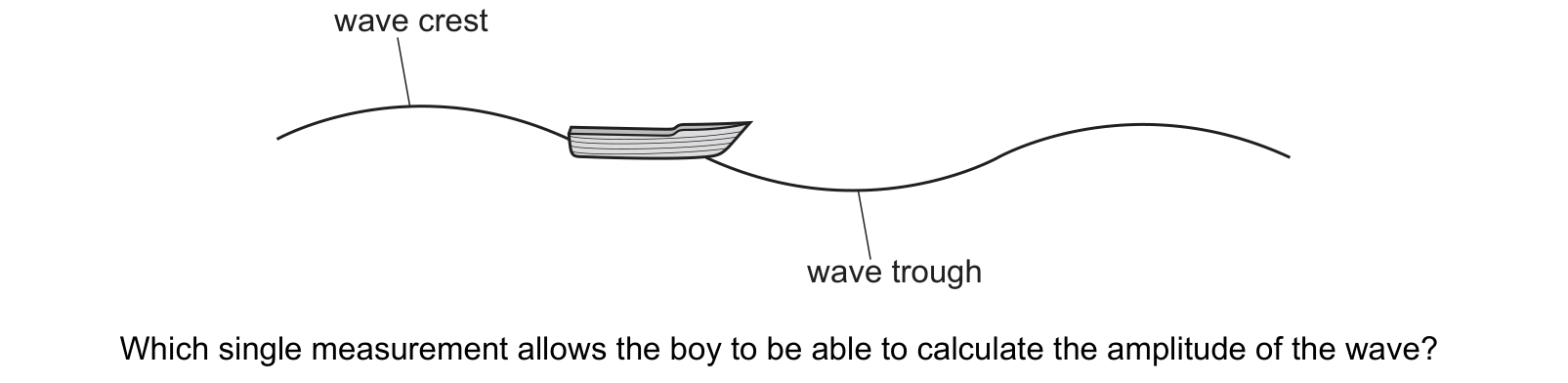
A boy watches a water wave passing a boat that is floating on the sea. Which single measurement allows the boy to be able to calculate the amplitude of the wave?
Answer: D.
Amplitude is the greatest distance a point on the wave moves from its rest position, which is half the vertical distance from a trough to a crest. The boat rides up to the crest and down to the trough, so measuring the vertical distance between its highest and lowest positions and halving it gives the amplitude, and D is the measurement that allows this. A gives the distance from one crest to the next, which is the wavelength. C gives the time from the lowest point to the highest, which is half a period and leads to the frequency rather than to any distance. B combines a time with the length of the boat, so it yields the speed of the wave.
Question 5
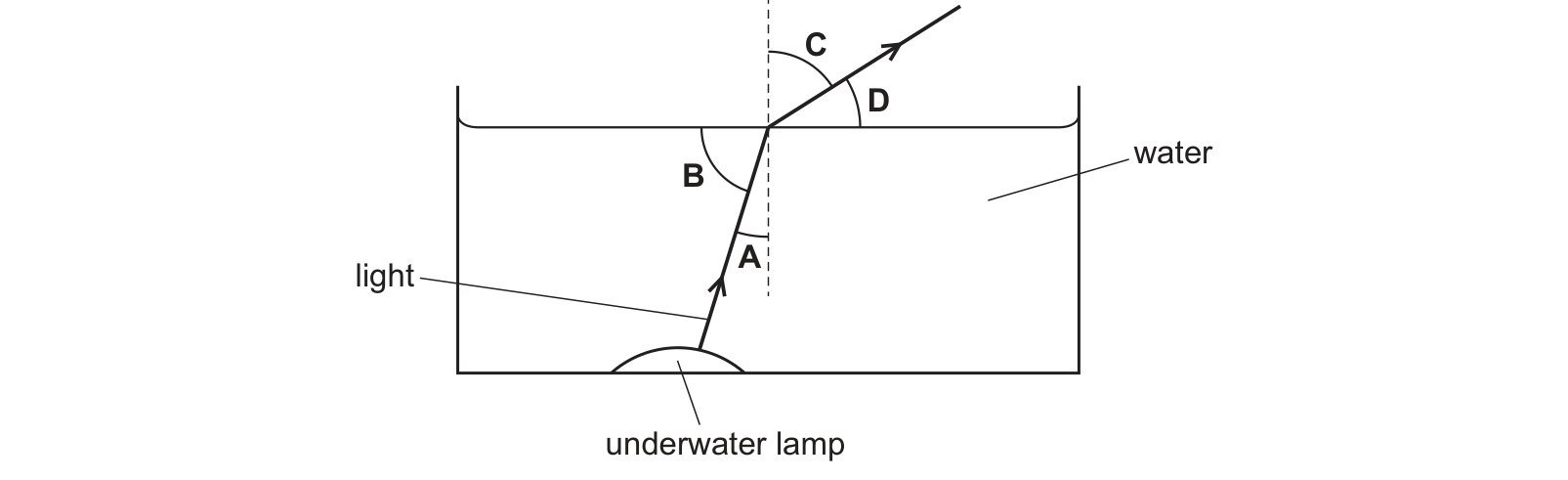
Light from an underwater lamp is refracted at the surface of water. Which labelled angle is the angle of refraction of the light? Use the source image for W22 Paper 13, question 34.
Answer: C.
The angle of refraction is measured between the refracted ray and the normal to the surface, and the refracted ray is the one that has crossed the boundary and is travelling in the air. So the angle wanted is the one between the ray in the air and the normal drawn at the point where the light leaves the water. The angle between the ray in the water and the normal is the angle of incidence, not the angle of refraction. The angles measured from the water surface rather than from the normal are each the complement of the angle they resemble, so using them would give ninety degrees minus the correct value, and it is the most frequent error on refraction diagrams.
These questions are drawn from past CIE 0654 Co-ordinated Sciences papers and filtered to waves. You answer, you find out immediately whether you were right, and you get the reasoning for the correct option and for each distractor. Wrong answers go to a mistakes locker so you can come back to exactly those.
Practice is free. You need an account only so your progress and your mistakes are still there next time.
These are the errors that cost marks on waves, taken from our own topic notes. Read them before you practise and you will recognise the traps in the questions.
Measuring angles from the surface instead of from the normal.
Saying light bends because it changes direction, rather than because it changes speed.
Saying sound travels fastest in air.
Saying sound can travel through a vacuum.
Swapping pitch and loudness, or linking pitch to amplitude.
Saying a wave carries matter along with it.
Putting the electromagnetic spectrum in the wrong order, especially swapping infrared and ultraviolet, which sit either side of visible light.
Revise it first
If any of the above is unfamiliar, work through the notes before practising: Waves revision notes.