Motion, forces and energy
Contents: 7 sections
Speed and acceleration
speed = distance / time
acceleration = change in velocity / time taken
A car covers 240 m in 30 s, so its average speed is 240 divided by 30, which is 8 m/s. If it then reaches 20 m/s from 8 m/s in 4 s, the acceleration is 12 divided by 4, which is 3 m/s².
Deceleration is simply negative acceleration; the arithmetic is identical and the sign carries the meaning.
Reading the two graphs
This is the most common source of lost marks in the topic, because the same shape means different things on each graph.
| Shape | Distance-time | Speed-time |
|---|---|---|
| Horizontal line | Stationary | Constant speed |
| Straight slope | Constant speed | Constant acceleration |
| Steeper slope | Faster | Greater acceleration |
| Curve getting steeper | Accelerating | Increasing acceleration |
Two rules do the rest. On a distance-time graph the gradient is the speed. On a speed-time graph the gradient is the acceleration and the area under the line is the distance travelled.
A body at 6 m/s for 10 s then accelerating uniformly to 14 m/s over the next 5 s travels 6 times 10, which is 60 m, plus the area of the trapezium, which is (6 plus 14) divided by 2, times 5, giving 50 m. The total is 110 m.
Forces
A resultant force is what is left when all the forces on a body are combined.
- Zero resultant force: the body stays still, or keeps moving at constant speed in a straight line.
- Non-zero resultant force: the body accelerates in the direction of that force.
The first of those is the one students doubt. An object moving at steady speed has no resultant force on it, because the driving force and the resistive forces are balanced.
Terminal velocity follows directly. A falling object accelerates, air resistance grows with speed, and when air resistance equals weight the resultant force is zero and the speed becomes constant.
Mass and weight are not the same. Mass is the amount of matter, measured in kilograms, and it does not change with location. Weight is the force of gravity on that mass, measured in newtons, and it does change.
weight = mass x gravitational field strength
Energy, work and power
work done = force x distance moved in the direction of the force
power = work done / time taken
kinetic energy = 1/2 x mass x speed²
change in gravitational potential energy = mass x gravitational field strength x change in height
A 60 kg student climbs 4 m of stairs in 8 s, with g taken as 10 N/kg. The work done against gravity is 60 times 10 times 4, which is 2400 J, so the power is 2400 divided by 8, which is 300 W.
Energy is conserved: it is never created or destroyed, only transferred. A falling object converts gravitational potential energy into kinetic energy, and a body dropped from rest arrives with kinetic energy equal to the potential energy it lost, ignoring air resistance.
efficiency = useful energy output / total energy input x 100%
Efficiency is never more than 100%, and the energy that is not useful is almost always transferred to the surroundings by heating.
Density and pressure
density = mass / volume
pressure = force / area
A block of mass 240 g and volume 300 cm³ has a density of 240 divided by 300, which is 0.8 g/cm³. That is less than the 1.0 g/cm³ of water, so it floats.
Pressure explains why a sharp knife cuts and a wide snowshoe does not sink: the same force over a smaller area gives a larger pressure, and over a larger area a smaller one.
Pressure in a liquid increases with depth and with the density of the liquid, and at any one point it acts equally in all directions.
Common mistakes
- Reading a horizontal line on a speed-time graph as stationary.
- Taking the area under a distance-time graph, which means nothing.
- Saying a body moving at constant speed has a resultant force pushing it along.
- Using mass in newtons or weight in kilograms.
- Forgetting to square the speed in the kinetic energy formula, or to halve it.
- Saying energy is "used up".
- Giving an efficiency above 100%.
Check you have it
Question 1
The diagram shows the extension–load graph for a spring. Which labelled point is the limit of proportionality of the spring? Use the source image for W20 Paper 21, question 29.

Answer: C.
Question 2
The diagrams show the only forces acting on four moving objects. Which object is travelling at constant speed? Use the source image for S22 Paper 11, question 29.
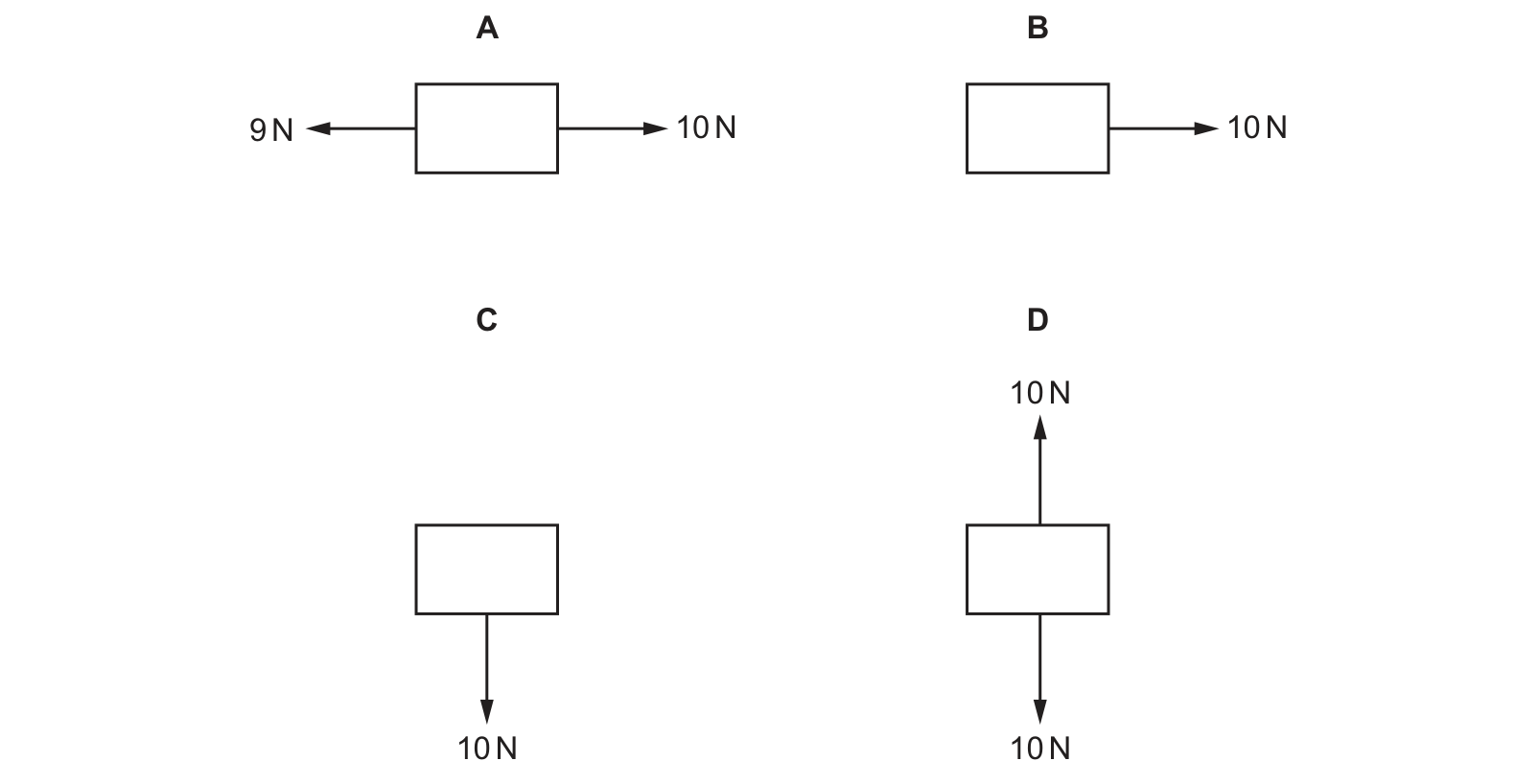
Answer: D.
Question 3
An object of mass 2.0 kg is acted upon by a force of 3.0 N and a force of 7.0 N.
The directions of the forces are shown. What is the acceleration of the object?
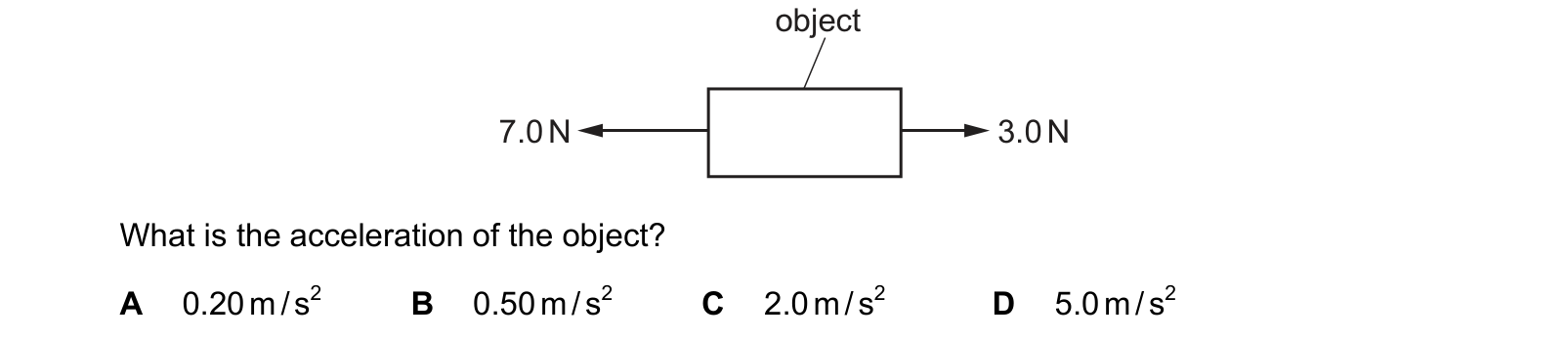
Answer: C.
What the syllabus asks for on this topicSyllabus points
Syllabus points
- Define and calculate speed, average speed and acceleration.
- Interpret distance-time and speed-time graphs.
- Describe the effect of a resultant force, and explain forces in equilibrium.
- Calculate work, power, kinetic energy and gravitational potential energy, and apply conservation of energy.
- Calculate density and pressure.
Related CIE 0654 Co-ordinated Sciences topics
Not the topic you were looking for? Describe what you are stuck on in your own words and we will take you to the notes that answer it.