Atoms, elements and compounds
Contents: 6 sections
Inside the atom
| Particle | Where | Relative charge | Relative mass |
|---|---|---|---|
| Proton | Nucleus | +1 | 1 |
| Neutron | Nucleus | 0 | 1 |
| Electron | Shells around the nucleus | −1 | Negligible |
Almost all the mass is in the nucleus, because electrons weigh almost nothing. Almost all the volume is empty space where the electrons move.
Proton number (atomic number) is the number of protons, and it is what makes an element that element. Nucleon number (mass number) is protons plus neutrons.
number of neutrons = nucleon number − proton number
An atom is neutral, so protons equal electrons. An ion has lost or gained electrons: losing them gives a positive ion, gaining them a negative one. The number of protons never changes when an ion forms.
Isotopes are atoms of the same element with the same proton number but different numbers of neutrons. They have identical chemical properties, because chemistry depends on the electrons, and different physical properties such as density.
Chlorine-35 and chlorine-37 both have 17 protons and 17 electrons; one has 18 neutrons and the other 20.
Electron shells
Electrons fill shells from the inside out, holding 2 in the first, then 8, then 8. Sodium, with 11 electrons, is 2,8,1.
The outer shell decides everything about an element's chemistry:
- The number of outer electrons is the group number.
- The number of occupied shells is the period number.
- A full outer shell means the element is unreactive, which is why the noble gases do almost nothing.
Ionic bonding
Between a metal and a non-metal. Electrons are transferred from the metal to the non-metal, so both reach a full outer shell, and the oppositely charged ions attract.
Sodium loses one electron to become Na⁺, chlorine gains it to become Cl⁻, and the two are held by strong electrostatic attraction in a giant lattice.
Properties follow from the lattice:
- High melting and boiling points, because the attractions between ions are strong and need much energy to break.
- Do not conduct when solid, because the ions are fixed in place.
- Do conduct when molten or dissolved, because the ions are then free to move and carry charge.
- Usually soluble in water.
That third point is examined constantly, and the phrase that earns the mark is that the ions are free to move.
Covalent bonding
Between non-metals. Electrons are shared in pairs, so both atoms count a full outer shell.
Simple molecular substances such as water, methane, chlorine and carbon dioxide have strong bonds within each molecule but weak forces between molecules. Only those weak forces break on melting, so:
- Low melting and boiling points, and many are gases or liquids at room temperature.
- They do not conduct in any state, because there are no free electrons and no ions.
Giant covalent substances are the exception that is always tested.
| Diamond | Graphite | |
|---|---|---|
| Bonds per carbon | 4 | 3 |
| Structure | Rigid 3D network | Flat layers |
| Hardness | Very hard | Soft, slippery |
| Conducts? | No | Yes |
| Uses | Cutting tools, drill tips | Electrodes, lubricant, pencils |
Both are pure carbon, so the difference comes entirely from the structure. Graphite conducts because each carbon bonds to only three others, leaving one delocalised electron free to move; it is slippery because the weak forces between layers let them slide.
Common mistakes
- Saying electrons are shared in ionic bonding, or transferred in covalent bonding.
- Saying a solid ionic compound conducts.
- Saying "the electrons are free to move" for molten ionic compounds. It is the ions that move.
- Saying isotopes have different chemical properties.
- Saying an ion has a different number of protons from its atom.
- Saying covalent bonds are weak. The bonds are strong; the forces between molecules are weak.
- Forgetting that diamond does not conduct even though graphite does.
Check you have it
Question 1
The numbers of protons, neutrons and electrons in four particles are shown.
number of number of number of particle protons neutrons electrons Which two particles are isotopes of the same element?
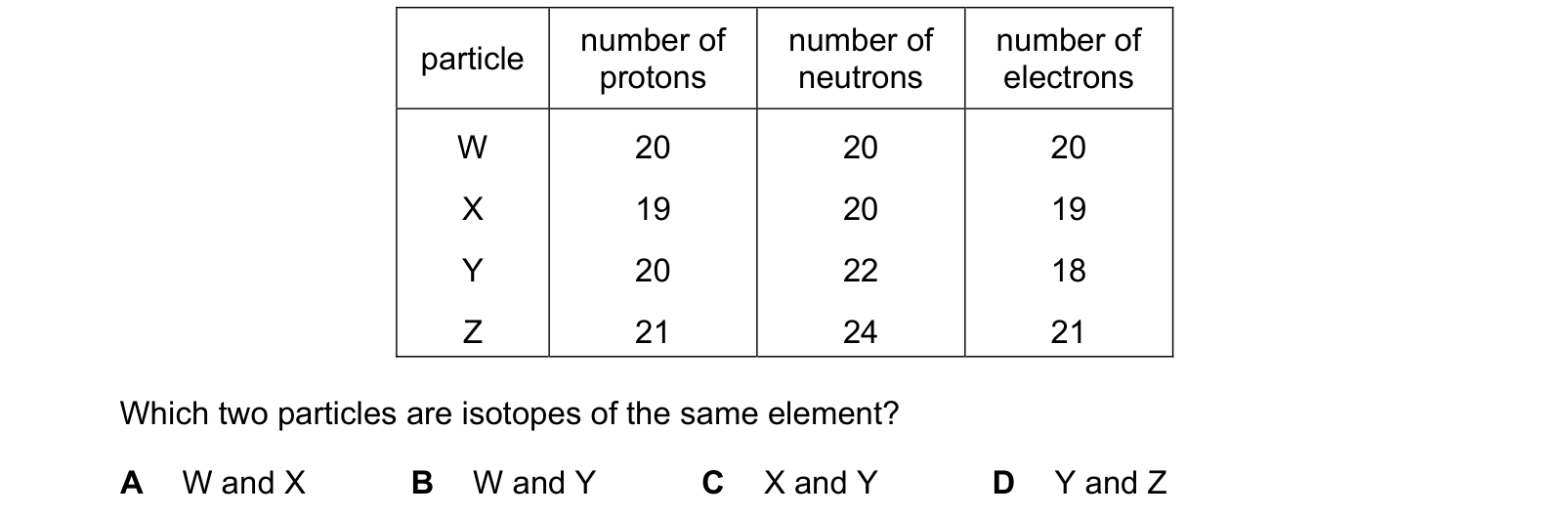
Answer: B.
Question 2
Which dot-and-cross diagram shows the outer shell electrons in a molecule of carbon dioxide? Use the source image for S20 Paper 23, question 15.

Answer: A.
Question 3
Which dot-and-cross diagram represents the outer-shell electrons in a molecule of methanol? Use the source image for S24 Paper 21, question 16.
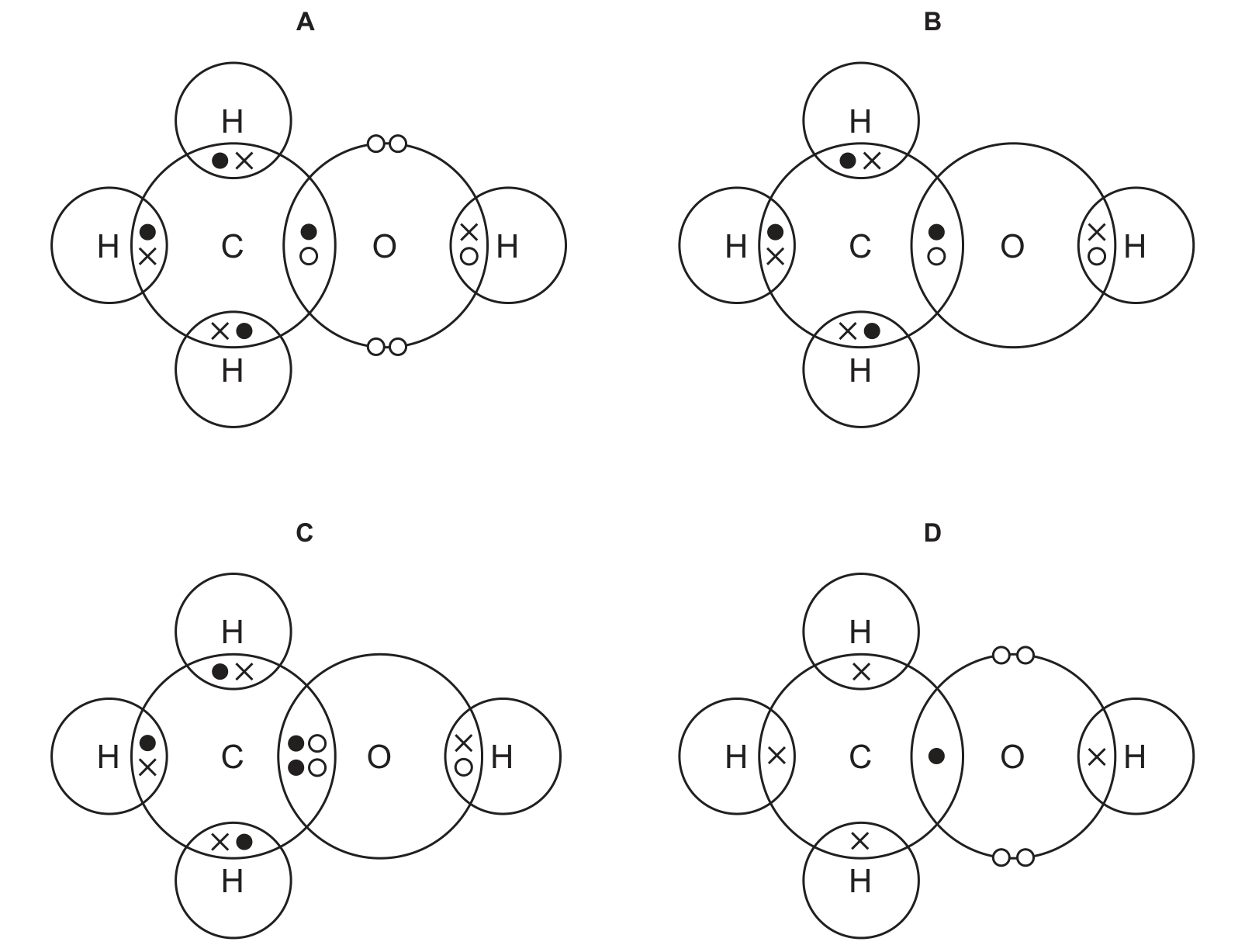
Answer: A.
What the syllabus asks for on this topicSyllabus points
Syllabus points
- Describe the structure of the atom and the properties of protons, neutrons and electrons.
- Define proton number, nucleon number and isotopes.
- Describe ionic and covalent bonding.
- Relate structure to properties for ionic, simple molecular and giant covalent substances.
Related CIE 0654 Co-ordinated Sciences topics
Not the topic you were looking for? Describe what you are stuck on in your own words and we will take you to the notes that answer it.